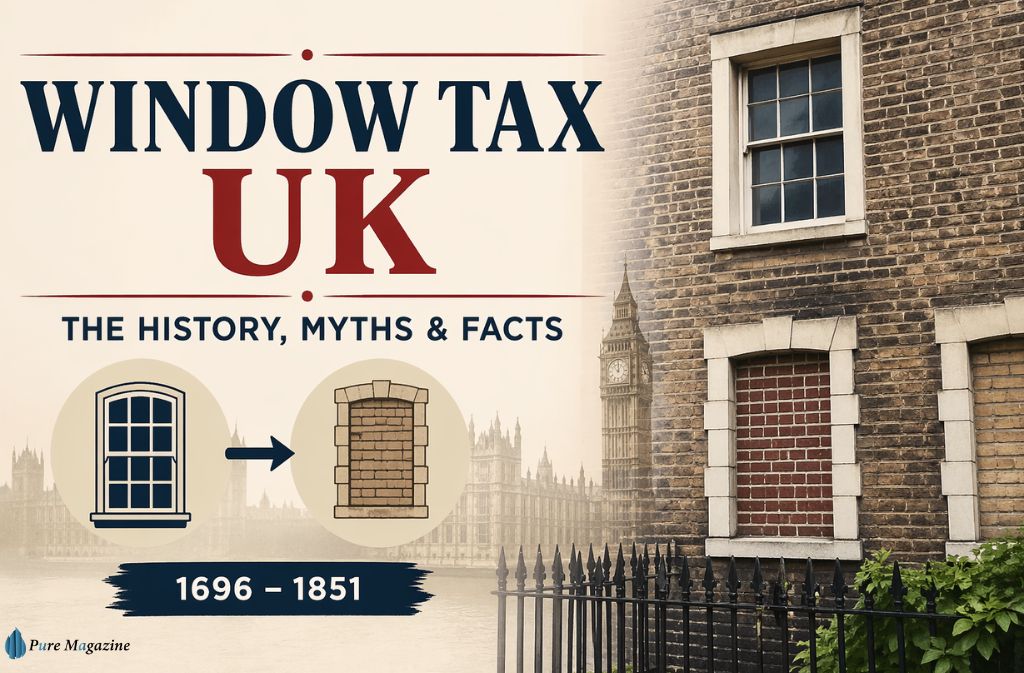
Picture this: you’re charged a tax simply for letting sunlight into your home. It sounds absurd today, but that’s exactly what the window tax did for over 150 years.
Introduced in 1696, the policy taxed homeowners based on how many windows their property contained. The result was streets of bricked-up openings, darker homes, and public health consequences that shaped how Victorian reformers thought about housing. If you’ve ever stopped in front of a Georgian terrace in Bath or an Old Town close in Edinburgh and noticed a section of wall where a window should logically be, you’ve already encountered its physical legacy.
In 2026, people still search for “window tax UK” and wonder whether something similar might return, or whether replacement windows carry tax implications. This guide clears up those questions and connects the history to modern property systems, energy policy, and the building regulations that actually govern windows today.
What Was the Window Tax?
The window tax was a property tax introduced in 1696 that levied a charge based on the number of windows in a property. It functioned as an early wealth tax — using a visible, countable feature of a house as a proxy for how much the owner could afford to pay.
The logic made sense from a collection standpoint: windows were difficult to conceal, easy to count from the street, and strongly associated with larger, more prosperous homes. A modest cottage might have eight windows; a merchant’s townhouse might have thirty. The disparity mapped roughly onto wealth, which made windows a workable taxable indicator in an era before income records existed.
What the designers of the tax didn’t fully anticipate was how systematically homeowners would respond to the incentive to block them.
Why the Window Tax Was Introduced
England introduced the tax to raise government revenue after costly military campaigns, at a time when income tax systems didn’t yet exist. Governments relied on observable, physical features of wealth — windows, hearths, carriages — because these could be assessed without requiring disclosure of earnings or assets.
The window tax replaced an earlier hearth tax, which had proven deeply unpopular because it required inspectors to enter homes. Counting windows from the street was both cheaper to administer and less intrusive. For roughly a decade after its introduction, it was considered a reasonable compromise.
How the Window Tax Worked
A base property tax is applied to all homes, with an additional tiered charge based on window count. The more windows a property contained, the higher the band — and the higher the bill.
| Number of Windows | Tax Level |
|---|---|
| Up to 9 | Low |
| 10–19 | Medium |
| 20+ | High |
A homeowner with 25 windows could pay significantly more than a neighbour with eight, even if both properties were similar in size and value. The incentive to reduce window count was immediate and financial — and at various points during the tax’s 155-year lifespan, the rates were steep enough that blocking a window could save the equivalent of months of household income.
To translate that into modern terms: a £10 tax burden in 1750 carries a rough modern equivalent of £2,000–£3,000 or more. Bricking up a window wasn’t a cosmetic decision — it was a meaningful financial calculation.
Why Houses Have Bricked-Up Windows
The most visible legacy of the window tax is bricked-up openings on older British buildings. To fall into a lower tax band, homeowners reduced their window count — filling openings with brick, plastering over them, or simply removing the frames and sealing the gap.
What to look for when walking through Georgian or Victorian streets:
- Uneven window spacing on otherwise symmetrical facades
- Filled-in sections of brickwork, often slightly different in colour or texture from the surrounding wall
- Buildings where the ground-floor windows are present but the upper-floor openings are sealed
But here’s the detail worth knowing before identifying every blocked window as tax avoidance: not all bricked or false windows were responses to the tax. Some were deliberate architectural choices, made by designers who wanted to maintain the visual symmetry of a facade without building a room behind the opening. A blind window might have been cheaper to include than the interior work a real window would require, or it might simply have been a stylistic preference to continue a window pattern across a wall where the interior layout made an actual window impractical.
The tax avoidance motivation was real and widespread — but attributing every blocked opening to it oversimplifies what architects and builders were actually doing.
Where to See Window Tax Evidence Today
| Location | What to Look For |
|---|---|
| Bath | Georgian terraces with sealed window spaces and slightly mismatched brickwork |
| Edinburgh Old Town | Symmetrical “blind windows” are common across tenement facades |
| London | Uneven window patterns, particularly in Southwark and the City |
| York | Historic homes near the Shambles with filled window arches |
Bath is perhaps the clearest place to observe the effect. The Georgian terraces were built for ,wealthy residents and originally contained high window counts, which the tax hit hard. Many owners sealed windows on upper floors while retaining them on the ground and first floors where they were most used and most visible to the street.
Window Tax Timeline
| Year | Event |
|---|---|
| 1696 | Tax introduced under William III |
| 1747 | Rates increased |
| 1797 | Expanded further during the Napoleonic War, under financial pressures |
| 1851 | Tax abolished |
Why the Window Tax Was Abolished
By the mid-nineteenth century, the window tax had accumulated a formidable list of critics. The health consequences — documented as the tax’s duration extended — drove the final push for abolition.
Reduced natural light and ventilation in homes where windows had been sealed created conditions that accelerated the spread of disease. Cholera and typhus spread more easily through dark, poorly ventilated rooms. Reformers, public health advocates, and physicians presented evidence to Parliament that the tax was directly contributing to preventable illness, particularly in densely populated working-class areas where residents had the fewest options.
The public characterisation of the tax as a “tax on light and air” gained traction in the years before its abolition in 1851. Parliament responded — though not quickly by modern standards, given that the health consequences were visible well before the final abolition.
The “Daylight Robbery” Myth
The phrase “daylight robbery” is frequently connected to the window tax, but the historical evidence is more complicated. The tax certainly felt like paying for sunlight — paying to access a natural resource that cost nothing before, which makes the connection feel intuitive.
What historians note is that the phrase may predate the tax entirely, or may have entered common usage in other contexts before being retrospectively associated with the window tax. The connection is plausible and emotionally accurate, but not definitively established.
The more useful observation is that even if the etymology is uncertain, the window tax perfectly embodies what “daylight robbery” describes: a charge on something fundamental, applied by those with power to those with less.
The Overlooked Economic Impact: The Glass Industry
The window tax didn’t only affect homeowners — it shaped an entire industry. Demand for glass dropped as homeowners reduced window counts, suppressing both production and innovation in glassmaking at a time when other European industries were advancing. The cumulative effect across 155 years of reduced demand was a meaningful drag on an industry that would later play a significant role in the Industrial Revolution.
It’s a pattern that appears repeatedly in tax history: a tax designed to solve one problem creates unintended consequences in sectors that weren’t the original target.
Window Tax vs Modern Council Tax
Today’s property taxation bears a conceptual relationship to the window tax, even if the mechanisms are entirely different.
| Feature | Window Tax | Modern Council Tax |
|---|---|---|
| Basis | Window count | Property value (1991 valuation) |
| Measurement | Visible physical features | Valuation Office Agency assessment |
| Fairness | Regressive in practice | More balanced, with bands |
| Discounts available | None | Single person, disability, CTR |
Both systems use the property as a proxy for wealth — the underlying logic that a more expensive home reflects greater capacity to pay remains consistent across three centuries of British property taxation. The council tax band system is more nuanced and includes significant discount mechanisms that the window tax lacked entirely, but the philosophical thread is the same.
The Net Zero Paradox: History in Reverse
The window tax created a powerful financial incentive to reduce the number of windows in a home. Energy policy in 2026 creates a different kind of pressure — not to reduce windows, but to upgrade them.
Buildings with poorly insulated windows lose heat. Under current UK energy efficiency standards, single-glazed windows in older properties represent a significant source of heat loss that affects energy performance certificates (EPCs), which in turn affect rental valuations, mortgage products, and the costs of running the building.
The result is a curious reversal:
- Then: More windows = higher tax. Incentive to block them.
- Now: Poor windows = worse energy rating. Incentive to upgrade them.
Both represent government policy shaping how homeowners relate to the windows in their properties — through different mechanisms, for different stated purposes, with different consequences.
Modern Window Rules: What Actually Applies in 2026
This is the section that answers what many people searching for “window tax UK 2026” are actually looking for. There’s no window tax. But there are regulations that govern replacement windows and affect what installers must provide and certify.
Any company that replaces windows in England and Wales must join a competent person scheme, such as FENSA or Certass. These schemes allow installers to self-certify that their work meets Building Regulations without needing a separate inspection from the local authority.
When a FENSA- or Certass-registered installer fits replacement windows, they issue a compliance certificate. Homeowners should keep this certificate because they may need it when they sell the property in the future.
Building Regulations Part L (Conservation of Fuel and Power): Part L sets thermal efficiency standards for replacement windows. In practice, this means double or triple glazing with appropriate U-values is required for most replacement installations. Single glazing generally doesn’t meet current Part L requirements for replacement work.
VAT on window installation: Standard-rate VAT (20%) applies to most window replacement work. Energy-saving materials that qualify under the reduced rate scheme can attract 5% VAT, though the qualifying criteria are specific and worth confirming with the installer before quoting.
None of this is a window tax. But for a homeowner replacing windows in 2026 and wondering about costs and compliance, these are the rules that actually apply.
Myth vs Reality (2026)
Myth: The UK still has a window tax. False — it ended in 1851.
Myth: A new window tax is coming. No evidence. Confusion often arises from energy efficiency regulations or speculation about property-based green levies, neither of which resembles the historical window tax.
Myth: Replacement windows are taxed in the same way. No — only standard VAT and installation costs apply. FENSA certification requirements are compliance obligations, not taxes.
Myth: Every bricked-up window was blocked to avoid tax. Not necessarily. Some were aesthetic architectural choices made to maintain facade symmetry without building a room behind the opening.
Common Mistakes When Reading About the Window Tax
Assuming it still exists — it ended 175 years ago.
Attributing every blind window to tax avoidance — architects used false windows for design purposes too, independent of any tax consideration.
Confusing FENSA requirements with taxation — compliance certification is a building regulation obligation, not a revenue measure.
Thinking the health consequences were minor, reduced light and ventilation contributed to the spread of cholera and typhus in densely populated areas. The abolition in 1851 came partly in direct response to public health evidence.
FAQs
Q. What was the window tax in the UK?
The UK introduced the window tax in 1696 as a property tax that charged homeowners based on the number of windows in their property. To reduce tax costs, many people blocked up windows, which explains why you can still see bricked-up windows on older British buildings. The government abolished the tax in 1851 due to health concerns.
Q. When was the window tax introduced in the UK?
The window tax was introduced in 1696 during the reign of William III as a way to raise government revenue without taxing income.
Q. When was the window tax abolished?
The window tax was abolished in 1851 after widespread criticism, particularly due to its negative effects on public health and living conditions.
Q. Why did people brick up their windows?
Homeowners bricked up windows to reduce their taxable window count and move into a lower tax band, lowering the amount they had to pay under the window tax system.
Q. Is there a window tax in the UK today?
No, there is no window tax in the UK today. The tax ended in 1851 and has not been reintroduced in any form.
Q. Do modern building regulations count as a window tax?
No. Modern rules like FENSA certification and Building Regulations Part L are compliance standards, not taxes. They ensure energy efficiency and safety, not revenue collection.
Q. Did the window tax cause health problems?
Yes. The window tax led to sealed and poorly ventilated homes, contributing to the spread of diseases like Cholera and Typhus. These health concerns played a major role in its abolition.
Q. Were all bricked-up windows blocked to avoid the tax?
No. While many were blocked to avoid taxes, some “blind windows” were architectural design choices used to maintain symmetry in building facades.
Q. What taxes apply to windows in the UK in 2026?
In 2026, there is no window-specific tax. However:
- Standard VAT (20%) applies to installation work
- Some energy-saving materials may qualify for a reduced 5% VAT rate
Q. Is a new window tax coming in the UK?
No, there is no evidence of a new window tax in the UK. Confusion usually comes from energy efficiency policies, which regulate building standards rather than impose taxes.
Conclusion
The window tax is one of those historical policies that reveals something enduring about how governments design taxation and how people respond to it. Create a financial incentive to reduce a visible feature of a building, and enough people will reduce it to change the architectural character of entire streets.
What makes the window tax worth understanding in 2026 isn’t nostalgia — it’s the pattern it demonstrates. Taxes on observable physical features produce avoidance behaviour that changes the physical environment. Energy policy creates incentives that shape what people do with their windows for entirely different reasons. The mechanisms differ, the intentions differ, and the scale of harm differs enormously. But the relationship between policy and the built environment runs in both directions, and the window tax is one of the clearest historical examples of what happens when the incentives point the wrong way.
For more guides on property taxes and UK finance, visit Pure Magazine.