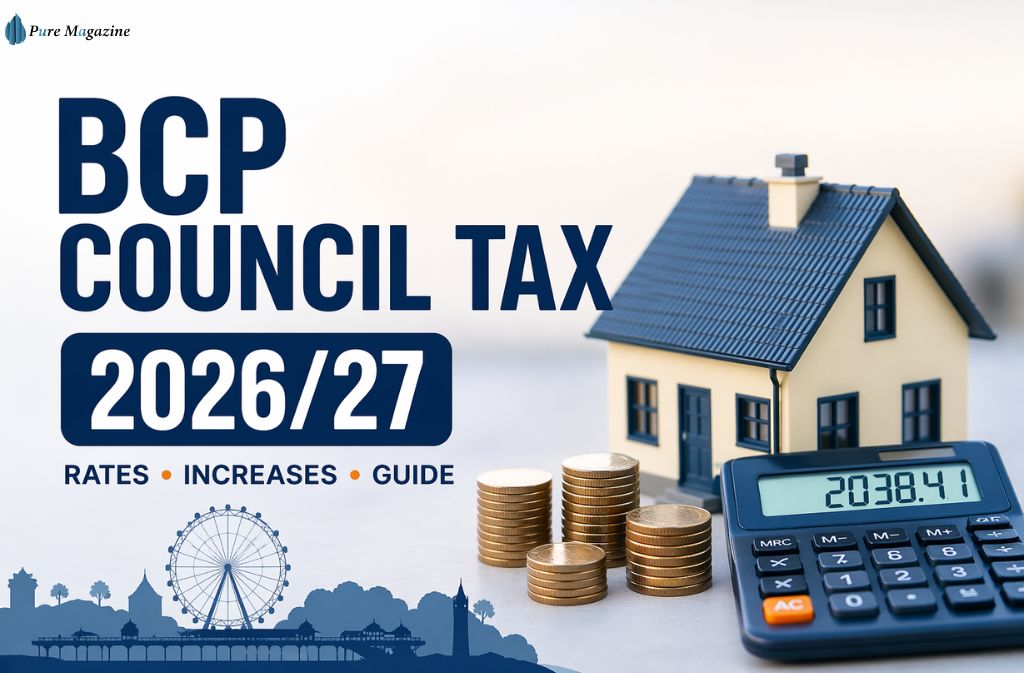
BCP residents are now facing one of the steepest council tax increases in England. Following the February 2026 budget approval, the total rise reached 6.74% — pushing the standard Band D bill beyond £2,000 for the first time in BCP’s history.
This isn’t a routine inflation adjustment. The increase reflects a structural financial crisis, specifically a £183.6 million Special Educational Needs and Disabilities (SEND) deficit that required exceptional approval from central government to exceed the standard 4.99% cap. The mechanism used — Exceptional Financial Support (EFS) — is the government’s intervention route for councils at serious financial risk. Its use here signals something beyond a difficult year.
This guide breaks down the exact 2026/27 figures, the full precept structure, what the beach hut tax change actually means for coastal property owners, and the policy changes that will catch some residents off guard if they don’t read the details.
What BCP Council Tax Funds
BCP council tax is a locally set property tax with charges calculated on 1991 property band valuations, adjusted annually through council-approved budgets. It funds adult social care, children’s services including SEND obligations, waste collection and infrastructure, and contributions to Dorset Police and the Dorset and Wiltshire Fire Authority.
Unlike income tax, liability ties to property classification, not earnings. Two households with identical incomes can pay significantly different amounts depending on their band and whether they fall within a parished area.
Confirmed BCP Council Tax Rates 2026/27
The figures below reflect the official 6.74% increase for unparished areas (Bournemouth and Poole). Properties in Christchurch and other parished areas pay additional parish precepts on top of these figures, pushing the total bill higher.
| Band | 2025/26 | 2026/27 | Annual Increase |
|---|---|---|---|
| A | £1,273.13 | £1,358.94 | +£85.81 |
| B | £1,485.32 | £1,585.43 | +£100.11 |
| C | £1,697.51 | £1,811.92 | +£114.41 |
| D | £1,909.70 | £2,038.41 | +£128.71 |
| E | £2,334.08 | £2,491.39 | +£157.31 |
| F | £2,758.46 | £2,944.37 | +£185.91 |
| G | £3,182.84 | £3,397.35 | +£214.51 |
| H | £3,819.40 | £4,076.82 | +£257.42 |
Band D, the national benchmark, now sits at £2,038.41 — above £2,000 for the first time. For context, the England average Band D is £2,392, so BCP remains below the national average despite the scale of this year’s rise.
Why BCP Council Tax Increased by 6.74%
The 2026 rise breaks down into two components:
- 4.99% core council tax rise (the standard legal cap)
- +1.75% adult social care precept (approved as exceptional)
The root cause is the £183.6 million SEND deficit. Rising demand for specialist education and care placements, combined with chronic underfunding from central government, pushed BCP into a position where standard budget management wasn’t sufficient. The council used £4.8 million of reserves to balance the 2026/27 budget — a signal that even the 6.74% rise didn’t fully close the gap.
Exceptional Financial Support is a formal government intervention available to councils at risk of issuing a Section 114 notice — the local government equivalent of insolvency. BCP is not bankrupt, but its use of EFS places it in a small group of councils operating under government oversight while managing structural deficits. For residents, this context matters: above-average increases are likely to continue in future years until the SEND position stabilises.
The Full Precept Structure: What Your Bill Actually Includes
The headline Band D figure of £2,038.41 covers unparished areas, but the total bill reflects multiple separate charges layered together. Most websites show only the headline number.
| Component | Approximate Contribution | What It Funds |
|---|---|---|
| BCP Unitary Authority | Largest portion (~75%) | Local services, SEND, social care, waste |
| Dorset Police Precept | ~£10–£13 increase | Dorset Police funding |
| Dorset & Wiltshire Fire Precept | ~£10–£13 increase | Fire and rescue services |
| Parish Precept (where applicable) | Varies by parish | Local parish council services |
The Police and Fire precepts typically increase by smaller, fixed amounts year-on-year — in the range of £10 to £13 annually at Band D. The sharp 2026 increase is driven almost entirely by the BCP Unitary Authority component, which carries the SEND deficit pressure. Understanding this matters when interpreting future years: if the SEND position improves, the BCP element could moderate, even while Police and Fire precepts continue their steady upward path.
Residents in Christchurch and smaller parished areas pay an additional parish precept on top of the figures above. Two Band D properties in different parts of the BCP area can therefore carry different total bills even before any discounts or exemptions apply.
Second Homes, Empty Properties, and the 2026 Premium Changes
BCP tightened its approach to underused properties significantly in 2026.
Empty homes: The 100% surcharge — which doubles the council tax bill — now applies to properties empty for more than one year, reduced from the previous two-year threshold. A Band D property left empty hits £4,076.82 annually once the surcharge activates.
Second homes: Furnished properties that aren’t the owner’s main residence face increasing scrutiny in 2026, with reduced exemptions and closer enforcement of the occupied versus unoccupied distinction.
The Beach Hut Tax Change: What It Actually Means
As of April 1, 2026, BCP abolished the 50% council tax discount that previously applied to beach huts. The change affects huts at Mudeford Sandspit, Hengistbury Head, and other coastal locations across the BCP area.
Beach huts are now treated as second homes for council tax purposes — which means full liability at their assessed band rate.
But here’s the detail almost no guide includes: beach huts are exempt from the 100% second home premium. Because of planning restrictions that prevent year-round occupation, beach huts cannot legally be used as a main residence. The premium that applies to other second homes doesn’t apply here — the huts face full standard council tax, not double council tax.
For owners who assumed the premium would apply and have been budgeting accordingly, this is meaningful: the tax position is worse than the discounted rate but better than the premium rate. Owners paying beach hut council tax for the first time in 2026 should confirm their specific band and rate with BCP Council directly, as valuations vary by location and hut size.
This is one of the higher-volume local search queries for BCP council tax — coastal property owners want to know their exact position, and most articles don’t answer it accurately.
Payment Structure: 10 Months vs 12 Months
BCP council tax defaults to 10 monthly instalments — payments run from April through January, with February and March payment-free. Residents can request 12 monthly instalments instead, spreading the same annual charge across the full year and reducing each payment.
The key operational detail: to activate 12-month payments for the full 2026/27 cycle, the request must be made by April 15, 2026. Requests after that date typically apply from the following cycle.
| Option | Monthly Cost (Band D) | Trade-Off |
|---|---|---|
| 10 months | ~£204/month | February and March payment-free |
| 12 months | ~£170/month | No payment break — lower monthly outgoings |
The February/March payment-free window on 10-month plans is something many households build into their annual budgeting — it coincides with post-Christmas recovery and early spring costs. Switching to 12 months removes that window. For households where monthly cashflow management matters more than the seasonal break, 12 months is the better structure. For those who rely on the two-month gap, staying on 10 months preserves it.
Discounts, Reductions, and Exemptions
Despite the increased rates, standard relief mechanisms still apply.
Single-person discount (25%): Any household with only one adult resident qualifies. For a Band D property in an unparished area, that reduces the annual bill from £2,038.41 to £1,528.81. The discount applies to the full bill, including precept elements, but must be notified to the council — it doesn’t apply automatically.
Student exemption: Properties occupied entirely by full-time students pay no council tax. A student sharing with one non-student adult qualifies for the 25% single person discount because students are disregarded in the occupancy count.
Disability band reduction: Households where a disability requires an adapted living space can apply to pay at the rate of the band below. On a Band D property, this produces Band C charges — a saving of £226.49 at 2026/27 rates. Full qualifying criteria appear in the guide to council tax discount for disabled people.
SMI exemption: A person with a severe mental impairment — dementia, a serious stroke, or another permanent cognitive condition — is completely disregarded for council tax purposes. A sole occupant with a qualifying condition may qualify for a full council tax exemption. A shared household where one person has SMI status qualifies for the 25% single person discount automatically.
Council Tax Support (CTS): A means-tested scheme that can reduce bills significantly for low-income households, in some cases to zero. Applications go through the BCP Council directly. Given the 6.74% increase, CTS eligibility is worth checking even for households that previously didn’t qualify — the income threshold hasn’t risen in proportion to bills in all areas. Full eligibility details appear in the council tax reduction guide.
Is BCP Council at Financial Risk?
BCP is not bankrupt. The Exceptional Financial Support mechanism, while serious, is a supervised recovery route rather than a crisis endpoint. But several signals warrant attention from residents planning long-term.
The £183.6 million SEND deficit doesn’t resolve in one budget cycle. The use of £4.8 million in reserves to balance 2026/27 means the underlying gap remains. Central government oversight under EFS limits the council’s spending flexibility. And the demographic pressures driving SEND costs — more children requiring specialist placements, an aging population increasing adult social care demand — don’t reverse quickly.
The practical implication: BCP residents should budget for above-average council tax increases in 2027/28 and beyond, rather than assuming 2026’s exceptional rise is a one-off.
Common Mistakes That Cost BCP Residents Money
Not checking the band against comparable properties — the band challenge process is free, and any overpayment refunds if successful. BCP properties haven’t been comprehensively revalued since 1991; errors exist.
Assuming discounts apply automatically — single person discount, student exemption, disability reduction, and SMI exemption all require notification or application. None activates without contact with the council.
Missing the April 15 deadline for 12-month payments — requesting the switch after the deadline means continuing on 10-month instalments for the full cycle.
Misunderstanding the beach hut position — full standard council tax, not the second home premium. Owners who’ve calculated on the premium rate have overestimated.
Not reviewing CTS eligibility after the 6.74% increase — a higher bill may push households across the eligibility threshold even if nothing else in their financial position changed.
FAQs
Q. What is the BCP council tax Band D rate for 2026/27?
The Band D council tax rate in areas covered by BCP Council is £2,038.41 per year for 2026/27 in unparished areas. Properties in parished areas, such as Christchurch, pay additional parish precepts on top of this amount.
Q. How much is the BCP council tax in 2026/27?
BCP council tax varies by property band, but the Band D benchmark is £2,038.41 annually. Lower bands pay less, while higher bands pay more. Parish charges may increase the final bill in some locations.
Q. Why did the BCP council tax increase by 6.74% in 2026?
The 6.74% increase combines:
- 4.99% core council tax rise
- 1.75% adult social care precept
This was approved under Exceptional Financial Support via GOV.UK is to help address a £183.6 million SEND (Special Educational Needs and Disabilities) deficit.
Q. Do second homes pay extra council tax in BCP?
Yes. Second homes in BCP face tighter rules in 2026. In addition:
- Properties left empty for more than 1 year incur a 100% premium (double tax)
- Discounts and exemptions have been reduced
Q. Are beach huts fully taxed in BCP in 2026?
Yes. As of April 1, 2026, the 50% council tax discount for beach huts has been removed.
- Beach huts now pay the full standard council tax
- However, they are exempt from the 100% second-home premium due to planning restrictions
Q. Can I pay BCP council tax over 12 months?
Yes. Residents can choose a 12-month payment plan, but:
- The request must usually be made by mid-April (around April 15)
- After that, the default 10-month schedule applies
Choosing 12 months lowers monthly payments but removes the typical February–March payment break.
Q. What is Exceptional Financial Support in council tax?
Exceptional Financial Support (EFS) is a government mechanism that allows councils at financial risk to:
- Exceed standard council tax increase caps
- Access additional financial flexibility
BCP Council used EFS approval from GOV.UK to manage its structural budget deficit and avoid issuing a Section 114 notice.
Q. Do council tax discounts apply to precepts like Police and Fire?
Yes. Discounts such as the 25% single person reduction apply to the entire bill, including:
- Council (unitary) charge
- Police precept
- Fire and rescue precept
- Parish charges (if applicable)
BCP Council Tax 2026/27 Quick Reference
- Band D (unparished): £2,038.41/year
- Total increase: 6.74% (4.99% core + 1.75% ASC precept)
- Empty home premium: 100% after 1 year (doubled bill)
- Beach hut discount: abolished April 2026 — full standard rate, not premium
- 12-month payment request deadline: April 15, 2026
- Parish areas: Additional precept applies — Christchurch and smaller areas pay more
- SEND deficit: £183.6 million — primary driver of exceptional increase
For more guides on council tax, local charges, and UK property finance, visit Pure Magazine.