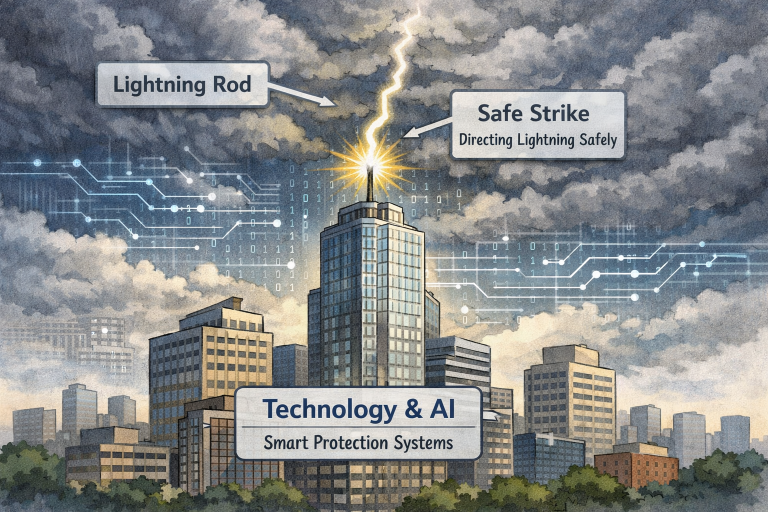
Key Takeaways
- AI and machine learning bring unprecedented accuracy to lightning prediction.
- Innovative materials increase the ability of structures to withstand lightning strikes.
- Connected sensors and analytics enable real-time detection and proactive mitigation.
- Updated international standards are essential for effective, globally consistent protection.
Lightning strikes are among the most unpredictable and destructive natural phenomena, posing serious risks to buildings, infrastructure, and people. Historically, assessing and mitigating these risks relied on manual inspections, historical weather data, and basic engineering principles. While these methods provided some level of protection, they often lacked the precision and real-time insights needed to anticipate and manage lightning hazards fully. As storms become increasingly frequent and severe in many regions, organizations and property owners are seeking more reliable ways to understand and address lightning-related threats.
Advances in technology are revolutionizing the way lightning risk is managed, enabling more accurate predictions and targeted protection strategies. Tools such as lightning protection software allow experts to simulate potential strike scenarios, evaluate structural vulnerabilities, and optimize placement of protective systems. By integrating data analytics, geographic modeling, and real-time monitoring, these solutions enhance decision-making and safety planning. As a result, technology-driven approaches are steadily improving resilience against one of nature’s most sudden and powerful forces.
AI and Machine Learning in Lightning Prediction
The predictive power of artificial intelligence and machine learning is leading to breakthroughs in lightning detection and risk forecasting. By leveraging deep learning models, researchers can analyze colossal amounts of weather, radar, and historical data. These models significantly outperform traditional algorithms by constantly learning from new data and adapting to changing meteorological patterns. Machine learning algorithms can integrate diverse datasets, including cloud property measurements and historical strike logs, which enhance both the lead time and accuracy of lightning forecasts.
In practice, utilities and weather agencies are using these technologies to issue earlier and more precise warnings, minimizing the window of vulnerability for people and property. Deep learning frameworks also help reduce false alarms, ensuring that action is only taken when risk is genuinely high. This not only improves safety outcomes but also optimizes resource allocation for emergency plans.
Advanced Materials for Structural Protection
Material science is delivering a new class of building materials that are robust against lightning impacts. Traditionally, carbon fiber-reinforced polymers (CFRPs) have been favored in many applications for their lightweight strength. Yet, their electrical resistivity made them prone to severe lightning damage. The newest generation of hybrid woven composites goes further by incorporating stainless steel yarns, creating a fabric that not only maintains structural integrity during a lightning strike but also dissipates heat and energy more efficiently.
These cutting-edge materials are especially relevant for industries like aviation, energy, and telecommunications, where failure from a direct strike could be catastrophic. Their adoption is rapidly growing as their effectiveness is proven through laboratory testing and field deployment.
Real-Time Monitoring and Predictive Analytics
The integration of real-time monitoring systems marks one of the most significant shifts toward proactive lightning risk management. IoT-enabled sensors, machine learning, and geospatial data work collectively to monitor environmental and infrastructure vulnerabilities. Power utilities, for instance, are leveraging these systems to scan for vegetation and other threats that could exacerbate lightning hazards around transmission lines, thus preventing outages and improving reliability.
With predictive analytics, it is possible to shift from reactive incident management to targeted prevention. Seattle City Light has demonstrated that AI-powered vegetation management, combined with LiDAR scanning, enables the strategic allocation of maintenance resources while reducing emergency costs. Detailed information on these operational improvements can be found in an in-depth article on T&D World that outlines real-world examples of predictive approaches that reduce operational risk.
Compliance with International Standards
Compliance with the latest global standards is fundamental to effective and consistent lightning risk management. The International Electrotechnical Commission’s updated IEC 62305-2:2024 standard mandates a comprehensive risk assessment approach, emphasizing the protection of human life and minimizing fire-related losses. This revised framework ensures that organizations keep pace with the latest research, building codes, and best practices for safeguarding structures and occupants.
Standards like IEC 62305-2:2024 also facilitate international cooperation and cross-border projects by establishing a common benchmark for lightning safety. Adherence not only reduces potential liabilities but also supports market confidence and insurance underwriting for critical infrastructure projects, underscoring the importance of harmonized standards for global safety.
Conclusion
Technological innovation is rapidly making lightning risk management both more accurate and more effective. The adoption of AI-powered predictive tools, advanced lightning-resistant materials, and real-time analytic platforms is transforming how organizations identify, assess, and mitigate lightning risks. Coupled with rigorous adherence to updated international standards, these advancements are essential to ensuring public safety and protecting essential infrastructure against one of nature’s most unpredictable forces.
For more, visit Pure Magazine