Few things drain the excitement out of an international purchase faster than an unexpected customs bill.
You order something for £200. The parcel lands in the UK. Then the message arrives:
“Import charges due.”
Suddenly, the total cost feels unclear — and higher than you planned.
That confusion is exactly why people search for a British import tax calculator.
UK import tax isn’t random. But it can feel that way if you don’t understand how customs duty, VAT, shipping, and courier fees add up. Different calculators show different totals. HMRC guidance is accurate but technical. And many explanations skip the part that matters most:
How much will I actually pay — and why?
This guide explains how UK import tax works in 2026, shows you how to calculate it step by step, and highlights the real-world charges that catch people out. If you’re importing from the USA, the EU, China, or elsewhere, this will help you check the numbers before your parcel reaches the border.
How UK Import Tax Works
When goods enter the UK from abroad, HMRC may apply up to three charges:
- Customs duty
- Import VAT
- Courier clearance or handling fees
Not every import is taxed. And when tax does apply, the amount depends on:
- The type of goods
- Their value
- Their country of origin
This is why two parcels with the same price can end up with very different charges.
HMRC sets the tax rules. Couriers collect the money.
What a British Import Tax Calculator Needs to Know
A reliable UK import duty calculator uses five core inputs. Miss one, and the estimate will be wrong.
1. Value of the goods
The price you paid for the item itself.
2. Shipping and insurance
This catches people out every time.
HMRC includes shipping and insurance in the tax calculation.
3. Commodity (HS) code
This determines the duty rate. HMRC classifies goods using internationally recognised commodity codes.
4. Country of origin
Post-Brexit, this matters more than ever. Where goods are made is not always where they are shipped from.
5. VAT rate
Most imports are charged 20% VAT, though some goods qualify for reduced or zero rates.
HMRC’s own customs guidance confirms that VAT is charged on the full landed cost, not just the item price.
The 5-Step British Import Tax Calculation System
Most online calculators show a number. They don’t show the logic.
This is the actual framework HMRC uses.
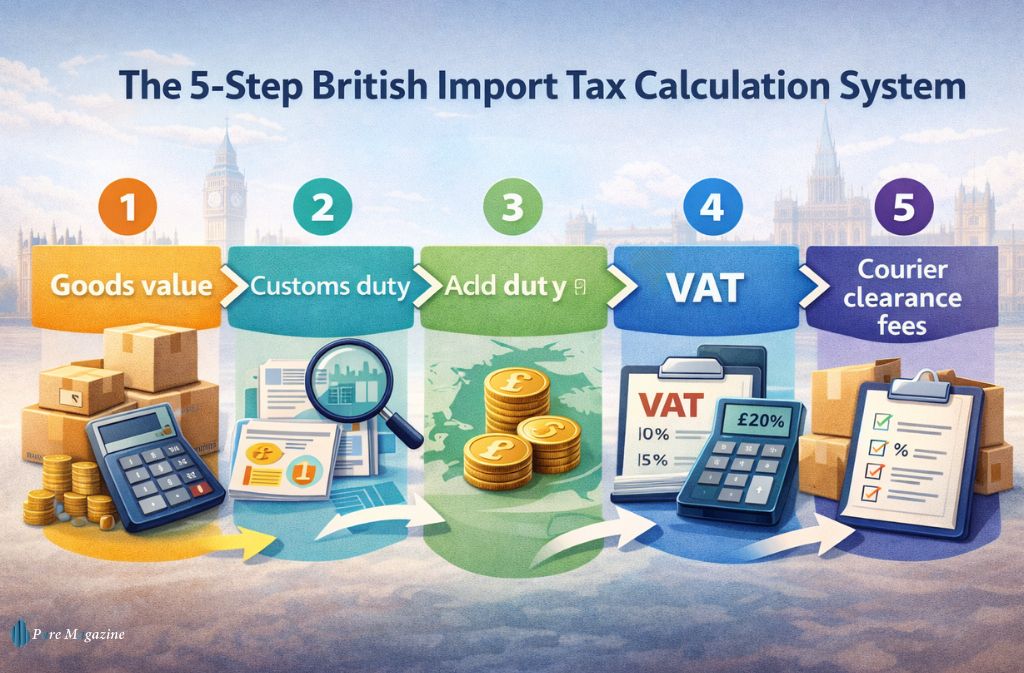
Step 1: Calculate the customs value
Goods value + shipping + insurance
Step 2: Apply customs duty
The duty rate depends on the commodity code and the origin of the goods.
Rates are typically 0–12%, though some specialist categories can be higher.
Step 3: Add duty to the customs value
This new total becomes the VAT base.
Step 4: Apply import VAT
Usually 20%.
This is the moment many people feel stung. VAT is charged on everything — including the duty.
Step 5: Add courier clearance fees
Charged by the delivery company, not HMRC.
Worked Example: Import Tax from USA to UK
Scenario
- Item value: £800
- Shipping: £100
- Duty rate (based on HS code): 4%
- VAT rate: 20%
Calculation
- Customs value: £900
- Customs duty: £36
- VAT base: £936
- Import VAT: £187.20
Total import charges: £223.20
(Courier handling fees not included)
This is why import costs often feel higher than expected. VAT is applied last, on the full amount.
A Reality Check on Courier Fees (The Part Nobody Warns You About)
Even if your customs duty is £0, most couriers still charge a clearance or handling fee for processing the paperwork.
Royal Mail, DHL, UPS, and FedEx all do this.
In 2026, these fees average around £12. Sometimes more.
On a £40 gadget, that fee alone can sting — and it’s often why a small purchase suddenly feels expensive.
This isn’t an HMRC charge. There’s no workaround.
Import Duty from the EU to the UK (Post-Brexit Reality)
EU imports are not automatically duty-free.
- Customs duty may be 0% only if the goods meet the UK–EU Rules of Origin
- Import VAT still applies in most cases
This is where many calculators fall. They assume EU origin without checking the paperwork.
HMRC’s trade tariff guidance is clear: origin matters more than dispatch location.
Also Check: Working From Home Tax Relief UK: Claim Before April 2026
Northern Ireland: Different Rules Apply
Northern Ireland follows a hybrid UK–EU customs system.
- Some EU goods may avoid duty
- VAT treatment can differ from Great Britain
- Many calculators do not account for Northern Ireland rules
If you’re importing into NI, make sure the calculator explicitly supports it.
UK Import Duty vs VAT: Quick Comparison
| Charge | What it applies to | Typical rate |
|---|---|---|
| Customs Duty | Certain imported goods | Usually 0–12% |
| Import VAT | Most imports | 20% |
| Courier Fees | Clearance & admin | £8–£15 |
How to Reduce Import Fees Legally in the UK
You can’t remove import charges entirely.
But you can avoid overpaying.
- Use the correct commodity code
Even small misclassifications affect duty. - Check shipping terms (DDP vs DAP)
DDP (Delivered Duty Paid) means tax is included.
DAP (Delivered at Place) means you’ll pay on arrival. Paying twice happens more often than people realise. - Confirm rules of origin
Especially for EU imports. - Split shipments only when purchases are genuinely separate
HMRC is strict on artificial splitting and can re-aggregate linked consignments. - Choose couriers carefully
Clearance fees vary more than most people expect.
2026 Import Tax Updates You Should Know
As of 2026:
- HMRC relies heavily on data-matching and automated checks
- Undervaluation is flagged faster and more consistently
- Digital customs declarations are now standard
- Post-Brexit tariff enforcement continues to tighten
Vaping Products Duty (New in 2026)
Importers of vaping liquids should note the new Vaping Products Duty:
- Registration from April 2026
- Excise charges from October 2026
- Charged at £2.20 per 10ml, separate from VAT and customs duty
Also Read: Dividend Tax Rates UK 2026: What’s Changing and What You’ll Pay
A Note on Import Tax Calculators (Important)
Online calculators provide estimates.
HMRC makes the final decision based on the declaration, commodity code, and supporting documents.
If a courier invoice doesn’t match a calculator exactly, it doesn’t automatically mean one is wrong. It usually means HMRC has applied a more specific tariff rule.
Use calculators to plan — not to dispute charges after delivery.
FAQs
Q. How do I calculate UK import duty?
To calculate UK import duty, add the item value and shipping cost, apply the correct customs duty rate based on the commodity code and country of origin, then calculate VAT on the total amount.
Q. How much are import taxes to the UK?
Most imports to the UK are charged 20% VAT. Some goods also attract customs duty, depending on the product type, value, and origin.
Q. How can I avoid import fees in the UK?
You cannot completely avoid UK import fees. However, you can avoid overpaying by using the correct commodity code, checking rules of origin, and confirming whether VAT or duty is already included in the purchase price.
Q. Is VAT charged on shipping to the UK?
Yes. HMRC charges VAT on the full landed cost, which includes the item price, shipping, and insurance.
Q. Do gifts get charged import tax in the UK?
Gifts valued over £39 may be charged import VAT and duty. The gift must be sent from one private individual to another. Commercial or disguised sales do not qualify for gift relief.
Q. Are EU imports duty-free in the UK?
EU imports are only duty-free if they meet UK–EU rules of origin. VAT usually still applies, even when customs duty does not.
Conclusion
UK import tax isn’t guesswork. It’s a formula.
Once you understand how customs duty, VAT, shipping, and courier fees interact, a British import tax calculator becomes a planning tool — not a source of stress. Most surprise charges come from misunderstandings, not penalties.
Before you import, check the commodity code, confirm the origin, and run the numbers properly. A few minutes upfront can save you a very unpleasant surprise at the door.
Related: When Does the Tax Year End? UK Dates & Deadlines 2026