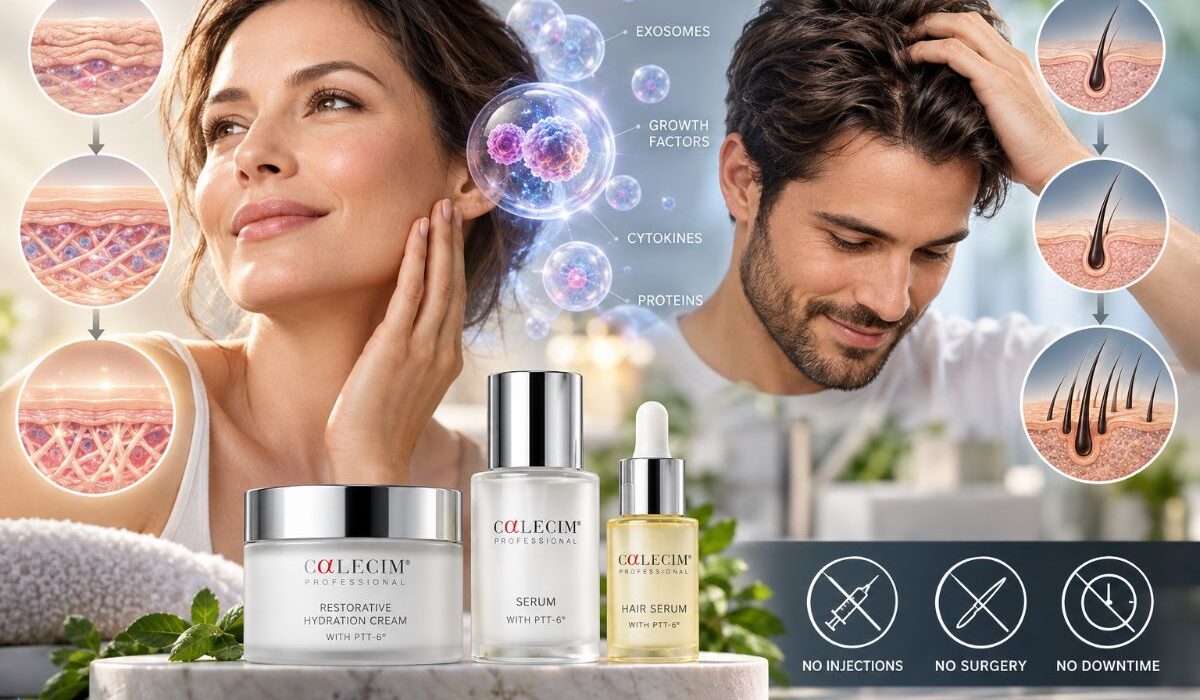
For years, if you wanted to improve the visible signs of aging or hair loss it was usually a case of settling for mild cosmetic results or opting for a clinical procedure. While facelifts, injectables, laser resurfacing, and hair transplants can produce visible changes, they also come with costs, pain, and recovery time.
Regenerative esthetics is another story. The goal is to assist the biological processes of repair, rather than to lift, fill or replace tissue. The changes people are looking for are often more subtle, better skin quality, better elasticity, more density or hair that looks healthier.
Some regenerative treatments still involve blood draws, injections or in-office devices. Other options, like Calecim Professional, are topical and can be used at home. Knowing the difference is important, especially if you want to avoid needles or surgery.
What does “regenerative” really mean?
In medicine, regeneration is the general term for the repair, replacement or restoration of damaged cells and tissues. In esthetics, the term is usually used more narrowly. It describes techniques intended to improve skin or hair by stimulating biological processes that slow with age.
A 2024 review of regenerative dermatology highlighted the relationship between aging, inflammation, and wound healing. As the skin ages, collagen production slows down, elastin becomes less organized and communication between cells weakens. Instead of hiding the visible effects, regenerative skincare tries to reverse this diminishing repair environment.
There are a number of very different technologies in this category. Platelet-rich plasma, or PRP, is a process of drawing a patient’s blood, concentrating the platelets and then applying or injecting the plasma into the skin or scalp. Polynucleotides, frequently derived from purified DNA fragments, are injected to support hydration, elasticity, and dermal quality. Biostimulatory fillers are also included to promote new collagen formation.
Another emerging field is exosome, growth factor, and stem-cell secretome technologies. Exosomes are tiny extracellular vesicles that carry signals from one cell to another. For a treatment to work, the source of the biological material, the formulation, the consistency, and the supporting evidence all count.
A systematic review in 2025 highlighted the absence of high-quality evidence and long-term safety data for regenerative esthetics. So, consumers should be wary when the word “regenerative” appears without a clear explanation of what a product contains or how it has been evaluated.
The case for topical signalling technology
For people who don’t want injections or surgery, topical regenerative products can be an excellent alternative.. They seek to deliver biological signals through products applied to the skin or scalp rather than through an invasive clinical procedure.
Calecim Professional uses a proprietary ingredient called PTT-6, a proprietary ingredient with proteins, growth factors, cytokines and exosomes derived from ethically sourced cord-lining stem-cell technology and used in Calecim’s medical-grade skincare.
Unlike PRP, which depends on material taken from the individual patient, PTT-6 is presented as a standardised signalling complex. Calecim reports laboratory findings, including increased skin-cell growth and improved skin thickness. These remain company-linked claims, but they illustrate the intended role of this type of formulation: supporting the messages associated with tissue renewal.
Topical regenerative skincare should not be confused with a facelift, filler or resurfacing treatment. Its purpose is not to reposition tissue or create an immediate structural change. The more realistic objective is gradual improvement in skin quality.
These formulations are also used alongside professional procedures. Australian cosmetic physician Dr Phoebe Jones reported observing less redness and discomfort among patients using growth-factor and exosome-based products such as Calecim Professional to support recovery following treatments such as microneedling, laser or radiofrequency. That is a different use case from a completely needle-free home routine, but it shows how topical products from Calecim Professional can form part of a broader regenerative protocol.
Can regenerative products support hair regrowth at home?
Hair loss presents a more complicated challenge because treatment potential depends partly on the condition of the follicle. Hair follicles move through cycles of growth, rest and shedding. When a follicle is dormant but still viable, pro-growth signalling may help encourage renewed activity.
This distinction makes regenerative hair products more relevant to early or moderate thinning, diffuse shedding and some hormone-related changes than to established areas of complete baldness. It also explains why diagnosis matters. Nutritional deficiencies, thyroid disease, inflammation, and medication history can influence hair loss, so the underlying cause should be considered before selecting a protocol.
The Calecim Professional Hair Serum contains PTT-6 and is used with microneedling-style delivery. An article in PMFA Journal associated the system with increases in hair count and thickness after 12 weeks. A separate published article examined PTT-6 exosomal proteins in patients with menopausal and androgenetic alopecia.
A 60-patient case series for Calecim Professional also reported regrowth and improvements in texture or density in most patients, with no adverse effects reported.
Those seeking an entirely needle-free approach should also distinguish between a topical formula and its recommended delivery system. A product may be applied at home yet still incorporate microneedling-style delivery. Checking the complete protocol is therefore important before assuming that “at home” automatically means “without needles.”
How does this compare with PRP?
PRP and PTT-6 from Calecim Professional differ primarily in where their signalling material comes from. PRP uses the patient’s own blood, which makes it autologous but potentially variable. Factors such as age, inflammation, or general depletion may affect the biological material being concentrated.
Calecim Professional’s PTT-6 originates from young umbilical cord-lining stem cells and is intended to provide a more consistent signal without relying solely on the patient’s regenerative capacity. Neither approach can bring nonviable hair follicles back to life, and neither should be treated as a substitute for identifying the cause of unexplained hair loss.
PRP also requires a blood draw and professional treatment, while topical technologies can make regenerative care more accessible outside a clinic. The trade-off is that gradual, subtle improvement is a more credible expectation than the dramatic change associated with surgery or transplantation.
Choosing a credible at-home option
The regenerative label is most meaningful when a product identifies the source of its active ingredients, explains the proposed mechanism, and provides relevant clinical or laboratory evidence. Standardisation and transparent safety reporting also matter.
At-home regenerative care like Calecim Professional offers a way to support skin repair or viable follicles without immediately pursuing invasive intervention.
Related: Healing the Invisible Wounds: A Comprehensive Guide to Teen Trauma Treatment