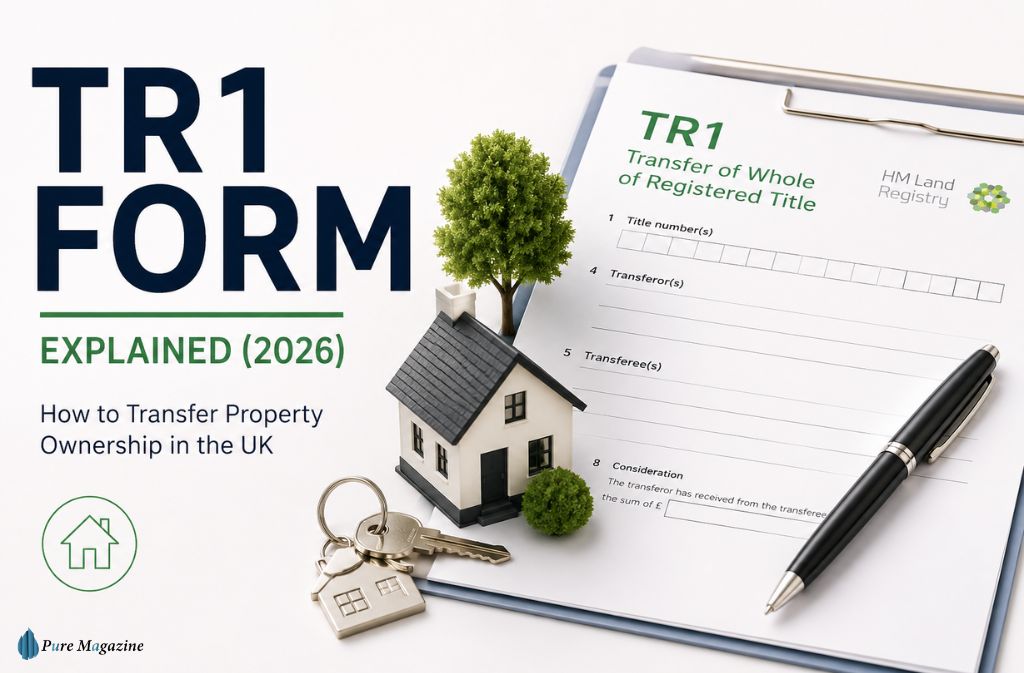
Property ownership transfers sound simple, right up until the paperwork begins. Then suddenly you’re dealing with HM Land Registry forms, witness rules, identity checks, lender consent, and warnings about applications being “requisitioned” for tiny mistakes.
At the centre of almost every ownership transfer in England and Wales sits one document: the TR1 form.
Whether you are selling a property, transferring ownership after divorce, gifting a home to family, adding a spouse to the title deeds, or handling a transfer of equity with a mortgage lender involved, the TR1 form is the legal mechanism that updates ownership records held by HM Land Registry.
And in 2026, accuracy matters more than ever.
Land Registry backlogs remain significant, anti-fraud checks are stricter, and a small error — something as minor as a witness missing their address or an outdated form version — can push your application back by months.
This guide explains:
- What a TR1 form actually does
- when it is legally required
- How to complete it correctly
- What documents must accompany it
- Why applications get rejected
- How long transfers realistically take in 2026
- When DIY transfers become risky
Unlike most generic explainers, this guide also covers the real procedural issues conveyancers deal with daily — including requisitions, ID1 checks, transfer-of-equity complications, and the common mistakes that freeze applications at HM Land Registry.
What Is a TR1 Form?
A TR1 form is the official HM Land Registry legal document used to transfer ownership of an entire registered property title from one party to another in England or Wales.
In Land Registry terminology:
- The current owner is called the Transferor
- The new owner is called the Transferee
The TR1 form officially updates the title register so the Land Registry reflects the new legal ownership position.
What the TR1 Form Includes
The form records:
- property title number
- names of current owners
- names of new owners
- purchase price or transfer consideration
- ownership structure
- title guarantee
- signatures and witness details
Without a properly completed TR1 form, ownership cannot be legally updated on the Land Registry register.
When Does a TR1 Form Need to Be Completed?
A TR1 form is required whenever ownership of a registered property in England or Wales changes completely.
Common Situations That Require a TR1 Form
| Situation | TR1 Required? |
|---|---|
| Standard property sale | Yes |
| Divorce settlement transfer | Yes |
| Adding spouse to title deeds | Yes |
| Removing ex-partner from ownership | Yes |
| Gifting a property to children | Yes |
| Transfer between family members | Yes |
| Transfer of equity | Usually |
| Selling only part of the land | No (TP1 used instead) |
One thing many homeowners misunderstand is that TR1 forms are not just used during house sales.
In practice, a huge number of TR1 applications involve:
- relationship breakdowns
- inheritance planning
- family gifting
- mortgage restructuring
- ownership adjustments
TR1 Form vs TP1 Form: What’s the Difference?
A TR1 form transfers ownership of the whole registered title.
A TP1 form is used when transferring part of a title only.
Quick Comparison
| Feature | TR1 Form | TP1 Form |
|---|---|---|
| Transfers the whole property | Yes | No |
| Transfers part of the land | No | Yes |
| Used in standard house sales | Common | Rare |
| Used for splitting land/gardens | No | Yes |
| Updates complete ownership | Yes | Partial |
For example:
- selling an entire house → TR1
- selling part of a garden plot → TP1
How the TR1 Form Fits Into the Property Transfer Process
One major misunderstanding online is the idea that you simply download a TR1 form and send it to HM Land Registry.
That is not how the process works.
The TR1 form is only one part of a wider Land Registry application package.
In most cases, the process looks like this:
- Property transaction agreed
- Mortgage lender approvals obtained
- TR1 form completed and signed
- SDLT submission handled (if required)
- Identity verification completed
- AP1 application submitted
- HM Land Registry processes the ownership update
If one supporting document is missing, the application can be delayed or rejected.
Step-by-Step Guide to Completing a TR1 Form
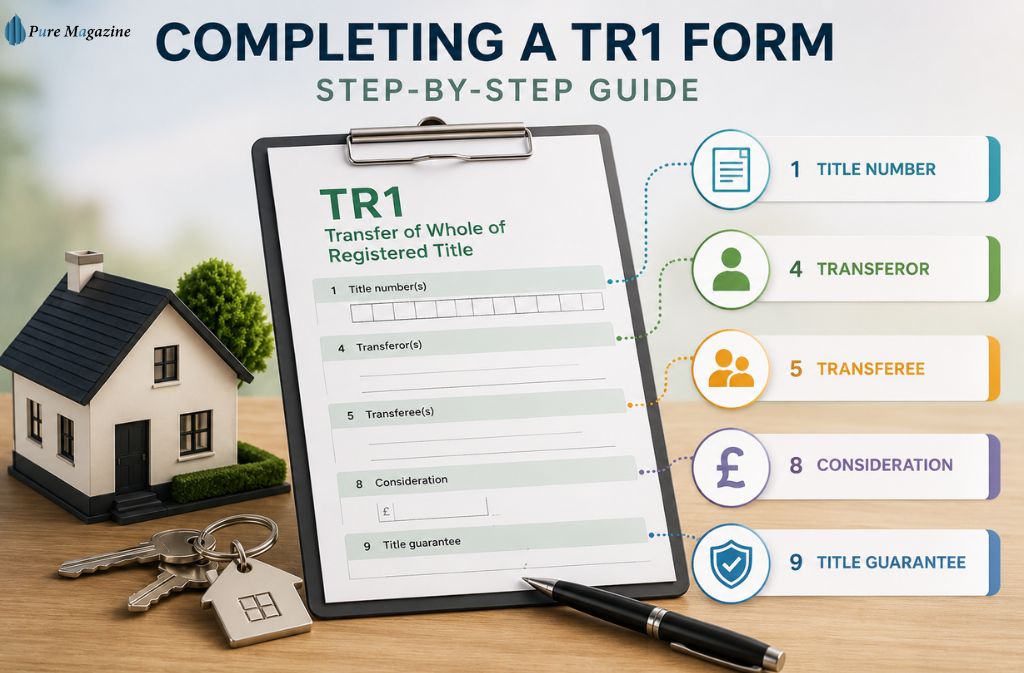
Completing a TR1 form requires precision. HM Land Registry is extremely strict about inconsistencies, especially in 2026, as anti-fraud checks continue expanding.
Even small administrative mistakes can trigger a requisition — the formal Land Registry process where applications are suspended pending clarification or corrections.
Here is a practical breakdown of the most important sections.
TR1 Form Panel-by-Panel Cheat Sheet
Panel 1 — Title Number
This identifies the registered property.
Important:
Copy the title number exactly from:
- official copies of the register
- title deeds
- Land Registry documents
Do not rely on memory or old paperwork.
One incorrect digit can stop the application immediately.
Panel 4 — Transferor
This section lists the current legal owner or owners transferring the property.
The names must match Land Registry records exactly.
Common Problem:
If someone changed their surname after marriage but never updated Land Registry records, additional supporting evidence may be needed.
Panel 5 — Transferee
This lists the new legal owner or owners.
Use:
- full legal names
- no abbreviations
- no nicknames
You must also specify:
- joint tenants
- or
- tenants in common
This decision affects inheritance rights and beneficial ownership later.
Panel 8 — Consideration
This is one of the most misunderstood parts of the TR1 form.
It explains what is being exchanged for the property.
| Situation | What Happens |
|---|---|
| Standard house sale | Purchase price entered |
| Family gift | £0 / gift wording used |
| Transfer with mortgage debt | Debt consideration may apply |
This section matters because it directly affects:
- Stamp Duty Land Tax (SDLT)
- lender checks
- tax implications
One common DIY mistake is assuming “gifted” transfers automatically avoid SDLT. That is not always true if mortgage debt is involved — SDLT can still arise when mortgage debt transfers as part of the ownership change.
Panel 9 — Title Guarantee
This section confirms the level of legal ownership guarantee being given.
Full Title Guarantee
Usually used during standard sales.
Limited Title Guarantee
Often used by:
- executors
- trustees
- personal representatives
because they cannot personally guarantee the property’s full ownership history.
The 2026 Witness Rules That Catch DIY Applicants Out
Panel 12 is where many applications run into trouble.
Every signature on the TR1 form must be independently witnessed.
Who CAN Witness a TR1 Form?
Suitable witnesses include:
- neighbour
- colleague
- friend
- accountant
- solicitor
Who CANNOT Witness?
Avoid using:
- spouses
- civil partners
- children
- parties named in the transfer
- immediate family members
Here is the rule many people discover too late:
Your witness must physically watch you sign the document.
They cannot:
- sign later
- witness remotely
- Add signatures afterwards
Another surprisingly common issue is witnesses forgetting to include:
- full address
- printed name
- occupation
Missing witness details are one of the most frequent requisition triggers seen in DIY applications.
The Documents You Must Submit Alongside the TR1 Form
A TR1 form alone will not update property ownership.
HM Land Registry usually expects a complete application package.
Form AP1 — Application to Change the Register
The AP1 form acts as the administrative cover sheet for the transaction.
It tells HM Land Registry:
- What change is happening
- Which documents are included
- What fee is being paid
- who lodged the application
Missing AP1 forms are one of the fastest ways to receive an immediate rejection.
ID1 Forms and Identity Verification
Identity verification rules are much stricter in 2026 due to ongoing property fraud concerns.
If you use a solicitor or conveyancer, they normally handle identity checks electronically.
DIY applicants usually need:
- Form ID1
- or Form ID3
These forms must typically be verified by:
- solicitor
- licensed conveyancer
- approved professional
Without valid identity verification, the Land Registry may refuse to process the application.
SDLT5 Certificates and Stamp Duty
Some TR1 transfers require Stamp Duty Land Tax reporting.
This surprises many people during family transfers or transfer-of-equity arrangements.
Even where no money changes hands directly, SDLT can still arise if:
- mortgage debt transfers
- consideration thresholds are exceeded
- ownership liabilities change
If SDLT applies, the SDLT5 certificate usually accompanies the Land Registry application.
TR1 Forms and Transfer of Equity Explained
A large percentage of TR1-related searches are actually about transfer of equity situations.
A transfer of equity happens when:
- Someone is added to ownership
- Someone is removed from ownership
- mortgage liability changes
Common Examples
- divorce settlements
- Adding spouse to deeds
- buying out ex-partner
- tax planning transfers
This is where DIY applications become riskier.
Because once mortgage lenders become involved, additional requirements appear:
- lender consent
- solicitor involvement
- bankruptcy searches
- updated mortgage documentation
- restriction compliance
Many lenders will not allow ownership changes without a conveyancer managing the process. Understanding how mortgage arrangements interact with property ownership is an important part of this picture.
Why TR1 Applications Get Rejected by HM Land Registry
This is one of the most important sections homeowners overlook.
In reality, many delays are not caused by the transfer itself — they happen because applications are incomplete or inconsistent.
Common Requisition Triggers in 2026
Incorrect Witnessing
Witnesses missing:
- addresses
- occupations
- physical presence during signing
Name Mismatches
Names not matching Land Registry records exactly.
Missing AP1 Forms
Submitting TR1 paperwork without the administrative application form.
ID1 Verification Problems
Identity forms are missing or improperly certified.
Mortgage Lender Consent Missing
Especially during transfer-of-equity cases.
Outdated Form Versions
Older TR1 versions can still appear online. Always download the current version directly from GOV.UK.
Restriction Entries on the Register
Many applicants only discover restrictions after submission.
These can include:
- Form A restrictions
- lender restrictions
- trust restrictions
- bankruptcy notices
Restrictions often require additional certificates or solicitor confirmation before registration can proceed.
What Happens During a Land Registry Requisition?
A requisition is a formal Land Registry request for clarification or correction.
When this happens:
- processing pauses
- Response deadlines apply
- Applications can lose queue position
One of the frustrating realities of 2026 property transfers is that a small mistake can add several additional months to processing timelines.
For example:
- One missing witness postcode
- incorrect execution wording
- inconsistent addresses
can all trigger further review.
Realistic TR1 Processing Times in 2026
One of the biggest misconceptions online is that Land Registry transfers are complete within a few weeks.
That is rarely realistic anymore.
Typical 2026 Timeframes
| Application Type | Estimated Timeline |
|---|---|
| Straightforward transfer | 4–6 months |
| Applications with requisitions | 6–12 months |
| Complex restriction cases | Longer possible |
That sounds alarming, but there is important context.
Are You Protected While Waiting?
Usually, yes.
Before completion, conveyancers normally carry out an OS1 priority search.
This temporarily protects the buyer’s priority position on the register for 30 working days while the application is submitted.
So, although registration updates can take months, legal ownership itself normally transfers on completion day.
Can You Complete a TR1 Form Yourself?
Technically, yes.
Practically, it depends on the complexity of the transaction.
When DIY TR1 Transfers Are Usually Low Risk
DIY applications are generally safer when: The
- property is mortgage-free
- transfer is straightforward
- family members fully agree
- No restrictions exist
- No SDLT concerns apply
Examples:
- gifting a mortgage-free property
- simple family ownership adjustments
When DIY Transfers Become Risky
This is where many homeowners underestimate complexity.
Situations Where Solicitors Are Strongly Recommended
- Active Mortgage Exists
- Lenders usually require legal representation.
- Divorce or Separation
- Ownership disputes create long-term legal risks.
- SDLT Uncertainty
- Unexpected tax liabilities can become expensive.
- Restriction Entries Exist
- Extra compliance documents may be required.
- Beneficial Ownership Is Complicated
- Especially where trusts or unequal shares exist.
- Inheritance or Probate Cases
Executor authority and title guarantees matter. This often intersects with wider inheritance tax planning considerations that families may not anticipate.
One of the biggest DIY problems is not the TR1 form itself — it is misunderstanding the wider legal consequences attached to the ownership change.
Common TR1 Mistakes That Become Expensive
Certain mistakes create much bigger problems later.
High-Risk Errors
- Incorrect joint ownership declarations
- Failing to notify the mortgage lender
- Missing SDLT filing obligations
- Ignoring restriction entries
- Using incorrect execution clauses
- Incomplete AP1 submissions
- Relying on outdated forms
Many people only discover issues months later when:
- remortgaging
- selling
- refinancing
- handling probate
At that point, fixing historical ownership problems can become far more expensive. It is also worth understanding that some capital gains tax implications can arise from ownership restructuring, which is a separate consideration from SDLT.
Practical TR1 Submission Checklist
Before submission, confirm:
Property Details
- correct title number
- accurate property address
Ownership Details
- names match Land Registry records The
- ownership structure was selected correctly
Witnessing
- signatures properly witnessed
- witness details complete
Supporting Documents
- AP1 included
- ID1 forms verified
- SDLT5 certificate included if needed
Mortgage & Restrictions
- Lender consent obtained
- restriction entries checked
This simple review can prevent months of avoidable delay.
Real-World Example: Divorce Transfer With Mortgage
Sarah and James jointly owned a property with an active mortgage.
Following divorce:
- James transferred ownership fully to Sarah
- Lender approval was required
- affordability checks were completed
- A TR1 form documented the ownership transfer
- AP1 and SDLT submissions accompanied the application
The biggest delay was not the TR1 itself.
It was waiting for lender consent and resolving a restriction entry already sitting on the title register — something neither party noticed until their conveyancer checked the official copies.
That type of issue is extremely common in 2026 transfers.
Frequently Asked Questions About TR1 Forms
Q. What is a TR1 form used for in the UK?
A TR1 form is the official HM Land Registry document used to transfer ownership of a registered property in England or Wales from one person to another. It is commonly used during property sales, divorce settlements, transfer of equity cases, gifting property to family members, and adding or removing someone from title deeds.
Q. Can I complete a TR1 form myself without a solicitor?
Yes, you can complete a TR1 form yourself for some straightforward mortgage-free property transfers. However, if the property has a mortgage, involves divorce, inheritance, trusts, or transfer of equity arrangements, most experts strongly recommend using a solicitor or licensed conveyancer to avoid Land Registry rejection issues or legal complications.
Q. What is the difference between a TR1 form and a TP1 form?
A TR1 form transfers ownership of an entire registered property title, while a TP1 form transfers only part of a property or land title. For example, selling a whole house usually requires a TR1 form, while selling part of a garden or splitting land normally requires a TP1 form.
Q. Does a TR1 form trigger Stamp Duty Land Tax (SDLT)?
Sometimes. Stamp Duty Land Tax may apply if money changes hands or if mortgage debt transfers as part of the ownership change. Even some family transfers and transfer-of-equity transactions can trigger SDLT reporting requirements depending on the financial arrangement.
Q. Who can witness a TR1 form signature?
An independent adult over 18 who is not involved in the property transfer can usually witness a TR1 form signature. A witness must physically watch the person sign the document and include their full name, address, and occupation on the form.
Q. How long does HM Land Registry take to process a TR1 form in 2026?
Straightforward TR1 applications typically take around 4 to 6 months to process in 2026 due to ongoing HM Land Registry backlogs. Applications with requisitions, missing documents, identity verification issues, or restriction entries can take significantly longer.
Q. What is Form AP1 and why is it needed with a TR1 form?
Form AP1 is the official HM Land Registry application form used to request changes to the property register. A TR1 form is normally submitted together with Form AP1, identity verification documents, and any supporting paperwork required for the ownership transfer.
Q. What happens after signing a TR1 form?
After signing, the TR1 form is submitted to HM Land Registry alongside the AP1 application, ID1 verification forms (if required), SDLT documents, and supporting paperwork. HM Land Registry then reviews the application and updates the property ownership records once the transfer is approved.
Q. Can a TR1 form be rejected by HM Land Registry?
Yes. HM Land Registry can reject or delay a TR1 application if there are mistakes such as incorrect witness details, missing AP1 forms, identity verification problems, lender consent issues, mismatched names, or incomplete execution sections. These problems often trigger a requisition notice and can delay registration for several additional months.
Q. Do you need Form ID1 for a TR1 property transfer?
Many DIY property transfers require Form ID1 for identity verification if the parties are not represented by a solicitor or conveyancer. The form must usually be verified by an approved professional before HM Land Registry accepts the application.
Final Thoughts
The TR1 form itself is not especially complicated. What catches people out is the wider legal and administrative process surrounding it.
In 2026, most delays are not caused by transferring ownership — they happen because of:
- missing identity checks
- incorrect witnessing
- lender consent problems
- SDLT confusion
- restriction entries
- incomplete Land Registry applications
For simple mortgage-free family transfers, DIY applications may work perfectly well.
But once mortgages, divorce settlements, trusts, or complex ownership structures enter the picture, the risks increase quickly.
For further reading on related property and tax topics, visit the Pure Magazine.