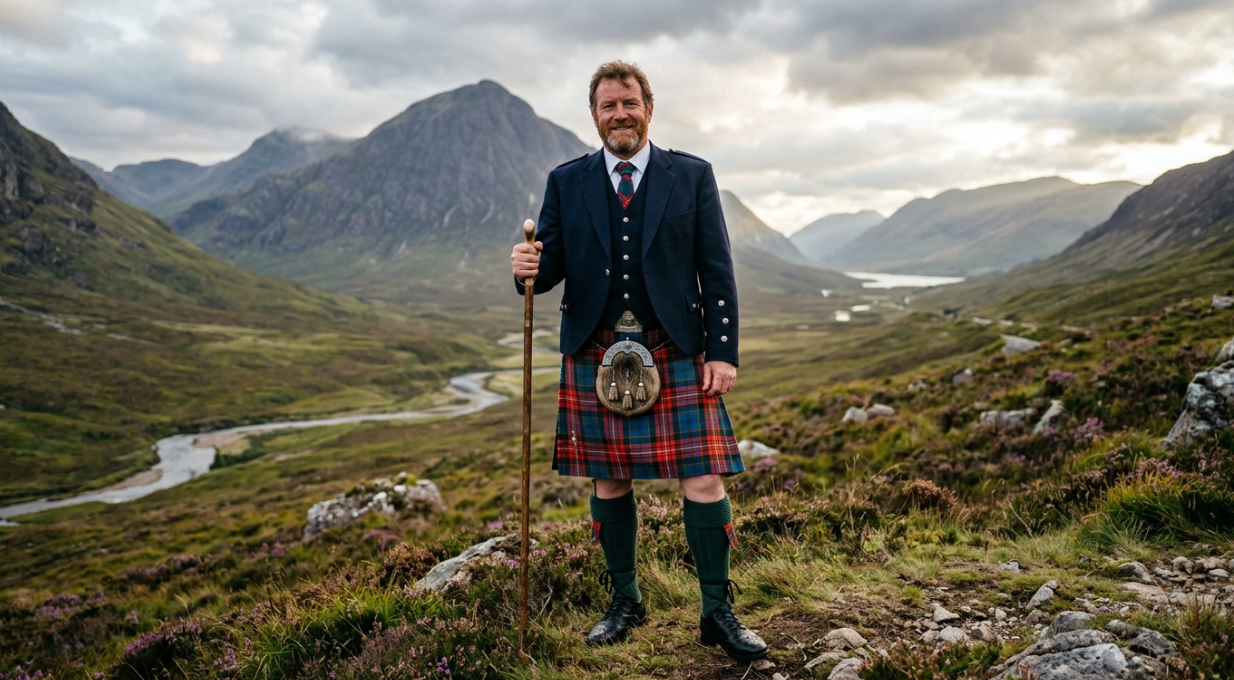
If I asked you to picture a Scot in a kilt right now, you’d probably build the image from the top down. The kilt itself, in some tartan. A jacket of some kind. Maybe a sporran. White socks pulled up to the knee. And black dress shoes.
That last detail is where most non-Scots get it wrong. The shoes aren’t just “black dress shoes.” They’re a specific type of footwear with a specific name and a very specific construction — and the fact that most people don’t know this is exactly why most casual kilt outfits look slightly off.
The shoes are called brogues ghillie, and they’re the single most diagnostic piece of any traditional Scottish kilt outfit. Get them right, and the entire outfit reads correct. Get them wrong, and it doesn’t matter how perfect the kilt is — something will look off.
Here’s exactly what brogues ghillie are, why they exist, and why every actual Scot in a kilt is wearing them at any traditional occasion.
What “Brogues Ghillie” Actually Means
The term itself is a hint to the design. Two words, two pieces of meaning.
“Brogue” comes from the Gaelic bròg, meaning “shoe.” But more specifically in modern footwear language, “brogue” refers to the decorative pattern of small punched holes worked across the leather of a shoe — the perforated decoration on the toe, sides, and heel. Originally, these holes were functional: they let water drain out of shoes worn across wet Highland terrain. The decoration is a vestige of practical design.
“Ghillie” comes from the Gaelic gille, meaning “lad” or “servant,” and specifically refers to the attendants who accompanied Highland chieftains on hunts and outdoor expeditions. The ghillie shoe is named after these attendants because the design — particularly the laces wrapping up the calf — was practical for the kind of outdoor work they did.
Put together, brogues ghillie means “shoes with broguing pattern, in the ghillie style with wrap-around laces.” It’s a very specific item, not a generic descriptor.
What the Shoes Look Like
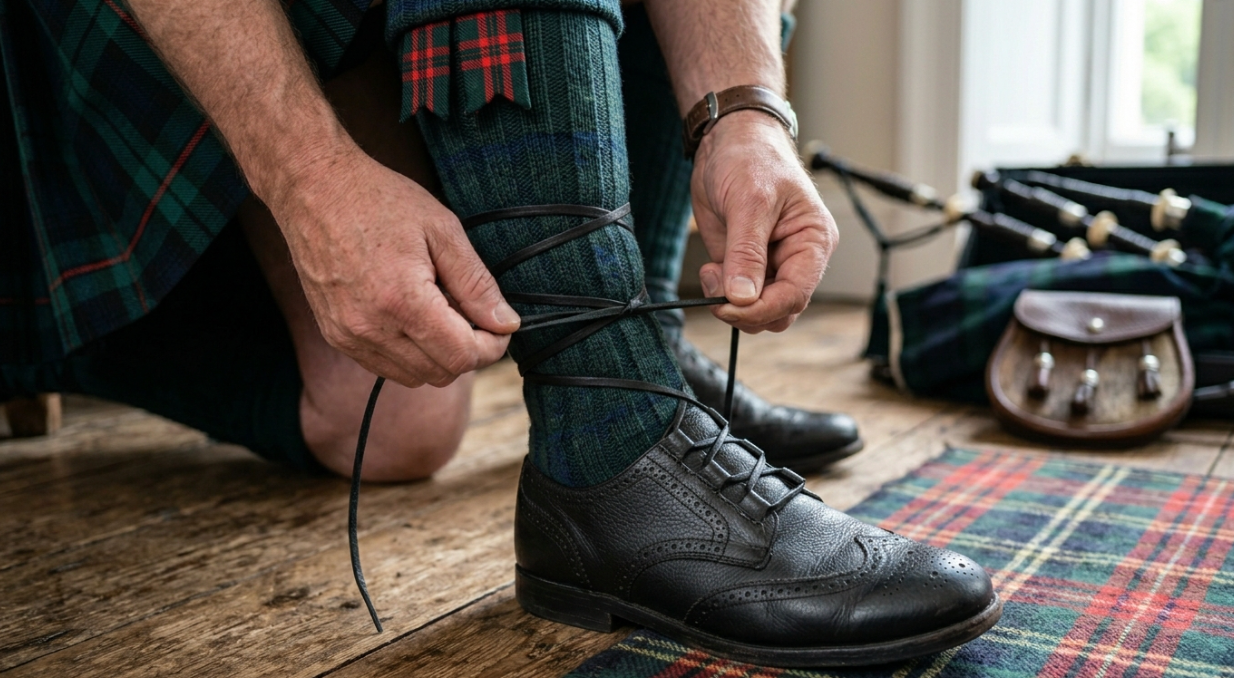
If you’ve never seen a pair in person, the design has five defining features:
- No tongue. The lacing area is open across the top of the foot. There’s no padded fabric or leather flap underneath the laces.
- Long leather laces. The laces are typically 30 to 40 inches long — much longer than standard dress shoes — because they need to wrap around the calf above the ankle and tie below the knee.
- Punched leather pattern. The “broguing” — small holes in geometric patterns — is worked across the toe cap, the sides, and often the heel of the shoe.
- Polished leather, usually black. Brown is acceptable for less formal events. Other colors (oxblood, tan) are non-traditional.
- Thin, low-profile sole. The sole sits flat to the ground with minimal heel lift. There’s no chunky modern sole, no athletic shape.
Stand a pair of brogues ghillie next to a normal Oxford or Derby shoe and the difference is immediately obvious. The ghillie has clean, almost minimal lines. It’s designed to integrate visually with the kilt outfit, not to stand out as its own statement piece.
Why “Just Black Dress Shoes” Doesn’t Work
This is where most casual kilt wearers go wrong, and the reasons it fails are worth understanding.
A standard black dress shoe — Oxford, Derby, monk strap — has a closed lacing system, a chunky sole, and a heel lift. All three of these design elements are wrong for kilt outfits.
The closed tongue interrupts the leg line. Standard dress shoes have a piece of leather under the laces. With a kilt, this creates a visual break between your kilt hose and the shoe itself. The leg looks chopped off at the ankle.
The chunky sole adds height in the wrong place. Standard dress shoes lift the foot half an inch or more off the ground. With a kilt, this throws off the proportions — your calves look shorter, the kilt hangs lower than it should visually, and the whole silhouette stops working.
The heel lift looks businesslike, not Scottish. Heel lifts in standard dress shoes give a slight forward lean that suits trousers but not kilts. The kilt’s silhouette is built around standing tall and straight; a heel lift undercuts that posture.
A real Scot in a kilt, even one who’s not a stickler for tradition, will have brogues ghillie precisely because regular dress shoes don’t deliver the right look — and the right look matters at the events kilts are worn for.
When Scots Actually Wear Brogues Ghillie (And When They Don’t)
It’s worth being precise about this, because tourists sometimes assume Scottish men wear kilts and brogues ghillie all the time. They don’t.
Brogues ghillie are worn by Scottish men at:
- Weddings (theirs and others)
- Burns Night dinners
- Funerals
- Highland Games (the formal portions, not athletic competition)
- Burns Night and Saint Andrew’s Day events
- Pipe band performances
- Graduations
- Formal dinners and receptions
- Cultural festivals
Brogues ghillie are not worn by Scottish men at:
- Normal weekday work or errands (most Scots wear modern clothing day-to-day)
- Casual outings with friends
- Athletic events
- Anywhere a kilt would be inappropriate
The shoes are part of formal Scottish dress. A typical Scot in a kilt wears them perhaps a dozen times a year — at the events that justify the outfit. The rest of the time, the brogues ghillie sit polished in the closet alongside the kilt itself.
This is why a real pair of brogues ghillie can last a Scottish man 20 to 30 years. They’re not subjected to daily wear and tear.
How a Scot Ties Brogues Ghillie
The lacing technique is unique enough that it warrants explanation, because doing it correctly is part of looking right.
The standard method:
- Start with the laces threaded normally through the eyelets up to the top of the shoe, with equal length on both sides
- Cross the laces over the open top of the foot
- Bring both ends up and around the back of the calf, just above the ankle bone
- Cross them again behind the calf
- Bring them back to the front of the calf
- Tie a simple bow at the front, roughly four inches below the kneecap
- Tuck the loose ends behind the wrap so they don’t dangle visibly
The position of the final bow matters. Too low (right at the ankle) and the laces look unstable. Too high (close to the kneecap) and they interfere with the kilt hem. Roughly four inches below the knee — at the same height where your kilt hose flashes peek out — is correct.
A first-time wearer will take five minutes per shoe. By the third event, the technique becomes natural and takes about a minute per side.

The Quality Levels: What Scots Actually Buy
Real Scottish men don’t all wear identical brogues ghillie. There’s a quality spectrum that maps to budgets and how often the shoes get worn.
Entry-level pair ($80-$150): Genuine leather upper, leather sole, basic broguing pattern. Acceptable for someone attending one or two formal events a year. Will need polish maintenance and will show wear after 50-100 wears.
Mid-range pair ($150-$250): Better leather quality, more refined broguing, often hand-stitched details, sometimes with rubber soles for outdoor wearability. This is the sweet spot for someone wearing kilts 5-15 times a year.
Premium pair ($250-$500+): Calfskin leather, fully hand-finished, often from named Scottish or English shoemakers, designed to last a generation. For frequent wearers, pipe band members, or anyone who treats kilt outfits as serious wardrobe investment.
The honest truth: a well-cared-for $150 pair will last most kilt wearers their entire kilt-wearing life. Above $250, you’re buying for refinement and brand prestige rather than functional improvement.
Maintenance Habits of Actual Kilt Wearers
A few small details separate well-kept brogues ghillie from neglected ones:
Polish before every event. Standard black leather shoe polish, applied with a soft cloth, then buffed. Takes 10 minutes. Pays off enormously in photographs.
Use shoe trees between wears. Cedar shoe trees absorb moisture and help maintain the shoe’s shape. For shoes worn in damp Scottish weather, this is essential.
Brush the broguing pattern. The punched holes catch dust and small debris. A soft brush before polishing keeps the pattern crisp and visible.
Replace laces when they fray. Leather laces wear out faster than the shoes themselves. Keep a spare set on hand for any kilt event.
Store properly. In the original box if possible, with shoe trees in place. Avoid stacking other shoes on top.
A pair of brogues ghillie maintained this way will look great for decades. A neglected pair will look tired after a year.
The Final Test: A Scot in a Kilt You Don’t Notice
Here’s the strange truth about brogues ghillie. When they’re worn correctly, you don’t really notice them.
A real Scot in a kilt at a wedding, properly assembled, looks like a coordinated whole. The eye reads “kilt outfit” without breaking down into components. The shoes are doing their job, but they’re not drawing attention.
Wrong shoes — regular black dress shoes — break this illusion immediately. The eye stops at the feet and registers something off. Even people who can’t articulate what’s wrong will sense the disconnect.
Brogues ghillie are the invisible foundation of the entire outfit. They’re meant to disappear into the look, supporting everything above them. That’s why getting them right matters so much, and why every actual Scot in a kilt has a pair waiting for the next event.
Frequently Asked Questions
What’s the difference between brogues ghillie and ghillie shoes?
Ghillie shoes have the same wrap-around lacing construction but without the punched broguing pattern. Brogues ghillie have the broguing. Both work with kilts; brogues are slightly more formal.
Can I wear brown brogues ghillie with a black kilt outfit?
For formal events, no — black is standard. For tweed or daytime semi-formal events, brown is acceptable and even preferred.
Are brogues ghillie comfortable for all-day wear?
Once broken in, yes. New pairs can be stiff for the first few wears. A traditional break-in routine involves wearing them around the house with kilt hose for a few hours before any major event.
Where can I find authentic brogues ghillie?
Specialist Scottish footwear retailers and dedicated kilt outfitters. Avoid generic costume shops or non-specialist online sellers, where “ghillie shoes” listings often turn out to be cheap modified dress shoes.
Can women wear brogues ghillie?
Yes. Women’s-cut brogues ghillie exist, slightly more delicate in proportion but with the same construction. They work with women’s Highland dress and kilted skirts.
Do brogues ghillie need to match the metal hardware on the rest of my outfit?
The leather and brogue pattern are the focus. Most pairs have minimal metal hardware (just the eyelets), which generally tones in subtly. Don’t overthink matching.
The shoes are the smallest piece of a Scottish kilt outfit and arguably the most diagnostic. Brogues ghillie are what every real Scot in a kilt wears at occasions that matter — and now you know exactly why, exactly how, and exactly what to look for in your own pair.
For more, visit Pure Magazine