Hot flashes that jolt you awake at 3 a.m. Night sweats that drench the sheets. The sudden spike of irritability over a misplaced set of keys that feels completely disproportionate — and you know it does, which somehow makes it worse. For many women, menopause isn’t a phase to push through quietly. It’s a daily disruption that touches sleep, work, relationships, and the basic sense of feeling like yourself.
That’s why natural options like red clover have attracted serious attention. The problem is that most of what’s written lands in one of two places: breathless enthusiasm that treats it like a cure, or flat dismissal that ignores what the evidence actually shows. Neither serves the woman trying to make an informed decision about her own body.
We looked at the 2026 clinical consensus on red clover — the systematic reviews, the receptor biology, the safety data — and here’s what we found.
Red Clover Compatibility Checklist
Before reading further, check where you stand:
- ☐ I have mild to moderate menopause symptoms (hot flashes, night sweats, mood changes)
- ☐ I am not on warfarin, tamoxifen, or hormone therapy
- ☐ I do not have a personal or family history of hormone-sensitive breast cancer
- ☐ I am not pregnant or breastfeeding
- ☐ I am willing to track symptoms consistently for 12 weeks
If you checked all five, red clover is worth considering seriously. If any box doesn’t apply, read the safety and interactions sections carefully before proceeding.
What Is a Red Clover Supplement?
Red clover supplements derive from Trifolium pratense, a plant unusually rich in isoflavones — plant-based compounds that interact with estrogen receptors selectively rather than replacing estrogen outright.
The four isoflavones present in red clover are genistein, daidzein, biochanin A, and formononetin. That four-compound profile matters practically. Soy isoflavone supplements — the most common alternative — typically contain only genistein and daidzein. Red clover’s full-spectrum content explains why some studies show stronger symptom improvement compared to soy-based products: more receptor-active compounds working through slightly different pathways means broader coverage across the biological mechanisms involved in menopause symptoms.
How Red Clover Works: ERβ Receptors and the SERM Mechanism
Red clover isoflavones function as Selective Estrogen Receptor Modulators — SERMs. That classification is clinically precise and meaningfully different from “natural estrogen,” which is how most supplement marketing describes them. Your body has two primary estrogen receptor types:
- ERα — associated with breast and uterine tissue growth, the pathway that raises concern with traditional estrogen therapy.
- ERβ — associated with anti-inflammatory effects, metabolic regulation, vascular health, and mood stability.
Red clover isoflavones preferentially bind to ERβ. This receptor selectivity is why red clover sits in a different risk category from non-selective estrogen activity — and why correctly identifying it as a SERM matters for understanding both its benefits and its safety profile. The ERβ preference doesn’t eliminate all concern, but it explains why the risk profile differs meaningfully from traditional hormone therapy.
The Gut-Hormone Connection: Equol Production
Here’s something that 99% of red clover guides miss entirely. A subset of the population — “equol producers” — carries gut bacteria capable of converting isoflavones into equol, a more potent active metabolite. Research suggests only around 25–30% of Western populations produce equol efficiently, compared to roughly 50–60% of Asian populations, where fermented soy consumption supports a different gut microbiome composition.
If you’ve tried isoflavone supplements before without noticeable effect, equol non-production may explain why. Your gut bacteria simply didn’t complete the conversion to the most biologically active form.
To support equol production alongside red clover supplementation, prebiotic fibre helps. Taking your supplement with a meal containing fermented foods (yoghurt, kefir, sauerkraut) or prebiotic-rich foods (garlic, onion, oats) creates a more favourable gut environment for isoflavone conversion. It’s a small adjustment that could meaningfully affect how much benefit you actually extract from the same dose.
Red Clover Supplement Benefits: What the Evidence Actually Supports
Hot Flash and Night Sweat Relief
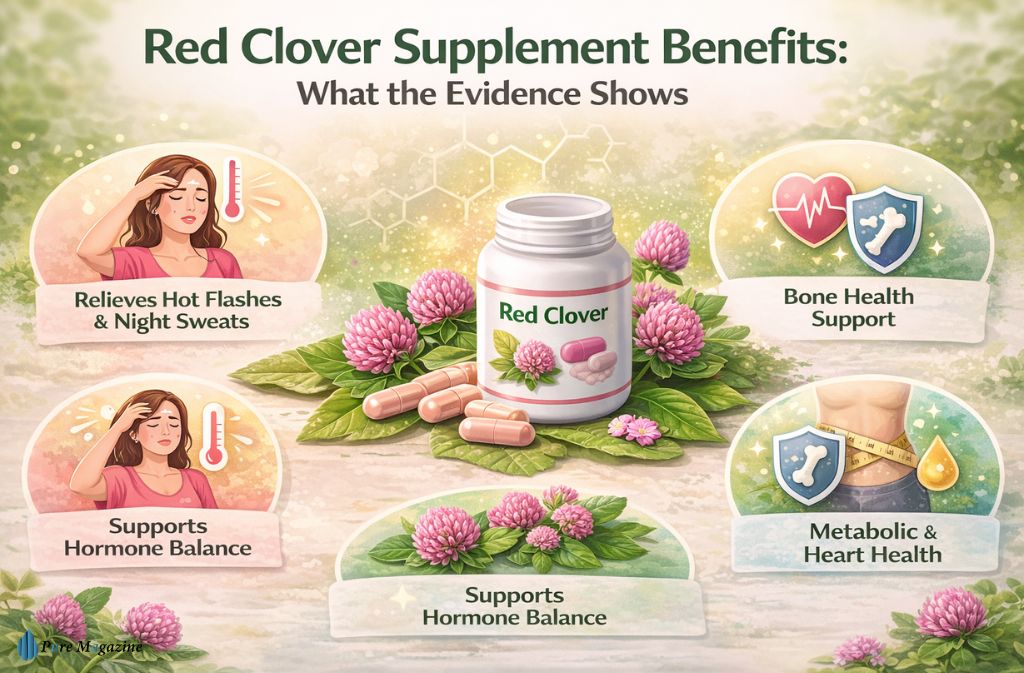
This is the most evidence-supported application. A Cochrane review on phytoestrogens for menopausal symptoms found meaningful reductions in hot flash frequency with isoflavone supplementation, with red clover preparations showing particularly consistent results. A 2007 randomised controlled trial in Maturitas confirmed significant symptom reduction compared to placebo over 12 weeks.
Realistic expectation: red clover won’t eliminate hot flashes. For mild to moderate presentations, it reduces frequency and intensity, which, for women experiencing multiple episodes daily, represents a genuinely meaningful improvement in quality of life.
Hormonal Balance During Perimenopause
Rather than pushing estrogen levels higher, red clover smooths the fluctuations that characterise perimenopause — the transition period where hormone levels swing unpredictably before the full menopause transition. This makes it particularly useful in the early stages, where the goal is stability rather than replacement. How vitamins and plant compounds support broader hormonal regulation is worth understanding alongside red clover, since perimenopause rarely affects just one biological system.
Bone Health Support After Menopause
Isoflavones influence bone turnover markers through ERβ activity in bone tissue. The mechanistic rationale is sound, and some clinical data supports a modest protective effect on bone density during the post-menopausal period when estrogen-driven bone maintenance declines. Long-term data is still accumulating, but the direction of evidence is consistent.
Cardiovascular Effects and Arterial Flexibility
Red clover may improve arterial flexibility and modestly reduce LDL cholesterol — both relevant during menopause when cardiovascular risk increases. The effects are modest rather than dramatic. Circulation health depends on multiple factors working together, and red clover contributes one piece of that picture rather than solving it comprehensively.
Metabolic Support and the “Menopause Middle”
Red clover doesn’t cause weight gain — that’s a myth worth clearing up directly. The “menopause middle” is driven primarily by hormonal shifts affecting fat distribution toward the abdomen, not by phytoestrogen supplementation. ERβ activation may actually offer modest support against visceral fat accumulation. This isn’t a weight management claim; it’s a clarification that removes a misconception preventing some women from trying something that might help.
Does Red Clover Increase Estrogen Levels?
No. Red clover doesn’t stimulate estrogen production or raise circulating hormone levels. It interacts selectively with estrogen receptors — specifically ERβ — producing some estrogen-like effects through receptor activity without touching actual hormone concentrations.
The distinction matters clinically. “Interacts with estrogen receptors” and “raises your estrogen” are different statements with different implications for women with hormone-sensitive conditions. The SERM classification captures this accurately. The colloquial “natural estrogen” framing does not.
Red Clover Tea vs Capsules vs Extracts: Which Form Works Best?
| Form | Absorption | Best For | Limitation |
|---|---|---|---|
| Standardised capsules | High | Menopause symptoms | Higher cost |
| Tea | Low–moderate | General wellness | Inconsistent isoflavone content |
| Tincture | Moderate | Faster absorption | Strong taste |
| Raw powder | Low | Budget option | Unreliable dosing |
Isoflavones absorb better alongside dietary fat. Taking your supplement with a meal containing avocado, olive oil, or nuts improves uptake meaningfully — some clinical observations suggest fat co-ingestion can improve bioavailability by 15% or more. Standardised extracts delivering 40–80mg of isoflavones daily are the most reliable form for symptom management. In 2026, the shift is clearly toward standardised preparations over raw herb products.
A note on sourcing: In 2026, where your red clover comes from matters to a growing number of buyers — and not just for ethical reasons. Organically grown Trifolium pratense from uncontaminated soil tends to produce more consistent isoflavone concentrations than conventionally farmed alternatives. Look for supplements that specify organic sourcing and country of origin, not just total extract weight.
Red Clover Dosage: The 12-Week Protocol
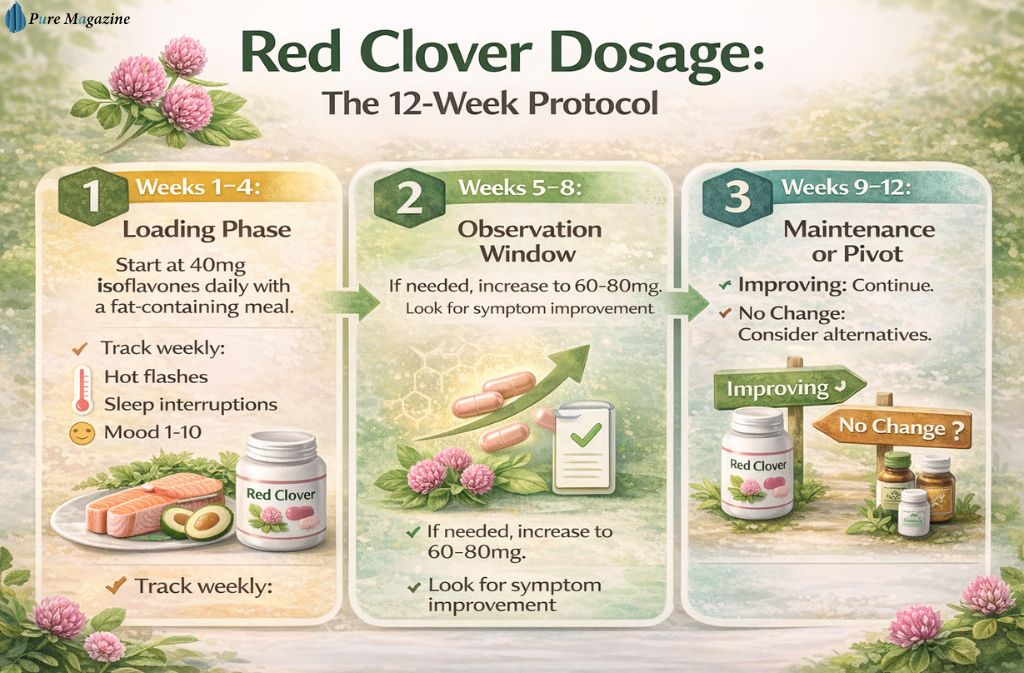
Rather than guessing, a structured approach gives you actual data about whether red clover is working for your specific situation.
Weeks 1–4: Loading Phase Start at 40mg isoflavones daily with a fat-containing meal. Track three metrics weekly: hot flash frequency per day, sleep interruption count, and mood on a 1–10 scale. Don’t introduce other new supplements during this phase — clean signals matter.
Weeks 5–8: Observation Window If symptom reduction is partial, increase to 60–80mg. This is where most women who respond notice meaningful change. Look for reduced frequency and intensity of hot flashes, not complete elimination. Complete elimination is an unrealistic benchmark; meaningful reduction is the appropriate target.
Weeks 9–12: Maintenance or Pivot Improvement → continue at the effective dose. No measurable change across tracked metrics after 12 weeks at full dose → red clover likely isn’t producing sufficient effect for your symptom profile. At that point, reviewing alternatives is appropriate rather than continuing indefinitely without evidence of benefit.
From clinical observation: women with mild to moderate symptoms respond most consistently. Women with severe, frequent hot flashes that significantly impair function usually need stronger interventions. Red clover works best as a complementary tool in those cases rather than a primary one.
Red Clover vs Black Cohosh: Which Is Better for Menopause?
| Feature | Red Clover | Black Cohosh |
|---|---|---|
| Mechanism | Phytoestrogen (ERβ selective) | Neuroactive (serotonin pathways) |
| Best for | Hormonal balance, gradual support | Hot flash intensity, faster relief |
| Onset | Slow (4–8 weeks) | Faster (2–4 weeks) |
| Hormone sensitivity concern | Higher | Lower |
| Liver safety | No documented concern | Rare cases reported |
One topic competitors focus on heavily: liver safety. Black cohosh has rare but documented associations with liver toxicity — enough that regulatory agencies in several countries have added warnings to product labels. Red clover has no comparable documented concern at standard doses. For women who’ve been advised to avoid black cohosh due to liver considerations, red clover offers an alternative with a different safety profile.
Red Clover vs Wild Yam and Dong Quai
| Feature | Red Clover | Wild Yam | Dong Quai |
|---|---|---|---|
| Active mechanism | Isoflavones (SERM) | Diosgenin (no proven conversion) | Coumarins, phytoestrogens |
| Evidence base | Moderate–strong | Weak | Limited |
| Best for | Hot flashes, hormonal balance | Topical use only | Traditional use |
| Safety concern | Drug interactions | Low at standard doses | Photosensitivity, interactions |
Wild yam frequently appears alongside red clover in menopause supplement searches. The important clarification: wild yam contains diosgenin, which supplement marketing often describes as a progesterone precursor. The body cannot convert diosgenin to progesterone — that conversion requires laboratory processing. Wild yam cream and capsules don’t deliver progesterone. Red clover’s mechanism is better understood and better evidenced.
Red Clover vs Hormone Replacement Therapy (HRT)
| Feature | Red Clover | HRT |
|---|---|---|
| Strength | Mild | Strong |
| Onset | Slow | Fast |
| Risk profile | Lower (not zero) | Higher, varies by type |
| Access | Over the counter | Prescription |
It works best as a first-line option for mild to moderate symptoms or as a complementary approach alongside medical management. It’s not a replacement for HRT in women with significant symptom burden or specific clinical indications for hormone therapy. DHEA’s role in menopausal hormone management sits at a different point on the intervention spectrum — understanding the regulatory and clinical context there helps map where each option belongs.
Who Should NOT Take Red Clover Supplements
This isn’t boilerplate caution. The contraindications are clinically meaningful:
Avoid — or use only under direct medical supervision — if you have a personal or family history of hormone-sensitive breast cancer, a history of estrogen-dependent tumours, blood clotting disorders, or endometriosis. Pregnancy and breastfeeding are absolute contraindications.
The ERβ selectivity that makes red clover interesting theoretically also means it’s interacting with hormone-sensitive tissue. “Reduces concern compared to non-selective estrogen” is not the same as “no concern.” Women with the above histories need individualised medical assessment rather than general supplement guidance.
Red Clover Drug Interactions: Critical Safety Information
| Medication | Risk Level | Clinical Note |
|---|---|---|
| Warfarin | High | Coumarin derivatives potentiate anticoagulant effects |
| Tamoxifen | High | May interfere with mechanism of action |
| Estrogen therapy | Moderate | Unpredictable additive hormonal effects |
| Birth control pills | Moderate | Potential disruption of contraceptive efficacy |
| Methotrexate | Low–moderate | Theoretical interaction via folate pathways |
The warfarin interaction is the most clinically significant. Red clover contains coumarin derivatives that can meaningfully potentiate anticoagulant effects — this is one of the better-documented herb-drug interactions in this category, not a theoretical concern. Anyone on anticoagulant therapy must discuss red clover with their prescriber before starting, without exception.
Red Clover Side Effects: What to Expect
Most women tolerate red clover well at standard doses. Reported side effects include nausea, headache, skin rash, and muscle aches — typically mild and often resolving within the first two weeks. Less commonly, hormonal sensitivity reactions occur, particularly in women with existing hormone-sensitive conditions. Starting at 40mg rather than jumping straight to 80mg gives your body time to adjust and gives you cleaner information about your individual tolerance.
How to Choose the Best Red Clover Supplement
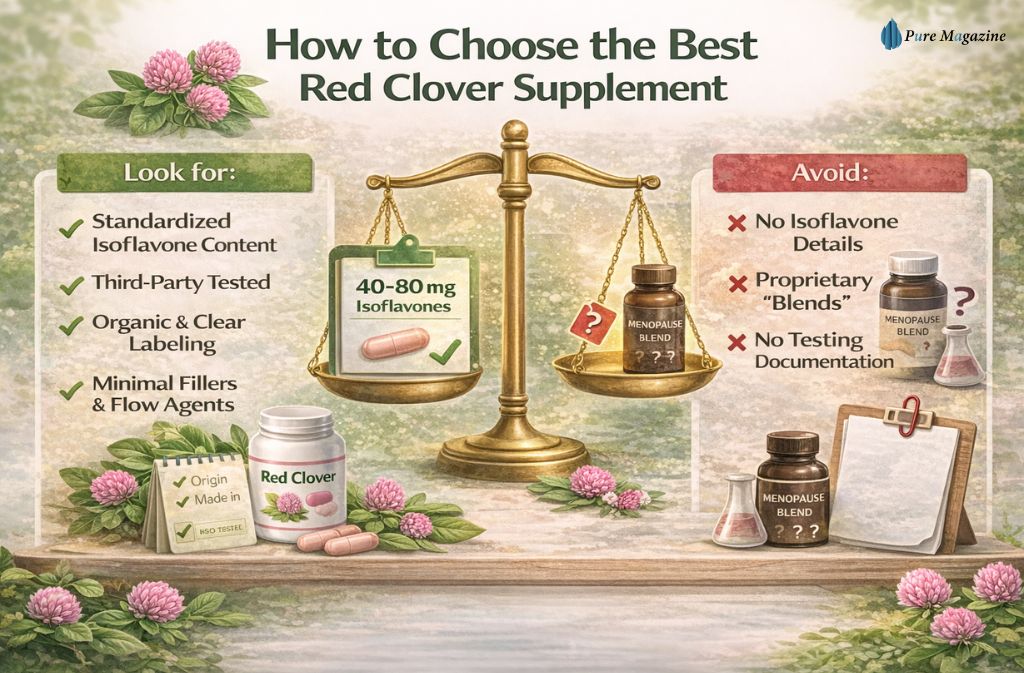
Look for: standardised isoflavone content specified in milligrams (40–80mg per dose), third-party testing confirmation, organic sourcing with country of origin specified, clear labelling that lists individual isoflavone amounts rather than just total extract weight, and minimal fillers or flow agents.
Avoid: products listing “red clover herb” without specifying isoflavone content, proprietary blends that obscure individual compound amounts, and anything without accessible third-party testing documentation.
How to evaluate supplement quality beyond label claims applies here — the supplement market for menopause products varies considerably in quality, and the gap between a well-formulated standardised extract and a poorly made raw herb capsule is significant enough to explain why two women on “the same supplement” have completely different experiences.
For women managing menopause alongside other age-related nutritional shifts, how protein and micronutrient needs change during this period is worth understanding as a connected picture. Addressing those foundational needs alongside red clover produces better outcomes than treating each concern in isolation.
2026 Updates: What’s New in Red Clover Research
The market has shifted toward standardised extract formulations over raw herb products, reflecting accumulated understanding of why isoflavone content consistency matters for clinical outcomes. Research interest in ERβ-selective mechanisms has grown as the clinical community distinguishes more carefully between phytoestrogen applications and traditional hormone therapy. A 2024 systematic review in Maturitas confirmed that standardised red clover extracts produce more consistent hot flash reduction than non-standardised preparations — validating what better manufacturers have been doing for years.
The equol production question is an active research area, with increasing interest in using microbiome profiling to predict individual isoflavone response before supplementation begins. This is not yet commercially standard, but it represents where personalised menopause supplementation is heading.
Symptom Tracking Table
| Week | Hot Flashes/Day | Sleep Interruptions | Mood (1–10) | Energy (1–10) |
|---|---|---|---|---|
| Baseline | ||||
| Week 4 | ||||
| Week 8 | ||||
| Week 12 |
Tracking turns supplementation into a measurable experiment rather than a hope. If the numbers don’t move over 12 weeks, that’s useful information. Getting baseline blood work — including estrogen, FSH, and LH — before starting gives you a more complete picture of where you’re starting from and what’s driving your specific symptom pattern.
FAQs
Q. What are the main benefits of red clover supplements for menopause?
Red clover supplements may help reduce menopause symptoms by supporting hormonal balance through plant-based isoflavones.
Key benefits include:
- Reduced hot flash frequency
- Improved night sweats
- Mild cardiovascular support
- Bone health support
- Hormonal stabilisation during perimenopause
These effects are linked to ERβ receptor activity, not direct estrogen replacement, which makes red clover a gentler alternative to hormone therapy.
Q. Who should avoid red clover supplements?
Red clover is not suitable for everyone, especially those with hormone-sensitive conditions.
Avoid or consult a clinician if you have:
- A personal or family history of hormone-sensitive breast cancer
- Blood clotting disorders
- Use medications like warfarin or tamoxifen
- You are pregnant or breastfeeding
Because red clover interacts with estrogen receptors and blood clotting pathways, medical guidance is essential in these cases.
Q. What is the correct red clover dosage for perimenopause?
The standard dosage for red clover supplements is based on isoflavone content.
Recommended approach:
- Start with 40 mg of standardized isoflavones daily
- Take with a fat-containing meal for better absorption
- Increase to 60–80 mg after 4 weeks if needed
- Continue consistently for up to 12 weeks
This structured approach helps you accurately assess whether the supplement is working for your body.
Q. Does red clover increase estrogen levels?
No, red clover does not increase estrogen levels in the body.
Instead, it acts as a Selective Estrogen Receptor Modulator (SERM), meaning it:
- Binds selectively to estrogen receptors
- Shows preference for ERβ receptors
- Mimics some estrogen effects without raising hormone levels
This is the key difference between red clover and hormone replacement therapy.
Q. Which is better for menopause: red clover or black cohosh?
Red clover and black cohosh work differently, so the better option depends on your symptoms.
Comparison:
- Red clover: Gradual hormonal support via phytoestrogens
- Black cohosh: Faster relief for hot flashes via brain signaling pathways
Some women use both at different stages of menopause, depending on symptom severity and response.
Q. Does red clover cause weight gain?
No, there is no strong evidence that red clover causes weight gain. In fact, some research suggests that ERβ receptor activity may help reduce visceral fat accumulation, which commonly increases during menopause. While red clover is not a weight loss supplement, it is unlikely to contribute to weight gain.
Q. How long does red clover take to work?
Red clover does not work immediately and requires consistent use.
Typical timeline:
- Early changes: 4–8 weeks
- Full evaluation: up to 12 weeks
If no improvement is seen after 12 weeks at an adequate dose, it may not be effective for your symptoms.
Q. Can I take red clover with collagen supplements?
Yes, red clover can generally be taken alongside collagen supplements.
These supplements work through different pathways:
- Red clover: Hormonal support via phytoestrogens
- Collagen: Supports skin, joints, and connective tissue
There are no known significant interactions between the two.
Conclusion
Red clover occupies a well-defined and genuinely useful space in the menopause conversation. It’s not as powerful as hormone replacement therapy. It’s not a miracle plant that eliminates symptoms. What it is — for the right woman, at the right dose, approached with realistic expectations — is a clinically grounded, plant-based SERM with a reasonable evidence base and a safety profile that compares favourably to stronger interventions.
The ERβ selectivity is real. The full-spectrum isoflavone advantage over soy is real. The equol production variability that explains inconsistent responses is real. And the 12-week tracking protocol is more useful than any amount of anecdotal reassurance in either direction.
Use it consistently. Take it with food and prebiotic-rich meals to support equol production. Track something measurable. And be honest at week 12 about what the data shows — because that honesty, more than any supplement, is what leads to genuinely better decisions about your health.
This article is for informational purposes only and does not constitute medical advice. Always consult a qualified healthcare professional before starting any supplement, particularly if you have a personal or family history of hormone-sensitive conditions, are taking prescription medications, or are currently undergoing cancer treatment.
Explore our full library of expert-reviewed health and nutrition guides at Pure Magazine.