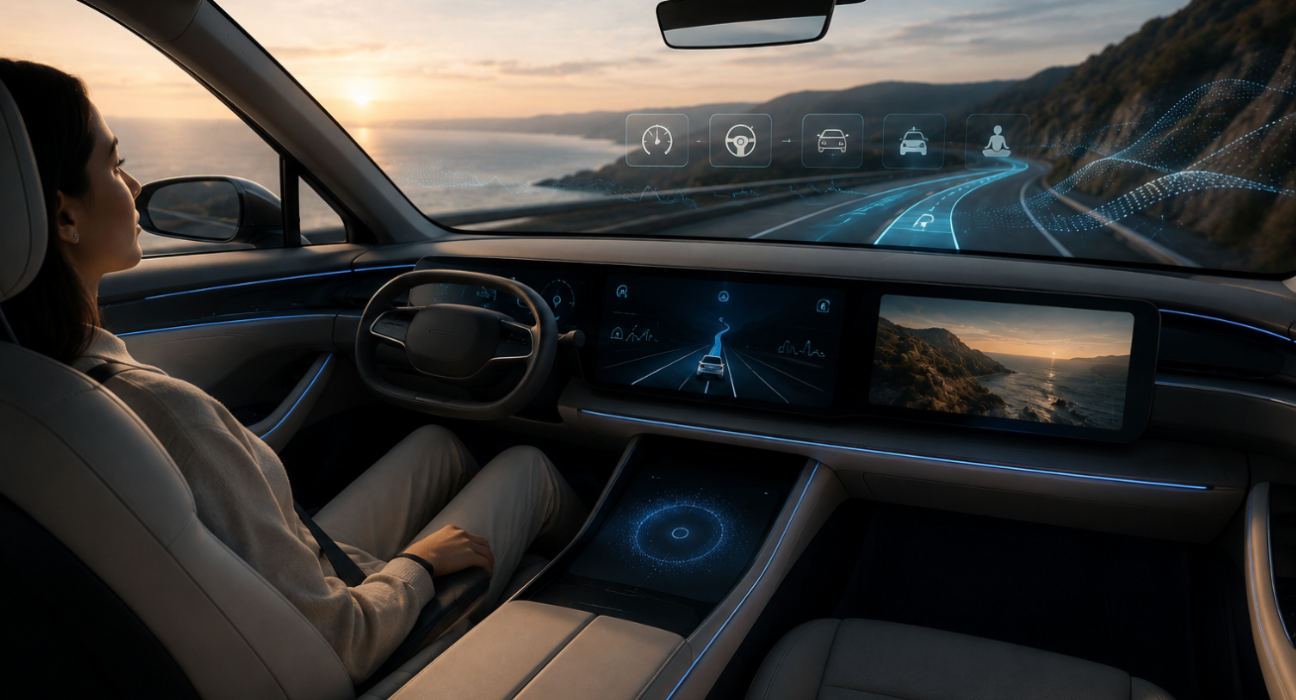
For more than a century, driving pleasure was defined by mechanical interaction. The feel of a clutch biting, the weight of steering at speed, the sound of a naturally aspirated engine building through the rev range — these sensations formed the emotional core of automotive enthusiasm.
Today, that definition is shifting.
As automation, AI systems, and adaptive vehicle technologies become increasingly common, the experience of driving is being restructured. Not removed, but reinterpreted. Pleasure is no longer purely about mechanical engagement. It is becoming a more layered experience shaped by assistance systems, digital feedback, and sensory refinement.
The result is a quiet but significant evolution in what it means to enjoy a car.
From Mechanical Involvement to Assisted Control
Traditional driving pleasure has long been associated with effort. Manual gear changes, throttle modulation, and steering feedback created a direct connection between driver and machine. The car responded to physical input in a linear, predictable way.
Modern vehicles introduce a different dynamic.
Advanced driver assistance systems (ADAS), adaptive cruise control, lane-keeping support, and predictive braking systems now handle many of the tasks once central to driving involvement. These systems are not just safety features; they actively reshape how drivers engage with the road.
Manufacturers such as Toyota have played a major role in normalising hybrid systems that blend human input with algorithmic control, gradually easing drivers into a more assisted form of mobility.
Rather than removing enjoyment, these technologies shift its location. The pleasure is no longer concentrated in constant physical input, but distributed across smoother journeys, reduced fatigue, and more controlled driving environments.
The Rise of Predictive Driving Systems
One of the most significant developments in recent years is the move from reactive systems to predictive ones.
Where older technologies responded to immediate driver actions, modern systems anticipate behaviour. Adaptive suspension can adjust damping before a corner is fully entered. Navigation systems now analyse traffic patterns and suggest optimised routes in real time. Some vehicles even learn driving styles over time, adjusting responsiveness accordingly.
This predictive capability changes the emotional tone of driving. Instead of constantly correcting and controlling, drivers experience a more fluid interaction with the vehicle — one that feels increasingly intuitive.
Companies such as Volvo have invested heavily in this area, integrating safety-first predictive systems that aim to reduce cognitive load while maintaining driver awareness.
The experience becomes less about managing the car and more about trusting it.
AI Assistance and the Changing Role of the Driver
Artificial intelligence is now embedded across multiple layers of modern vehicles, from voice assistants to real-time driver monitoring systems.
These technologies do more than execute commands. They interpret intent.
Voice systems can now adjust navigation routes based on conversational input, while in-cabin AI can detect driver fatigue and suggest breaks or modify cabin conditions to improve alertness. In some cases, vehicles can even adapt performance characteristics depending on context — prioritising efficiency in urban environments and responsiveness on open roads.
The implications for driving pleasure are subtle but important. The driver is no longer the sole operator of all decisions. Instead, they become part of a collaborative system.
This shift is particularly evident in vehicles produced by BMW, where intelligent driving modes allow the car to adjust steering weight, throttle response, and suspension settings dynamically based on road conditions and driving behaviour.
The result is a more adaptive experience — one that responds to mood, environment, and intent rather than fixed mechanical settings.
Sensory Experience Over Mechanical Feedback
As automation increases, manufacturers are placing greater emphasis on sensory design.
With fewer manual inputs required, attention turns to how the vehicle feels rather than how it is controlled. Cabin acoustics, seat ergonomics, lighting temperature, and haptic feedback are becoming central to the driving experience.
This represents a shift from mechanical engagement to environmental immersion.
Electric vehicles have accelerated this trend significantly. Without engine noise or vibration, designers have greater control over the acoustic environment. Some manufacturers introduce artificial soundscapes to preserve emotional connection, while others focus on near-silent cabins that emphasise calm and clarity.
Driving pleasure, in this context, becomes closer to experience design than mechanical interaction.
The Balance Between Control and Convenience
Despite rapid technological progress, the most successful systems are those that maintain a sense of driver agency.
Fully autonomous systems remain limited in many regions, and even highly advanced assistance features are designed to keep the driver engaged. This is partly regulatory, but also psychological. Many drivers still associate enjoyment with a sense of control, even if that control is partially supported by automation.
The challenge for manufacturers is balance.
Too much automation risks detachment, where the journey becomes passive rather than engaging. Too little risks fatigue and inefficiency. The most effective systems sit somewhere in between, offering support without removing involvement entirely.
This balance is still evolving, and different brands interpret it differently depending on their design philosophy and target audience.
Personalisation in the Age of Intelligent Vehicles
One of the more interesting consequences of modern automotive technology is the expansion of personalisation.
Vehicles are no longer static objects with fixed behaviour. They are configurable systems that adapt to individual drivers over time. Seat positions, climate preferences, infotainment layouts, and even driving characteristics can now be stored and recalled automatically.
This extends beyond software into physical identity as well. Owners increasingly view their vehicles as extensions of personal style, combining digital configuration with subtle physical expression.
Even elements such as registration styling and presentation contribute to this sense of identity. Companies such as Plates Express operate within this broader landscape of automotive individuality, where small design choices form part of a larger expression of ownership rather than overt modification.
The modern vehicle is less a fixed product and more a responsive platform.
Does Automation Reduce Driving Pleasure?
A common concern is that increasing automation inevitably reduces the emotional appeal of driving. If machines handle more of the work, what remains for the driver?
The reality is more nuanced.
For some drivers, particularly enthusiasts, mechanical engagement remains central to enjoyment. Manual transmissions and analogue feedback still hold strong appeal in specific segments of the market. However, for many others, driving pleasure has already evolved beyond mechanical input.
Comfort, predictability, reduced stress, and seamless navigation are now significant contributors to perceived enjoyment. A smooth, intelligent journey can be just as satisfying as a highly engaged driving experience — just in a different emotional register.
The definition of pleasure is expanding rather than disappearing.
A New Kind of Driving Experience
What emerges from this shift is not the end of driving pleasure, but its diversification.
Mechanical engagement, once the dominant form of automotive enjoyment, is now one of several valid interpretations. Alongside it sits a growing appreciation for assisted mobility, adaptive systems, and sensory refinement.
Technology has not removed the driver from the experience. Instead, it has redefined their role — from constant operator to informed participant in a more complex system.
As vehicles continue to evolve, the most important question is not whether driving remains enjoyable, but how that enjoyment is expressed. Increasingly, it is found not only in what the driver does, but in how seamlessly the entire experience responds to them.
Driving pleasure is no longer just about control. It is about connection — and that connection is becoming more intelligent, adaptive, and quietly sophisticated.
For more, visit Pure Magazine