
April 2026 brought a fresh round of Vehicle Excise Duty changes — and unlike previous years, the increases haven’t landed equally across fuel types. Petrol drivers face higher first-year bills, EV buyers just got a meaningful threshold shift, and anyone eyeing a high-emission performance car is looking at showroom tax figures that would have seemed implausible a few years ago.
Here’s a clear breakdown of what changed, what stayed the same, and where the real money decisions sit.
What VED Actually Is (and What It Isn’t)
Vehicle Excise Duty is the annual tax levied by the UK government on vehicles kept or used on public roads. Collected by the DVLA, it goes into general government funds — not ring-fenced road maintenance budgets, despite the historic “road tax” label still sticking around in everyday speech.
Since the paper tax disc disappeared in 2014, the whole system runs digitally. The DVLA no longer sends postal renewal reminders either — those now come by text or email, which catches a surprising number of people off guard.
VED is calculated using four things: when the vehicle was first registered, what fuel type it uses, its CO₂ emissions, and its original list price. Get any of those wrong when estimating costs, and the numbers can look very different.
The 3-Part Structure That Determines Your Bill
Most drivers think of car tax as one flat fee. In practice, it’s three separate charges that stack depending on the vehicle.
First-year rate — paid when the car is first registered, tied to CO₂ emissions. This is where the biggest variation sits, and where the 2026 increases bite hardest on high-emission vehicles.
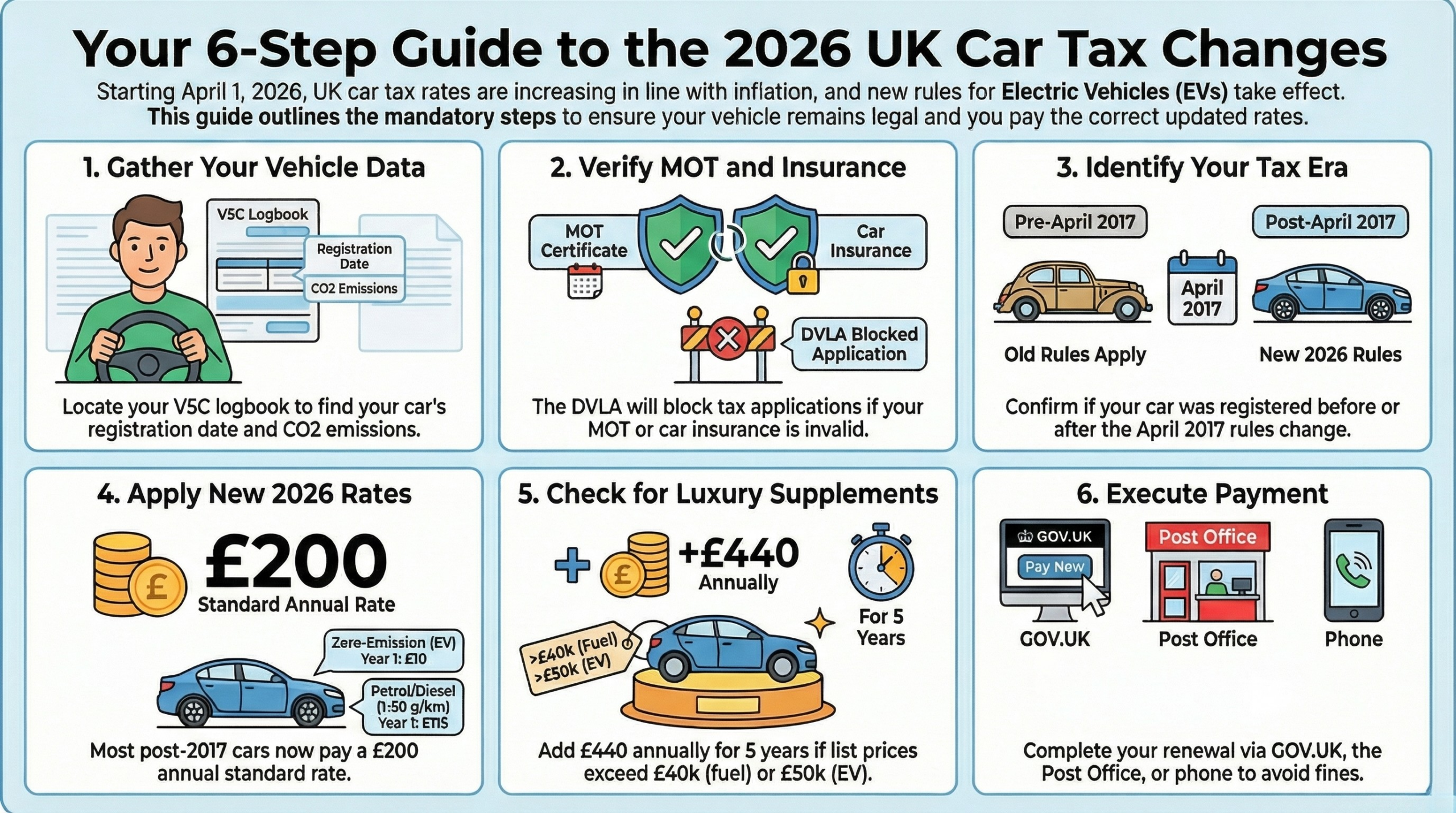
Standard annual rate — from the second year onward, this becomes a flat £200 for most cars registered after April 2017. That’s up from £195 in 2025/26, a modest RPI-linked rise.
Expensive Car Supplement — an additional £440 per year applied to higher-value vehicles for five years after the first year. The threshold at which this kicks in now differs by fuel type, which is the most significant structural change in 2026.
First-Year VED Rates for Cars Registered After 1 April 2026
| CO₂ Emissions (g/km) | First-Year Tax |
|---|---|
| 0 (Electric) | £10 |
| 1–50 | £10–£20 |
| 51–75 | £30–£40 |
| 76–90 | £135 |
| 91–100 | £175 |
| 101–110 | £195 |
| 111–130 | £220 |
| 131–150 | £270 |
| 151–170 | £680 |
| 171–190 | £1,095 |
| 191–225 | £1,650 |
| 226–255 | £2,340 |
| 255+ | £5,690 |
The top band increased by £200 compared to 2025/26. For context, that top figure — £5,690 — applies to cars like large V8 performance SUVs and certain high-output diesels. The government’s direction here is unambiguous: high-emission cars are being taxed to a point where the first-year cost alone becomes a genuine deterrent.
The Expensive Car Supplement: Now Split by Fuel Type
Until April 2026, the luxury supplement threshold sat at £40,000 for all vehicles. From 1 April 2026, that changes.
- Petrol, diesel, hybrid cars: supplement applies above £40,000
- Electric vehicles: supplement applies above £50,000
The supplement itself remains £440 per year, applied for five years from the second year of registration, taking annual VED from £200 to £640 during that period.
The practical effect of raising the EV threshold is significant. A £45,000 electric car registered before April 2026 would have triggered the supplement. The same car bought now does not. Over five years, that’s £2,200 saved purely from the threshold adjustment — before any fuel or maintenance comparison comes into the picture.
For anyone weighing up whether an EV purchase makes financial sense, understanding the full VED picture for electric cars is worth doing before committing. The supplement isn’t the only cost variable.
The Pre-Registration Tactic Dealers Use
This one doesn’t get discussed as openly as it should.
When major VED changes are announced — particularly first-year rate increases — some dealers pre-register vehicles before the cut-off date. The car is registered in their name, accumulates a few hundred delivery miles, then sold to the buyer as effectively new but at the previous year’s tax rate.
For cars in the top emissions band, the gap between the 2025/26 rate and the current rate is £200. For buyers, that’s a saving. But it also means the car’s clock starts ticking on the Expensive Car Supplement from the dealer’s registration date, not the buyer’s purchase date.
If buying a nearly-new car in the months following April 2026, checking the V5C logbook registration date — and running the numbers on the supplement period — is worth the few minutes it takes.
Electric Cars: The Tax Landscape Has Changed, But EVs Still Have Advantages
The full VED exemption for electric vehicles ended in April 2025. The 2026/27 tax year is the first full renewal cycle where EV owners are paying standard rates.
In practical terms: new EVs pay £10 in year one, then £200 annually — the same standard rate as petrol and diesel. The advantage EVs retain is the raised supplement threshold. At £50,000 versus £40,000 for combustion cars, a meaningful portion of the EV market — particularly mid-range models from mainstream manufacturers — stays below the luxury charge line.
Looking ahead, the government has confirmed a pay-per-mile eVED system from April 2028. Electric car drivers will pay 3p per mile, with mileage expected to be verified at MOT centres rather than through tracking devices. For an average driver covering 8,000 miles annually, that adds roughly £240 per year on top of standard VED — a notable shift from where EV running costs stood even two years ago.
Older EVs: A Tax Detail Worth Knowing
Electric vehicles registered between 2001 and 2017 follow a different rate structure entirely. Rather than the standard £200, these older EVs attract just £20 per year — a carryover from the CO₂-banded system that applied to registrations before April 2017.
There’s no Expensive Car Supplement on these vehicles either. For someone who wants low running costs and can live without the latest technology, a used EV from this registration window offers a tax position that newer models simply can’t match.
This connects to a broader point about used car tax rates and how registration date affects ongoing costs in ways buyers don’t always factor in at the point of purchase.
Diesel, Petrol, and Hybrid: How They Compare in 2026
All three fuel types land at the same £200 standard rate from year two. The differences sit in the first-year charge.
Diesel cars are penalised most on emissions grounds — many modern diesels sit in bands that generate first-year bills between £680 and £1,650. Petrol cars span a wide range depending on engine size and efficiency. Hybrids tend to cluster in the mid-bands given their lower combined emissions figures, though plug-in hybrids emitting under 50g/km now face a £115 first-year charge following the 2026 update.
The pattern is consistent with where government VED policy has been heading for several years: pushing buyers toward lower-emission options through upfront cost pressure rather than ongoing annual penalties.
How to Work Out What You’ll Pay
The quickest route is to use the DVLA’s official vehicle tax checker by registration number. For a car not yet purchased, the calculation works like this:
- Find the CO₂ emissions figure — available in the manufacturer’s specs or the V5C logbook for used cars
- Match it to the relevant first-year band in the table above
- Add £200 for each subsequent year
- Check whether the original list price exceeds £40,000 (petrol/diesel/hybrid) or £50,000 (electric) — if so, add £440 per year for five years from year two
A £48,000 electric car, for instance, pays £10 in year one, then £200 annually from year two. No supplement applies. Total VED over five years: around £810.

The same vehicle as a petrol car at £48,000 would pay a first-year rate based on its emissions, then £200 per year plus £440 per year for five years — taking annual tax to £640 during the supplement period.
What to Watch on Your Tax Code and Payments
Car tax can be paid annually, every six months, or monthly by direct debit. The six-month rate is £110, and monthly instalments work out to £210 annually — a 5% surcharge for spreading the cost.
For company car drivers, Benefit-in-Kind tax is a separate calculation entirely, based on list price and CO₂ emissions rather than VED. The BIK rate for electric cars rises to 4% in 2026/27, up from 3% the previous year. That’s still low relative to petrol equivalents, but the trajectory is upward. Understanding how income tax bands interact with company car benefits matters more than it once did for employees driving EVs on company schemes.
The Direction of Travel
The pattern running through 2026’s VED changes isn’t subtle. High-emission vehicles are being taxed more steeply at the point of registration. EV buyers below £50,000 are being actively rewarded. And from 2028, the per-mile charge brings electric cars closer to parity with combustion vehicles on an ongoing basis.
VED has historically been one input among many in a car purchase decision. For drivers considering vehicles at the margins of the supplement threshold, or comparing a high-emission petrol against an EV equivalent, the tax difference over five years is now large enough to shift the outcome.
Anyone making a purchase decision this year who hasn’t run the full numbers — including the supplement period — is likely working with an incomplete picture.
FAQs
Q. How much is road tax in 2026 UK?
The standard road tax rate in the UK for 2026 is £200 per year for most cars registered after April 2017. However, the first-year tax (VED) depends on your vehicle’s CO₂ emissions, with higher-emission cars paying significantly more upfront.
Q. Are electric cars taxed in 2026 UK?
Yes, electric cars are taxed in 2026. New EVs pay a £10 first-year Vehicle Excise Duty (VED), followed by the standard £200 annual road tax from year two onwards. This marks the end of fully tax-free electric vehicles in the UK.
Q. What is the luxury car tax threshold in 2026?
In 2026, the luxury car tax (Expensive Car Supplement) thresholds are:
- £40,000 for petrol, diesel, and hybrid cars
- £50,000 for electric vehicles (EVs)
Cars above these thresholds pay an extra £440 per year for five years.
Q. Why is the car tax so high in 2026 UK?
The car tax in 2026 is higher due to inflation-linked increases (RPI) and stricter environmental policies. High-emission vehicles now face much higher first-year tax rates, with the highest band reaching £5,690, making polluting cars significantly more expensive.
Q. Should I buy an EV before or after April 2026?
Buying an EV after April 2026 can be beneficial if the price is under £50,000, as you’ll avoid the luxury car tax. However, all EVs now pay standard road tax, so timing depends on the model price and your budget.
Q. Do diesel cars pay more tax in 2026?
Yes, diesel cars generally pay more tax in 2026. They often fall into higher CO₂ emission bands, leading to increased first-year VED charges compared to petrol or electric vehicles.
Q. How do I check my car tax band UK?
You can check your car tax band using your vehicle’s CO₂ emissions figure, which is listed on your V5C logbook. This determines your first-year tax rate and helps estimate your total road tax cost.
Q. How much is the first-year car tax in 2026?
First-year car tax in 2026 ranges from £10 for electric vehicles to as much as £5,690 for high-emission cars (255g/km+), depending on CO₂ output. This is often the most expensive year of car ownership.
Q. What is the standard VED rate after the first year?
After the first year, most vehicles in the UK pay a flat £200 annual VED rate, regardless of fuel type, including petrol, diesel, hybrid, and electric cars.m \
For a broader look at how UK taxes interact with personal finances, visit Pure Magazine.