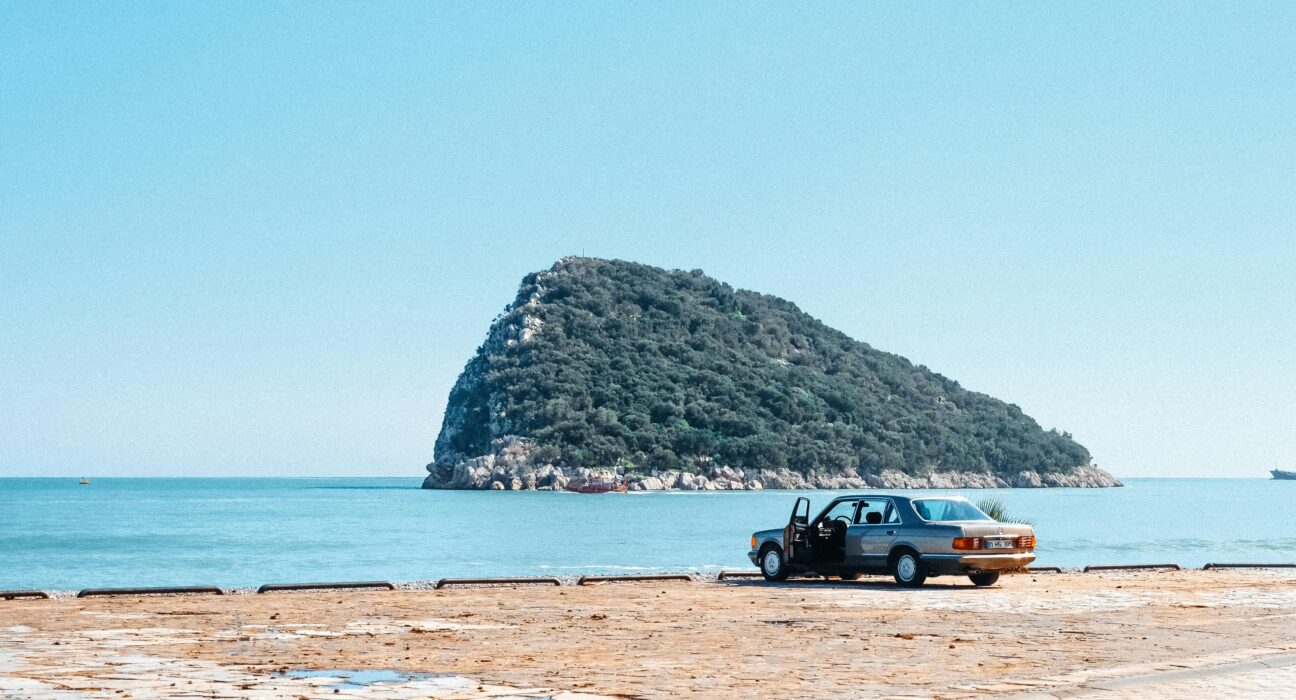
The thing most Albania guides won’t tell you
Albania doesn’t give up its best spots easily. That’s actually the point.
Buses here run on a loose interpretation of “scheduled.” Taxis will get you to the postcard places – Tirana’s colourful boulevards, the waterfront in Sarandë. But the canyon where the cliffs turn gold at 4pm? The thermal springs tucked beneath a Roman arch in the middle of nowhere? The coastal road that makes the Amalfi Drive look, well, a bit tame? Those require a car. Specifically, they require the freedom to turn left when nothing on the map tells you to.
Albania’s tourism numbers have been climbing steadily – arrivals grew by over 20% between 2022 and 2024, according to the Albanian Institute of Statistics – yet the country still feels wildly undiscovered the moment travellers leave the main highway. The trick is knowing where to point the wheel. And it starts, for most people, at the airport.
Why the journey begins at Rinas
Tirana International Airport sits in Rinas, about 17 kilometres from the capital. It’s a compact, well-organised hub – and it’s also the logical starting block for any serious Albania road trip. Sorting transport here, before the city noise kicks in, is the smartest move most travellers make. Rinas car rental Tirana airport options are available directly at the terminal, which means no shuttle buses, no waiting – just keys in hand and an open road ahead within minutes of landing.
This matters more than it sounds. Albania’s hidden gems aren’t clustered. They’re scattered across a country roughly the size of Maryland, from alpine villages in the north to wild Ionian coves in the south. Having a self-drive Albania vehicle from day one isn’t a luxury – it’s the difference between seeing 20% of the country and seeing all of it.
The places that reward the detour
Theth and the Albanian Alps
Up north, the village of Theth sits in a valley that used to require a full day’s effort to reach. The road was – and in places still is – a test of nerves: narrow mountain passes, blind corners, drops that make passengers go very quiet. A recently paved stretch has made the approach from Shkodër considerably more manageable, but a sturdy vehicle and unhurried pace are still non-negotiable.
What’s waiting: an alpine village that feels genuinely frozen in time, with stone guesthouses, a waterfall trail, and the famous Blue Eye of Theth – a cold spring pool that glows an almost unreal shade of turquoise. It’s the kind of place that converts sceptics.
Travel writer Sarah Baxter, who covered the Albanian Alps extensively for Wanderlust magazine, described the region as “Europe’s last genuinely wild corner – not curated, not packaged, just breathtakingly real.”
Osumi Canyon
South of Berat – itself a UNESCO-listed city of stacked Ottoman houses and hilltop castle – lies Osumi Canyon. The cliffs rise up to 80 metres above the river. In spring, the water rushes hard enough for proper white-water rafting; in summer, it calms into something you can wade through on foot.
Getting there by public transport is theoretically possible. In practice, the schedules are unreliable enough that most travellers who try it end up stranded in Çorovoda wondering what went wrong. By car, it’s a scenic 30-minute drive from Berat on a road that’s narrow in places but perfectly manageable – exactly the kind of Albania road trip moment that doesn’t fit on a tour bus itinerary.
The Llogara Pass and the Riviera beyond it
Here’s a road that genuinely earns its reputation. The Llogara Pass climbs to over 1,000 metres through pine forest before dropping – in a series of switchbacks that demand full attention – down to the Albanian Riviera. The views are extraordinary. Veteran road-trippers compare it to the Col de Turini in France, with better weather and dramatically fewer other cars.
What makes it a hidden gem Albania experience rather than just a scenic drive is what’s waiting at the bottom:
- Drymades Beach – quieter than its neighbours, with turquoise water and a guesthouse hanging off the cliff above it
- Gjipe Canyon Beach – wedged between two limestone walls at the mouth of a gorge, accessible by a short hike from the nearest parking spot
- Himarë – a town with a Greek Orthodox church, a Venetian castle, and a seafront that still feels like it belongs to locals rather than to Instagram
- Ksamil – four tiny islands visible from shore, the water shallow enough to wade to the nearest one
A 2024 campervan travel survey found that 73% of visitors to the Albanian Riviera rated coastal Albania driving as the highlight of their trip – ahead of the beaches themselves.
Bënjë thermal baths, Përmet
This one requires a bit of commitment. Përmet is a quiet, flower-lined town in the Vjosa Valley – less visited than Berat or Gjirokastër, which is precisely why it’s worth the detour. Just outside town, at a place called Bënjë, a series of natural thermal springs bubble up beneath a dramatic Ottoman stone arch bridge.
The scene is almost absurdly photogenic. Mountains on every side. A river running cold beside the warm pools. A handful of locals soaking in what they treat as a perfectly normal afternoon. There’s no admission fee, no gift shop, no organised tours. Just a road, a car, and a left turn off the main route that most travellers drive straight past.
The road to Gjirokastër: going slow on purpose
Gjirokastër is sometimes called the City of Stone – all grey-slate rooftops, cobbled streets that haven’t changed since the 18th century, and a castle on the hill that watches over everything with quiet authority. It’s a UNESCO World Heritage Site, so it does appear on itineraries. What doesn’t always appear: the drive there.
Coming from Berat via the SH72 through the Muzina Pass offers mountain scenery that most travellers speed through to reach the destination. The pass reaches elevations where the air changes – cooler, clearer, genuinely alpine. Pull over at one of the unmarked viewpoints and the valley below looks like something from a film that hasn’t been made yet.
Practical note worth sharing: the temptation to drive south from Berat directly through the mountains to Gjirokastër via back roads is real – and best resisted. The rocky terrain has a reputation for punishing rental cars. Stick to the main SH highway. The scenery is better anyway.
Final thoughts on driving Albania
Albania rewards a particular kind of traveller: one who’s comfortable not knowing exactly what the next hour holds, who’s willing to take a road because it looks interesting rather than because it’s in the guidebook. The infrastructure has improved substantially in recent years – a new 7-kilometre tunnel through the Llogara mountains cut travel time significantly when it opened in 2024 – and car hire Albania options are more varied and affordable than ever.
The country’s geography means that the best experiences are rarely the most accessible ones. That’s true of Theth’s alpine isolation, of Osumi’s cathedral-like canyon walls, of a thermal bath in Përmet on a Tuesday afternoon with no one else around. None of these happen without wheels. Albania is one of those rare destinations where the question isn’t whether to rent a car – it’s whether to get the keys before or after the first coffee.
For more, visit Pure Magazine