We’ve all done it — tilting our heads under the bathroom’s harsh LED lights, pulling at strands, trying to decide whether the thinning is actually worse or just our imagination playing tricks. The part looks wider. The scalp shows more under direct light. The drain catches more hair than it used to.
For many people, that quiet progression has the same root cause: dihydrotestosterone, or DHT — a hormone that gradually miniaturises hair follicles until they can no longer produce visible hair. The process is slow, which is why it’s so easy to dismiss early and so frustrating to address once you’ve noticed it properly.
DHT blocker supplements have attracted serious interest as a result. The problem is that most guides list ingredients without explaining mechanisms, ignore the scalp environment entirely, and leave you no clearer on what actually makes a difference. This guide takes a more rigorous approach.
What Is a DHT Blocker Supplement?
A DHT blocker supplement is a nutraceutical designed to reduce the production or activity of dihydrotestosterone — a testosterone derivative that binds to hair-follicle receptors and triggers progressive miniaturisation.
The mechanism: testosterone converts to DHT via the 5-alpha reductase (5-AR) enzyme. DHT binds to androgen receptors in hair follicles. Over repeated cycles, affected follicles produce progressively thinner, shorter hair until they stop producing visible hair entirely.
What supplements aim to do: inhibit the 5-AR enzyme, reduce DHT binding at follicle receptors, and support the scalp environment in which follicles operate. They’re support tools — genuinely useful ones when formulated correctly — but not pharmaceutical treatments.
The 2026 Mechanism: Beyond Simple DHT Blocking
Older single-ingredient DHT supplements targeted one pathway. Modern evidence-based formulations follow a three-layer strategy that reflects how hair loss actually works.
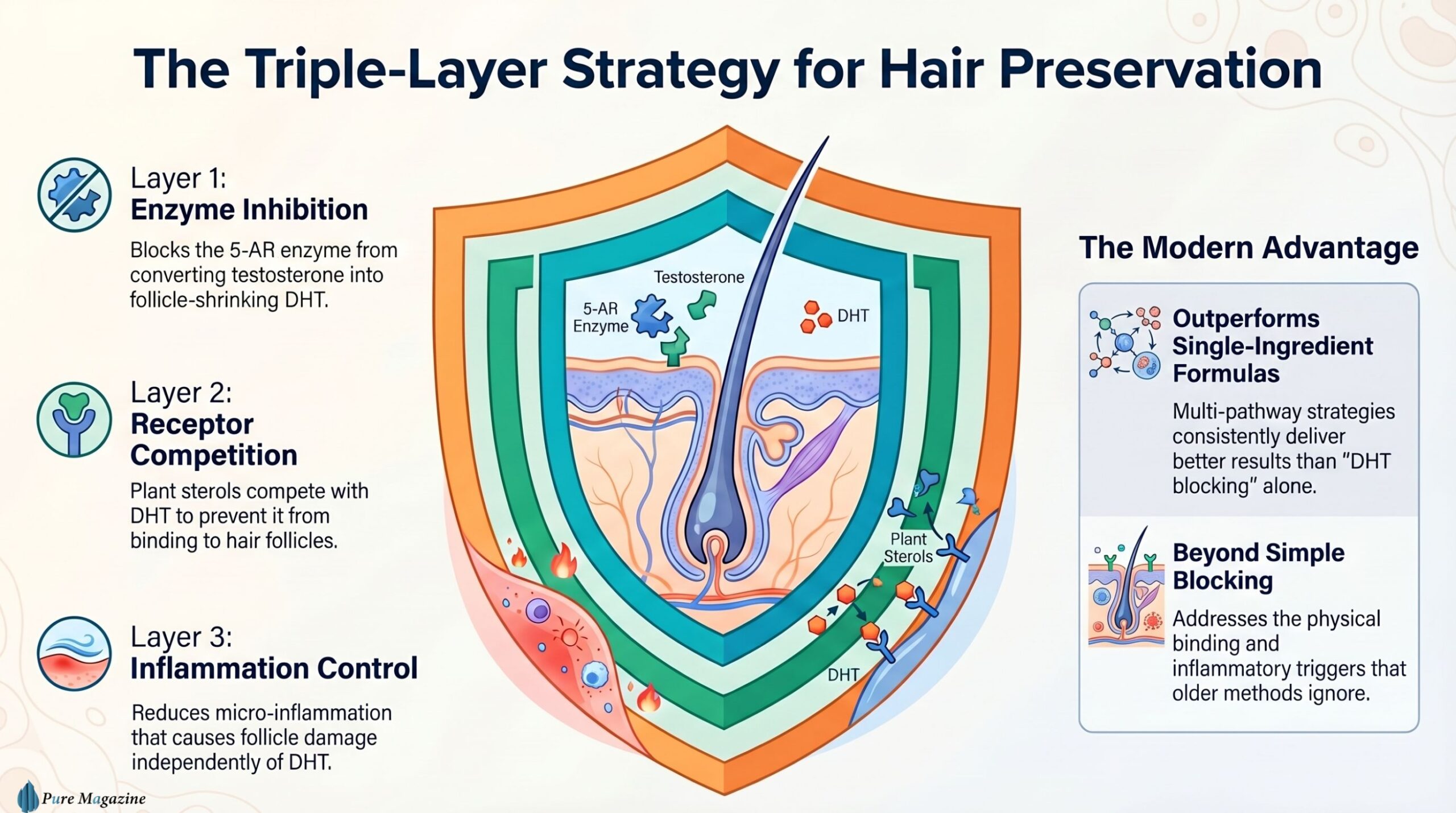

- Layer 1 — Enzyme Inhibition: Slowing the conversion of testosterone to DHT at the source, primarily through 5-AR inhibition.
- Layer 2 — Receptor Competition: Plant sterols like beta-sitosterol compete with DHT at follicle receptors, reducing binding even when DHT is present.
- Layer 3 — Micro-Inflammation Control: Reducing scalp inflammation that accelerates follicle damage independently of DHT levels.
This three-layer approach explains why newer multi-ingredient formulas consistently outperform older single-ingredient products — and why “just block DHT” is an increasingly outdated framing.
The Follicle Sensitivity Paradox Nobody Talks About
Here’s something that reframes the entire conversation: many men with high DHT levels keep their hair, while others with relatively low DHT experience significant loss.
The difference isn’t DHT concentration — it’s androgen receptor sensitivity at the follicle level. Genetic variations in androgen receptor expression determine how aggressively a follicle responds to DHT binding. Two people with identical DHT levels can have completely different hair outcomes based on this receptor sensitivity alone.
This matters practically because it shifts the goal from simply “lower DHT” to “reduce DHT impact on a sensitive follicle,” — which includes anti-inflammatory and scalp barrier strategies alongside enzyme inhibition. Supplements that only address DHT production without considering follicle sensitivity and scalp environment are addressing half the problem.
Do DHT Blocker Supplements Actually Work?
Yes — with honest expectations attached.
Evidence supports that saw palmetto and pumpkin seed oil can moderately reduce DHT activity. Results depend heavily on dosage, formulation quality, and individual androgen receptor sensitivity. Supplements work best for people in earlier stages of hair thinning, where follicles are miniaturised but not yet permanently inactive.
Realistic timeline:
- Weeks 2–4: Possible transition shed (more on this below — don’t quit)
- Weeks 8–12: Reduced shedding rate
- Months 3–6: Visible improvement in density and strand thickness
- Full regrowth on bald areas: uncommon without medical intervention
Best DHT Blocking Ingredients: 2026 Evidence Update
Saw Palmetto (Serenoa repens)
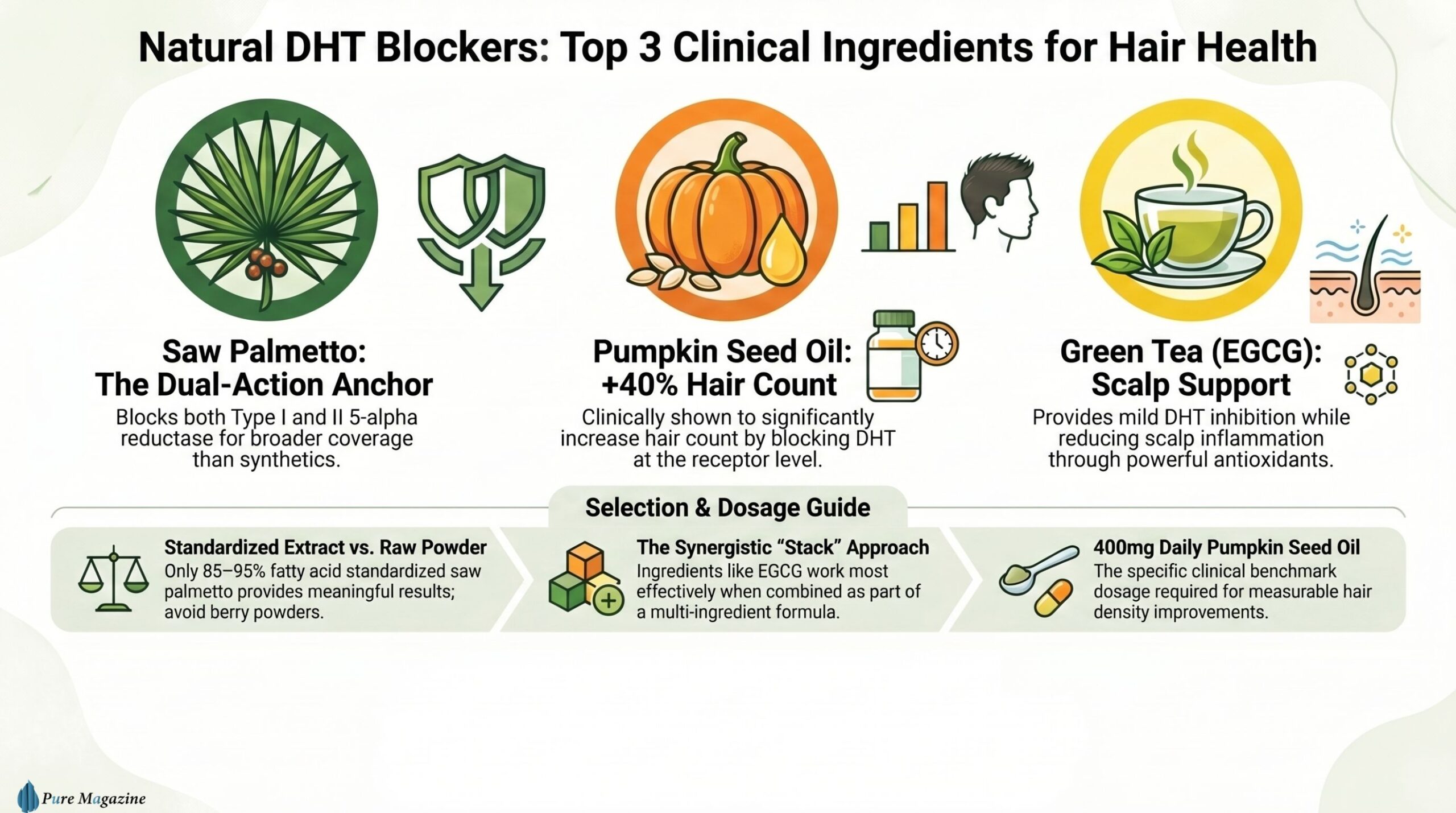
The most studied natural DHT blocker and the anchor ingredient in any serious formulation. Saw palmetto inhibits both Type I and Type II 5-alpha reductase — the distinction matters because prescription finasteride targets only Type II, while saw palmetto’s dual inhibition may offer broader coverage through a different mechanism with a better tolerability profile.
The form specification is critical: 85–95% fatty acid standardised extract, not raw berry powder. A 2012 randomised trial in the International Journal of Immunopathology and Pharmacology found that standardised saw palmetto extract produced significant improvements in hair density compared to placebo. Raw powder doesn’t deliver the fatty acid concentration needed for meaningful 5-AR inhibition.
Pumpkin Seed Oil
Works through a different mechanism — reducing DHT binding at the receptor level rather than purely inhibiting 5-AR. A 2014 double-blind placebo-controlled trial found a 40% increase in hair count in men taking pumpkin seed oil compared to placebo over 24 weeks. This remains one of the stronger clinical benchmarks for a natural DHT blocker in 2026. Effective dose: 400mg daily.
Green Tea Extract (EGCG)
Provides mild 5-AR inhibition alongside meaningful anti-inflammatory activity — relevant to the scalp microbiome layer of hair loss management. EGCG works best as part of a stack rather than as a standalone intervention.
Golden Dosage Table
| Ingredient | Effective Daily Dose | Form to Look For |
|---|---|---|
| Saw Palmetto | 320mg | 85–95% fatty acid standardised |
| Pumpkin Seed Oil | 400mg | Cold-pressed, standardised |
| Zinc | 15–30mg | Bisglycinate or picolinate |
| Green Tea (EGCG) | 300–400mg | Standardised to 45%+ EGCG |
| Stinging Nettle Root | 300–500mg | Root extract, not leaf |
| Beta-sitosterol | 60–130mg | Phytosterol complex |
| Curcumin | 500mg | Phospholipid complex for absorption |
Supporting Ingredients That Complete the Stack
Zinc regulates androgen metabolism and prevents deficiency-related hair shedding — a common and underappreciated cause of increased hair loss that gets attributed to DHT when the actual fix is straightforward nutritional correction. How iodine and zinc interact with thyroid and hormonal function is worth understanding if you suspect broader hormonal involvement in your hair loss pattern.
Stinging Nettle Root may reduce DHT binding at androgen receptors through a mechanism separate from 5-AR inhibition, adding a complementary layer alongside saw palmetto.
Curcumin and Resveratrol address the inflammation component of follicle damage. Standard curcumin absorbs poorly — phospholipid complexes or piperine-enhanced formulas are worth the additional cost.
The Missing Link: Scalp Microbiome and Hair Loss
This is where 2026 research has shifted the conversation most significantly — and where most supplement guides still haven’t caught up.
The scalp hosts an ecosystem of bacteria and fungi that directly influences follicle health. When that ecosystem falls out of balance — a state called dysbiosis — inflammation increases, follicle stress escalates, and sensitivity to DHT accelerates. Research published between 2024 and 2026 has specifically identified Malassezia overgrowth and Staphylococcus imbalances as direct contributors to androgenetic alopecia progression.
The mechanism chain: microbiome imbalance → increased local inflammation → elevated follicle stress → higher androgen receptor sensitivity → faster miniaturisation.
DHT damage amplifies on an inflamed scalp. Even the best-formulated supplement struggles when the scalp environment actively works against it. This is why addressing scalp health isn’t optional — it’s foundational.
The “Skinification” Shift
The scalp is biologically similar to facial skin. Barrier damage creates inflammation. Inflammation accelerates follicle miniaturisation. The “skinification” of hair care — treating scalp health with the same rigour applied to facial skincare — reflects this understanding.
The 2026 Complete System: Internal + External Protocol
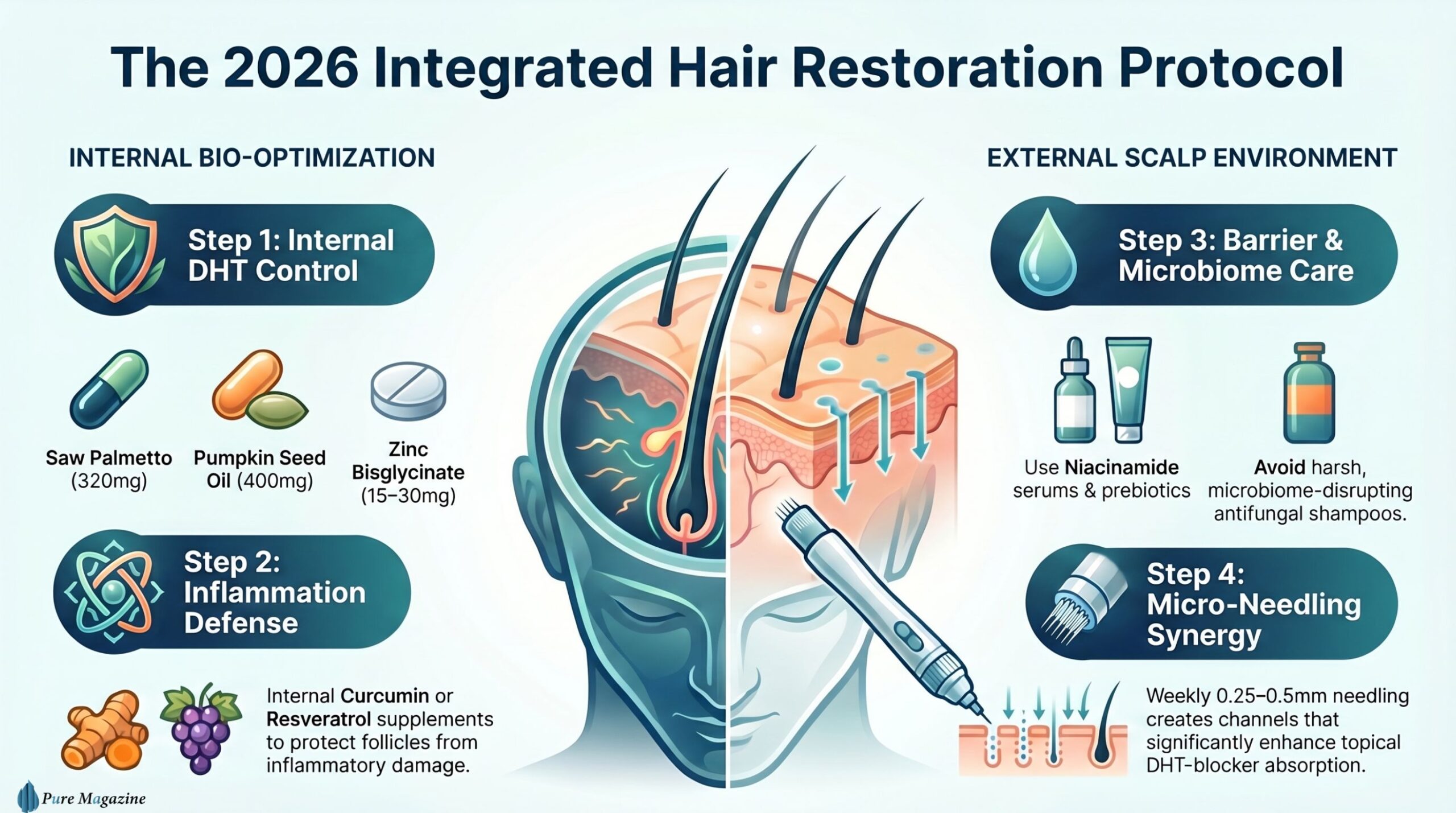
Step 1 — Internal DHT Control Standardised saw palmetto (320mg), pumpkin seed oil (400mg), zinc (15–30mg bisglycinate). These address the hormonal layer.
Step 2 — Scalp Barrier Repair: Niacinamide-based scalp serums, panthenol (vitamin B5), sulfate-free gentle cleansers. Barrier integrity reduces the inflammation that amplifies DHT sensitivity.
Step 3 — Microbiome Balance Prebiotic scalp treatments support bacterial diversity. Avoid overusing harsh antifungal shampoos — they disrupt the broader microbiome beyond Malassezia control.
Step 4 — Inflammation Control: Curcumin or resveratrol supplements internally. Green tea extract topically or orally. These reduce the inflammatory environment that makes follicles more vulnerable.
Step 5 — Micro-Needling Synergy 2026 research shows that topical natural DHT blockers — pumpkin seed oil applied to the scalp, for instance — perform significantly better when paired with weekly 0.5mm micro-needling. The micro-channels temporarily created allow much deeper penetration of active compounds that the scalp barrier would otherwise limit. This doesn’t require professional equipment — a dermaroller at 0.25–0.5mm used weekly is sufficient for this purpose.
GLP-1 Medications and Hair Thinning: An Important 2026 Context
A significant number of people in 2026 are experiencing hair thinning not primarily driven by DHT, but by telogen effluvium — a stress-related shedding triggered by rapid weight loss from GLP-1 medications like semaglutide. Telogen effluvium and androgenetic alopecia can occur simultaneously and are often confused.
DHT blockers don’t directly address telogen effluvium, which resolves as weight stabilises and nutritional status recovers. However, if you’re on a GLP-1 medication and experiencing hair loss, supporting adequate protein and micronutrient intake — including zinc, which GLP-1-related caloric restriction can deplete — addresses one of the contributing factors. How amino acid availability affects hair and muscle tissue is relevant context here, since protein adequacy underpins hair growth independently of DHT status.
How to Choose the Best DHT Blocker Supplement
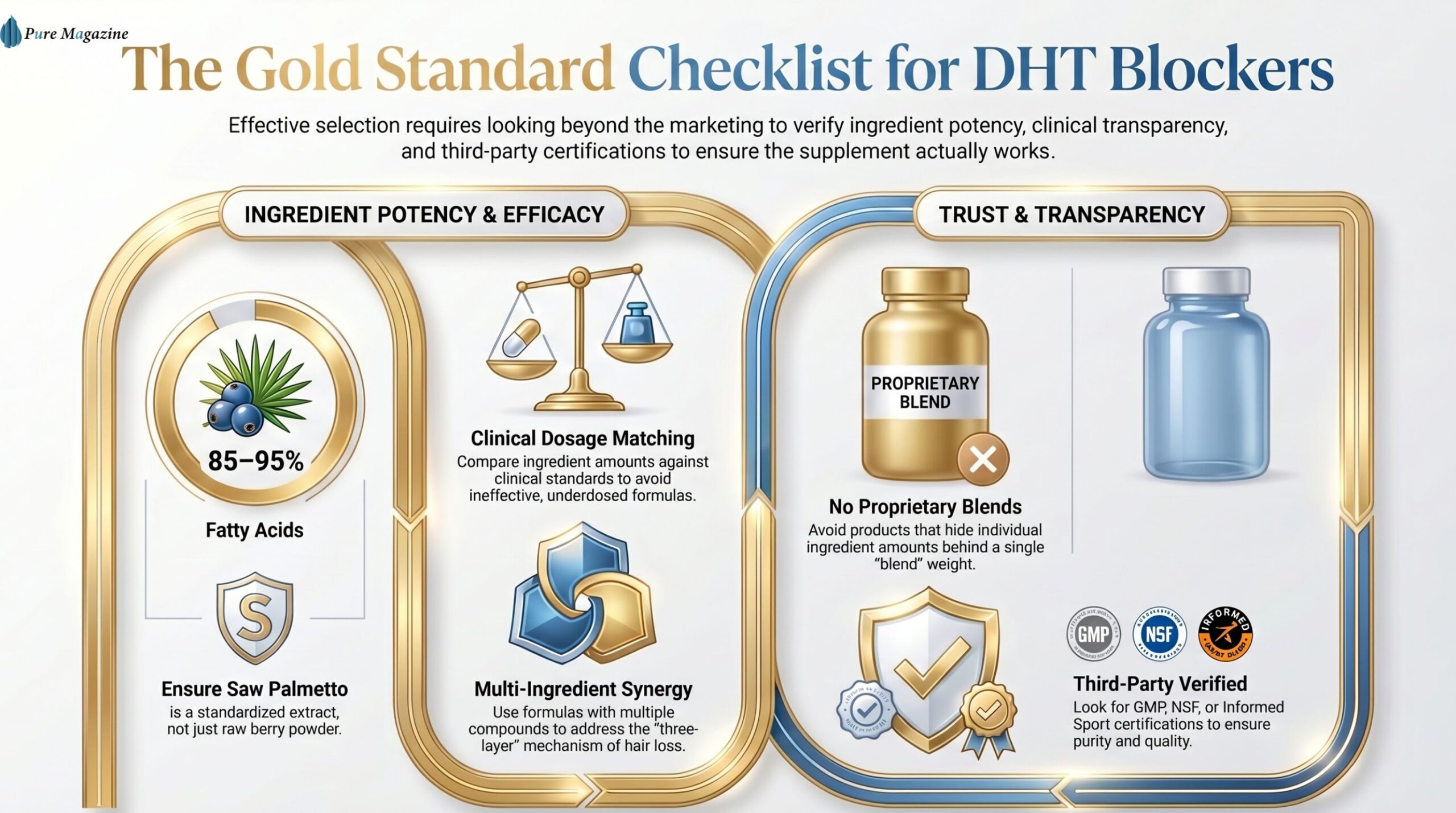
Standardised extracts: Saw palmetto must specify fatty acid percentage (85–95%). Products that list “saw palmetto berry” without this specification are almost certainly using raw powder — cheaper and significantly less effective.
Clinically relevant dosages: Compare the actual amounts in the product against the golden dosage table above. Underdosed formulas are the most common reason people conclude “DHT blockers don’t work.”
No proprietary blends: You can’t evaluate a product you can’t see. If individual ingredient amounts are hidden in a blend, move on.
Third-party testing: GMP certification at minimum, NSF or Informed Sport if you’re in a tested sport.
Multi-ingredient formulas: The three-layer mechanism requires multiple compounds. Single-ingredient saw palmetto products are a starting point, not a complete solution.
Understanding how supplement quality varies across the market — beyond what labels claim — is worth investing time in before spending money on any hair loss supplement.
The Transition Shed: Why Most People Quit Too Early
This is the number one reason people abandon DHT blocker supplements before they’ve had a chance to work.
Around weeks two to four, many users experience a temporary increase in shedding. This isn’t the supplement making things worse — it’s weaker, miniaturised hairs being pushed out as the follicle begins a new growth cycle. The transition shed is a sign that the follicle is responding, not that the supplement is failing.
This increase typically resolves by weeks six to eight and is followed by the reduced shedding rate that represents the actual benefit. Knowing this in advance is the difference between staying the course and discarding something that was working.
Safety Overview
DHT blocker supplements are generally well-tolerated in healthy adults. Possible side effects include mild digestive discomfort, headaches, and occasional hormonal sensitivity reactions — typically mild and resolving quickly at lower doses.
Avoid or consult a clinician before use if you are pregnant or breastfeeding, taking hormone-related medications, or managing a hormone-sensitive condition. The 5-AR inhibition mechanism that makes these supplements useful for hair loss is the same mechanism that influences prostate-related hormones — something worth discussing with a doctor if you have existing prostate health concerns.
Getting baseline hormone and nutrient blood panels before starting gives you a reference point and helps distinguish DHT-driven loss from nutritional deficiency-related shedding, which requires a completely different intervention.
DHT, Biotin, and Hair Supplement Confusion
Biotin supplements dominate the hair supplement market, but biotin addresses a completely different mechanism — it supports keratin infrastructure rather than androgen receptor activity. Whether biotin actually delivers on its hair growth reputation is worth examining separately, because the two approaches solve different problems. DHT-driven loss won’t respond to biotin. Biotin deficiency-related shedding won’t respond to saw palmetto. Getting the diagnosis right is more important than the supplement itself.
Common Mistakes That Guarantee Failure
Expecting results in four weeks. Hair cycles operate on a three to six-month timeline — impatience is the most common reason people conclude these supplements don’t work when they haven’t given them sufficient time.
Choosing underdosed products. Most supplements in this category fail not because the ingredients don’t work, but because the doses are too low to produce a meaningful effect. Always verify amounts against the golden dosage table.
Ignoring scalp health. The best DHT blocker supplement in the world underperforms on an inflamed scalp with a dysbiotic microbiome. The external protocol isn’t optional.
Treating supplements as a standalone solution. The evidence supports supplements as part of a system — dietary adequacy, scalp care, potentially medical treatment for more advanced loss — not as a replacement for that system.
Quitting at the transition shed. Already covered above, but worth repeating because it’s the most preventable failure point.
FAQs
Q. What is the best natural DHT blocker in 2026?
The most effective natural DHT blocker in 2026 is saw palmetto standardized to 85–95% fatty acids, which has the strongest evidence for inhibiting the 5-alpha reductase (5-AR) enzyme. For better results, it is often combined with pumpkin seed oil, zinc, beta-sitosterol, and green tea extract, as multi-ingredient formulas outperform single ingredients.
Q. How can I stop DHT from damaging my hair follicles naturally?
To stop DHT-related hair loss naturally, you need a multi-pathway approach:
- Reduce DHT production: saw palmetto, pumpkin seed oil
- Block DHT binding: beta-sitosterol
- Lower inflammation: curcumin, green tea extract
- Support scalp barrier: niacinamide, panthenol
- Balance microbiome: gentle scalp care, prebiotics
👉 No single supplement covers all these pathways, so combining internal and topical strategies is essential.
Q. How long do DHT blocker supplements take to work?
DHT blocker supplements typically take 3 to 6 months to show visible results.
- Weeks 2–4: possible transition shedding phase
- Weeks 8–12: reduced hair shedding
- Months 3–6: improved thickness and density
Consistency is critical—stopping early often prevents results.
Q. Are DHT blocker supplements safe for long-term use?
DHT blocker supplements are generally safe for long-term use in healthy adults when taken at recommended doses. However, you should consult a healthcare professional if you:
- Take hormone-related medications
- Have prostate or endocrine conditions
- Are you pregnant or breastfeeding
Mild side effects like digestive discomfort may occur in some users.
Q. Can women use DHT blocker supplements for hair loss?
Yes, women can use DHT blocker supplements, especially for androgen-related hair thinning.
- Ingredients like saw palmetto and pumpkin seed oil are commonly used
- They help reduce follicle sensitivity to DHT
⚠️ Women should consult a doctor before using stronger hormone-influencing compounds.
Q. Can DHT blockers regrow hair on bald areas?
DHT blockers can help thicken miniaturized hair follicles, but they are unlikely to regrow hair on completely bald areas where follicles are inactive.
For advanced hair loss, treatments like minoxidil or hair transplantation are typically required.
Q. What’s the difference between DHT blockers and biotin for hair loss?
DHT blockers and biotin serve completely different purposes:
- DHT blockers: target hormonal hair loss by reducing DHT
- Biotin: supports keratin production and helps only if there is a deficiency
👉 If hair loss is caused by DHT, biotin alone won’t help.
👉 If hair loss is due to a nutrient deficiency, DHT blockers won’t fix the issue.
Correct diagnosis is more important than supplement choice.
Q. Do DHT blocker supplements work for androgenetic alopecia?
Yes, DHT-blocking supplements can help slow the progression of androgenetic alopecia (male or female pattern hair loss) by reducing DHT activity and protecting hair follicles.
They are most effective in early to mid-stage hair thinning, not advanced baldness.
Conclusion
DHT blocker supplements genuinely help — but only when the approach reflects how hair loss actually works rather than how it’s commonly marketed.
The mechanism goes beyond DHT levels to follicle receptor sensitivity, scalp microbiome health, and local inflammation. The best outcomes come from addressing all three layers rather than fixating on one. Standardised extracts at clinically relevant doses, combined with scalp barrier and microbiome support, produce meaningful results over a three to six-month timeline for people willing to approach this as a system rather than a quick fix.
Know what the transition shed is before it happens. Give it time. Track changes. And choose formulations you can actually verify — ingredients, doses, and third-party testing all visible on the label.
This article is for informational purposes only and does not constitute medical advice. Always consult a qualified healthcare professional before starting any supplement regimen, particularly if you are taking hormone-related medications or managing a diagnosed health condition.
Explore our full library of expert-reviewed health and nutrition guides at Pure Magazine.