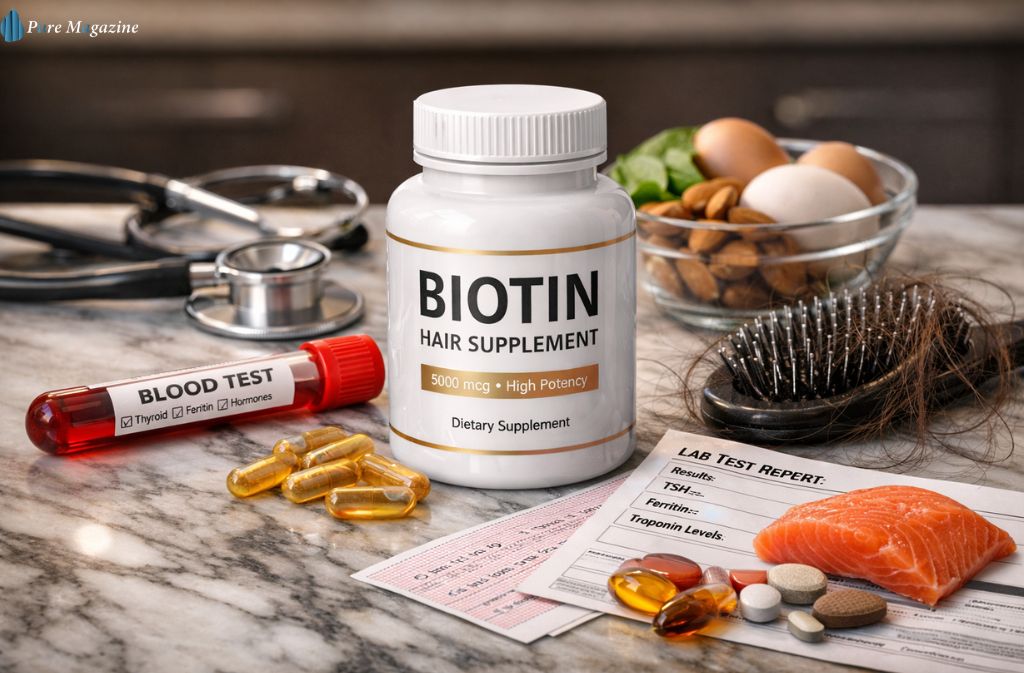
Most people taking biotin for hair growth don’t actually need it.
That’s the part no one tells you.
Yes, biotin supports keratin — the protein your hair is made of. But if you’re not deficient, taking high doses won’t suddenly make your hair grow faster. In many cases, it just turns into what doctors bluntly call “expensive urine.”
Worse, high-dose biotin can interfere with important blood tests — including thyroid levels and even heart attack markers.
So before you start (or continue) taking it, you need to know one thing:
Will biotin actually help your hair — or are you solving the wrong problem?
This guide breaks it down clearly — what works, what doesn’t, and what actually matters.
What Is Biotin?
Biotin goes by a few names — Vitamin B7, Vitamin H. It’s water-soluble, which means your body doesn’t store it. You need a steady supply of food or supplements.
Its main job is acting as a cofactor for enzymes. Those enzymes break down fats, carbohydrates, and amino acids. Amino acids are what your body uses to build keratin — the protein that hair is made of. So the connection to hair is real, but it’s indirect. Biotin doesn’t make hair grow the way watering a plant makes it grow. It keeps the underlying machinery running.
Where does biotin come from naturally?
- Cooked eggs
- Salmon
- Beef liver
- Almonds
- Sweet potato
- Sunflower seeds
- Spinach
A normal varied diet usually provides 35–70 mcg a day, already above the 30 mcg daily adequate intake.
Most people who eat reasonably well are not deficient.
Will Biotin Actually Help Your Hair?

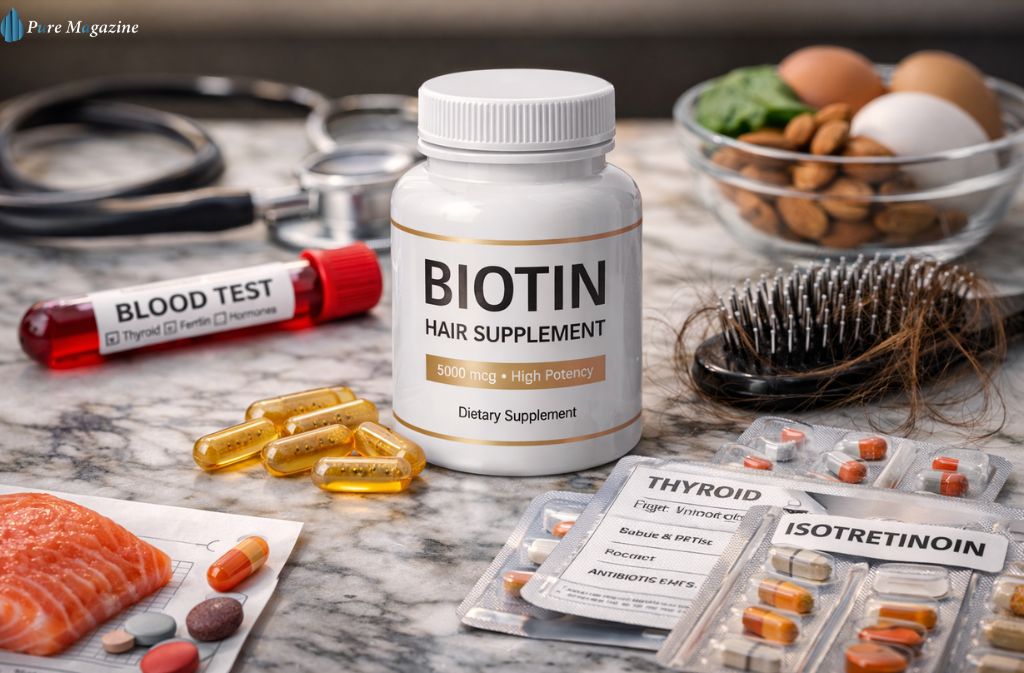
Probably not — unless you’re deficient. That’s the short answer, and most guides skip over it.
A 2024 review published in the Journal of Clinical and Aesthetic Dermatology looked at every decent-quality study on biotin and hair growth. The best of those studies — a double-blind, placebo-controlled trial — found no meaningful difference between the biotin group and the placebo group. The participants didn’t have a deficiency. Their hair didn’t grow faster or thicker just because they took the supplement.
The NIH puts it plainly: in people without a deficiency, evidence for biotin improving hair health is limited to a handful of individual case reports. That’s a pretty thin basis for the multi-billion-dollar biotin supplement market.
So when does it actually work?
- You have a confirmed or suspected biotin deficiency
- You’ve been on antibiotics long-term — these affect the gut bacteria that help produce biotin
- You’ve had bariatric surgery, which can affect nutrient absorption
- You’re taking isotretinoin (Accutane) for acne
- Your diet has been consistently poor, or you drink heavily
- You’re pregnant or breastfeeding (your requirements increase)
When it won’t help
- Stress-related shedding (telogen effluvium) — the hair falls because of a biological shock, not a deficiency. Biotin does nothing here.
- Pattern baldness — genetic, hormonal, needs different treatment
- Thyroid-related hair loss — the thyroid needs fixing, not more biotin
- General thinning with no underlying nutritional gap
How to Recognise a Deficiency
Genuine biotin deficiency is uncommon. But uncommon doesn’t mean impossible, especially in certain groups. The signs overlap with other deficiencies, which is why a blood test matters more than self-diagnosing off a list.
Symptoms to know about
- Hair thinning — gradual, sometimes across the whole body, including eyebrows
- Scaly, red skin rash, particularly around the eyes, nose, and mouth
- Nails that break easily
- Fatigue that doesn’t go away with rest
- Pins and needles in hands or feet
- Low mood, brain fog, or depression
People who are genuinely at higher risk
- Those on long-term antibiotic courses — antibiotics kill gut bacteria that naturally produce some biotin
- Heavy drinkers — alcohol interferes with biotin absorption
- Pregnant women — biotin demand rises during pregnancy
- Anyone who eats raw egg whites regularly — raw whites contain avidin, a protein that grabs onto biotin and stops you absorbing it (cooking destroys avidin)
- People on anticonvulsants like carbamazepine, phenytoin, or phenobarbital
- Those with rare inherited conditions: biotinidase deficiency or holocarboxylase synthetase deficiency
Hair Loss Is Rarely About One Nutrient
If your hair is thinning, the odds are good that more than one thing is going on.
Ferritin (your iron stores), vitamin D, zinc, and B12 are all common culprits — and they don’t always show obvious symptoms outside of the hair loss itself.
| Nutrient | What It Does for Hair | What Deficiency Looks Like |
|---|---|---|
| Biotin (B7) | Keeps keratin-building enzymes working | Gradual thinning, brittle strands |
| Iron / Ferritin | Carries oxygen to follicles | Diffuse shedding — very common in women |
| Vitamin D | Regulates the hair growth cycle | Increased daily shedding |
| Zinc | Cell repair and follicle structure | Slow growth, brittle texture |
| Vitamin B12 | Red blood cell production | Diffuse thinning, often with fatigue |
| Protein | Hair is roughly 95% keratin — protein is hair | Shedding, weak strands, slow growth |
Dosage — How Much Is Reasonable
The Institute of Medicine puts the adequate intake for adults at 30 mcg per day.
There’s no official Recommended Daily Allowance because deficiency is rare enough that setting one wasn’t considered necessary.
Walk into any pharmacy, and you’ll see supplements selling 5,000 mcg, 10,000 mcg, sometimes higher. That’s 166 to 333 times the adequate intake.
The logic seems to be that if some is good, more must be better. With biotin, that’s not how it works — and the higher doses carry real risks (see the lab test warning below).
| Dose | How to Think About It | Guidance |
|---|---|---|
| 30 mcg | Your actual daily requirement | Most people get this from food already |
| 1,000–2,500 mcg | Standard supplement range | Safe for daily use; reasonable starting point |
| 5,000 mcg | High-dose territory | Only use if a doctor suspects a deficiency; the lab test risk increases |
| 10,000+ mcg | Very high dose | Avoid without medical supervision — significant lab interference risk |
Where to start
- If you’re supplementing without a confirmed deficiency, 1,000–2,500 mcg a day is a sensible range.
- Take it with food — reduces the chance of an upset stomach.
- Stick with it. Three months minimum before you judge whether it’s doing anything.
The Lab Test Warning — Read This
This doesn’t get enough attention. The FDA has issued formal safety communications about it, and it’s something everyone taking biotin needs to know.
FDA Official Warning
High-dose biotin — typically 5,000 mcg and above — can interfere with a wide range of blood tests, producing results that are falsely high or falsely low.
The interference happens because many lab tests use a biotin-based detection method. Extra biotin in your system throws off the reaction.
The FDA has received reports of at least one patient death linked to a falsely low troponin result caused by biotin in the blood. Troponin is the marker doctors use to diagnose heart attacks.
Which tests are affected?
- Troponin — the heart attack marker
- Thyroid hormones: TSH, free T3, free T4 — high biotin can make results look like hyperthyroidism
- Parathyroid hormone (PTH)
- Sex hormones — testosterone, estradiol
- Vitamin D and ferritin
- Beta-hCG — used in pregnancy testing
- Certain cancer markers
What to do
- Tell every doctor and lab technician that you’re taking biotin, including through multivitamins or hair supplements.
- Stop biotin at least 3–7 days before any blood test. For very high doses, ask your doctor how long to pause.
- Don’t assume your dose is too low to matter. The threshold varies by assay and by individual.
- Check your multivitamin label — many contain biotin without making it obvious.
Side Effects Worth Knowing
Because biotin is water-soluble, your kidneys filter out whatever you don’t use. There’s no established upper limit for toxicity. But that doesn’t make it consequence-free at high doses.
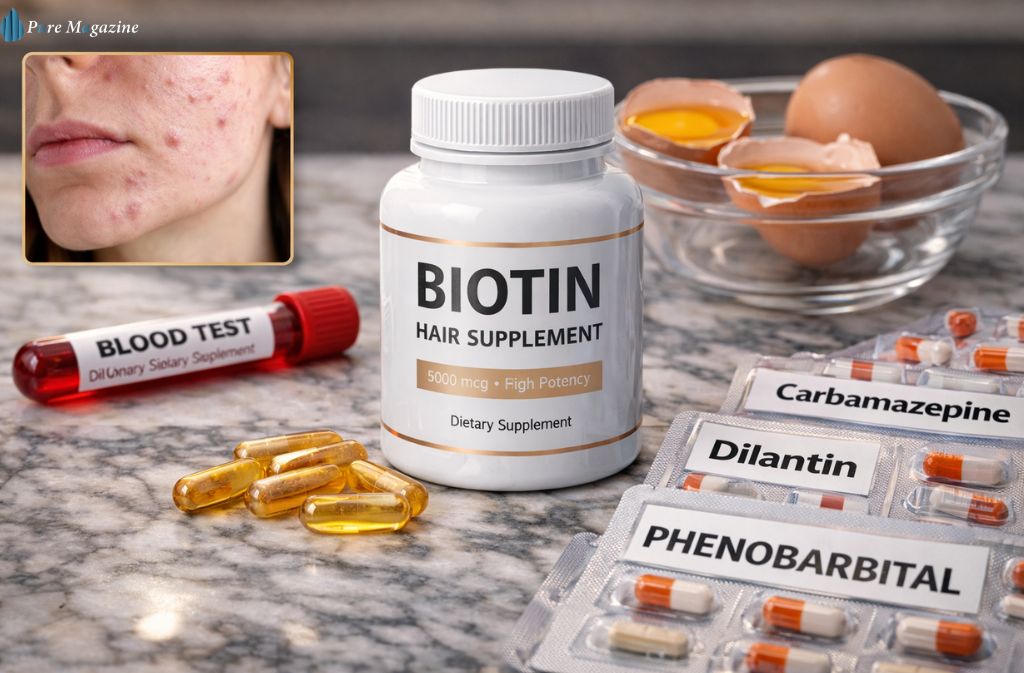
Acne
This is the one people notice most. Biotin and vitamin B5 (pantothenic acid) use the same absorption pathway.
When you flood that pathway with biotin, B5 gets crowded out. B5 helps regulate sebum production in the skin. Less B5 can mean more oil, which for some people means breakouts — usually on the face, chest, or back.
If this happens to you, cutting the dose or switching to a supplement that balances both nutrients usually helps.
Raw eggs — a hidden problem
Raw egg whites contain a protein called avidin. Avidin binds to biotin in your gut and carries it out of your body unabsorbed.
Eating raw whites a few times a week can genuinely deplete your biotin over time.
Cooking denatures avidin completely, so cooked eggs are fine — and actually a solid biotin source.
Medication interactions
If you take anticonvulsants
- Carbamazepine (Tegretol)
- Phenytoin (Dilantin)
- Phenobarbital
These drugs speed up how fast the body breaks down biotin.
This can lower your levels noticeably. Worth discussing with your neurologist or GP before starting biotin.
Realistic Timeline
Hair grows about 1 to 1.5 cm a month. No supplement changes that rate.
What you’re hoping for is that once any deficiency is corrected, the hair that does grow comes in stronger — and that shedding slows down.
| When | What’s Realistic |
|---|---|
| Weeks 1–2 | Nothing visible. Your body is restoring internal levels, not growing hair yet. |
| Month 1–2 | Shedding may start to slow down. Nails sometimes improve before hair. |
| Month 3–4 | New growth may become visible at the hairline if deficiency was the root cause. |
| 6 months | This is the real evaluation point. If nothing has changed, something else is driving the hair loss. |
Practical tip
Take a photo every four weeks in the same spot, same lighting.
Hair changes happen too slowly to notice day to day.
You’ll only see progress when you compare photos from months apart.
How to Start Taking Biotin For Hair Growth — Step by Step
If your doctor has recommended biotin, or you’ve decided to try it, here’s a sensible way to approach it.
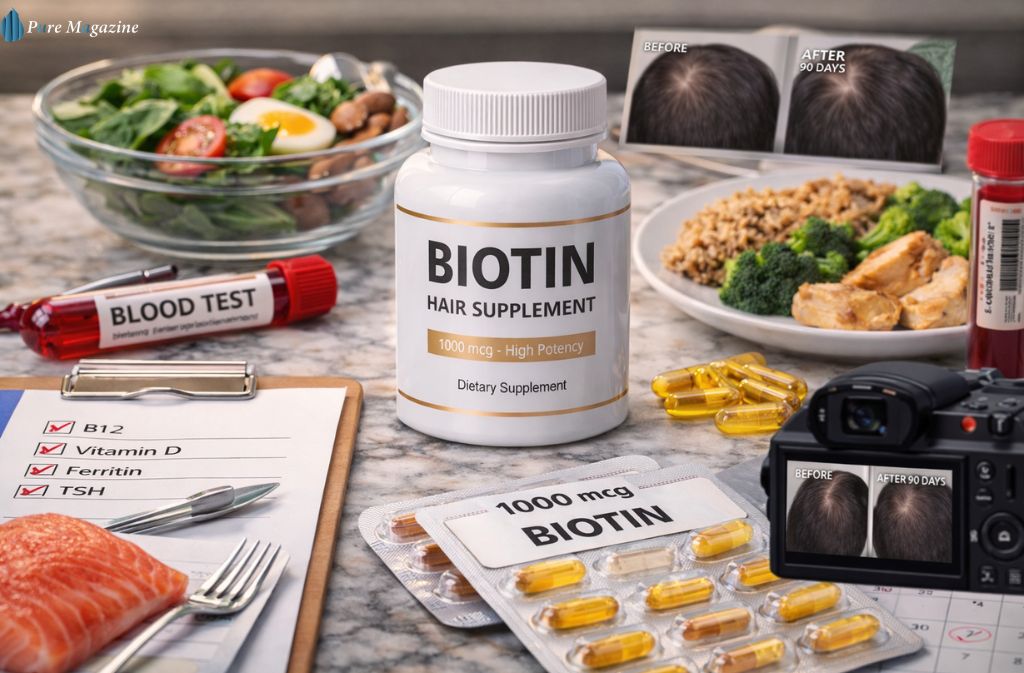
- Get a blood test first if you can. At a minimum, ask for ferritin, vitamin D, and TSH. This tells you whether biotin is even the right focus.
- Sort out your diet before adding supplements. Eggs, nuts, oily fish, leafy greens — these cover multiple bases, not just biotin.
- Start at 1,000–2,500 mcg daily. Don’t begin at 10,000 mcg. There’s no evidence it works faster, and there’s good reason not to.
- Take it with a meal. Reduces the likelihood of nausea and may improve absorption.
- Tell your GP, pharmacist, and any lab technician before blood tests. This matters. Don’t skip this.
- Give it at least 90 days before you judge results. Take monthly photos.
- Reassess at six months. No change? The cause of your hair loss likely isn’t biotin deficiency.
Also Check: The Benefits of black seed oil for Healthier Hair and Scalp
When a Doctor’s Visit Matters More
Some hair loss patterns point to things that supplements can’t touch.
If you recognise yourself in any of the following, a GP visit should come before any supplement purchase.
See a doctor if you have
- Hair loss + constant tiredness + feeling cold more than usual → possible underactive thyroid
- Hair loss + heavy periods + fatigue → likely iron deficiency anaemia
- Sudden heavy shedding over a few weeks → telogen effluvium (shock shedding) — resolves with time, not biotin
- Round or oval bald patches → alopecia areata — an autoimmune condition, needs proper treatment
- Receding hairline or crown thinning (men or women) → androgenetic alopecia — may respond to minoxidil or finasteride
- Scalp itching, redness, or scaling alongside hair loss → likely needs a dermatologist
What to Ask for at Your Appointment
A full blood panel:
- Ferritin (iron stores, not just total iron)
- 25-OH vitamin D
- TSH + free T3/T4
- Zinc
- B12
- Full blood count
This panel will tell you far more than any supplement experiment.
Mistakes People Commonly Make
- Starting at 10,000 mcg — there’s no established benefit over 2,500 mcg for most people, and the lab test risk goes up significantly
- Expecting results in two weeks — if someone promises that, they’re selling something
- Not mentioning it to their doctor — this is how diagnostic errors happen, particularly with thyroid and cardiac tests
- Treating biotin as the whole solution — iron, vitamin D, zinc, and protein all matter as much or more
- Eating raw eggs regularly — avidin blocks biotin absorption; cook your eggs
- Ignoring the scalp — seborrheic dermatitis, inflammation, and product buildup all impair follicle health, regardless of what you supplement
Common Questions
Q. Which vitamin is actually best for hair growth?
There isn’t a single “best” vitamin for hair growth. Hair health depends on multiple nutrients working together.
For example:
- Low ferritin (iron stores) → Iron becomes the most important nutrient to correct.
- Low vitamin D → Vitamin D becomes the priority.
Hair loss is rarely caused by just one deficiency. Nutrients like iron, vitamin D, zinc, vitamin B12, protein, and biotin all play roles in healthy hair growth.
The most reliable way to identify the right supplement is a blood test, not guessing which vitamin to take.
Q. I’ve been taking biotin for a month and nothing has happened. Should I stop?
Not necessarily. One month is usually too early to see results.
Hair grows slowly — about 1 to 1.5 cm per month — so supplements need time to show visible effects.
A reasonable timeline is:
- 1–2 months: Internal nutrient levels stabilizing
- 3 months: Possible reduction in shedding
- 3–4 months: Early signs of new growth if a deficiency existed
- 6 months: Clear point to evaluate results
If there’s no improvement after six months, the hair loss is likely caused by something other than biotin deficiency.
Q. Is taking 10,000 mcg of biotin safe?
High doses like 10,000 mcg (10 mg) are generally not considered acutely toxic, but they are far higher than most people need.
The typical adequate intake for adults is 30 mcg per day, meaning many supplements provide hundreds of times more than necessary.
A more important concern is laboratory test interference. According to the U.S. Food and Drug Administration, biotin doses above 5,000 mcg can interfere with certain blood tests and cause false results.
This can affect tests used to diagnose:
- Heart attacks (troponin)
- Thyroid disorders
- Hormone levels
- Vitamin D and ferritin levels
Because of this risk, high-dose biotin should only be used under medical supervision.
Q. Can biotin cause acne?
Yes, biotin supplements can trigger acne in some people, particularly at higher doses.
Biotin and vitamin B5 (pantothenic acid) share the same absorption pathway in the body. When large amounts of biotin are taken, it may reduce B5 absorption.
Vitamin B5 helps regulate sebum (skin oil) production, so reduced levels can sometimes lead to increased oil and breakouts, especially on the face, chest, or back.
If acne develops:
- Lower the biotin dose
- Choose a supplement that includes both biotin and vitamin B5
Many people find that reducing the dose resolves the issue.
Q. My doctor recommended biotin. What should I do?
If your doctor has recommended biotin, follow the exact dosage they prescribed.
However, there is one important precaution.
Before any blood test, even routine lab work, tell your doctor or nurse that you are taking biotin. Biotin supplements can interfere with several diagnostic tests.
Most clinicians recommend stopping biotin 3–7 days before blood tests, but the exact timing depends on the dose.
Mentioning it during a lab appointment takes only a few seconds but can prevent inaccurate results or misdiagnosis.
Q. Does biotin interact with medications?
Biotin has relatively few medication interactions, but there is an important exception.
Certain anticonvulsant medications can lower biotin levels by increasing how quickly the body breaks it down.
Examples include:
- Carbamazepine
- Phenytoin
- Phenobarbital
People taking these medications may have reduced biotin levels over time.
If you take anticonvulsants, speak with your neurologist or doctor before starting a biotin supplement to determine whether supplementation is appropriate.
Related: Daily Multivitamin for Women’s Health and Wellness
|
Disclaimer: This article is for informational purposes only and is not medical advice. Always consult a qualified healthcare professional before starting or changing any supplement, including biotin. Individual health needs vary, and biotin may interact with certain medications or interfere with some blood tests. If you have persistent hair loss or other symptoms, seek guidance from a medical professional. |