Council tax is one of those bills that keeps rising while most people remain uncertain about what they’re actually paying — or why the figure differs so dramatically from one postcode to the next.
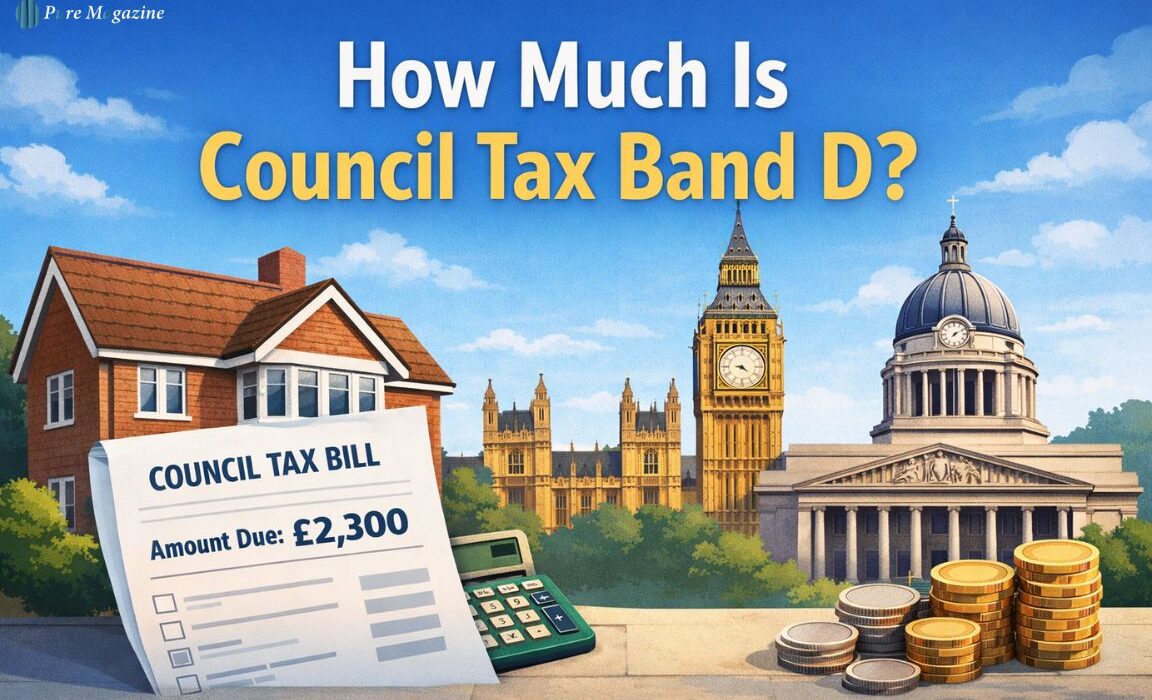
If you’ve searched “how much is council tax band D,” you’re looking for a real number. Here’s the honest answer: there isn’t a single one. Your bill depends entirely on where you live, and in 2026/27, the gap between the cheapest and most expensive councils in England is nearly £1,500 on the same band.
This guide covers accurate 2026/27 costs, why that variation exists, how your band relates to the others, and what can legally reduce your bill.
What Is Council Tax Band D?
Band D is the standard reference point for the entire UK council tax system. Every local authority sets its rates using Band D as the benchmark; all other bands are calculated as a fixed proportion of Band D.
As UKCalculator’s council tax band guide explains, officials introduced Band D in 1993 when council tax replaced the Poll Tax, using estimated property values from April 1991. England still uses that 1991 valuation today, making it the only part of the UK that has never carried out a full revaluation since the system began. Wales revalued in 2005. Scotland also uses 1991 values but sets rates independently.
How other bands relate to Band D:
| Band | % of Band D | Example at £2,394 baseline |
|---|---|---|
| A | 67% | £1,603 |
| B | 78% | £1,867 |
| C | 89% | £2,128 |
| D | 100% | £2,394 |
| E | 122% | £2,921 |
| F | 144% | £3,447 |
| G | 167% | £3,998 |
| H | 200% | £4,788 |
Even if your property isn’t Band D, your bill is calculated directly from it. Understanding the local Band D rate unlocks the cost of every other band in your area — and explains why the same band costs different amounts across the country. For a complete breakdown of all eight bands and how they’re calculated nationally, that guide covers the full framework including Scotland’s proposed new Bands I and J.
How Much Is Band D in 2026/27?
The England average Band D for 2025/26 was £2,280, confirmed by GOV.UK’s official council tax levels publication. With 125 of 153 top-tier English councils applying the maximum 4.99% increase for 2026/27 — adding approximately £114 per year — the England average for 2026/27 lands at approximately £2,394.
2026/27 Band D Averages by Region
| Region | Approx Annual Cost | Monthly (10 payments) | Monthly (12 payments) |
|---|---|---|---|
| England (overall) | ~£2,394 | ~£239 | ~£200 |
| London (average) | ~£2,100 | ~£210 | ~£175 |
| Wales | ~£1,954 | ~£195 | ~£163 |
| Scotland | ~£1,495 | ~£150 | ~£125 |
Scotland note: Scottish figures exclude water and sewerage charges, billed separately by Scottish Water — typically adding £400–£500 per year to the true cost of living in Scotland.
The 4.99% Ceiling — And Where It Breaks
Most English councils applied the maximum permitted 4.99% increase for 2026/27 — comprising a 2.99% core rise and a 2% Adult Social Care precept. As Homenicom’s council tax rises analysis notes, 125 of 153 top-tier councils planned rises of at least 4.99%, slightly down from 134 councils (88%) that did so in 2025/26.
Some councils went further. Through the government’s Exceptional Financial Support scheme, councils in severe financial distress can bypass the referendum threshold entirely. In 2026/27, seven councils received this permission — Worcestershire and Shropshire both hitting 8.99%, Trafford and Warrington reaching 7.49%. If you live in one of these areas, your Band D bill may be rising at nearly twice the national average.
Durham approved just 1.99%. Lincolnshire 2.90%. Wandsworth and Westminster — two of London’s lowest-rate councils — applied only 2%, leaving Wandsworth with England’s cheapest Band D at £1,020.
Why Band D Varies So Much: The Westminster vs Nottingham Gap
The most striking example of regional variation in 2026/27:
| Council | Band D 2026/27 |
|---|---|
| Westminster (London) | ~£971 |
| Wandsworth (London) | ~£1,020 |
| Nottingham | ~£2,755 |
| Rutland | £2,500+ |
Westminster sits at roughly £971. Nottingham sits at roughly £2,755. That’s nearly a £1,800 annual gap on identical Band D properties.
As Council Tax Checker’s UK rates comparison explains, this isn’t because Westminster spends less per resident — London boroughs actually spend significantly more per head. The difference is that inner London boroughs receive far higher central government grants and retain a larger share of business rates income, meaning they need to extract far less from residential council tax. Councils like Nottingham and Rutland have smaller commercial tax bases, older populations driving higher social care costs, and fewer central grants to draw on.
Same band. Vastly different financial reality. The band tells you your relative position within your council’s rate — not what that rate actually is.
Finding Your Exact Rate
The GOV.UK council tax band checker is the fastest route — enter your postcode, see your band, and view your council’s full charge schedule. It also shows your neighbours’ bands, which is the starting point for any challenge if your band looks inconsistent with nearby similar properties.
If you believe your band is wrong — around 400,000 properties in England are estimated to be in incorrect bands — a formal proposal to the Valuation Office Agency costs nothing to submit. A successful challenge typically backdates the lower rate to when the change took effect.
The 10-Month vs 12-Month Payment Question
Most people don’t realise they have a choice.
| Annual Cost | 10-Month Payment | 12-Month Payment |
|---|---|---|
| £2,300 | £230/month | £192/month |
| £2,394 | £239/month | £200/month |
The 10-month default runs April through January, leaving February and March payment-free. The 12-month option spreads the same total across the full year, reducing each monthly deduction. Most councils offer both — contact your council tax department to switch. Neither changes what you owe overall, only how it lands in your budget.
How to Reduce Your Band D Bill
- Single Person Discount (25%) — one adult living alone receives an automatic 25% reduction on request. On a £2,394 bill, that’s nearly £600 saved per year. It doesn’t apply automatically — you need to notify the council.
- Disregarded residents — full-time students, apprentices, carers, and people with Severe Mental Impairment don’t count as occupants. A property where all adults are disregarded pays only 50% — and where one adult is disregarded, the remaining person may qualify for the 25% single-person rate.
- Council Tax Reduction — income-based support through the local CTR scheme can reduce bills significantly for qualifying households, potentially to zero. The council-tax-reduction guide covers eligibility thresholds, savings limits, and how to apply.
- Disability band reduction — properties adapted for a disabled resident may qualify to pay at the rate of the band below.
Quick savings example:
| Scenario | Annual Bill |
|---|---|
| Standard Band D | £2,394 |
| With 25% single-person discount | £1,796 |
| Annual saving | £598 |
Empty Property Premium (2026 Update)
The rules on vacant properties tightened in 2026. Many councils now apply a 100% premium to properties empty for more than one year — meaning the owner pays double the standard Band D rate.
| Property Status | Annual Bill |
|---|---|
| Occupied Band D | £2,394 |
| Empty over 1 year (100% premium) | £4,788 |
| Empty over 10 years (300% premium) | £9,576 |
Previously this threshold applied after two years. Many owners of empty properties are still unaware the timeline shortened. The do-you-pay-council-tax-on-an-empty-property guide covers which exemptions pause the premium clock and for how long.
Why Council Tax Keeps Rising
The structural pressure on local authority finances is real. Social care costs are rising faster than council tax income, the central government has reduced grants in real terms over the past decade, and an aging population is increasing demand for services while shrinking the working-age population that funds them.
As UKCalculator’s 2026 council tax rates page notes, the trajectory has been consistent: average Band D has risen from around £1,900 a few years ago to £2,280 in 2025/26 and approximately £2,394 in 2026/27 — a meaningful increase in the real cost of local services for most households. Understanding how council tax interacts with income tax obligations matters particularly for landlords managing properties across multiple bands.
Band D Quick Reference (2026/27)
| Feature | Detail |
|---|---|
| England average Band D | ~£2,394 |
| Cheapest (Wandsworth) | ~£1,020 |
| Most expensive (Rutland) | £2,500+ |
| Monthly (10-month default) | ~£239 |
| Monthly (12-month option) | ~£200 |
| Standard cap | 4.99% |
| EFS councils (maximum) | 8.99% |
| Single person discount | 25% |
| Valuation basis | April 1991 (England) |
Conclusion
Band D isn’t a fixed number — it’s a reference point shaped by local decisions, funding structures, and a valuation system frozen in 1991. In 2026/27, most English households will pay somewhere around £2,394, but the actual figure ranges from under £1,000 in Westminster to over £2,700 in Nottingham.
Check your local rate on GOV.UK’s council tax band checker, apply every discount you legitimately qualify for, and consider whether requesting 12-month payments reduces the monthly pressure. If your band looks inconsistent with similar nearby properties, a challenge costs nothing to submit.
For reliable, plain-English guidance on UK tax and personal finance in 2026, Pure Magazine is the resource worth bookmarking.