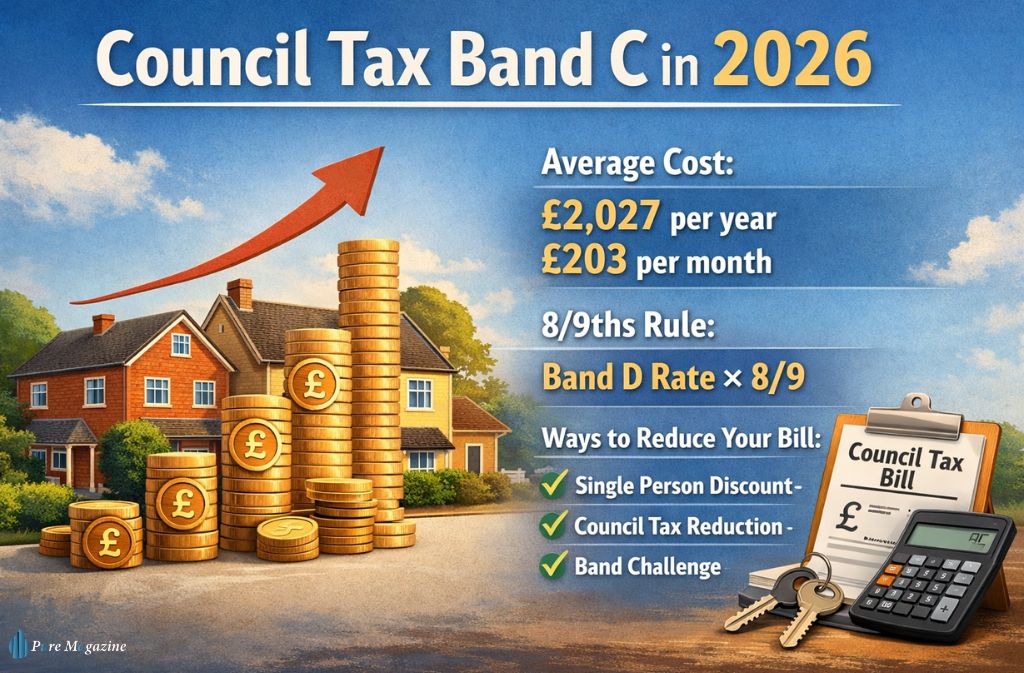
Council tax isn’t just another bill — it’s one of those expenses that quietly compounds every year. In 2026, that compounding is more visible than usual. Most English councils hit the maximum permitted 4.99% increase, some were allowed to go higher, and the average Band D bill in England reached £2,280 for 2025/26 — meaning Band C households are paying more than most people realise.
If you’re searching for Band C council tax rates, you’re likely trying to answer one specific question: how much should I actually be paying, and is there any way to reduce it?
This guide answers both.
What Is Council Tax Band C?
Band C is a mid-range property valuation bracket used to calculate the annual council tax. As GOV.UK’s council tax band assessment guidance confirms, every residential property in England and Wales was assigned a band by the Valuation Office Agency based on what it would have sold for at a fixed point in time — not what it’s worth today.
| Country | Valuation Date | Band C Range |
|---|---|---|
| England | 1 April 1991 | £52,001 – £68,000 |
| Scotland | 1 April 1991 | £52,001 – £68,000 |
| Wales | 1 April 2003 | £65,001 – £91,000 |
This is why a house worth £350,000 today can still sit in Band C — it’s assessed on a value from 35 years ago. As the VOA’s March 2026 blog post confirms, bands don’t change just because property prices rise. An increase in current market value won’t automatically move a property into a higher band — only specific material changes or a successful challenge trigger reassessment.
How Much Is Band C Per Month in 2026?
Band C is always calculated as 8/9ths of the Band D rate in your area. As GOV.UK’s 2025/26 council tax levels publication confirms, the England-wide average Band D sits at £2,280 — which puts the Band C average at approximately £2,027 annually.
| Area Type | Approx Annual Band C | Monthly (10 payments) |
|---|---|---|
| Low-cost areas | ~£1,450 | ~£145 |
| England average | ~£2,027 | ~£203 |
| High-cost areas (London/South) | ~£2,100+ | ~£210+ |
Council tax is usually billed over 10 months, not 12 — April through January. That’s why the monthly figure looks higher than dividing the annual bill by 12. A £2,027 annual bill divided by 10 comes to £202.70 per month.
The 8/9ths Rule: How Your Bill Is Actually Calculated
Band D is the reference point. Every other band is a fixed fraction or multiple of it. As UKCalculator’s council tax band confirms, the ratios are set nationally and don’t vary between councils:
Band C = Band D × 8/9
| Band D Rate | Band C Annual | Monthly (10 payments) |
|---|---|---|
| £1,600 | £1,422 | £142 |
| £1,800 | £1,600 | £160 |
| £2,000 | £1,778 | £178 |
| £2,280 (England avg) | £2,027 | £203 |
Find your local Band D rate — it’s on your annual bill or on your council’s website — apply the 8/9ths formula, and you know immediately whether your bill is correct. For a full breakdown of how all bands from A to H compare, including Scotland’s new proposed Bands I and J for 2028, the complete UK bands guide covers the full picture.
Why Two Band C Properties Can Have Very Different Bills
Same band, completely different amounts. That gap comes from how councils set their rates independently each year.
As the MHCLG’s council tax levels data confirms, the average Band D ranges from £1,982 in London to £2,366 in unitary authority areas — a difference of nearly £400 before the 8/9ths multiplier is even applied. Bills also include separate precepts from police and fire authorities, which vary by region.
The result: a Band C home in a northern town might pay £1,450 per year while a Band C home in parts of the south-east pays over £2,000 — purely due to local budget decisions, not the property itself.
How to Check Your Band
Two tools cover this. GOV.UK’s council tax band checker lets you search any property in England and Wales by postcode — and crucially, see the bands of neighbouring properties too. That comparison is the foundation of any band challenge. For Scotland, the Scottish Assessors Association holds the equivalent records.
Your band is also printed on your annual council tax bill.
2026 Ways to Reduce Your Band C Bill
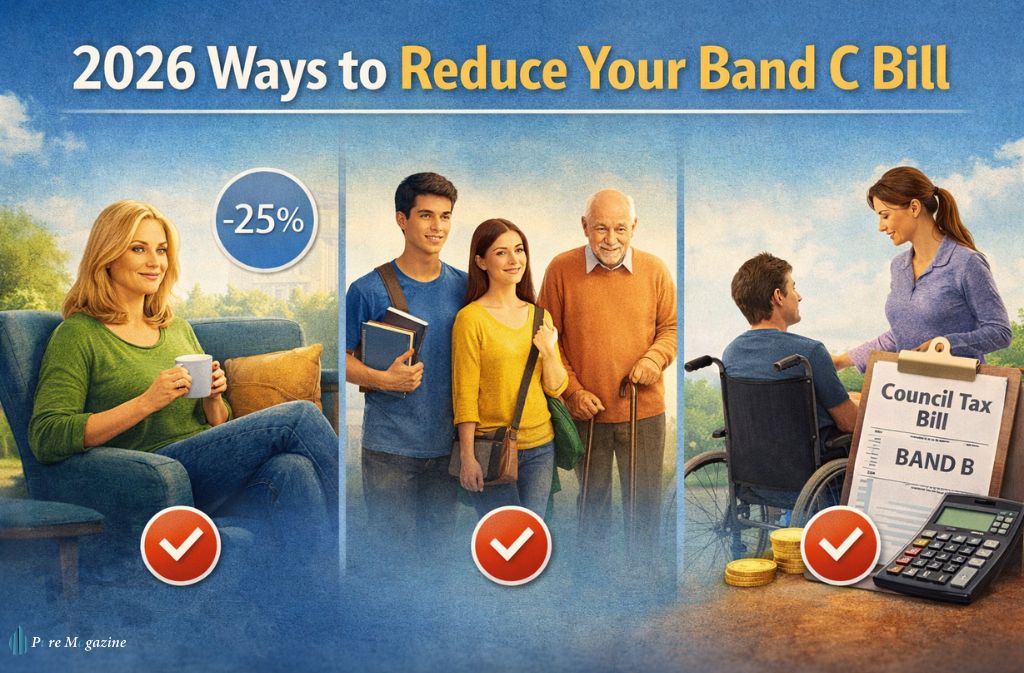
Single Person Discount (25%)
One adult living alone qualifies for a 25% reduction. On a £2,027 annual Band C bill, that’s over £500 back each year — but it requires an application. It doesn’t apply automatically. For full details on income thresholds, savings limits, and how to apply, the council-tax-reduction guide covers all qualifying criteria.
The Disregard Rule
Even if multiple people live in the property, some residents don’t count as “occupants” for council tax purposes. As UKCalculator’s 2026 rates confirm, full-time students, apprentices, and people with Severe Mental Impairment are disregarded — meaning a property shared between a working adult and a full-time student still qualifies for the 25% single-person discount.
Disability Band Reduction
Properties adapted to meet a disabled resident’s needs can qualify for a band reduction — paying at the rate of the band below. For a Band C property, that means paying Band B rates.
Council Tax Reduction Scheme
Low-income households with savings below £6,000 may qualify for a significant reduction through the local CTR scheme. As the council-tax-reduction scheme guidelines confirm, this can reduce the bill by up to 100% in qualifying cases.
Challenge the Band
As GOV.UK’s band challenge guidance confirms, challenging a band is free. The VOA reviews proposals and the process typically takes two to six months. A successful challenge backdates the saving to when the change took effect. As the VOA’s March 2026 blog confirms, challenging your band is always free — though the risk is that a thorough review could result in the band going up as well as down if evidence supports a higher valuation. Checking what neighbouring similar properties are banded at before submitting protects against that risk.
2026 Premium Updates: What Empty Property and Second Home Owners Face
From April 2026, most councils have updated their premium rules for underused properties. As confirmed in the do-you-pay-council-tax-on-an-empty-property guide:
| Property Type | Council Tax Charged |
|---|---|
| Primary residence | 100% |
| Second home | Up to 200% |
| Empty property (over 1 year) | Up to 200% |
A Band C property with a £2,027 annual bill could cost a second-home owner up to £4,054 per year. Some councils have lowered the empty property threshold from two years to one; check with the specific local authority.
Common Mistakes That Cost Money
Assuming all Band C properties pay the same, location drives far more variation than the band itself. Check your specific council’s Band D rate before assuming anything.
- Ignoring discounts — single person discount, student disregard, and CTR are all worth hundreds per year. None apply without an application.
- Not comparing neighbours — identical properties on the same street should be in the same band. GOV.UK’s band checker shows every property’s band by postcode.
- Not checking after moving — if a previous owner successfully challenged the band downward, the lower band travels with the property. If they extended it, the band may be due for reassessment at the next sale.
Quick Reference: Band C 2026
| Feature | Details |
|---|---|
| Formula | 8/9 of local Band D rate |
| England valuation basis | 1 April 1991 |
| Wales valuation basis | 1 April 2003 |
| England’s average annual cost | ~£2,027 |
| Monthly payment (10 months) | ~£203 |
| Single-person discount | 25% |
| Band checker | gov.uk/council-tax-bands |
FAQs
Q. How much is the council tax Band C per month in 2026?
Around £142–£210 per month depending on location, paid over 10 months. The England average works out to approximately £203/month. Use GOV.UK’s council tax band checker to find your local Band D rate, then multiply by 8/9 and divide by 10.
Q. Why is my Band C bill higher than expected?
Councils bill over 10 months rather than 12, pushing monthly payments higher than the annual figure divided by 12 would suggest. Regional precepts for police and fire services also add to the total.
Q. What is the Band C property value range? £52,001–£68,000 in England and Scotland (based on April 1991 values) or £65,001–£91,000 in Wales (based on April 2003 values), as confirmed by GOV.UK’s band assessment guidance.
Can I reduce my Band C council tax?
Yes — through the single person discount (25%), student disregard, disability band reduction, council tax reduction for low-income households, or a successful band challenge via the VOA.
Q. What is the 8/9ths rule?
Band C is always 8/9 of the local Band D rate — the national reference point.
Q. Do second homes pay more council tax in 2026?
Yes — most councils now charge up to 200%, meaning second home owners pay double the standard rate.
Conclusion
Band C council tax in 2026 costs most English households around £2,027 annually — paid over 10 months at roughly £203 per month. The 8/9ths rule makes it simple to verify any bill against the local Band D rate.
What matters just as much as the rate is whether you’re paying the right one. A wrong band, an unclaimed discount, or a missed CTR application can each represent hundreds of pounds per year, leaving your account unnecessarily.
Check your band, compare neighbours, apply for any discounts you qualify for, and review your bill against the 8/9ths calculation each April when rates reset.
For reliable, plain-English guidance on UK tax and personal finance in 2026, Pure Magazine is the resource worth bookmarking.