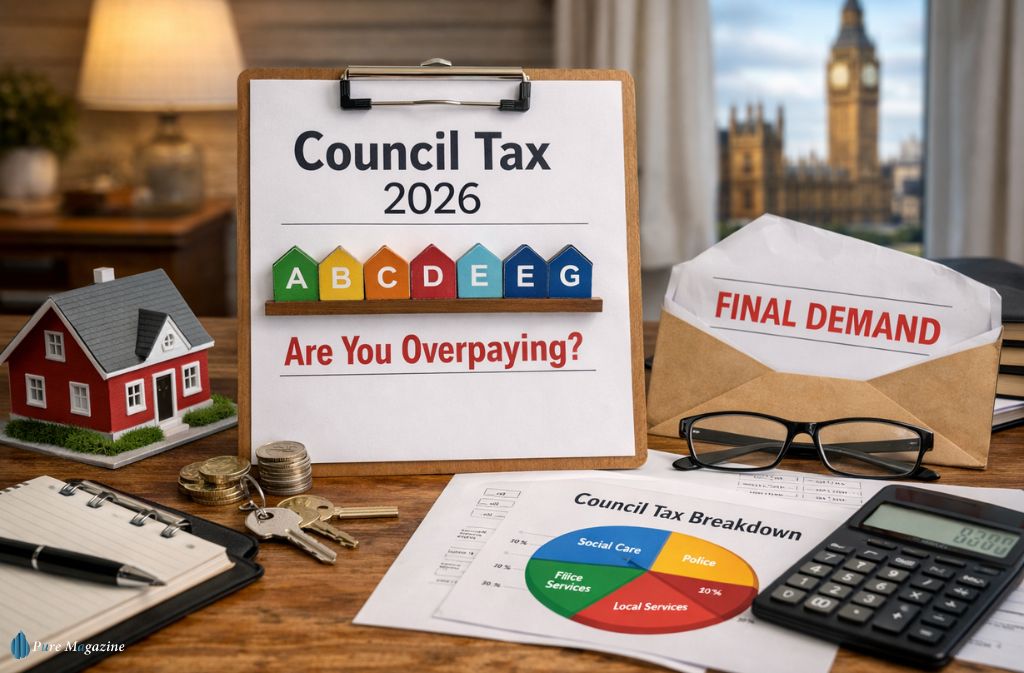
Council Tax is one of those bills you just pay — until something feels off.
Maybe your neighbour in an identical house pays less. Maybe your bill jumped this April again. Or maybe you’ve inherited a second property, and the charge has doubled.
Understanding Council Tax bands UK isn’t just about knowing whether you’re Band B or Band D. In 2026, it’s about understanding why your bill keeps rising, how precepts quietly increase costs, what the second-home and empty property premiums mean, when a band can legally change, and how to challenge it — without making things worse.
This guide goes beyond the standard A–H table. It explains the system the way a practitioner would — with the nuances most comparison sites skip.
All information is accurate as of 2026, based on guidance from the Valuation Office Agency, GOV.UK, and the Scottish Assessors Association.
Quick Verdict (If You Want the Essentials)
- Your band is based on 1991 property values (England & Scotland) or 2003 (Wales)
- Band D is the benchmark
- Higher band = higher proportion of Band D
- Extensions usually don’t increase your band until you sell
- Second homes can face a 100% premium
- Empty homes may face up to a 300% surcharge in some councils
- You can appeal — but only with strong comparable evidence
Now let’s unpack what that actually means.
What Are Council Tax Bands UK?
Council Tax bands are value brackets assigned to residential properties to determine how much Council Tax you pay each year.
England & Scotland: Bands A–H (based on April 1991 market values)
Wales: Bands A–I (based on April 2003 values)
In England and Wales, banding is handled by the Valuation Office Agency. In Scotland, it’s overseen by the Scottish Assessors Association.
And yes — the system is still tied to valuations from over 30 years ago. That’s not a typo.
Council Tax Band Table (England – 1991 Values)
| Band | 1991 Property Value | Proportion of Band D |
|---|---|---|
| A | Up to £40,000 | 6/9 |
| B | £40,001–£52,000 | 7/9 |
| C | £52,001–£68,000 | 8/9 |
| D | £68,001–£88,000 | 9/9 |
| E | £88,001–£120,000 | 11/9 |
| F | £120,001–£160,000 | 13/9 |
| G | £160,001–£320,000 | 15/9 |
| H | Over £320,000 | 18/9 |
Band D is the anchor. Every other band is calculated as a fraction of it. For a deeper breakdown of what Band B specifically means — including typical charges and how it compares to surrounding bands — that covers the details most residents in lower bands need.
How Much Are Council Tax Bands in 2026?
There is no national flat rate. Each local authority sets its own Band D figure annually.
2026 Average Estimates (England)
- Band D: £2,100–£2,300 per year
- Band A: £1,400–£1,600
- Band B: £1,600–£1,800
- Band C: £1,800–£2,000
- Band E: £2,600+
(Compiled from 2026 council budget reports published via GOV.UK.)
Important Reality Check
Two Band D properties in different towns can have bills hundreds of pounds apart. The band controls proportion. Your council controls the actual cost.
Why Is My Council Tax Going Up? (Precepts Explained)
Your bill isn’t just “for the council.” It usually includes core council services, the Adult Social Care precept, the Police precept, and the Fire & Rescue precept.
In 2026, many authorities increased bills close to the 5% referendum cap. Often this is structured as ~2–3% core council increase plus ~2% Adult Social Care precept. So even if your council says it “froze” services funding, a precept rise can still increase your bill by £15–£20 per year.
Where Every £1 Goes (Typical 2026 Split)
| Service | Approx Share |
|---|---|
| Adult Social Care | ~31p |
| Core Services | ~40p |
| Police | ~14p |
| Fire | ~5p |
| Other | ~10p |
This breakdown explains why social care pressures are driving sustained increases. For local-level examples of exactly how this plays out in practice, the breakdowns for Manchester, Birmingham, and Lambeth all show how the same national precept structure produces different final bills depending on the local authority.
The “Material Increase” Rule (Commonly Misunderstood)
You added a loft conversion. Your band didn’t change. Why?
Because of the material increase rule. Under rules administered by the Valuation Office Agency, improvements are recorded and your band usually only changes after the property is sold — or if there’s a major physical change in the locality (e.g., new bypass, major development).
So yes, your extension might increase value. But the rebanding often waits until ownership changes.
Scotland 2026 Update: New Bands I & J
As confirmed in the Scottish Government’s official Budget 2026–27 publication, two new council tax bands will be introduced from 1 April 2028: Band I for properties valued between £1 million and £2 million, and Band J for properties valued above £2 million. The new bands will be based on up-to-date valuations, while all other homes remain within the existing framework — and the Scottish Government has allocated £5 million in 2026–27 toward the targeted revaluation of properties worth over £1 million to support this.
If you own high-value property in Scotland, your liability may increase significantly compared to the previous Band H ceiling. This is a structural shift worth monitoring. For Scottish residents, understanding Scottish tax bands more broadly — including how income tax and council tax interact differently north of the border — helps frame the full picture.
Second Home Premium (2026)
Many councils now apply up to a 100% surcharge on second homes. Example: Band D standard = £2,200; second home charge = £4,400.
Policies vary locally, so always check your council’s rules via GOV.UK guidance. Those navigating council tax on unoccupied or second properties should also confirm whether their local authority has activated the premium — not all have, and the rate varies significantly.
Empty Homes Premium (Up to 300%)
Empty properties face escalating charges: 100% premium after 1 year empty, 200% after 5 years, and up to 300% in some areas. For example, Denbighshire has moved toward a 300% premium for long-term empty properties.
If your property has been empty 12 months, the surcharge clock is already ticking. Renovating? Waiting to sell? Track the timeline carefully. For a full breakdown of exemptions, timelines, and how to legally reduce the charge, and how to avoid paying council tax on an empty property after death covers the scenarios where exemption windows apply.
Council Tax Reduction vs Discounts
These are not the same thing.
Discounts: 25% single-person discount, student exemptions, severe mental impairment exemption.
Council Tax Reduction (CTR): Means-tested support for low-income households. CTR varies by council. You must apply. It’s not automatic.
In 2026’s economic climate, this can reduce bills significantly — sometimes more than a band appeal would. The council tax reduction guide covers eligibility thresholds, how to apply, and the working-age cap that catches many people by surprise.
HMO Re-Banding (Landlord Note)
Houses in Multiple Occupation (HMOs) can be banded as one unit or banded per self-contained unit. This depends on structural layout and VOA classification. Landlords should confirm status directly with the Valuation Office Agency before assuming a liability structure. Mistakes here can be costly.
How to Check Your Council Tax Band
Go to GOV.UK’s official council tax band checker. Use the service to find your band, compare neighbouring properties, and assess risk before appealing. It takes minutes. It could save hundreds per year.
The “No-Go” Zone Before Appealing
Appeals aren’t emotional arguments. They’re evidence-based submissions.
Before you challenge your band: check at least 5 comparable properties, ensure similar size, layout, and build age, and confirm they’re in a lower band. If neighbouring identical homes are in higher bands, a review could increase yours.
It’s a double-edged sword.
Common Mistakes That Cost People Money
- Assuming today’s house price determines the band
- Ignoring precepts when calculating increases
- Appealing without strong comparables
- Missing Council Tax Reduction eligibility
- Letting the property sit empty for too long
Frequently Asked Questions
Q1. Which is higher, Council Tax Band C or Band D?
Band D is higher than Band C. Band C pays 8/9 of the Band D rate. This means if your property is Band C, you pay slightly less than a Band D home in the same area.
Q2. What is Council Tax Band D?
Band D is the standard benchmark councils use to calculate Council Tax rates. All other bands are expressed as a fraction or multiple of Band D. For example, Band A is 6/9 of Band D, and Band H is 18/9.
Q3. How much is Council Tax Band A per month in 2026?
Council Tax for Band A properties in 2026 typically ranges from £115–£135 per month, depending on your local authority. Always check your council’s official website for the exact rate.
Q4. Is a higher Council Tax band more expensive?
Yes. Higher alphabetical bands (C, D, E, etc.) correspond to more valuable properties and pay a larger proportion of the Band D rate. For example, Band E pays 11/9 of Band D.
Q5. How is the Council Tax band calculated?
Council Tax bands are based on the estimated market value of your property:
- England & Scotland: Values as of 1 April 1991
- Wales: Values as of 1 April 2003
The valuation reflects what your home would have sold for on the open market at that date, not the current market price. Assessment is performed by the Valuation Office Agency in England/Wales or the Scottish Assessors Association in Scotland.
Q6. How much is Council Tax Band B per month in 2026?
Band B properties usually pay £135–£155 per month, depending on your local council’s rate. Band B is 7/9 of the Band D benchmark, so it’s slightly higher than Band A but lower than Band C or D.
Q7. Why do Council Tax bills differ even within the same band?
Local councils set the actual Band D rate annually, so two Band D properties in different councils can have significantly different bills. Precepts for Adult Social Care, Police, and Fire services can also increase your total bill, even if your core council rate remains the same.
Final Thoughts
Understanding Council Tax bands UK in 2026 means looking beyond the letter on your bill.
You need to know how Band D drives pricing, how precepts affect increases, how second-home and empty-home premiums apply, when material increases trigger rebanding, and when to appeal — and when not to.
Start by checking your band on GOV.UK and comparing neighbours. Then review whether you qualify for council tax reduction before launching an appeal.
Small checks. Potentially big savings.
Stay informed, stay compliant, and stay ahead — Pure Magazine covers the UK tax and finance topics that actually matter to real people in 2026.