That company car, private health insurance, or employer perk might feel like a straightforward bonus. But it can quietly shrink your take-home pay in a way that catches a lot of people off guard.
The mechanism is a benefit-in-kind tax, and most employees only notice it when their tax code changes or their monthly net salary drops without any obvious explanation.
The confusion usually stems from one thing: these benefits aren’t paid in cash, yet HMRC treats them as income. Once you understand why, the whole system becomes much easier to navigate — and easier to manage in your favour.
What Is Benefit in Kind Tax?
Benefit-in-kind tax is the income tax you pay on non-cash perks your employer provides. As GOV.The UK’s expenses and benefits guidance confirms that employers must report most benefits to HMRC, and employees pay income tax on the taxable value of those benefits, just as they would on salary.
Common examples:
- Company cars
- Private medical insurance
- Interest-free or low-interest loans
- Employer-provided accommodation
- Gym memberships
If your employer provides something with real financial value, it probably carries a tax consequence.
Does Benefit in Kind Count as Income?
Yes — and this is what makes it consequential.
Benefits in kind are added to your total taxable income. That means you might move into a higher tax bracket, your overall tax bill rises, and your tax code adjusts to collect that extra liability through PAYE. The net result is a lower monthly salary — even if your pay rate hasn’t changed at all.
How Benefit in Kind Tax Works
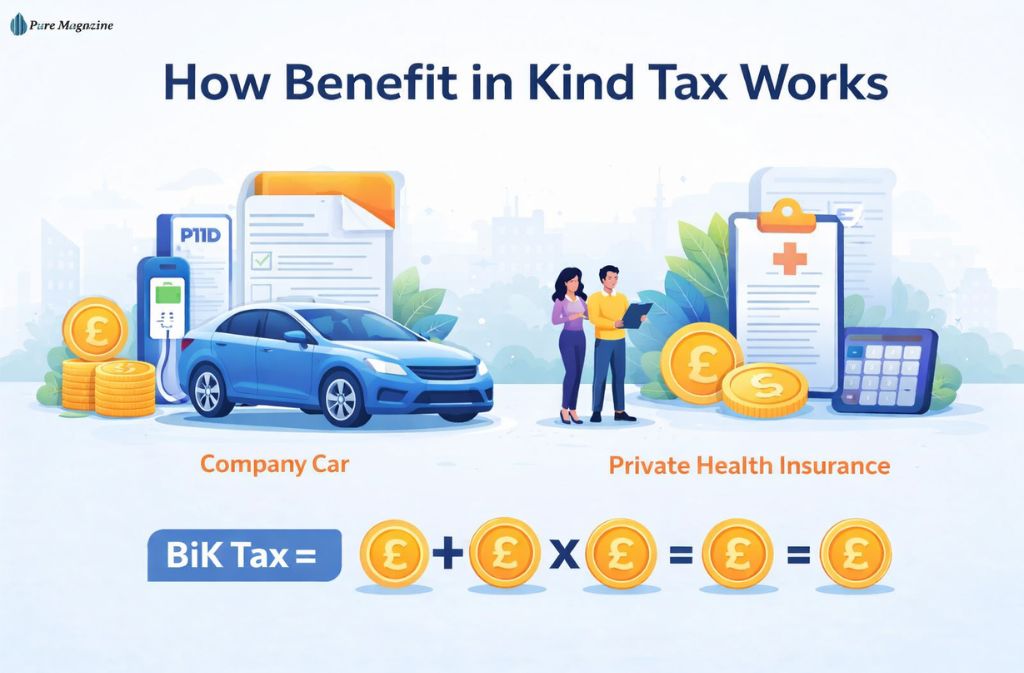
HMRC assigns a cash value to each benefit. The employer reports it — either through a P11D form or via payrolled benefits — and HMRC adjusts the tax code accordingly.
The formula is straightforward:
BiK Tax = Benefit Value × Your Income Tax Rate
Example 1: Company car
- Car list price (P11D value): £30,000
- BiK rate: 25%
- Tax band: 20%
Taxable value = £7,500 → Annual tax = £1,500
Example 2: Private health insurance
- Annual cost: £1,200
- Tax band: 40%
Annual tax = £480
Mandatory Payrolling of Benefits: 2026 Update
Payrolling means taxing benefits in real time through salary rather than reporting them after the year ends via P11D. As GOV.The UK’s payrolling benefits guidance confirms that mandatory payrolling was originally expected in April 2026 but has been deferred to April 2027.
What this means now:
- Employers can still voluntarily offer payroll benefits in 2026/27
- The deadline to register for voluntary payrolling was 5 April 2026
- 2026/27 is the final year before payrolling becomes compulsory
Companies that have already registered avoid the last-minute scramble when the mandate arrives next year.
Company Car BiK Rates (2026–2028)
Company car BiK tax depends on three things: the car’s P11D value (list price including VAT and options, excluding first registration fee), its CO₂ emissions, and your income tax rate. As Fleet News’ current BiK band guide confirms, these rates were legislated years ahead to give businesses planning certainty.
| Vehicle Type | CO₂ Emissions | 2026/27 BiK Rate | 2027/28 Rate |
|---|---|---|---|
| Fully electric | 0g/km | 4% | 5% |
| PHEV (70–129m range) | 1–50g/km | 7% | 8% |
| Hybrid | 51–99g/km | 10%–19% | 11%–20% |
| Petrol/diesel | 100g/km+ | 25%–37% | 25%–37% |
The diesel surcharge of 4% still applies to non-RDE2-compliant diesel vehicles on top of the standard rate. Understanding how this aligns with income tax bands determines the employee’s actual monthly cost.
Electric Cars and BiK Tax: The Real 2026 Picture
Electric vehicles remain by far the most tax-efficient company car option — even after the April 2026 rate increase.
As Electric Car Guide’s BiK analysis confirms, the 4% rate in 2026/27 compares with up to 37% for high-emission petrol or diesel cars. On a £40,000 vehicle:
| Vehicle Type | P11D Value | BiK Rate | Taxable Value | Basic Rate (20%) Tax | Higher Rate (40%) Tax |
|---|---|---|---|---|---|
| Electric | £40,000 | 4% | £1,600 | £320/yr | £640/yr |
| Petrol (100g/km) | £40,000 | 25% | £10,000 | £2,000/yr | £4,000/yr |
The gap is enormous — and it persists even as EV rates tick upward annually. As GOV.UK’s company car appropriate percentage publication confirms that rates through 2029/30 are already legislated, giving both employers and employees multi-year visibility for planning.
For employees considering whether to check their road tax obligations or to understand the full cost of a vehicle benefit, the P11D value is the starting point for all calculations.
The Expensive Car Supplement: 2026 Change
As Regit’s 2026 company car tax guide confirms, the threshold above which the Expensive Car Supplement applies increased from £40,000 to £50,000 in 2026. This is a meaningful change for EV drivers — many electric cars that previously triggered the supplement now fall below the new limit.
A £48,000 electric company car no longer attracts the extra charge. That’s a real and frequently overlooked saving.
Tax-Free Company Benefits
Not everything an employer provides triggers a BiK charge. As GOV.UK’s tax-free benefits overview confirms that common exemptions include:
- Workplace parking
- One mobile phone per employee
- Employer pension contributions
- Cycle to Work scheme bikes
- Reimbursed business travel expenses
If you’re unsure whether a specific perk is taxable, GOV.The UK’s A-to-Z benefits directory lists treatments for almost every category.
Who Pays What
Employees pay income tax on the benefit value. Employers pay Class 1A National Insurance — the rate for 2026/27 is 15%. That employer NIC cost is one reason some businesses now prefer salary sacrifice arrangements over direct benefit provision for certain perks.
What Is a P11D Form?
The P11D is the annual report employers file with HMRC detailing each employee’s benefits and their taxable values. As GOV.UK’s P11D submission guidance confirms that P11Ds must be filed by 6 July following the end of the tax year — and errors on the form flow directly into incorrect tax codes.
Common BiK Traps
The “free car” trap — a high-spec company car with a 25% BiK rate on a £35,000 list price generates a £8,750 taxable value. At 40% tax, that’s £3,500 extra tax annually — roughly £292 per month off take-home pay before seeing the car. Always calculate the actual tax before accepting the benefit.
The EV “tax-free” myth — low-tax is not no-tax. At 4%, a £40,000 EV costs a higher-rate taxpayer £640 per year. Still a bargain compared with petrol, but worth knowing.
The tax code blind spot — an incorrect tax code caused by a benefit reporting error can mean overpaying for months. A wrong tax code check through HMRC’s Personal Tax Account takes minutes and can surface a refund.
The “small benefit” calculation — private health insurance at £1,200 per year costs a 40% taxpayer £480 annually. Worth knowing before assuming the benefit is cost-free.
How to Reduce BiK Tax Legally
- Choose an electric or low-emission company car — the BiK rate gap versus petrol/diesel is still substantial through 2028
- Use a salary sacrifice scheme for EVs — as Electric Car Guide confirms, HMRC’s OpRA rules allow ULEV BiK to be calculated on the list price rather than the salary sacrifice amount, making the savings significant
- Opt out of benefits you don’t actually use — a gym membership or private health cover you rarely access still costs tax
- Review your tax code at the start of each tax year to confirm benefits are being taxed at the right value
Why BiK Rates Are Rising Through 2028
EV adoption is accelerating. As government incentives normalise and EV market share grows, the tax treatment is gradually moving toward parity with other vehicles — though parity remains years away at current trajectories.
For petrol and diesel cars, the 25%–37% rates are largely stable. The annual 1% EV increases through 2028 are the main movement, and as the numbers above show, even at 5% in 2027/28, the electric advantage remains decisive.
Quick BiK Reference (2026/27)
| Feature | 2026/27 Position |
|---|---|
| BiK definition | Non-cash benefit taxed as income |
| EV BiK rate | 4% |
| Petrol/diesel (max) | 37% |
| Employer Class 1A NIC | 15% |
| Mandatory payrolling | Delayed to April 2027 |
| EV luxury supplement threshold | £50,000 (up from £40,000) |
FAQs
Q. How much tax do you pay on a benefit in kind?
You pay income tax at your marginal rate (20%, 40%, or 45%) on the benefit’s taxable value. As GOV.UK’s BiK guidance confirms that the value depends on the type of benefit and how it’s calculated.
Q. What is benefit in kind tax, and how does it work?
HMRC assigns a cash value to non-cash employer benefits and taxes them as income through PAYE. The P11D form reports those values to HMRC annually.
Q. What is an example of a benefit in kind?
A company car is the most common — and most costly — example. On a £30,000 petrol car at 25% BiK, a basic-rate taxpayer pays £1,500 per year.
Q. Does BiK count as income?
Yes — it’s added to your taxable income and can push earnings into a higher tax bracket.
Q. Do you pay BiK on electric cars?
Yes — at 4% for 2026/27. As the Electric Car Guide confirms, the rate rises to 5% in 2027/28, but EVs remain dramatically cheaper than petrol or diesel alternatives at the same list price.
Conclusion
Benefit in kind tax is one of those areas where a small amount of understanding goes a long way. Once you know that HMRC treats non-cash benefits as income, that the P11D value is the starting number for every company car calculation, and that electric vehicles still offer a substantial tax advantage over petrol alternatives despite rising rates, the system stops being confusing and starts being manageable.
Review your benefits, calculate the actual tax cost, check your tax code, and consider whether salary sacrifice suits your situation. The savings available — particularly on electric company cars — are real and significant for anyone who plans.
For reliable, plain-English guidance on UK tax and personal finance in 2026, Pure Magazine is the resource worth bookmarking.