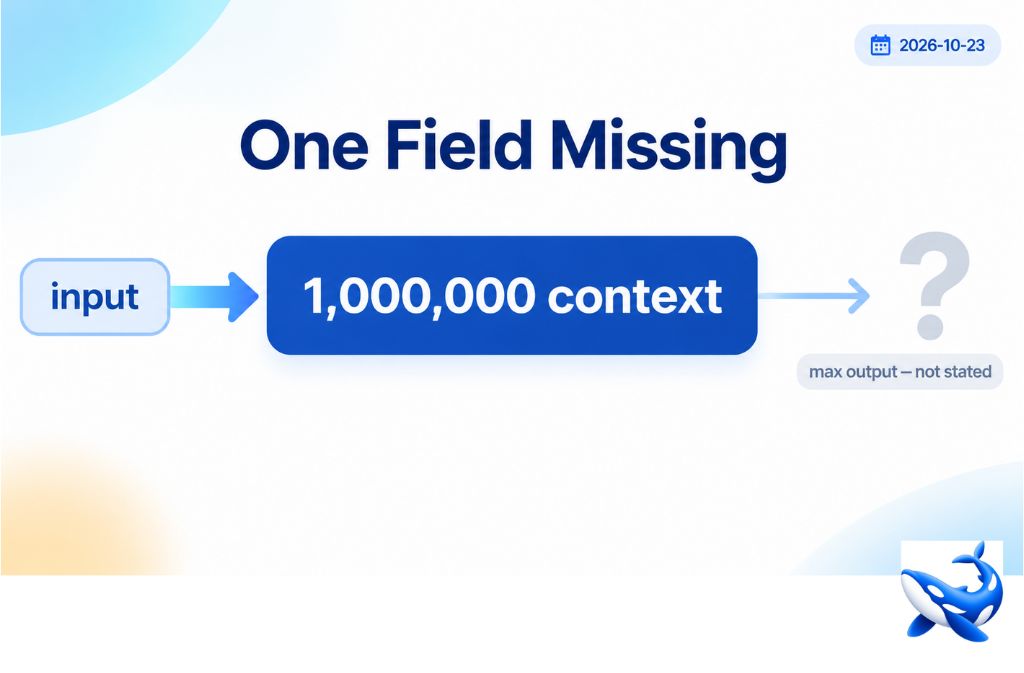
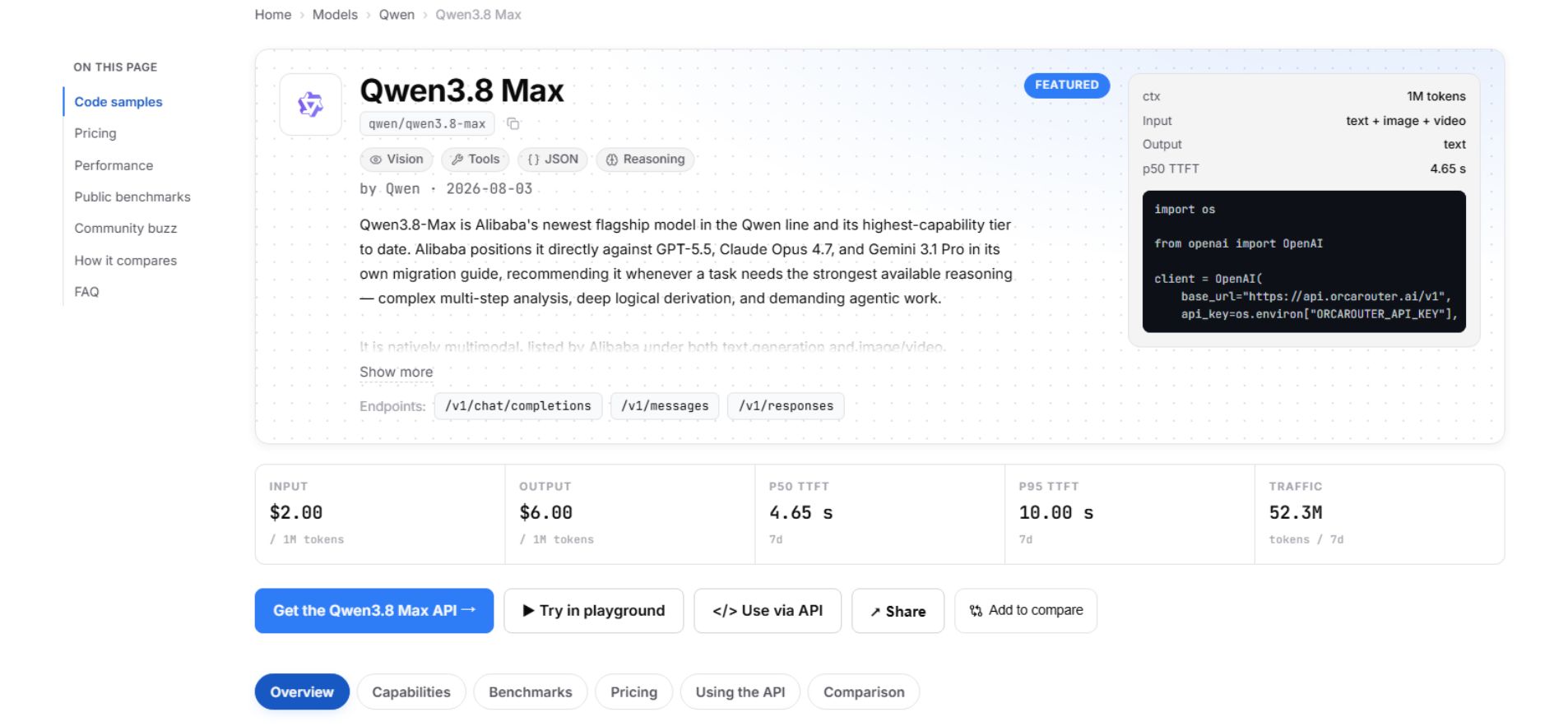
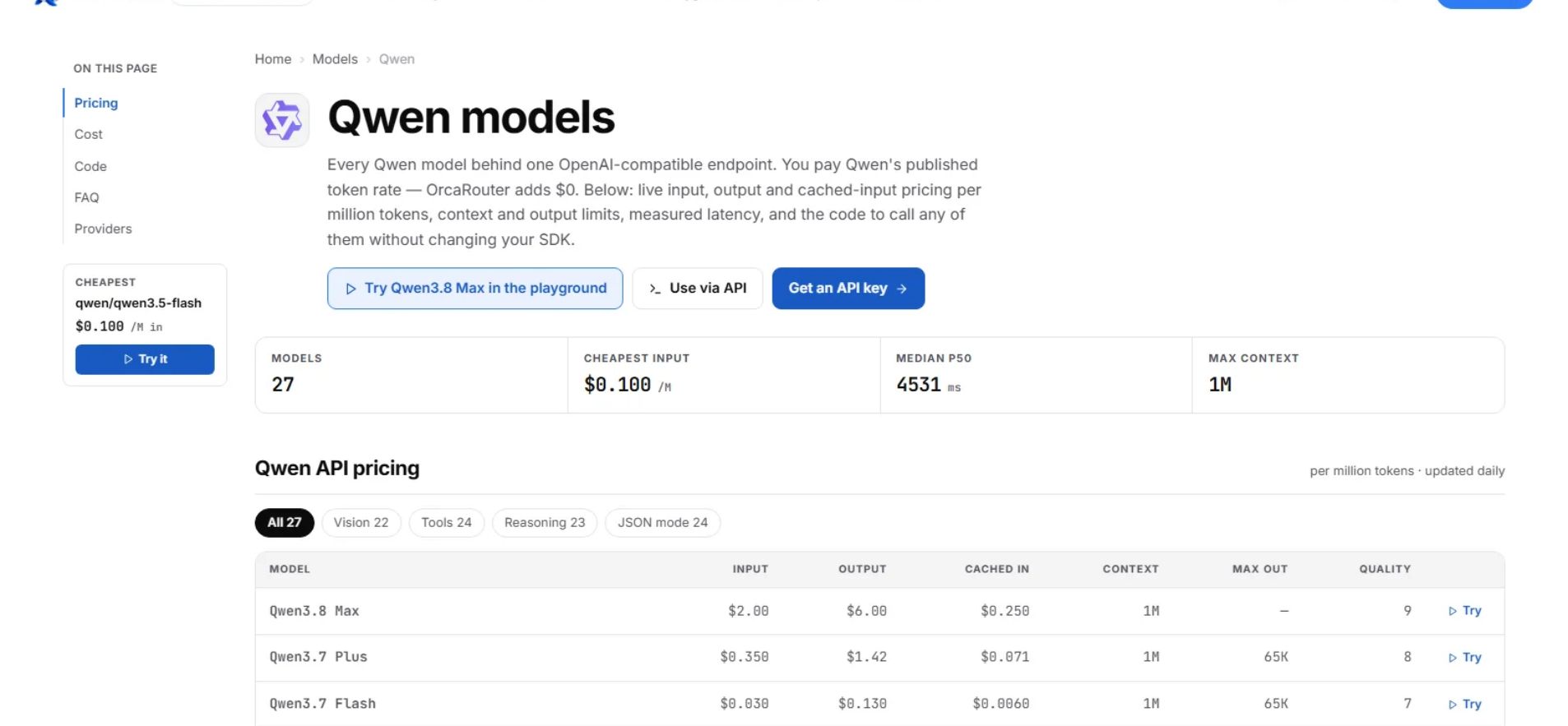
Qwen3.8 Max publishes a 1,000,000-token context window and a maximum output of 0 — which is not a ceiling of zero; it is the card declining to state one [OURS]. Two fields that normally arrive as a pair, and here only one of them has a value. The qwen3.8 max pricing query lands on a card that is otherwise complete. It is served by OrcaRouter.
The rate row
| Line | Rate per million | Against input |
| Input | $2.00 | 100% |
| Output | $6.00 | 300% |
| Cached read | $0.25 | 12.5% |
| Cache write | $2.50 | 125% |
An output ratio of 3×, a cached read at 12.5 percent, and a write at 1.25 times input — the same premium structure as the Anthropic family, applied at a fraction of the absolute price [OURS].
The break-even is short. Writing one million tokens costs $0.50 more than sending them plainly; reading that million back saves $1.75 per reuse. The premium is repaid in 0.29 reuses, so the first read covers it.
Why the missing output ceiling matters
On a card with a 1,000,000-token context, the output ceiling is not a minor field. It decides three things a buyer needs:
Whether a task fits at all. A model with a million-token window and a 4,096-token output ceiling cannot produce a long report from a long document. A model with the same window and a 128,000-token ceiling can.
What a run costs. Output is billed at three times input here. A job that reads 800,000 tokens and writes 60,000 costs $1.60 plus $0.36 — $1.96; the same job writing 200,000 tokens costs $1.60 plus $1.20 — $2.80 [OURS arithmetic on the published rates].
Whether truncation is silent or loud. A model that stops at an undocumented ceiling fails in a way the application may not detect.
The card publishes two of the three inputs to that arithmetic and leaves the third blank. That is a real gap on a premium card, and it is the kind of gap a reader only notices after the first long output came back cut.
The benchmark table is short but pointed
Nine rows, all from the independent evaluator [INDEPENDENT]:
| Row | Score |
| GPQA Diamond | 92.8 |
| terminalbench_v2_1 | 88.8 |
| Long-Context Recall | 80.3 |
| AA Coding | 76.2 |
| SciCode | 52.1 |
| tau_banking | 47.8 |
| AA Intelligence | 45.4 |
| Humanity’s Last Exam | 43.1 |
| terminalbench_v4_0 | 38.9 |
Two rows stand out. terminalbench_v2_1 at 88.8 is high — the Fable cards read 84.6 and 91.4, so this sits between them. terminalbench_v4_0 at 38.9 is the strongest position on the hardest generation among the cards in this batch that are not Fable-class.
Together they describe a model that handles long-horizon terminal work well, which fits the envelope: a million tokens of context and the ability to act on it for a sustained period.
Telemetry
Seven-day figures report 4,642 ms median time to first token, a p95 at the 10,000 ms ceiling, an error rate of 2.31 percent, and 63.5 output tokens per second [OURS]. Traffic was 51,895,592 tokens.
The generation speed is slow for this tier — the Gemini and Qwen Flash-tier cards run five to ten times faster — and it is consistent with a large model doing long-context work. A 2,000-token answer takes about thirty seconds of generation after the first token arrives.
The search position
The page earned 305 impressions over 28 days at an average position of 6.9, with two clicks [OURS: Search Console, 2026-09-24 to 2026-10-21]. It also carries 37 external links from earlier clusters, more than any card in this batch except the DeepSeek flagship.
So this page is not under-linked relative to its peers. It is at position 6.9 with a well-covered backlink profile, which means the remaining distance to the top is about page quality and query match rather than link volume — a different problem from the thin cards elsewhere in this batch.
The dominant queries are price phrasings: `qwen3.8 max pricing` at 35 impressions and 6.7, `qwen3.8 max price` at 27 and 6.6, `qwen3.8-max price` at 17 and 6.3. All page-one, all low click-through. That is a snippet problem, not a ranking problem.
The takeaway
Qwen3.8 Max prices at $2.00 input, $6.00 output, $0.25 cached read and $2.50 cache write per million tokens, with a 1,000,000-token context and no stated maximum output [OURS].
Its nine benchmark rows put it near the front on terminal work and long context — terminalbench_v2_1 at 88.8, v4.0 at 38.9 — which is what a million-token window is for. The blank output ceiling is the one field a buyer has to infer, and the card shouldn’t make them do that.
Sourcing note: the four rates, the context window, the empty maximum-output field, the nine benchmark values with their `source` fields, the FAQ and section counts, and the seven-day p50, p95, error rate, output speed and token total are read from the OrcaRouter public model card for `qwen/qwen3.8-max` on 2026-10-23 [OURS]. All rows are tagged artificialanalysis.ai [INDEPENDENT]. The break-even, the per-job arithmetic, and the reading of the missing ceiling are our own. Query, impression, click, and position figures are from Search Console for the 28 days to 2026-10-21 [OURS]; the external-link count comes from the historical link ledger. No competing gateway or inference marketplace is named. All values were checked on 2026-10-23.

For more, visit Pure Magazine