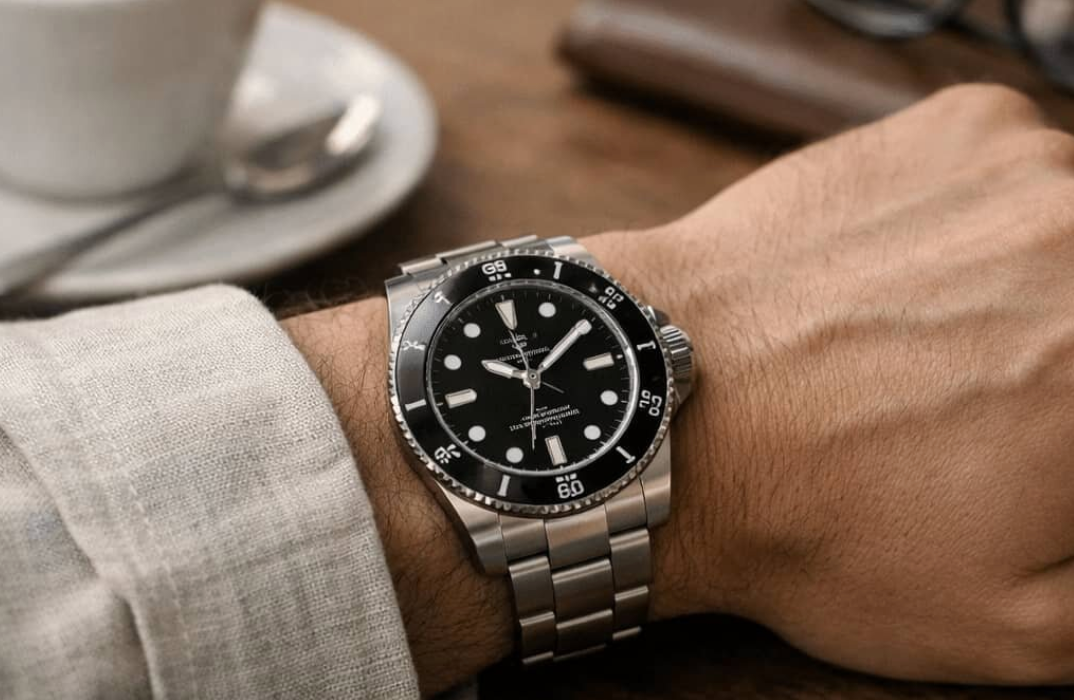
There’s a persistent tension at the heart of the Rolex Submariner market heading into 2026: the brand raised its official prices in January, yet buyers in the secondary market are still paying significantly more than the new, higher list price. For watch enthusiasts trying to make sense of what’s actually happening — and what various price figures really mean — clarity requires separating three very different data sources.
The Submariner has always been more than a specification sheet. It’s a watch people actually wear — to the office, on a dive trip, across a café table in morning light. That cultural staying power is part of why its pricing structure draws so much attention. But the numbers deserve to be read carefully.
This piece walks through the current market structure for three steel Submariner references, drawing on a February 2026 snapshot of available market data.
The Submariner has occupied a singular position in the luxury watch world for decades, but the 2020 generation refresh brought renewed attention to three specific references: the date-free 124060, the classic black-bezel 126610LN, and the iconic green-bezel 126610LV. All three are steel-cased sports watches routinely cited as benchmarks for secondary market pricing, and all three were affected by Rolex’s January 2026 price adjustment in Germany.
Understanding these models isn’t just watch-geek trivia. Their market behavior reflects broader dynamics in the collectible watch space — including the persistent gap between what a brand officially charges and what real buyers actually pay.
The 2020 Generation in Context
The 126610 series entered production in 2020, replacing the previous reference family with movement upgrades and revised case detailing. The date-free 124060 followed, completing a three-watch steel lineup. Since then, all three have been through multiple rounds of price adjustments, culminating in the January 2026 revision. What’s notable is that each price increase has not compressed the secondary market premium — it has simply relocated the floor.
A note on historical scope: while the trajectory of the 126610 series since its 2020 launch is an interesting backdrop, the 2020–2023 period lacks a continuous, unified price dataset from a single source. The pre-2024 market behavior is useful as qualitative context, but it should not be mathematically compared to the 2026 snapshot figures presented in this article — the data sources and methodologies are not equivalent.
Official German Prices vs. What the Market Shows
Deutsche UVP After the January 2026 Adjustment
Rolex’s official German retail prices (UVP — Unverbindliche Verkaufsempfehlung) as of the 2026 adjustment are:
| Reference | German UVP (EUR) | Notes |
| 124060 | €9,750 | Date-free, 41mm case |
| 126610LN | €10,950 | Black bezel, date |
| 126610LV | €11,500 | Green bezel, date |
These are authoritative figures. They represent what a German authorized dealer would charge if they had stock available — a significant “if,” given persistent supply dynamics across the steel sports watch segment.
Chrono24: Listing Prices, Not Transaction Prices
A February 14, 2026 snapshot of Chrono24 — one of the most widely referenced watch marketplaces in Europe — shows the following asking price ranges for EU-based sellers:
- 124060: approximately €11,650 – €12,900
- 126610LN: approximately €11,000 – €16,900
- 126610LV: approximately €12,225 – €14,754 (note: this range reflects a broader filter, not a strict EU-only view)
Chrono24 displays asking prices, not completed transaction prices. Sellers set their own figures, and the market does not confirm that every listed watch sells at the stated amount.
The spread between the floor and ceiling on the 126610LN — over €5,000 — reflects condition variance, seller confidence, and supply fragmentation rather than a uniform “market price.” For the 124060 specifically, the premium over official UVP falls in the range of approximately +19% to +32% based on the EU listing window.
Understanding the Data: Why EUR and USD Figures Must Stay Separate
WatchCharts as a USD-Based Proxy Indicator
WatchCharts provides an algorithmic price index — a useful proxy for tracking relative value trends across time, but denominated in USD and built from a data model that aggregates global signals. As of the same February 2026 snapshot period, WatchCharts shows the following proxy levels:
- 124060: ~$12,060 (Americas feed) / ~$12,133 (Global feed)
- 126610LN: ~$13,586 (Americas feed) / ~$13,566 (Global feed)
- 126610LV: ~$14,398 (Americas feed) / ~$14,164 (Global feed)
These numbers are not German market prices. They are not transaction-confirmed sales. Converting them to euros at a prevailing rate and comparing directly to UVP figures would produce misleading conclusions — the methodology, the currency, and the market scope are all different. WatchCharts is best used for trend direction over time within its own dataset, not as a cross-currency price reference.
Why the Methodology Gap Matters
One of the most common mistakes in watch market commentary is treating three different price sources as if they describe the same thing:
- German UVP — what the brand recommends dealers charge (euros, Germany, authorized channel)
- Chrono24 EU listings — what individual sellers are asking (euros, mixed EU sellers, pre-sale)
- WatchCharts index — algorithmic proxy value (USD, global inputs, model-based)
Conflating them — or converting between them without acknowledging the structural differences — produces figures that sound precise but aren’t grounded in the same reality.
A practical illustration: WatchCharts’ Americas proxy for the 124060 converted at a prevailing EUR/USD rate (approximately in the 1.03–1.05 range during this period) may appear to align numerically with the Chrono24 floor estimate. But this apparent alignment is coincidental. The two datasets draw on different transaction pools, different geographic scope, and different methodology — they are useful in parallel, not as cross-validation of each other.
Market Structure: What the Premium Actually Reflects
Liquidity, Demand, and Supply Constraints
The premium for the 124060 remains solid at +19% to +32% over German UVP — not arbitrary, but reflecting a structure where authorized dealer availability appears restricted relative to demand — a pattern commonly observed across Rolex steel sports references.
Secondary market sellers may factor in sourcing costs and intermediary considerations when setting prices. The 2026 price adjustment raised the official floor but did not appear to resolve underlying supply-side dynamics.
The same dynamic applies to the 126610LN and 126610LV, with the green-bezel model historically tending to command a wider premium — a pattern often associated with stronger collector demand and what may be comparatively tighter availability relative to the black-bezel variant.
The 126610LV occupies a particular niche. Its green ceramic bezel and dial combination has generated sustained collector interest since its 2020 introduction, partly because it carries forward the cultural cachet of earlier green-bezel Submariner generations while offering a technically superior movement. The February 2026 data reflects this: the 126610LV’s Chrono24 range starts at roughly €12,225 against a UVP of €11,500 — a floor premium of approximately +6%, with the ceiling extending considerably further for sought-after configurations.
One important caveat: unlike the 124060 and 126610LN figures, the 126610LV Chrono24 data in this snapshot reflects a broader geographic filter rather than a strict EU-only view. This means the +6% floor premium may be somewhat conservative in a pure EU context, and readers should factor in this statistical scope difference when comparing it directly to the other two references.
It’s worth paying close attention to Chrono24’s wide listing range for the 126610LN (€11,000–€16,900). Watches at the top of that range are likely in exceptional condition, unworn, or accompanied by full documentation. But the floor end — approximately €11,000 — sits almost exactly at the official UVP of €10,950. This means that under certain conditions (private sales, specific provenance, or motivated sellers), the black-bezel 126610LN is approaching return-to-retail territory. That’s a striking contrast to the 124060, which maintains a firm +19% to +32% premium above its official price with no comparable floor compression. The two models tell meaningfully different stories about where secondary market appetite currently sits.
A Note on What Premium Data Doesn’t Tell Us
A premium over list price is not, by itself, evidence of value retention or a directional signal. It reflects current supply-demand conditions in a specific market at a specific point in time. Conditions change: interest rates, consumer sentiment, currency fluctuations, and production and pricing decisions all affect the dynamic.
For context, the 2023–2024 period saw Submariner premiums compress significantly from earlier peaks. The 2026 snapshot shows a stabilized but still elevated premium structure — not a repeat of earlier volatility, but not a fully normalized market either.
For readers seeking a more detailed breakdown of the current EU premium landscape and how German UVP compares to observed market activity, a detailed Submariner market breakdown (detaillierte Analyse zum Submariner Markt) on KönigUhren offers an in-depth reference with additional model-level data. For collectors tracking real-time fluctuations beyond this snapshot, the German-language analysis provides additional granularity on listing volumes, reference-level spreads, and updated pricing context.
Conclusion: Reading the 2026 Submariner Market Clearly
The headline finding from the February 2026 data snapshot is straightforward: all three steel Submariner references trade above their official German prices in the secondary market, the January 2026 price increase has not eliminated that premium, and the premium’s persistence reflects structural supply conditions rather than speculative frenzy.
Chrono24 figures are asking prices, not sold prices. WatchCharts figures are USD proxies, not EUR market prices. The 2020–2026 pricing narrative lacks a continuous, unified dataset — the pre-2024 period is background context, not same-source evidence.
This piece does not constitute investment advice, purchase guidance, or a recommendation of any kind. It is an analysis of market data as observed at a specific snapshot date, for readers who want to understand the Submariner’s pricing dynamics with appropriate nuance.
Data note: Charts and comparisons in this article are based on the author’s own snapshot analysis. Price ranges reflect Chrono24 EU listing data as observed on 2026-02-14; WatchCharts figures reflect the platform’s algorithmic proxy index for the same period. German UVP figures are Rolex official retail prices for the German market.
About the Author: This analysis draws on market data compiled by the team at KönigUhren, a watch market resource covering European pricing trends and secondary market analysis.
For more, visit Pure Magazine