Reach for your phone, find the part, and have it on your doorstep tomorrow. For growing numbers of BMW owners across the UK, that’s become the norm, and it’s a very different experience from the days of calling around local yards or sitting in a dealership parts department waiting for a quote.
The Old Way of Finding BMW Parts
Not so long ago, sourcing a replacement BMW part followed a predictable sequence. You’d call your local garage. They’d call a motor factor. The motor factor would check whether a used part was available locally or whether a new OEM part needed to be ordered from a central warehouse. With luck, you’d have what you needed in three to five days. Without luck, you’d hear “two weeks”, and the wait would begin.
For common parts on common cars, the local supply chain worked reasonably well. But BMW ownership has always presented a particular challenge. These are precisely engineered vehicles, and the degree of variation between models, model years, trim levels, and engine variants means that the part you need is rarely the most generic item on the shelf. A G30 520d built in late 2019 doesn’t share all its components with one built in early 2018. An F30 330i and an F30 330d are similar cars, but require different components in any number of places. Local motor factors, however well-stocked, simply cannot hold this breadth of inventory.
That gap, between what BMW owners need and what’s physically available nearby, is precisely why buying BMW parts online has become the smarter and, increasingly, the faster choice.
The Numbers Behind the Shift
The UK’s car aftermarket is substantial. The sector was valued at £7.8 billion in 2025, with online purchasing forming a growing share of that total. A separate analysis puts the UK’s online automotive goods retail sector at £3.1 billion in 2025, having grown at a compound annual rate of 3.6% between 2019 and 2024. Meanwhile, European e-commerce in automotive aftermarket parts was valued at approximately £25.4 billion in 2024 and is projected to reach around £81.5 billion by 2034, a growth rate of 11.9% annually that reflects a structural, not cyclical, shift in how drivers buy car parts. The driver behind that shift is not simply convenience. It’s speed, accuracy, and availability — three areas where specialist online suppliers consistently outperform their local counterparts.
And the cost-of-living context matters too. Research found that 72% of UK motorists are actively seeking cheaper maintenance and repair options, rising to 92% among drivers aged 17 to 44. That’s not a niche behaviour. It’s the mainstream BMW-owning public, and they’re looking online.
Why Online Suppliers Often Deliver Faster
It seems counterintuitive at first. Surely a local factor with a van doing same-day runs is quicker than a warehouse dispatching parcels through a courier network? In practice, the logic often reverses, though not always, and not automatically. Here’s why online tends to win, and where the honest caveats lie.
1. Stock Is Actually Available
A local motor factor or BMW breakers yard can only hold what physically fits in its space. For common cars with common parts, that works reasonably well. For BMW specifically, with its generational complexity across newer series models, its multiple engine codes, its electrified lineup from the i3 through to the iX and i7, and its extensive range from 1 Series through to 8 Series and X1 to X7, local stock depth rarely matches what owners actually need.
The online market, collectively, is a different proposition entirely. A buyer can search across dozens of specialist breakers, national parts networks, and marketplace platforms simultaneously. Aggregator sites connect buyers to hundreds of independent suppliers across the UK in a single search. Dedicated BMW specialists hold deep, structured inventories for specific model generations. General online retailers carry OEM and aftermarket parts for virtually every variant. In 2024, roughly 25% of all UK auto parts sales were made online, driven largely by the simple fact that what buyers need is more reliably found online than through local channels.
Stock coverage does vary by seller type. A specialist breaker focused on newer models will hold strong, well-catalogued inventory for those generations but may not cover older or rarer variants as thoroughly. For pre-2012 cars or less common configurations, broader marketplace platforms tend to be the better starting point. The structural advantage online holds isn’t that any single seller stocks everything; it’s that the combined availability across the online market vastly exceeds what any local yard can offer.
2. Dispatch Is More Structured — But Speed Varies Considerably
Local yards and motor factors tend to operate on reactive, informal logistics. A part needs to be located, its condition assessed, a price agreed, and delivery or collection arranged separately, often over multiple conversations. Each step introduces friction, and friction introduces delay.
Most established online sellers have more systematic processes in place. Stock is catalogued, orders are processed digitally, and courier collections happen on regular schedules. For smaller parts, that typically means next-day or two-day delivery once dispatched. For heavier items, engines, gearboxes, and body panels, specialist freight is usually required, and delivery across the UK market generally runs to two to five working days, depending on the seller’s logistics arrangements.
That said, delivery speeds across the online market vary significantly and are not universally fast. Reviews of general online parts retailers include accounts of orders taking four to ten working days just to be dispatched, before the courier has even been collected. Smaller or less organised online sellers can be slower than a well-stocked local factor. The speed advantage online suppliers hold comes from the better-run end of the market: sellers with high order volumes, organised warehouses, and established courier relationships. These exist across the online BMW parts space, from large OEM retailers to specialist breakers, but they are not universal, and it pays to check delivery commitments and recent reviews before ordering anything urgent.
3. No Dead Ends — Usually
Perhaps the single most time-consuming aspect of sourcing parts locally is the dead end. The call that ends with “we haven’t got one.” The drive to a yard that turns out not to carry the right variant. The inquiry goes unanswered because the relevant person isn’t available on that day.
Online catalogues eliminate much of that friction. If a part is listed and in stock, you order it. If it isn’t there, you know in seconds and move on, no wasted journey, no afternoon spent on hold. Incorrect orders and returns in automotive e-commerce remain a genuine issue, with industry research suggesting return rates of 5–7% in the consumer segment, often caused by catalogue errors or fitment mismatches. This is particularly relevant for BMW, where trim levels, production dates, and option codes can affect compatibility in ways that generic listings don’t always capture.
The best online suppliers manage this with VIN-based searching, detailed part descriptions, and knowledgeable customer support. The weaker end of the market relies on registration lookups that don’t always account for mid-production changes, which is one reason BMW-specific knowledge, wherever it sits, tends to produce better outcomes than generic catalogue searches. For independent garages managing tight schedules, and for private owners who can’t afford to wait for a return and reorder, getting fitment right the first time is arguably more important than how fast the part arrives.
The Specialist Advantage: Why BMW-Only Beats General
There is an important distinction to draw within the online parts market. A large general retailer carrying millions of parts for every make and model is not the same as a specialist BMW-only supplier, and for BMW owners, that difference is tangible.
The complexity of modern BMW engineering means that part compatibility is rarely as simple as it appears. A headlight assembly might look identical across two variants of the same model but differ in its electrical connectors, control module, or adaptive lighting linkage. An automatic gearbox from a particular production period may require specific software coding that later units don’t. Getting this wrong means a part that doesn’t fit, a return, and lost time. Getting it right, first time, requires BMW-specific knowledge, the kind that general retailers simply don’t carry.
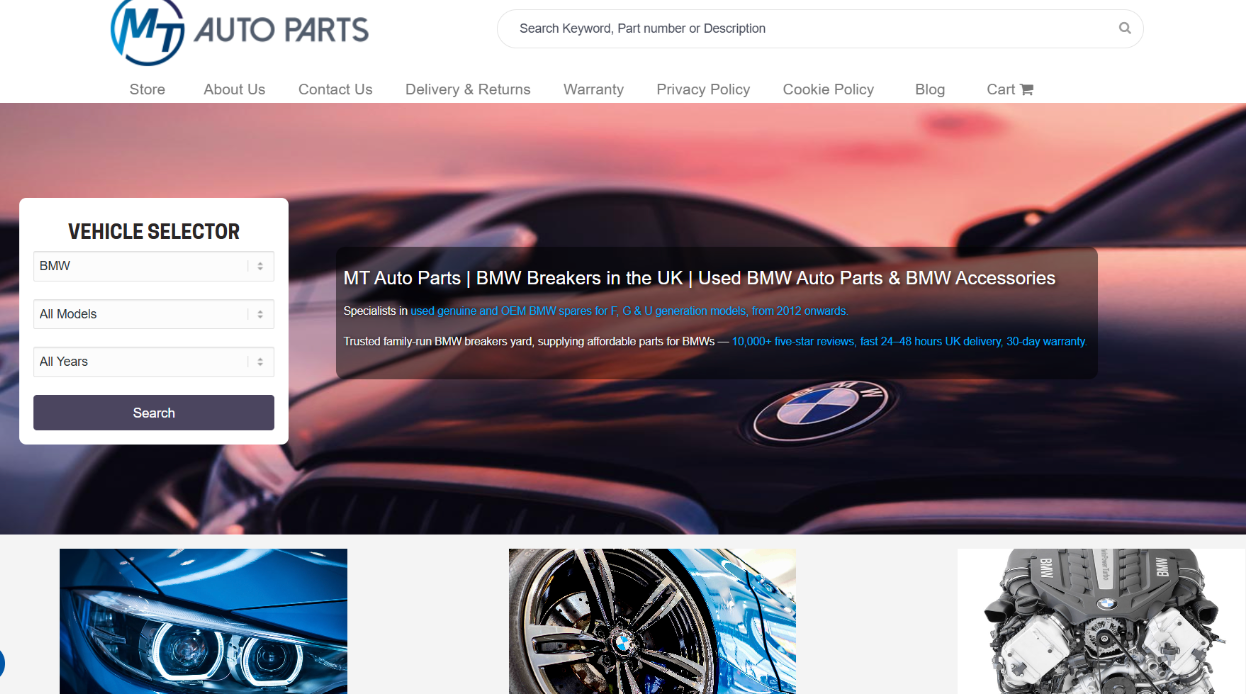
This is where suppliers like MT Auto Parts, one of the UK’s leading used BMW spares online suppliers, make a genuine practical difference. Based in Thurnscoe, South Yorkshire, MT Auto Parts operates exclusively within the BMW world, covering F, G, and U generation models from 2012 onwards. With over 14,000 customer reviews and an inventory running into tens of thousands of used BMW spares — lights, alloy wheels, complete engines, gearboxes, exhausts, body parts, interior components, electrical systems, drivetrain parts, and more — the operation is purpose-built for the kind of accurate, rapid fulfilment that general suppliers cannot replicate.
When an owner or garage needs a BMW part, the ability to speak with someone who knows the difference between an N47 and a B47 engine without looking it up is not a luxury. It’s the difference between ordering the right part and ordering the wrong one.
Buy Genuine BMW Parts Online: The Quality Question
One of the reservations some BMW owners carry about buying used BMW parts online relates to quality. It’s an understandable concern, and one that legitimate specialists address head-on.
The parts sold by reputable online BMW specialists are, in the vast majority of cases, genuine or OEM quality BMW components. They were fitted to real BMW vehicles at the factory and have been carefully dismantled from donor cars. In practical terms, when you buy genuine BMW parts online from a specialist breaker, you’re getting the same component you’d receive from a BMW dealer, minus the dealer markup, and often faster.
Each listing from a credible supplier clearly states the part type (genuine BMW, OEM-equivalent, or aftermarket), its condition, and its compatibility. Transparency is not optional here; it’s what distinguishes trustworthy suppliers from the rest. MT Auto Parts, for example, makes clear that its stock is predominantly genuine BMW, dismantled in-house, with OEM-equivalent or aftermarket parts only appearing where that’s what was originally fitted to the donor vehicle. Almost all used BMW parts sold by established online specialists come with some kind of warranty, a baseline that reflects real confidence in the product being sold. That’s not something every local yard offers.
Used BMW Parts Online: The Smart Buyer’s Calculation
The phrase “used BMW parts online” still carries a faint stigma in some quarters, as if buying second-hand necessarily means buying inferior. The reality, in 2025, is considerably more nuanced.
A used genuine headlight assembly, removed from a low-mileage BMW and sold with a warranty, is almost the same component that a dealer would sell you new, at a fraction of the price. The component itself hasn’t changed. The only variable is mileage and wear, both of which a reputable supplier assesses and communicates honestly. For body panels, interior trim, lighting units, alloy wheels, infotainment systems, many electrical components, engines and other car spares, using genuine parts makes obvious practical sense.
For safety-critical components — and for consumables like brake pads, oil filters, and timing belts, which responsible specialists don’t sell used at all, new OEM parts remain the right choice. The distinction isn’t complicated, and it’s one that BMW-specialist suppliers make clearly, rather than obscuring it.
The financial case is compelling. Depending on the part, sourcing used BMW spares online from a trusted specialist can reduce costs by as much as 70% compared to new dealer pricing. For high-value items like complete engines, gearboxes, or turbochargers, the savings can be measured in hundreds or thousands of pounds.
Delivery: The Final Piece
Delivery expectations in the online BMW parts market vary more than the headline promises suggest. Many established online suppliers offer free standard delivery on lighter items, with next-day or two-day windows quoted prominently. In practice, actual delivery speed depends on the seller’s logistics setup, the courier they use, the weight of the part, and where in the UK the buyer is located.
For smaller components, sensors, interior trim, lighting units, and electrical modules, next-day delivery is genuinely achievable from well-organised online suppliers, and free delivery thresholds are common once an order reaches a modest minimum value. Heavier items tell a different story. Engines, gearboxes, bumpers, and other bulky components require specialist freight, and two to five working days is a more realistic expectation across most of the market, with additional charges applying almost universally regardless of the seller.
The better-run end of the online market does set a meaningful standard. MT Auto Parts, for example, offers free standard delivery within 48 hours to UK mainland addresses for items under 20 kg, with smaller parts often arriving the next working day, a commitment that reflects genuine investment in logistics rather than just a marketing claim. Not every online seller operates at that level, but it illustrates what’s possible when a specialist builds its systems around volume and reliability.
The Bottom Line
Buying BMW parts online has moved from niche behaviour to mainstream practice. And for good reason. The combination of genuine inventory depth, BMW-specific expertise, systematic dispatch logistics, and transparent product information means that established online specialists regularly outperform local alternatives on every measure that matters: availability, speed, accuracy, and price.
For BMW owners across the UK, the question is no longer really “should I buy online?” It’s “which online specialist do I trust?” — and the answer to that question starts with the supplier’s focus, their track record, and the clarity with which they describe what they’re selling.
MT Auto Parts specialises exclusively in used BMW parts for F, G, and U generation models (2012 onwards), with over 14,000 customer reviews, free standard 48-hour delivery across the UK mainland, and a 30-day warranty on almost all parts. Browse the full live inventory at mtautoparts.com.
For more, visit Pure Magazine