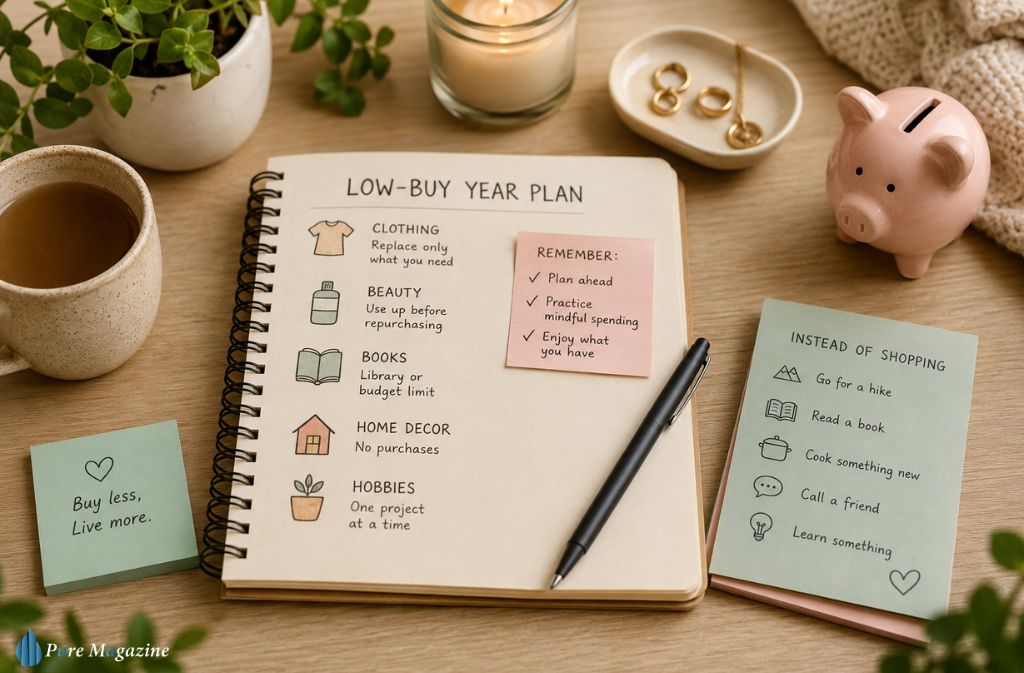
A low-buy year is a self-imposed challenge where you set spending limits on non-essential purchases instead of cutting them out completely. It’s different from a no-buy year, which eliminates nearly all discretionary spending. As Clever Girl Finance explains, a low-buy year allows some spending, but only within limits you define ahead of time.
Nobody hands you those rules. You build them around your own spending habits — which is exactly why so many people search for a template instead of starting from a blank page.
This guide covers the actual steps: reviewing your spending, choosing categories, writing rules you’ll realistically keep, and tracking progress without overcomplicating it. You’ll get a copy-paste rules template and a clear comparison to a full no-buy year.
What Rules Actually Go Into a Low-Buy Year?
A low-buy year’s rules cover three things: which categories you’re limiting, how much you can spend in each, and what exceptions you’ll allow before you start. The best templates come from your own bank statements, not a generic list pulled off the internet.
Start with the diagnostic step nearly every experienced low-buyer recommends. Pull three to six months of bank and credit card statements and see where the money actually goes, rather than guessing. Skip this step and your rules will either miss your real problem area or restrict something you barely spend on anyway.
Once you know your patterns, common categories to limit include clothing, beauty and skincare products, tech, books, home decor, and hobby supplies. One rule shows up again and again across long-time low-buy bloggers: don’t repurchase a consumable — toiletries, makeup, pantry staples — until the one you have is fully used up. It costs nothing to set up, and it’s one of the more durable places to start.
How Do You Write Rules You’ll Actually Keep?
Rules that survive a full year share three traits: they’re specific, they’re written down before temptation hits, and they leave room for real life. “Spend less” rarely survives past February. A list with categories and dollar amounts usually does.
A few patterns show up repeatedly among people who’ve finished a full low-buy year:
- Define “low” per category, not just overall. Mint Notion’s guide describes setting a firm dollar cap — say, a fixed clothing budget for the year — or a specific short list of needed items, like one pair of replacement running shoes, instead of an open-ended “buy less clothes” rule.
- List pre-approved exceptions before the year starts. One low-buy writer’s plan included a defined clothing budget for a specific trip and a handful of named big-ticket exceptions — a bookshelf, nightstands, wall art — decided in advance rather than negotiated in the moment, as documented on Substack.
- Call them guidelines, not rules. Some low-buy communities avoid the word “rules” on purpose. The point of the list is to clarify what counts as a staple versus a discretionary purchase — not to treat spending as inherently bad.
- Pick an honest timeframe. A full year can feel like too much upfront. Starting with a low-buy week, month, or quarter is a legitimate way to test your rules before committing to twelve.
Here’s the trade-off most generic templates skip: rules that are too rigid tend to backfire. Willpower is a finite resource, and a low-buy year that feels punishing burns through it fast. That’s worth naming before you write your rules, not after you’ve already broken one.
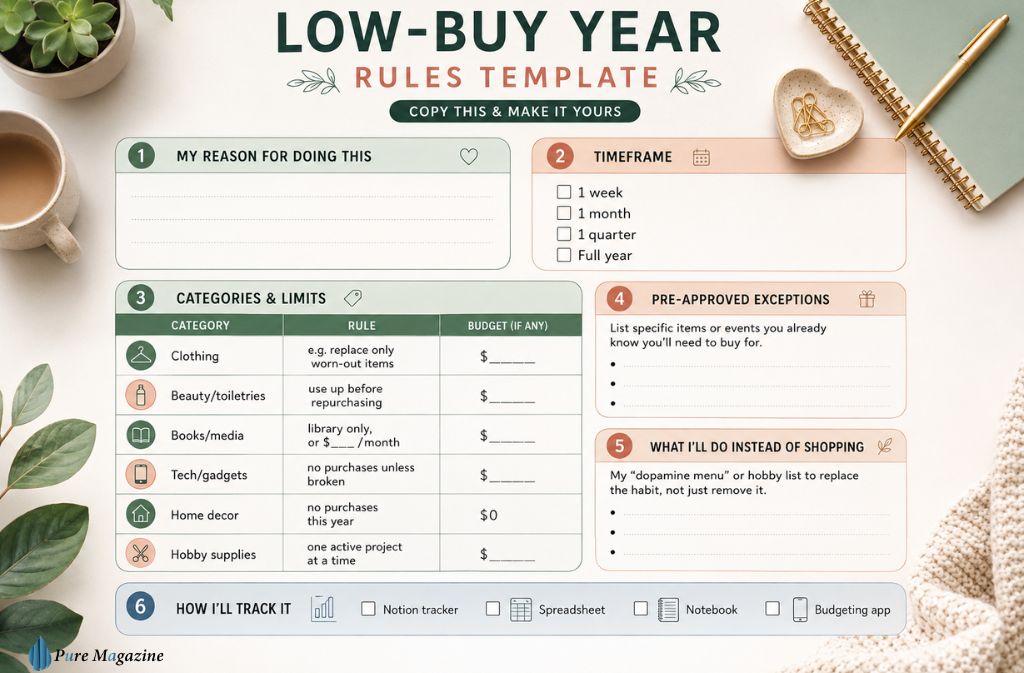
Low-Buy Year Rules Template (Copy This)
Use this as a starting structure, then fill it in with your own numbers from your spending review.
1. My reason for doing this: (e.g., pay off debt, declutter, break impulse-buying habits)
2. Timeframe: ☐ 1 week ☐ 1 month ☐ 1 quarter ☐ Full year
3. Categories and limits
| Category | Rule | Budget (if any) |
|---|---|---|
| Clothing | e.g. replace only worn-out items | $___ |
| Beauty/toiletries | use up before repurchasing | $___ |
| Books/media | library only, or $___ /month | $___ |
| Tech/gadgets | no purchases unless broken | $___ |
| Home decor | no purchases this year | $0 |
| Hobby supplies | one active project at a time | $___ |
4. Pre-approved exceptions (list specific items or events you already know you’ll need to buy for)
5. What I’ll do instead of shopping (a “dopamine menu” or hobby list some low-buy trackers include, to replace the habit rather than just remove it)
6. How I’ll track it ☐ Notion tracker ☐ Spreadsheet ☐ Notebook ☐ Budgeting app
Is a Low-Buy Year Different From a No-Buy Year?
Yes. A low-buy year permits planned, budgeted spending in certain categories. A no-buy year aims to eliminate nearly all non-essential purchases. The right choice depends on whether moderate limits keep you accountable, or whether you need a harder line to break a habit.
As Tidymalism’s no-buy guide puts it, a low-buy allows a small, planned budget for non-essentials, which tends to feel less restrictive — often the more approachable first step. A no-buy year is generally aimed at people who feel their shopping is out of control and want a full reset, not a moderated approach.
Neither is objectively better. A low-buy year suits people who overspend but don’t feel out of control. A no-buy year suits people who’ve found that any spending room reopens the habit. If you’re not sure which describes you, start with the low-buy year — you can always tighten the rules mid-year if a category isn’t working.
Managing the money side of this alongside your broader habits is its own skill; if budgeting itself feels like the harder problem, Pure Magazine’s guide to financial self-care covers that groundwork separately.
What Should You Do Instead of Shopping?
Replacing the habit, not just removing the purchase, is what separates a low-buy year that lasts from one that fizzles by March. Several trackers built for this challenge set aside space for alternative activities, precisely because willpower alone tends to run out.
Practical replacements that show up across low-buy templates: start a new hobby, join a hiking group, learn a language, get into cooking — anything offering the novelty that shopping used to provide. Some Notion-based trackers formalize this as a “dopamine menu,” a pre-made list of free or low-cost activities to reach for instead of a cart. If your impulse to shop is tangled up with phone habits or late-night scrolling, Pure Magazine’s digital decluttering checklist tackles that trigger directly.
Expect friction early. The first few weeks tend to be the hardest, since you’re breaking an ingrained habit — and knowing that going in can keep a rough first month from turning into a reason to quit.
What’s the Risk of Setting the Wrong Rules?
Writing rules so strict you abandon the whole challenge is a bigger risk than overspending. So is writing rules so vague they never change your behavior. Both are avoidable with a bit of upfront planning.
Strict rules create an all-or-nothing trap. One slip feels like total failure, so people quit instead of adjusting. Experienced low-buyers get around this by treating rules as revisable guidelines rather than a locked contract. Tighten a category that’s still tempting you. Loosen one that turned out unrealistic. Neither move means restarting the year.
Vague rules fail differently. “Spend less on clothes” gives you nothing to check a purchase against, so every individual buy gets rationalized as the exception. Pair each category with either a dollar limit or a concrete trigger — “replace only when worn out” — and that problem mostly disappears.
Worth saying plainly: most of what’s published about low-buy years comes from personal finance bloggers and creators describing their own experience, not controlled research. Treat tactics like the use-it-up-before-replacing rule as strategies that have worked for a lot of people, not a guarantee for your particular income or spending pattern.
FAQs
Q. Do I have to commit to a full 12 months?
No. Starting with a low-buy week, month, or quarter is a common way to test your rules before deciding whether to extend to a full year.
Q. What’s the difference between a low-buy and a no-buy year?
A low-buy year sets budgeted limits per category. A no-buy year eliminates non-essential purchases almost entirely and is typically for people who want a harder reset.
Q. Can I still buy gifts during a low-buy year?
Most templates treat gifts as a pre-approved exception category with its own budget, rather than banning them — write your gift rule in before the year starts so you’re not deciding in the moment.
Q. What if I break a rule?
Experienced low-buyers generally recommend logging the purchase and adjusting the rule if it’s genuinely unrealistic, rather than treating one slip as reason to abandon the whole year.
Q. Do I need an app or template to track this?
No — a notebook works fine. Digital trackers (commonly built in Notion) just make it easier to see spending percentages and patterns over time if you want that level of detail.
Q. What should I buy first if something breaks?
Write your replacement/repair-first rule into your template ahead of time (e.g., repair before replace, or check secondhand first) so it’s not a judgment call under pressure.
Q. Is a low-buy year the same as a strict budget?
Not exactly — a budget usually caps total spending, while a low-buy year adds category-specific rules and triggers (like “use up before repurchasing”) on top of or instead of a strict dollar cap.
For more, visit Pure Magazine