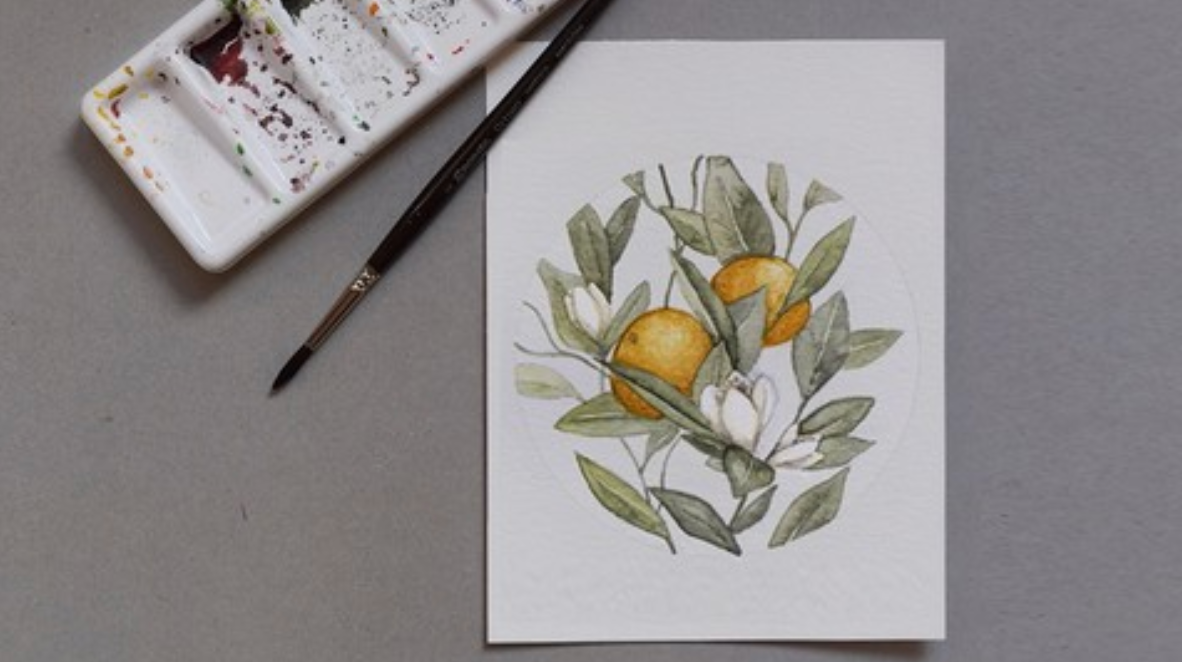
There is a quiet moment every artist remembers. It happens when a brush touches paper for the first time and pigment spreads like breath across water. That moment is where watercolor botanicals begin to feel alive. Not as drawings, but as living interpretations of nature.
You might be sitting at a small desk, sunlight hitting a glass of water, wondering why flowers look so different when you try to paint them. Real petals feel soft and unpredictable. Leaves twist in ways you did not plan. And yet, that is exactly where the beauty hides.
Many beginners expect control. Watercolor refuses that idea immediately. It flows, it bleeds, it surprises. And botanical subjects make that tension even more visible. A rose is not just a shape. It is layers, shadows, and fragile transparency.
In this guide, I want to walk you through everything I have learned from years of studying watercolor botanicals, including mistakes, breakthroughs, and the small discoveries that changed my entire approach to painting nature.
Why do watercolor botanicals feel so different from other art styles?
Watercolor botanicals feel different because they sit between structure and freedom. You are not just drawing a flower. You are translating organic life into controlled chaos.
The first time I painted a peony, I thought I could simplify it into shapes. Circles for petals. Lines for stems. But the result looked dead. The flower lost its rhythm. That was my first real lesson in watercolor botanicals: nature does not follow geometry.
Flowers move with light. Leaves shift with air. Even a still plant carries motion inside it.
When artists like Maria Sibylla Merian documented plants in the 17th century, they were not just illustrating. They were observing ecosystems. Modern artists continue that tradition, even when painting loosely.
The emotional pull of watercolor botanicals comes from this tension:
- Control versus surrender
- Structure versus flow
- Observation versus interpretation
Once you accept that balance, your work changes.
A personal mistake that changed everything
I once spent three hours painting tulips with tight outlines. It looked perfect technically. But it felt lifeless. A mentor looked at it and said, “You are drawing flowers. Not feeling them.” That sentence stayed with me. Since then, every watercolor botanicals piece I create begins with emotion, not outline.
What materials actually matter in watercolor botanicals?
People often overcomplicate supplies. I did too. I bought expensive paints, thinking quality alone would fix my results. It did not.
In watercolor botanicals, materials matter, but not in the way beginners expect.
The essentials are simple:
- Cold press paper with texture
- A round brush in sizes 2 to 8
- Artist-grade watercolor pigments
- Clean water control system
Brands like Winsor & Newton, Schmincke, and Daniel Smith are widely used. I personally prefer Daniel Smith for granulating colors because they add depth to petals.
Paper matters more than paint. A cheap sheet ruins flow control. I learned this after wasting an entire sketchbook of peonies that buckled and blurred uncontrollably.
Common beginner misunderstanding
Many think more colors equal better results. In reality, watercolor botanicals rely on restraint.
A limited palette forces harmony. I often use only five pigments:
- Ultramarine Blue
- Quinacridone Rose
- Burnt Sienna
- Sap Green
- Yellow Ochre
That alone can create hundreds of botanical variations.
How do you actually observe flowers for painting?
Here is what nobody tells beginners. You do not start with painting. You start with looking.
Real observation is uncomfortable at first. You notice details you usually ignore.
In watercolor botanicals, observation includes:
- How petals overlap
- Where light breaks edges
- How shadows shift inside curves
- Where color becomes transparent
I once spent an entire afternoon just watching a white lily change under sunlight. The petals were not white at all. They were blues, greens, and faint yellows depending on angle. That changed my entire understanding of color in watercolor botanicals.
Field practice exercise
Take one flower and study it for 20 minutes.
Do not sketch immediately.
Ask yourself:
- Where is the light strongest
- Where does color disappear
- Which parts feel soft versus sharp
Only then begin painting.
This habit improved my accuracy more than any technique book.
What techniques make watercolor botanicals look realistic?
There is a misconception that realism requires detail. In truth, it requires suggestion.
In watercolor botanicals, the most effective techniques are surprisingly minimal.
Wet-on-wet technique
This creates soft transitions. It works well for petals. I use it for roses and peonies.
Dry brush technique
This adds texture for stems and leaves. It creates natural imperfections.
Layering washes
This builds depth gradually. Most professional botanical artists rely on this.
Negative painting
This is where you paint around shapes instead of directly on them. It defines edges without outlining.
A turning point in my journey came when I stopped trying to “finish” everything in one layer. Watercolor botanicals reward patience more than precision.
Why do most beginners struggle with watercolor botanicals?
The biggest struggle is control. People expect watercolor to behave like acrylic or digital painting. It does not. I remember teaching a workshop where a student said, “My flowers always look like accidents.” My response was simple: “They are supposed to.” Mistakes are part of watercolor botanicals. Blooming edges, unexpected spreads, and uneven tones often create the most beautiful results.
Common issues
- Overworking the paper
- Using too much water
- Mixing muddy colors
- Rushing layers
Each of these destroys clarity.
One of my worst paintings happened because I tried to fix every mistake. I ended up with a brown blur instead of a rose garden.
Now I leave imperfections alone unless they truly disrupt the composition.
How do professionals build depth in watercolor botanicals?
Depth comes from contrast and layering.
Professional artists use three levels:
- Light base wash
- Mid-tone structure
- Dark accent definition
In watercolor botanicals, shadows are more important than outlines.
A leaf becomes realistic not because of its shape, but because of how shadow defines its curve.
Real studio insight
I once visited an artist in Portland who paints botanical illustrations for medical journals. She told me something that changed my approach:“If your shadows are right, your petals will fix themselves.” That is the essence of advanced watercolor botanicals.
What are the most common mistakes in watercolor botanicals?
Here are mistakes I see repeatedly:
- Using black for shadows
- Over-detailing every petal
- Ignoring paper texture
- Painting without reference
- Skipping value studies
Black kills transparency in watercolor botanicals. Natural shadows come from color mixing, not direct dark pigment.
Better approach
Use complementary colors instead of black. For example:
- Purple instead of black for yellow flowers
- Blue-brown mixes for green shadows
This keeps paintings alive.
Can watercolor botanicals be modern and expressive?
Absolutely. In fact, modern watercolor botanicals are shifting away from strict realism. Many contemporary artists blend abstraction with botanical structure. They exaggerate color, simplify shapes, or distort proportions intentionally. I experimented with this during a personal project where I painted flowers using only three brush strokes per petal. The result felt more emotional than technical. Art does not always need accuracy. Sometimes it needs energy.
How do you develop your own watercolor botanicals style?
Style does not appear suddenly. It develops through repetition and mistakes.
In watercolor botanicals, your style emerges when you:
- Repeat subjects often
- Experiment with color limits
- Allow mistakes to stay
- Study different plant types
- Paint without reference sometimes
I noticed my own style only after 50+ floral studies. Before that, everything looked like imitation.
Honest truth
You cannot force style. You uncover it.
FAQ about watercolor botanicals
What are watercolor botanicals?
They are artistic paintings of plants, flowers, and natural elements created using watercolor techniques that emphasize flow and transparency.
Do I need expensive materials to start?
No. Student-grade paints and basic brushes are enough to begin learning watercolor botanicals.
Why does my watercolor look muddy?
Usually due to overmixing or using too many pigments at once.
Can beginners learn watercolor botanicals easily?
Yes, but it requires patience and practice with water control.
How long does it take to improve?
Most artists notice improvement within 2 to 3 months of consistent practice.
Final thoughts
There is something deeply calming about painting nature. It slows time. It forces attention. Watercolor botanicals are not just about flowers. They are about observation, patience, and acceptance of imperfection. Every painting teaches something new. Sometimes it is technical. Sometimes it is emotional. I still have sketches that failed completely. I keep them because they remind me that growth is not linear. If you start this journey, expect confusion at first. Expect uneven results. But also expect moments where paint and water suddenly align perfectly.
For more, visit Pure Magazine