Universal Credit can sound simple: one monthly payment to help with living costs.
In reality, it often involves much more than that.
For many people, Universal Credit also comes with job search expectations, appointments with a work coach, a claimant commitment, and sometimes referrals to employment support schemes such as the Restart Programme or the Work and Health Programme.
That’s where a lot of the confusion starts. People often want to know whether Universal Credit is actually a “programme,” whether work schemes are compulsory, and what happens if they’re ill, working part-time, or moving over from older benefits.
This guide explains how it all fits together in plain English.
It covers what the Universal Credit programme includes, who can claim, how work-related requirements are decided, and where schemes like Restart fit in. You’ll also find practical examples, summary tables, and 2026-specific notes based on guidance from GOV.UK, Citizens Advice, and Turn2us.
Benefit rules can change, so always check GOV.UK before relying on any guidance.
What Is the Universal Credit Programme?
Universal Credit is a UK benefit for people who need help with living costs. It is paid monthly in most cases and is aimed at people on a low income, out of work, or whose circumstances make work difficult or unpredictable.
When people talk about the “Universal Credit programme,” they usually mean more than the payment itself. They’re referring to the wider system around it: work coach meetings, claimant commitments, job search rules, training, and in some cases referral to employment support schemes run through the Department for Work and Pensions (DWP).
Universal Credit replaced most of the main means-tested benefits for working-age claimants, including:
- Child Tax Credit
- Working Tax Credit
- income-based Jobseeker’s Allowance
- income-related Employment and Support Allowance (ESA)
- Income Support
- Housing Benefit for most working-age people
So technically, Universal Credit is the benefit. But in day-to-day life, many claimants experience it as a whole framework of payment, conditions, and support.
Who Can Claim Universal Credit?
Eligibility depends on several things, including your age, where you live, your immigration status, your income, and how much you have in savings.
In general, Universal Credit may apply if you:
- are on a low income
- are out of work
- work but don’t earn enough to cover basic living costs
- are self-employed with low or irregular earnings
- have rent or housing costs
- have children
- have a health condition or disability that affects your ability to work
In most cases, you’ll need to:
- be aged 18 or over, although there are exceptions
- be under State Pension age
- live in the UK
- meet the relevant residence and immigration rules
- have savings below the upper capital limit
- accept a claimant commitment if one applies to you
Universal Credit can also apply if you’re moving over from older benefits through managed migration.
If you’re unsure, the safest approach is to use the eligibility checker on GOV.UK or a benefits calculator, and if needed, speak to Citizens Advice.
What Does the Universal Credit Programme Include?
A lot of people think Universal Credit begins and ends with a payment. For some claimants, that’s more or less true. For others, it includes a much wider set of responsibilities.
In broad terms, there are four main parts.
| Part | What it means | Who it affects |
|---|---|---|
| Core payment | Monthly Universal Credit payment for living costs | Most claimants |
| Claimant commitment | An agreement setting out what the claimant must do | Many working-age claimants |
| Work-related support | Jobcentre meetings, job search, training, work preparation | Claimants expected to work or prepare for work |
| Extra programmes | Restart Programme, Work and Health Programme, specialist support | Selected claimants depending on circumstances |
Depending on your situation, you may be asked to:
- attend Jobcentre appointments
- Look for work regularly
- record activity in your online journal
- apply for jobs
- Take steps to increase your hours or earnings
- Provide fit notes or medical evidence
- attend training or support sessions
Not everyone has the same requirements. DWP is supposed to tailor them to your circumstances, including your health, caring duties, whether you already work, and the age of any children you’re responsible for.
What Is the Claimant Commitment?
The claimant commitment is the agreement between you and DWP that sets out what you’re expected to do while claiming Universal Credit.
This can include things like:
- How many hours a week are you expected to spend looking for work
- What kind of jobs should you apply for
- whether you need to attend interviews or training
- How often must you check or update your online account
- when you need to attend Jobcentre appointments
If you fail to do what your claimant commitment says, and you don’t have a good reason, DWP may impose a sanction. That means your payment can be reduced for a period of time.
But the commitment is not supposed to be one-size-fits-all.
It should take into account real-life circumstances such as:
- disability or long-term illness
- mental health problems
- childcare responsibilities
- caring for another person
- domestic abuse
- temporary illness
- existing work or fluctuating hours
If your situation changes, you can ask for the claimant’s commitment to be reviewed. That is a normal part of the system and often necessary.
Universal Credit Work Programme: What Work-Related Support Might You Be Asked to Do?
People often search for the “Universal Credit work programme,” but that phrase doesn’t always refer to one formal, branded scheme.
Usually, it means the work-related side of Universal Credit: everything connected to helping you move into work or increase your earnings.
That can include:
- regular meetings with a work coach
- job search reviews
- CV help
- interview preparation
- confidence or motivation support
- training courses
- skills support
- work preparation activity
- referrals to outside employment schemes
Some people will be expected to actively search for work. Others may only be asked to prepare for work. Some may have no work-related requirements at all.
Requirements may be reduced or switched off if, for example:
- You have a baby or a very young child
- You’re unwell
- You’ve been found to have limited capability for work
- You care for someone full-time
- Other special circumstances apply
This is one reason people find Universal Credit confusing. The payment is standard in principle, but the conditions around it vary a lot from person to person.
Restart Programme and Universal Credit: What’s the Difference?
Universal Credit and the Restart Programme are not the same thing.
Universal Credit is a benefit. Restart is a separate employment support scheme that some Universal Credit claimants are referred to if they’ve been unemployed for a long time and need more intensive help.
Restart typically offers:
- one-to-one employment coaching
- CV and application support
- interview preparation
- confidence-building help
- job matching
- skills development
- links to employers
For people in the Intensive Work Search group, a Restart referral can be mandatory. That said, work coaches can apply easements where someone is dealing with serious difficulties, such as health problems or domestic issues.
So in practice, Restart can be compulsory, but not in every circumstance, and not without flexibility.
2026 note: Restart referral window
Final referrals to the Restart Scheme are currently expected to end in June 2026. After that, some claimants who might previously have gone onto Restart may instead be directed into the newer Pathways to Work approach, which is expected to operate differently.
If you think a Restart referral may apply to you, it’s worth asking your work coach directly before the June 2026 deadline.
A simple example: someone who has been claiming Universal Credit for a sustained period, is fit for work, and has not found a job may be referred to Restart for more hands-on support than standard Jobcentre appointments provide.
Because local delivery can vary, always confirm current rules with DWP or GOV.UK.
Universal Credit Work and Health Programme: How Is It Different?
The Work and Health Programme is another employment support scheme, but it is generally aimed at people who face additional barriers to work, especially because of disability, long-term illness, or other disadvantages in the labour market.
That makes it different from Restart.
Here’s the distinction:
| Scheme | What it is | Typical target group | Mandatory or voluntary? |
|---|---|---|---|
| Universal Credit | Benefit payment system | People on low income or out of work | Core benefit system |
| Restart Programme | Employment support | Some long-term unemployed UC claimants | Mandatory for some Intensive Work Search claimants, though easements can apply |
| Work and Health Programme | Employment support focused on health and disability barriers | Disabled claimants or those with health-related barriers | Depends on pathway and local rules |
The Work and Health Programme may offer help with:
- Rebuilding confidence after illness
- work preparation
- dealing with disability-related barriers
- tailored employment advice
- support to stay in work once a job is found
This matters because many people assume any work-related scheme attached to Universal Credit is basically the same. It isn’t. Which programme applies can affect both what support you get and how compulsory it is.
The 2026 Health Element: An Important Change
One of the biggest Universal Credit changes for 2026 concerns the health element for people assessed as having Limited Capability for Work-Related Activity, usually shortened to LCWRA.
From April 2026, there is said to be a split between existing and new claimants.
| Claimant status | Health element rate (2026/27) | Why |
|---|---|---|
| Existing claimants before 5 April 2026 | £429.80 per month | Protected rate, uprated in the usual way |
| New claims from 6 April 2026 | £217.26 per month | Lower rate under the new policy approach |
| Severe or terminal illness cases | £429.80+ per month | Exempt from the lower-rate change |
The practical result is significant: a new claimant found to have LCWRA after 6 April 2026 may receive roughly half the amount paid to someone already on the protected rate.
Existing claimants are not being cut under this structure, but new claimants may receive less.
Claimants with terminal illness, and possibly some severe conditions, are expected to remain exempt from the lower rate.
Important: this point should be verified carefully against the latest official DWP guidance before publication, especially the exact implementation date and who qualifies for exemption.
How Universal Credit Payments Work
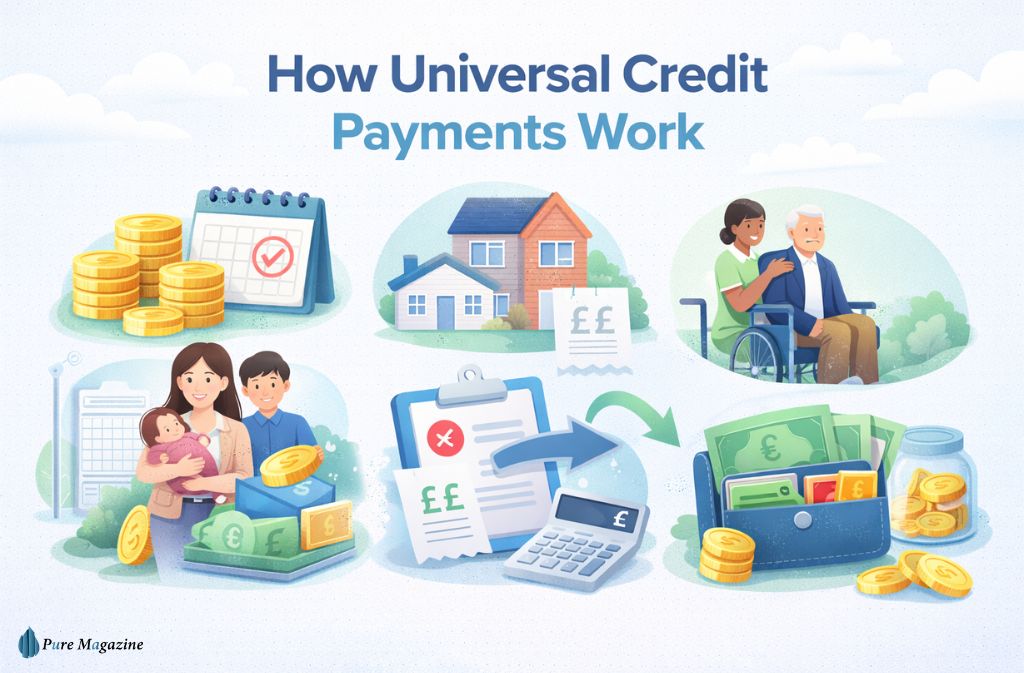
Universal Credit is usually paid once a month.
The amount you get is based on:
- a standard allowance
- any extra elements you qualify for
- deductions
- Your earnings during the assessment period
Extra amounts may apply for:
- children
- eligible childcare costs
- rent or housing costs
- limited capability for work
- caring responsibilities
If you’re working, your earnings can reduce the amount of Universal Credit you receive. That reduction normally happens through the taper rate once any work allowance has been taken into account.
If you need money before your first full payment, you can ask for an advance payment. But that is a loan, not extra free money. It has to be repaid through deductions from future Universal Credit payments.
A lot of people take an advance because they have no real choice. But it’s still worth understanding what the repayments will do to your later monthly budget.
How Universal Credit Affects Other Benefits
Universal Credit replaced most older means-tested benefits for working-age people, but not all benefits disappear when you claim it.
Housing Benefit
For most working-age claimants, Universal Credit replaced Housing Benefit.
But there are still exceptions. People in supported housing or temporary accommodation may still remain on the old Housing Benefit system in 2026. If that sounds like your situation, don’t assume the standard rule applies.
Personal Independence Payment (PIP)
PIP is completely separate from Universal Credit.
It is not replaced by Universal Credit, and it is not means-tested in the same way. Many people receive both at the same time. Moving onto Universal Credit does not automatically trigger a PIP reassessment.
Council Tax Support
Universal Credit does not include council tax support.
If you need help with council tax, you usually need to apply through your local authority for Council Tax Reduction or Council Tax Support.
Free school meals and other passported benefits
Universal Credit can also affect entitlement to things like:
- free school meals
- Healthy Start
- help with school-related costs
- other local or national schemes
The exact rules vary, especially at the local level, so it’s worth checking separately.
Because benefits often overlap in complicated ways, speaking to Citizens Advice, Turn2us, or a welfare adviser can save a lot of stress.
Common Mistakes People Make
A few problems come up again and again with Universal Credit.
Thinking Universal Credit and Restart are the same
They are not. Universal Credit is the benefit; Restart is one possible work scheme linked to some claimants.
Ignoring the online journal
This is where DWP often sends tasks, appointment details, and decisions. If you don’t check it, you can miss something important very easily.
Not reporting changes quickly
Changes to earnings, rent, address, relationship status, childcare costs, health, or caring responsibilities should be reported promptly. Delays can lead to underpayments, overpayments, or disputes.
Assuming work requirements never change
They can change a lot. A new diagnosis, a pregnancy, becoming a carer, or starting work can all affect what DWP should expect from you.
Taking an advance without planning
An advance can be necessary, but repayment deductions can make later months harder than expected.
Not providing medical evidence
If your health affects your ability to work, fit notes and the Work Capability Assessment process matter. Without evidence, DWP may continue to treat you as fully fit for work.
A 2026 Checklist for Claimants
If you’re claiming Universal Credit or expecting to claim, this is a useful checklist:
- confirm eligibility on GOV.UK
- gather ID, income, savings, and housing details before applying
- Submit the claim and start checking your online journal straight away
- Read the claimant commitment carefully before agreeing to it
- Challenge anything unrealistic in your work-search requirements
- report changes in circumstances as soon as they happen
- Keep records of job search or work preparation activity
- Check whether any referral is to Restart, the Work and Health Programme, or something else
- Ask whether the June 2026 Restart deadline affects you
- Use a benefits calculator if your circumstances change
- Get advice from Citizens Advice or Turn2us if you think a sanction or payment decision is wrong
Real-World Examples
New claimant with rent costs
Sarah loses her job and claims Universal Credit. She qualifies for the standard allowance and help with rent. Her claimant commitment includes regular job search and work coach meetings. She is not referred to Restart immediately, because Restart tends to apply after a longer period of unemployment.
Long-term unemployed claimant
David has been on Universal Credit for several months and is in the Intensive Work Search group. He still hasn’t found a job, so his work coach refers him to Restart. The referral is mandatory in his group, although easements may be possible if his circumstances change.
Claimant with a health condition
Amina claims Universal Credit in May 2026 and also receives PIP. She provides medical evidence and goes through the Work Capability Assessment process. If she is found to have LCWRA under the post-April 2026 rules, her health element would apply at the newer lower rate. Her work-related requirements would also be adjusted to reflect her condition.
FAQs
Q. What is the Universal Credit programme?
The Universal Credit programme refers to the wider UK benefits system that provides monthly payments to people on a low income or out of work, while also requiring some claimants to take part in work-related activities, Jobcentre support, and employment schemes like the Restart Programme.
Q. Is Universal Credit a programme or a benefit?
Universal Credit is primarily a benefit.
However, the term “Universal Credit programme” is often used to describe the full system, including:
- Claimant commitments
- Work coach meetings
- Jobcentre requirements
- Employment support schemes
Q. What is the Restart Programme in Universal Credit?
The Universal Credit Restart Programme is a government employment scheme for people who have been unemployed for around 9 months or more. It provides:
- Job coaching
- CV support
- Interview preparation
It is separate from Universal Credit payments but may be mandatory.
Q. Do all Universal Credit claimants have to join a work programme?
No, not all Universal Credit claimants are required to join a work programme.
Requirements depend on:
- Health conditions
- Caring responsibilities
- Work status
- Whether you have children
Some claimants may have no work-related requirements at all.
Q. What is the Universal Credit Work and Health Programme?
The Work and Health Programme was a support scheme for people with disabilities or long-term health conditions.
👉 2026 Update:
- Closed to new referrals in 2024
- Fully ending by July 2026
It is no longer a main programme for new claimants.
Q. Can you get PIP and Universal Credit together?
Yes, you can receive Personal Independence Payment (PIP) and Universal Credit at the same time.
- PIP is not means-tested
- It does not reduce your Universal Credit payment directly
Many people claim both.
Q. Does Universal Credit replace Housing Benefit?
For most working-age people, Universal Credit replaces Housing Benefit.
However, Housing Benefit may still apply if:
- You live in supported housing
- You are in temporary accommodation
Q. What happens if you miss a Universal Credit appointment?
If you miss an appointment, the DWP may review your claim and could apply a sanction.
To avoid this:
- Update your Universal Credit journal immediately
- Contact your work coach
- Provide a valid reason (e.g. illness or emergency)
Q. How does the 2026 health element change affect new claimants?
From April 2026, new claimants with Limited Capability for Work and Work-Related Activity (LCWRA) may receive:
- £217.26 per month (new claimants)
- £429.80 per month (existing protected claimants)
This creates a two-tier system, so always check the latest official guidance.
Q. How do you know if you’ve been referred to the Restart Programme?
You’ll usually be notified through:
- A Jobcentre appointment
- A message in your Universal Credit journal
- Direct communication from your work coach
If you’re unsure, contact your work coach for confirmation.
Q. Is the Universal Credit Restart Programme mandatory?
Yes, the Restart Programme is usually mandatory for eligible claimants.
If you refuse without a valid reason, it may result in:
- A sanction
- Reduced Universal Credit payments
Q. What is WorkWell in Universal Credit (2026)?
WorkWell is a new 2026 service that supports people with health conditions or disabilities before they become long-term unemployed.
- Focuses on early intervention
- Often voluntary
- Combines health and employment support
Q. Can Universal Credit payments be stopped for not attending programmes?
Yes, payments can be reduced through sanctions if you:
- Miss appointments
- Refuse mandatory programmes
- Don’t meet claimant commitments
However, sanctions can often be avoided with good communication and valid reasons.
2026 Outlook: What’s Changing?
The biggest practical trend is continued digitisation. More of the system is managed through online accounts, journals, and digital communication.
Managed migration from legacy benefits is also continuing, with remaining ESA, Income Support, and tax credit claimants being moved onto Universal Credit in stages.
The wider policy direction appears to be closer integration between employment support and health support. That’s part of the reason newer models such as Pathways to Work are becoming more important as Restart winds down.
Sanctions are still controversial. There is ongoing debate about whether they work as intended, and DWP guidance around easements and vulnerability has become more detailed.
If you receive a sanction and think it is unfair, you can challenge it by asking for a mandatory reconsideration.
A lot of Universal Credit content focuses only on how much money someone gets. But for many claimants, the harder part is understanding the responsibilities attached to the claim. That’s often where the real confusion lies.
For more guides on benefits, tax, and UK personal finance, visit Pure Magazine.