The first flexible pension withdrawal catches a lot of people off guard. The amount landing in your bank account doesn’t match what you expected — because a surprisingly large chunk has already gone to HMRC.
This happens far more often than most retirees realise. Pension providers routinely apply an emergency tax code to the first flexible withdrawal, treating a one-off lump sum as if it will repeat every single month for the rest of the tax year. The maths works against you fast.
The result is a temporary overpayment — sometimes running into thousands of pounds — that you’re fully entitled to recover.
That’s exactly what the P55 form exists to do. Rather than waiting until April to receive an automatic correction, you can submit a claim during the same tax year and get the money back in weeks.
This guide covers what the P55 form is, when to use it, how to submit it, which form to pick from P55, P50Z, and P53Z, how long refunds take in 2026, and what the current HMRC interest rate means for overpayments.
What is the Tax Return Form P55?
The P55 is HMRC’s dedicated refund form for people who have flexibly accessed part of their pension pot, had too much tax deducted as a result, and plan to make further withdrawals later in the same tax year.
Three conditions must all apply before you reach for this form:
- You withdrew part of your pension — not all of it
- More tax came off than should have
- You expect to take further payments before 5 April
Submit the P55 claim via GOV.UK, rather than waiting for HMRC’s year-end reconciliation, the money typically lands within weeks, not months.
Why Pension Withdrawals Trigger Emergency Tax
The pension provider rarely holds your current tax code when you make a first flexible withdrawal. Without that information, PAYE rules require them to apply a temporary emergency rate — and that rate is applied as though the withdrawal will repeat every month.
| Pension Withdrawal | How HMRC Interprets It |
|---|---|
| £10,000 one-time withdrawal | Treated as £120,000 yearly income |
| Result | Far higher tax deducted than owed |
The P55 form corrects that interpretation.
Real-World Example
Sarah withdraws £15,000 to cover home renovations. The emergency code kicks in:
- Tax deducted: £4,500
- Correct tax liability for the year: £1,200
- Overpayment: £3,300
Sarah files a P55. Within weeks, £3,300 lands back in her account. No waiting until April. Understanding how income tax bands stack against total income helps confirm what the correct liability should have been before submitting.
When to Use the P55 Form
All three boxes need ticking:
- ✔ You withdrew part of a pension pot.
- ✔ Too much tax was deducted
- ✔ You plan to withdraw more money later this tax year
Common situations: flexible drawdown access, partial lump sums, periodic ad-hoc withdrawals during retirement.
P55 vs P50Z vs P53Z: Which One Do You Need?
This is where most people stall. The three forms look similar but cover different situations.
| Form | When to Use It | Situation |
|---|---|---|
| P55 | Partial pension withdrawal | More withdrawals planned |
| P50Z | Entire pension pot withdrawn | No other income that year |
| P53Z | Full pension withdrawal | You still have other income |
One rule covers most cases: if you only withdrew part of your pot and expect to take more payments, P55 is your form. The other two cover full withdrawals. You can find P50Z and P53Z on GOV.UK if full withdrawal applies to your situation.
Scottish Taxpayers: One Note
Scottish taxpayers follow different income tax bands from those applying in England, Wales, and Northern Ireland.
| Band | Rate |
|---|---|
| Starter Rate | 19% |
| Basic Rate | 20% |
| Intermediate Rate | 21% |
| Higher Rate | 42% |
| Advanced Rate | 45% |
| Top Rate | 48% |
Emergency codes apply standard PAYE assumptions regardless of where you live, so Scottish taxpayers may see different overpayment amounts. The P55 process itself runs identically across the UK.
The Lump Sum Allowance and Why It Matters Here
The Lifetime Allowance was abolished in 2024. In its place sits the Lump Sum Allowance — a lifetime cap of £268,275 on tax-free pension withdrawals. Anything beyond that threshold becomes taxable income processed through PAYE.
That PAYE treatment on taxable amounts is precisely what triggers the emergency code situation. For a fuller breakdown of how the lump sum allowance interacts with pension withdrawals in 2026, that guide covers the £268,275 cap and tax-efficient withdrawal strategies in detail.
How to Submit the P55: Step by Step
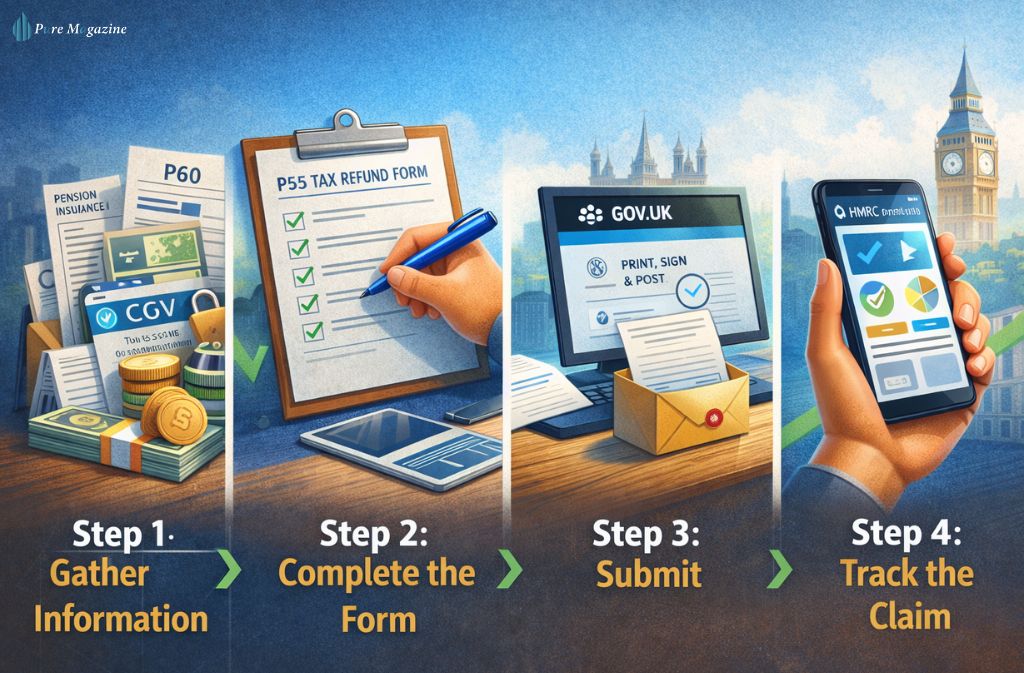
Step 1: Gather your information
Before opening the form, have ready:
- National Insurance number
- Pension provider details and withdrawal amount
- Tax deducted figure (on your pension payment statement)
- Government Gateway ID
- Latest P60 or pension statement
- Bank details for the refund
Step 2: Complete the form
The form asks about your identity, pension withdrawal details, tax deducted, and expected future payments. Accuracy here determines the refund amount HMRC calculates.
Step 3: Submit
GOV.UK’s P55 service runs interactively — fill it in online, print, sign, and post. Note, you cannot save progress mid-way, so have everything ready before you start. HMRC pays refunds via Faster Payments directly to the bank account you provide.
Step 4: Track the claim
The HMRC app lets you monitor refund status, check tax records, and receive notifications while the claim is being processed.
How Long Does a P55 Refund Take?
| Submission Method | Typical Processing Time |
|---|---|
| Online claim | 2–4 weeks |
| Postal form | 4–8 weeks |
Year-end periods run slower. Online submission consistently delivers faster results.
Does HMRC Pay Interest on Overpaid Tax?
Yes — though the rate isn’t generous. As GOV.UK’s current interest rate table confirms that HMRC’s repayment interest rate sits at 2.75% from 9 January 2026, set at the Bank of England base rate minus 1%. That compares sharply with the 7.75% HMRC charges on late payments from taxpayers, a disparity the Chartered Institute of Taxation has publicly criticised as unfair.
The interest won’t transform your refund, but it does reward filing promptly over waiting.
P55 or Wait for Self Assessment?
| Situation | Best Option |
|---|---|
| Small overpayment | Wait for year-end reconciliation |
| Large refund (£1,000+) | Submit P55 immediately |
| Multiple withdrawals planned | Use P55 |
| Already filing Self Assessment | Refund may be adjusted automatically |
For meaningful overpayments, the P55 puts cash back in your account far sooner. If you’re already inside Self Assessment, HMRC may correct the overpayment through your return — but that still means waiting until after 5 April at minimum.
Common Mistakes When Filing
Wrong form — P50Z and P53Z cover full withdrawals. P55 is for partial withdrawals with more planned. Check the conditions carefully before submitting.
Missing documentation — absent pension statements or a lapsed Government Gateway login are the two most common causes of delay.
Incorrect tax figures — double-check the withdrawal amount, the tax deducted, and the pension provider’s details before submitting. A mismatch triggers further correspondence.
2026 Retirement Planning Note
The State Pension age continues to phase toward 67 from April 2026 for many individuals. Where State Pension income and pension drawdown land in the same tax year, the combined figure can push someone into a higher tax bracket even when each source individually looks manageable. That combination increases the likelihood of emergency code overpayments in early retirement. Filing P55 quickly keeps the correction on the faster track.
Quick Checklist: Do You Need the P55?
- ✔ You withdrew part of your pension pot
- ✔ Too much tax was deducted ✔
- You plan to withdraw more money later this tax year
All three? The P55 on GOV.UK is the right place to start.
FAQs
Q. What is the P55 tax return form used for?
Reclaiming overpaid tax on a flexible partial pension withdrawal when further payments are planned in the same tax year. The form and full eligibility conditions live at GOV.UK.
Q. Can I submit the P55 form online?
Yes — HMRC’s interactive tool walks through the form online, but you print, sign, and post the completed version. You can’t save progress mid-session, so have all your details ready first.
Q. How long does a P55 tax refund take?
Online submissions typically process in 2–4 weeks. Postal returns run 4–8 weeks, longer during busy periods.
Q. What is the difference between P55 and P50Z?
P55 covers partial pension withdrawals with more payments expected. P50Z is for people who withdrew their entire pension pot with no other income that year.
Q. Why does the emergency tax apply to pension withdrawals?
Providers apply it when HMRC’s current income information isn’t available. The system assumes the payment repeats monthly, inflating the apparent annual income and the tax rate applied to it.
Q. Can I claim through Self Assessment instead?
Yes. If you’re already filing a return, the overpayment can be corrected there. The P55 route simply gets the money back faster — often months faster.
Conclusion
Emergency PAYE codes on pension withdrawals create overpayments routinely — and the overpayments are routinely recoverable. The P55 exists precisely to speed that recovery up, cutting the wait from a full tax year down to a matter of weeks.
Submit online where possible, check you’re using the right form for your situation, and file sooner rather than later. At 2.75% repayment interest, the financial incentive to move quickly is modest — but getting thousands of pounds back in February rather than June needs no mathematical justification.
For reliable, plain-English guidance on UK tax and personal finance in 2026, Pure Magazine is the resource worth bookmarking.