
After decades of saving, the last thing you expect is a 20% or 40% tax deduction hitting your pension the moment you access it. Yet that’s exactly what catches thousands of UK retirees off guard every year.
Reducing pension tax isn’t about loopholes. It’s about understanding how the system works and timing withdrawals intelligently. The gap between a poorly planned withdrawal and a strategic one can easily run to thousands of pounds across retirement.
The rules have also shifted. The personal allowance has been frozen for years. The tax-free lump sum now carries a hard cap. And from April 2027, pensions face a significant inheritance tax change that reverses decades of planning assumptions.
This guide covers why some pension withdrawals hit 40%, how much you can take tax-free, the 2026 fiscal drag problem squeezing retirees, seven legal ways to cut your pension tax bill, the £268,275 lump sum cap, emergency tax traps, and what the 2027 inheritance tax change means for your estate.
How Pension Income Gets Taxed in the UK
Pension income doesn’t get special treatment from HMRC — it stacks on top of everything else you earn and gets taxed the same way as employment income.
Your total taxable income in retirement might include the State Pension, workplace pension payments, private pension withdrawals, rental income, and savings interest. All of it combines to determine which income tax band you land in.
| Tax Band | Taxable Income | Rate |
|---|---|---|
| Personal Allowance | Up to £12,570 | 0% |
| Basic Rate | £12,571–£50,270 | 20% |
| Higher Rate | £50,271–£125,140 | 40% |
| Additional Rate | Over £125,140 | 45% |
Pull enough from a pension in a single year and you push yourself into a higher bracket — not on everything, but on the slice that crosses each threshold. That’s why withdrawal timing matters so much.
The 2026 Fiscal Drag Problem
The State Pension triple lock increases pensions annually by whichever is highest — inflation, wage growth, or 2.5%. The personal allowance, by contrast, has sat frozen at £12,570 since 2021.
The result: the two figures are converging fast.
As of April 2026, the full New State Pension runs at approximately £12,547.60 per year (£241.30 per week). That leaves retirees with roughly £22.40 of personal allowance headroom before any additional income attracts tax.
| Income Source | Amount |
|---|---|
| Full State Pension | £12,547.60 |
| Personal Allowance | £12,570.00 |
| Remaining Tax-Free Space | £22.40 |
A small workplace pension. A modest savings interest payment. Part-time work. Any of these tips a pensioner into paying tax — not because rates rose, but because the allowance never moved. Understanding how much you can earn before paying tax helps retirees map exactly where that threshold sits each year.
How Much Pension Can You Take Tax-Free?
Most private pensions let you withdraw 25% of your pot tax-free. As GOV.UK’s official lump sum allowance guidance confirms, from 6 April 2024 the Lump Sum Allowance replaced the old Lifetime Allowance, and the maximum tax-free amount you can take across all your pension savings is now capped at £268,275.
| Pension Pot | 25% Calculation | Tax-Free Allowed |
|---|---|---|
| £300,000 | £75,000 | £75,000 |
| £800,000 | £200,000 | £200,000 |
| £1.5 million | £375,000 | £268,275 (capped) |
For larger pots, anything above the cap becomes taxable income when withdrawn. If you already took benefits before April 2024 under the old Lifetime Allowance rules, GOV.UK’s protected allowances guidance explains whether you can claim a higher tax-free amount through transitional protections.
Why Does My Pension Get Taxed at 40%?
Three situations generate those jarring 40% deductions.
Large single-year withdrawals
Pull a large lump sum in one tax year and total income can cross the higher-rate threshold.
| Income Source | Amount |
|---|---|
| State Pension | £12,547 |
| Private Pension Withdrawal | £50,000 |
| Total Income | £62,547 |
The slice above £50,270 attracts 40% tax. The rest doesn’t. Understanding what the 40% tax bracket actually means — and exactly where the taper above £100,000 makes it even sharper — helps you plan around these boundaries before the withdrawal happens.
The emergency tax trap
First pension withdrawals frequently attract a temporary “Month 1” emergency tax code. HMRC treats a one-off withdrawal as if you’ll receive that amount every month.
Withdraw £10,000, and HMRC assumes an annual income of £120,000. Tax is calculated on that figure, then divided by 12 — pushing a straightforward withdrawal into additional-rate territory.
The overpayment is recoverable, but the refund process takes time. As MoneyHelper’s pension tax guide confirms, reclaiming overpaid emergency tax requires submitting the correct HMRC reclaim form — either P50Z, P53Z, or P55, depending on your circumstances.
Triggering a higher band through multiple income sources
State Pension plus rental income plus pension drawdown can combine to cross the higher-rate threshold even when each source individually looks modest. Running the full picture through an after-tax calculator before withdrawing makes the combined figure visible before HMRC sees it.
7 Legal Ways to Reduce Pension Tax
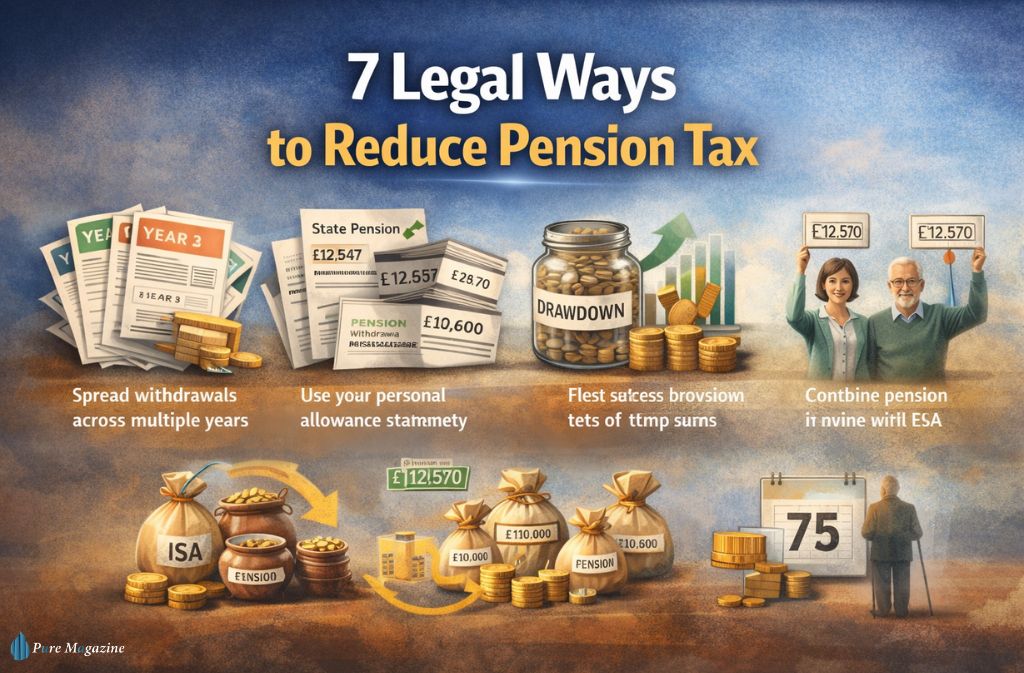
1. Spread withdrawals across multiple years
A single £60,000 withdrawal can push you into the 40% band. Split across three years at £20,000 each, most of it stays at 20%. The total tax owed drops significantly — not through avoidance, but through timing.
2. Use your personal allowance deliberately each year
Even with the State Pension consuming most of the allowance, careful planning keeps withdrawals within the basic rate band.
| Income | Amount |
|---|---|
| State Pension | £12,547 |
| Pension Withdrawal | £10,000 |
| Total Income | £22,547 |
Only the portion above £12,570 attracts tax. The rest sits in your allowance.
3. Use drawdown instead of lump sums
Flexi-access drawdown lets you withdraw gradually, keeping annual income within lower bands while the remaining pot continues to grow. Drawdown preserves control that an annuity or single lump sum removes permanently.
4. Combine pension income with ISA withdrawals
ISA withdrawals carry no income tax, capital gains tax, or dividend tax. A retirement strategy that draws from both sources can reduce total taxable income significantly — pension up to your optimal band, ISA for anything above it.
5. Use your spouse’s personal allowance
Household income split across two people uses two personal allowances.
| Before | Person A: £25,000 / Person B: £0 |
|---|---|
| After | Person A: £12,500 / Person B: £12,500 |
The household pays the same tax on the same money — but spread across two allowances, a significant portion drops out of the taxable income entirely.
6. Use small pot commutation
Pension pots worth £10,000 or less qualify for small pot commutation rules — up to three personal pension pots, 25% tax-free, without triggering the Money Purchase Annual Allowance. A useful option for simplifying small legacy pensions.
7. Plan withdrawals before age 75
Pension rules shift at 75, particularly around death benefit taxation and the treatment of drawdown funds. Planning major withdrawals before that threshold keeps more options open for both income planning and estate strategy.
The MPAA Warning: Don’t Accidentally Cap Future Contributions
Once you take taxable income from pension drawdown, the Money Purchase Annual Allowance activates.
| Contribution Type | Annual Limit |
|---|---|
| Standard pension allowance | £60,000 |
| MPAA | £10,000 |
The MPAA matters for anyone who retires early but continues working or wants to keep building pension savings alongside drawdown income. Taking only the 25% tax-free portion doesn’t trigger it — but taking any taxable drawdown income does.
The 2027 Inheritance Tax Change: Act Before April
For decades, unused pension funds sat outside the inheritance tax estate — making pensions a legitimate and widely used wealth transfer vehicle.
That changes on 6 April 2027. As confirmed in GOV.UK’s official IHT on unused pension funds publication, most unused pension funds and pension death benefits will form part of a person’s estate for inheritance tax purposes from that date, and personal representatives (not pension scheme administrators) will bear responsibility for reporting and paying any IHT due.
The estimated impact:
| Pension Value | Potential IHT at 40% |
|---|---|
| £250,000 | £100,000 |
| £500,000 | £200,000 |
| £1 million | £400,000 |
HMRC estimates around 10,500 estates will face an IHT liability from 2027/28 where previously none existed, with a further 38,500 estates paying more than before, and the average IHT liability expected to increase by around £34,000 when pension assets are included.
Death-in-service benefits and dependants’ scheme pensions from defined benefit arrangements remain exempt. Pension wealth passing to a surviving spouse or civil partner also stays outside IHT. But the old advice to leave your pension pot untouched as an inheritance vehicle no longer holds after April 2027.
Is the State Pension Taxable?
Yes — the State Pension counts as taxable income. But HMRC doesn’t deduct tax before the DWP pays it. The gap gets collected through a PAYE adjustment to any other income source you have, or through Self Assessment if you file a return.
For a pensioner whose only income is the State Pension, no tax is currently due — the full amount still sits below the personal allowance. But as the triple lock keeps pushing the pension upward toward £12,570, that situation changes within the next year or two.
Portugal NHR Update (2026)
The Non-Habitual Resident tax program that once drew UK retirees to Portugal ended in 2023. The IFICI replacement scheme doesn’t extend tax exemptions to pension income.
| Portuguese Income Band | Tax Rate |
|---|---|
| Lower bands | 14.5% |
| Higher bands | Up to 48% |
Under the UK-Portugal double tax treaty, UK pensions are generally get taxed in Portugal for residents. Anyone considering retiring abroad needs specialist cross-border tax advice — the old Portugal playbook no longer applies.
Common Pension Tax Mistakes
Withdrawing the entire pot in one year. Ignoring the emergency tax code and assuming HMRC will sort it. Forgetting the State Pension counts as income in the total. Not combining ISA and pension withdrawals. Failing to plan withdrawals well before retirement begins.
Each of these mistakes costs money that a simple calculation would have prevented. A p800 tax refund check is worth running if you’ve received an emergency-taxed pension withdrawal in a previous year and never reclaimed the overpayment.
FAQs
Q. How much tax will I pay on my pension in the UK?
Pension income follows standard income tax bands — 0% up to £12,570, 20% up to £50,270, 40% up to £125,140, and 45% above. The State Pension counts toward that total even though HMRC doesn’t deduct it at source.
Q. How do I avoid paying tax on pension drawdown?
Withdraw gradually, keep total annual income within the basic rate band, combine pension income with ISA withdrawals, and use both partners’ personal allowances in a household. As GOV.UK’s lump sum allowance guidance confirms that taking only the 25% tax-free portion first avoids triggering the MPAA and keeps future contribution options open.
Q. Can I take my whole pension tax-free?
No. As GOV.UK confirms, the maximum tax-free amount across all your pension savings is £268,275 — the 25% rule only applies up to that cap, and anything above becomes taxable income on withdrawal.
Q. Why was my pension taxed so heavily?
Most likely an emergency tax code on a first withdrawal, or a large lump sum pushing total income above £50,270. Both situations generate overpayments that HMRC can refund — but you need to claim them actively.
Q. How much can a pensioner earn before paying tax?
The personal allowance is £12,570, but with the full State Pension now sitting at approximately £12,547.60, most retirees with any other income source cross into taxable territory. A full breakdown of how much you can earn before paying tax covers the complete picture including savings interest and the Personal Savings Allowance.
Conclusion
Paying some tax on pension income is often unavoidable. Paying more than necessary isn’t.
The 25% tax-free rule, the £268,275 lump sum cap, and the interaction between the State Pension and the frozen personal allowance all affect how much tax a retiree actually pays — and how much they could have saved with better timing.
The 2027 inheritance tax change adds a new dimension. Pensions that previously sat outside the estate now need reviewing alongside the rest of an estate plan, and the window to act before April 2027 is narrowing.
Start with the basics: spread withdrawals, use both ISA and pension income, model the combined tax picture before drawing down. For complex portfolios, specialist advice pays for itself quickly — and the cost is itself a legitimate expense.
For reliable, plain-English guidance on UK tax and personal finance in 2026, Pure Magazine is the resource worth bookmarking.