In a market now dominated by prescription weight-loss injections like Wegovy and Ozempic, T5 fat burners occupy a strange position. They’re cheap, they’re everywhere, and they’re marketed with a confidence that the evidence doesn’t always support. For anyone trying to cut through the noise and make a sensible decision, that’s a problem.
Here’s the first thing worth knowing: “T5” is not a regulated formula, a specific ingredient, or a defined category. It’s a marketing label — one that gets applied to products ranging from relatively mild caffeine and green tea blends sold on the high street, to aggressively formulated imports containing ingredients that sit in a legal grey zone in the UK. The name tells you almost nothing about what’s actually inside the product.
This guide covers what T5 fat burners actually are in 2026, which versions are safe to use in the UK, what the research says about their real-world effectiveness, and what most sellers deliberately leave out. If you’re considering buying one, read this first.
What Are T5 Fat Burners?
T5 fat burners are high-stimulant thermogenic supplements — products designed to increase calorie expenditure, suppress appetite, and raise energy levels through nervous system stimulation. The “thermogenic” label refers to their mechanism: by raising core body temperature slightly and accelerating metabolism, they aim to increase the number of calories burned at rest and during exercise.
In practice, the term covers an enormous range of products. The UK high-street versions tend to be caffeine-led formulas with supporting ingredients like green tea extract, green coffee bean, and cayenne pepper. The imported and grey-market versions are a different matter entirely — and the distinction is one that the supplement industry has little incentive to make clear to buyers.
| Type | What It Typically Contains | UK Status |
|---|---|---|
| High-street UK T5s | Caffeine + green tea + cayenne | Legal food supplements |
| Grey-market imports | May include yohimbine, DMAA, or restricted compounds | Legally uncertain — can be stopped at customs |
What T5 Originally Meant — and Why That History Matters
The “T5” name has roots in the original ECA stack: ephedrine, caffeine, and aspirin. Ephedrine was a powerful thermogenic stimulant that was used widely in fat-loss supplements through the 1990s and early 2000s before being banned in the UK and across most of Europe following serious cardiovascular incidents. The name “T5” carried over into the post-ephedrine market, even though the formulas that followed it were considerably weaker.
What that means in 2026 is that modern T5 products are ephedra-free by necessity, not by choice. The compounds that made the original formulas work the way users remembered have been removed or replaced. Most modern versions rely on caffeine-based stimulation to approximate that effect, which is a meaningful step down in potency, even if the branding doesn’t reflect it.
If any product claims to deliver “ephedra-like effects,” that’s a significant red flag. Either the claim is false, or it contains something that deserves very careful scrutiny before you put it in your body.
How T5 Fat Burners Work — and Where the Real Limits Are
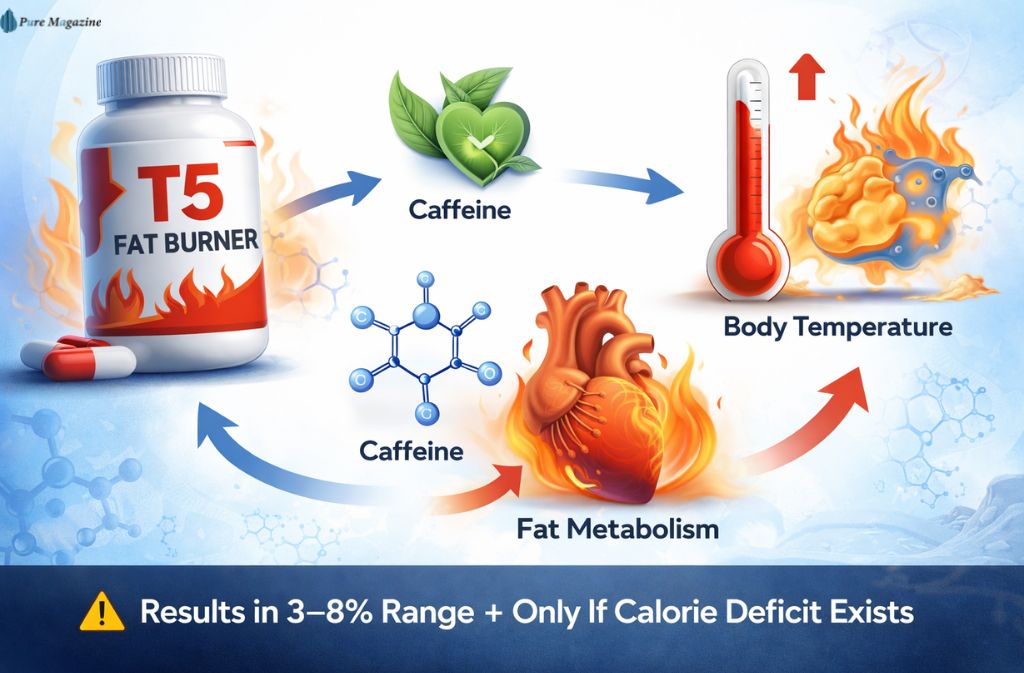
The mechanism is straightforward: stimulants raise adrenaline levels, which in turn increase heart rate, body temperature, and the rate at which your body burns through energy. Caffeine is the primary driver of this in most UK-legal T5 products. Green tea extract contributes through its catechin content, particularly EGCG, which has some evidence behind it for modest fat oxidation when combined with caffeine. A 2011 review in the Journal of the International Society of Sports Nutrition found that of all the commonly marketed thermogenic ingredients, caffeine and green tea had the most consistent evidence for fat metabolism support, while most other ingredients lacked meaningful clinical backing.
The expected boost to fat loss from a T5 supplement is small — studies generally put it in the 3–8% range over a calorie-matched control group. That’s nothing, but it’s also not the transformative effect the marketing implies. More importantly, none of that effect materialises without an existing calorie deficit. If your diet isn’t already structured to promote fat loss, a T5 supplement will not compensate. It works as a marginal accelerant, not as the primary mechanism.
What T5 Actually Feels Like (The Part Most Reviews Skip)
If you’ve ever had two or three strong coffees on an empty stomach, you already have a reasonable sense of what a high-stimulant T5 product feels like. For some people, that’s a useful state — sharper, more energised, better able to push through a workout. For others, it tips into something less productive: a slightly shaky, wired, anxious feeling that makes concentration harder rather than easier.
The physical effects typically include a faster heartbeat, slight tremor in the hands, a feeling of warmth, and what many users describe as either laser focus or low-grade anxiety, depending on their caffeine sensitivity. This isn’t a side effect unique to T5 products — it’s the predictable result of taking a significant dose of stimulants. The difference is that a T5 supplement often delivers that dose in a compressed timeframe, sometimes alongside other synergistic compounds that amplify the effect.
This variability in response is one reason why starting with a half dose is genuinely important, not just a disclaimer buried in the small print.
The Cortisol Problem: Why Long-Term Use Can Work Against You
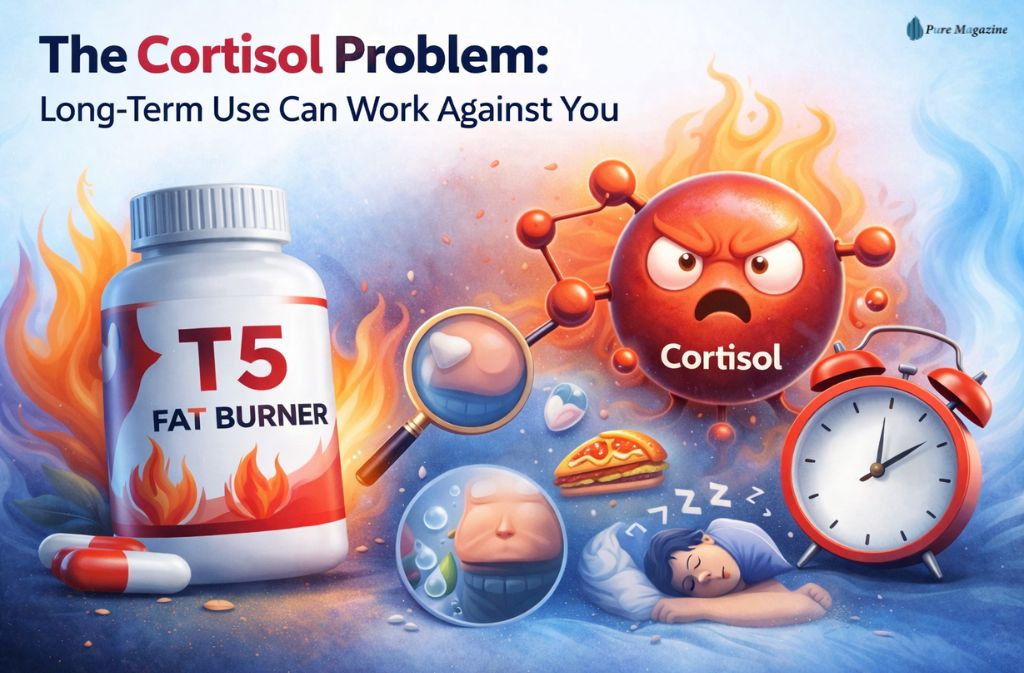
This is the mechanism that most product reviews completely ignore, and it’s one of the more important things to understand before committing to extended use of any high-stimulant fat burner.
Chronic stimulant use — particularly in high doses taken daily over several weeks — elevates cortisol, the body’s primary stress hormone. In the short term, cortisol elevation is normal and harmless. Over longer periods, sustained high cortisol creates a set of effects that are almost the opposite of what a fat-loss supplement is supposed to deliver: water retention, increased abdominal fat storage, disrupted sleep, heightened cravings for high-calorie foods, and fatigue.
The irony is pointed. Someone using a T5 fat burner for six to eight weeks without cycling off may find their results plateau or reverse — not because the supplement stopped working at the nervous system level, but because the hormonal downstream effects are actively counteracting the intended outcome. Routine blood tests can sometimes reveal elevated cortisol markers that flag this pattern before it becomes a real problem, which is worth knowing if you’re tracking progress across a longer supplementation period.
This is a strong argument for the cycling approach: six to eight weeks on, followed by a meaningful break. Not as a vague recommendation, but as a practical protection against the cortisol trap.
UK Regulatory Reality in 2026
T5 fat burners sold in the UK are classified as food supplements rather than medicines. That distinction matters more than most people realise: as food supplements, they are not required to prove clinical efficacy before being sold. The Food Standards Agency oversees this category, but regulation is largely reactive — problems tend to be identified after products reach the market rather than before.
The FSA’s current guidance places daily caffeine intake above 400mg under scrutiny for healthy adults. Some T5 products — particularly those sold through online marketplaces without UK-based manufacturing oversight — exceed this in a single serving, or combine caffeine with other stimulants that amplify its effect without the label making this interaction obvious.
What to look for and what to avoid when buying:
| Look For ✅ | Avoid ❌ |
|---|---|
| Clearly stated caffeine dose (under 200mg per serving) | “Proprietary blend” with hidden dosages |
| UK-based manufacturer with transparent contact details | Claims of “ephedra-like effects” or mentions of DMAA |
| Third-party testing (Informed Sport or NSF) | Unrealistic claims (“lose 5kg in a week”) |
| Full, readable ingredient list | Unknown imported brands with no UK address |
Yohimbine: The Ingredient That Sits in a Legal Grey Zone
Yohimbine deserves specific mention because it appears frequently in imported T5 formulas and is often marketed as an ephedrine alternative. In the UK, yohimbine is not straightforwardly permitted in food supplements — the FSA has raised concerns about its cardiovascular effects, and consignments can be stopped at customs depending on how the product is classified at the border.
Beyond the regulatory ambiguity, yohimbine has a genuinely narrow therapeutic window. At the doses that show any meaningful fat-loss effect in research, it also raises anxiety, heart rate, and blood pressure in a way that overlaps uncomfortably with high-caffeine stimulation. If you see it listed in a product, it’s a signal to look harder at the sourcing, check the regulatory status, and be clear about whether you have any cardiovascular sensitivities before proceeding.
Who Should Not Take T5 Fat Burners
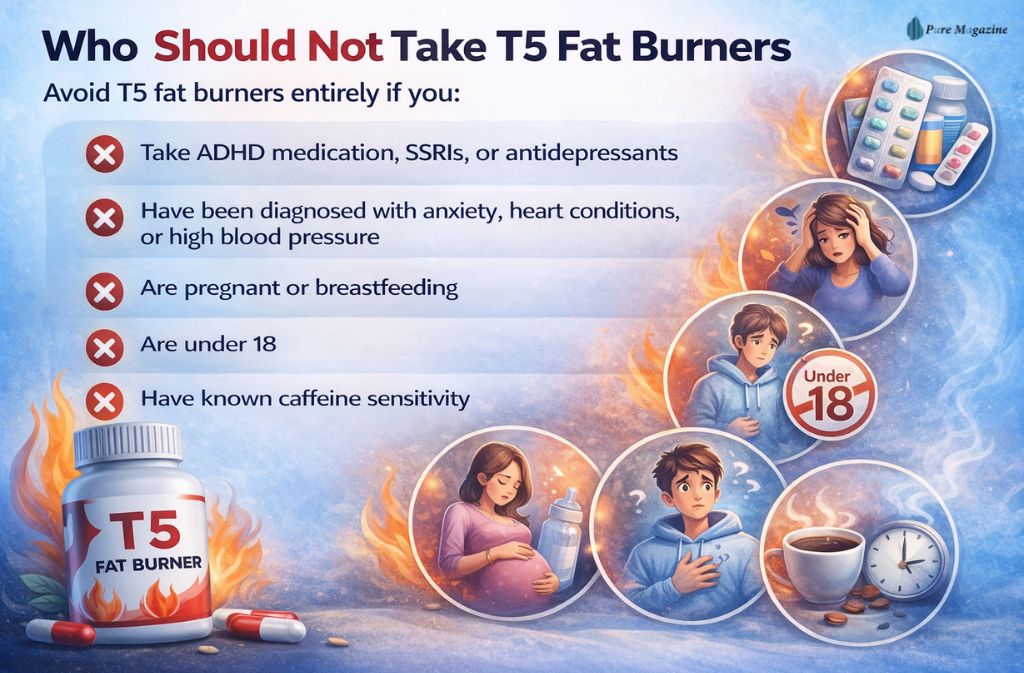
T5 fat burners carry meaningful risks for specific groups, and these aren’t edge cases. Anyone taking ADHD medication — which typically includes stimulant compounds like methylphenidate or amphetamine salts — is stacking stimulants when they add a T5 product, with unpredictable cardiovascular and psychological effects. SSRIs and some antidepressants interact poorly with high-dose stimulants, sometimes causing elevated heart rate and heightened anxiety in ways that aren’t immediately obvious as supplement-related.
People with existing anxiety disorders often find that even moderate caffeine doses worsen their symptoms. Those with hypertension or any cardiac history should approach stimulant-based supplements with considerable caution — not because a single dose will necessarily cause harm, but because repeated use over weeks creates a sustained cardiovascular load that GP monitoring wouldn’t routinely pick up.
If you’re taking any regular medication and considering a T5 product, a conversation with your GP or pharmacist before starting is the right move, not an optional precaution.
Avoid T5 fat burners entirely if you:
- Take ADHD medication, SSRIs, or antidepressants
- Have been diagnosed with anxiety, heart conditions, or high blood pressure
- Are you pregnant or breastfeeding
- Are under 18
- Have known caffeine sensitivity
Do T5 Fat Burners Actually Work? An Honest Assessment
Yes — within limits that most marketing refuses to acknowledge. The research is fairly detailed that caffeine and green tea together produce a small, real increase in calorie expenditure. A peer-reviewed review of thermogenic supplement ingredients concluded that the effect is genuine but modest, and that it only translates to meaningful fat loss when it’s layered on top of an already calorie-controlled diet and consistent training.
The honest framework for T5 effectiveness:
| Scenario | Expected Outcome |
|---|---|
| No dietary changes | Minimal to no fat loss |
| Calorie deficit alone | Fat loss — no supplement needed |
| Calorie deficit + T5 | Slight additional boost |
| Deficit + training + T5 | Best-case marginal support |
Think of T5 as a 5–10% helper when everything else is already in place — not as the engine driving the result. If you’re considering it primarily for the energy boost to make workouts more productive rather than as a metabolic accelerant, that’s a more realistic and lower-risk framing.
The Sleep Problem: A Risk That Compounds Over Time
High-stimulant supplements taken later in the day create a sleep disruption problem that most buyers underestimate. Caffeine’s half-life is typically five to six hours — meaning a 200mg serving taken at 5 pm still has around 100mg active in your system at 11 pm. For products with 300mg or more, the numbers shift further.
Recent research underlines how significant this is: a 2026 study found that high-stimulant supplement users aged 16–30 were more than twice as likely to sleep five hours or less per night compared to non-users. Poor sleep doesn’t just make you feel tired — it actively undermines the fat loss you’re trying to support, by raising cortisol, increasing appetite hormones like ghrelin, and reducing the anabolic recovery that maintains muscle mass during a calorie deficit.
If you’re taking a T5 supplement and your sleep is suffering, you may be cancelling out the metabolic benefits while accumulating the hormonal costs. The guideline of avoiding stimulant-based supplements within 12–14 hours of your intended sleep time isn’t overcautious — it’s the realistic buffer that accounts for caffeine’s actual duration of effect at the doses involved.
What Actually Works Better Than T5 in 2026?
The most evidence-backed non-prescription weight management tool in 2026 isn’t a stimulant at all. Glucomannan — a soluble fibre derived from the konjac plant — holds EFSA authorisation for weight management claims, which is a meaningful regulatory bar that most supplement ingredients never clear. It works by expanding in the stomach and significantly increasing satiety, which naturally reduces calorie intake without nervous system stimulation, cortisol elevation, or sleep disruption.
For women in particular, pairing a protein-rich diet with a quality supplement stack tends to outperform stimulant-led approaches over the medium term. If you’re also thinking about hair and nail support during a cutting phase — something that often gets neglected — it’s worth understanding what the actual evidence says on whether biotin delivers on its hair growth claims before adding it to the stack. The research is more complicated than most supplement brands let on.
| Option | Effectiveness | Risk Level | Accessibility |
|---|---|---|---|
| T5 Fat Burners | Moderate (as a support tool) | Medium to high (depending on version) | Easy |
| Fibre-based suppressants (glucomannan) | Moderate | Low | Easy |
| GLP-1 medications (Wegovy, Ozempic) | High | Medical oversight required | Prescription only |
| Diet + resistance training | Highest | Low | Requires consistency |
In 2026, T5 sits in the middle of that table — not at the top. Prescription GLP-1 medications like Wegovy have shifted the goalposts considerably for what “effective” means in weight management. Against that backdrop, the case for high-stimulant fat burners is more modest than it used to be.
How to Use T5 Fat Burners Safely — If You Decide To
If you’ve weighed the above and still want to try a UK-legal T5 product, a sensible protocol reduces the risk considerably.
Start with half a dose for the first week. This isn’t just about tolerating the stimulant effect — it’s about assessing how your sleep, anxiety levels, and cardiovascular response hold up before committing to the full serving. Take it early in the day, ideally before a morning or early afternoon workout, to keep caffeine clearance well ahead of your sleep window. Don’t stack it with pre-workout formulas, energy drinks, or high-caffeine coffee — track your total daily caffeine intake and keep it under 400mg from all sources.
Cycle off after six to eight weeks. That break — ideally two weeks minimum — resets your caffeine sensitivity and gives your cortisol and sleep patterns a chance to normalise before you start another phase.
Common mistakes that consistently undermine results:
- Treating a fat burner as a replacement for a calorie deficit rather than a complement to one
- Using it late in the day and then wondering why sleep quality has dropped
- Increasing the dose to try to accelerate results
- Buying cheap, unverified imports with no UK address or testing history
- Ignoring the early warning signs — jitteriness, elevated resting heart rate, poor sleep — that indicate the dose is too high
FAQs
Q. Are T5 fat burners good for losing weight?
They can contribute a small additional boost — roughly 3–8% over a calorie-matched approach — but only when combined with a proper calorie deficit and regular exercise. On their own, without those foundations, the effect is negligible.
Q. Are T5 fat burners safe in the UK?
UK-manufactured, legally compliant versions are generally safe for healthy adults in moderation. Grey-market imports and products with proprietary blends or unverified sourcing carry meaningful risks — particularly around cardiovascular strain and potentially restricted ingredients like yohimbine.
Q. Do T5 fat burners work without exercise?
Not meaningfully. The thermogenic effect requires a calorie deficit to translate into actual fat loss. Exercise amplifies both the energy-burning effect and the appetite-management benefits, making it a necessary part of the equation rather than optional.
Q. What are the side effects of T5 tablets?
Jitteriness, raised heart rate, anxiety, insomnia, and digestive discomfort are the most commonly reported. Most can be managed or avoided by starting at a half dose, timing intake early in the day, and not stacking with other stimulant sources.
Q. Are T5 fat burners legal in the UK?
Most products sold through UK high-street and mainstream online retailers are legal food supplements. Some imported versions may contain restricted ingredients — yohimbine in particular sits in a grey area — and can be stopped at customs. Always verify the source and check the ingredient list against FSA guidance before purchasing.
Q. What’s more effective than T5 fat burners?
Glucomannan fibre has stronger regulatory approval for weight management claims and none of the stimulant-related risks. Structured diet and resistance training consistently outperform any supplement category over the medium term. For those with clinically significant obesity, prescription GLP-1 medications offer a substantially higher level of efficacy under medical supervision.
Conclusion
T5 fat burners occupy a narrower and more complicated space in 2026 than their marketing suggests. The UK-legal versions are real supplements with modest, evidence-backed effects — they can support a fat loss phase when the dietary foundations are solid, and they do provide a tangible energy boost that makes training more productive for a lot of people. That’s a legitimate use case.
The grey-market versions are a different story. Variable ingredients, uncertain regulatory status, and formulas that push against what UK law permits are risks that aren’t justified by the modest fat-loss benefit on offer.
Whatever version you’re considering, the same questions determine whether it makes sense for you: Is your diet already in a deficit? Are you sleeping well? Do you have any health conditions or medications that interact with stimulants? Is the product from a traceable UK manufacturer with third-party testing? If the answers are mostly yes, a T5 product used in a sensible cycle is a reasonable addition to your stack. If several answers are no, the risk-to-benefit ratio doesn’t hold up.
Related: Women and Protein Shakes: Weight Loss, Hormones & Truth (2026)