Buying a home is one of those moments that swings between excitement and complete overwhelm. One second you’re imagining where your sofa will go, and the next you’re staring at a solicitor’s email asking for “stamp duty land tax return” details you don’t fully understand. And honestly? You are not alone. Stamp Duty catches people off guard every single year — and that’s before considering how often the rules change.
This guide is here to simplify everything for 2026. Not in an overly technical, accountant-style tone, nor in a vague, AI-generated way. Think of this as the version you’d get if a friendly tax advisor sat next to you and walked you through the stamp duty land tax return process step by step, without assuming you already speak legal jargon.
Everything you’ll read is verified for 2026, with updated thresholds, corrected first-time buyer relief, and examples that actually make sense in real-life situations buyers face today.
Why SDLT Still Confuses People in 2026
Part of the confusion is historical: thresholds have changed several times over the last decade. Temporary reliefs came and went. COVID-era adjustments expired. Political promises shifted. Then the government reversed some thresholds again in 2025.
So when buyers search Google, they often find conflicting information because half the internet is still quoting outdated bands. That’s why fact-checking matters — and why this guide is specifically updated for the current legal framework.
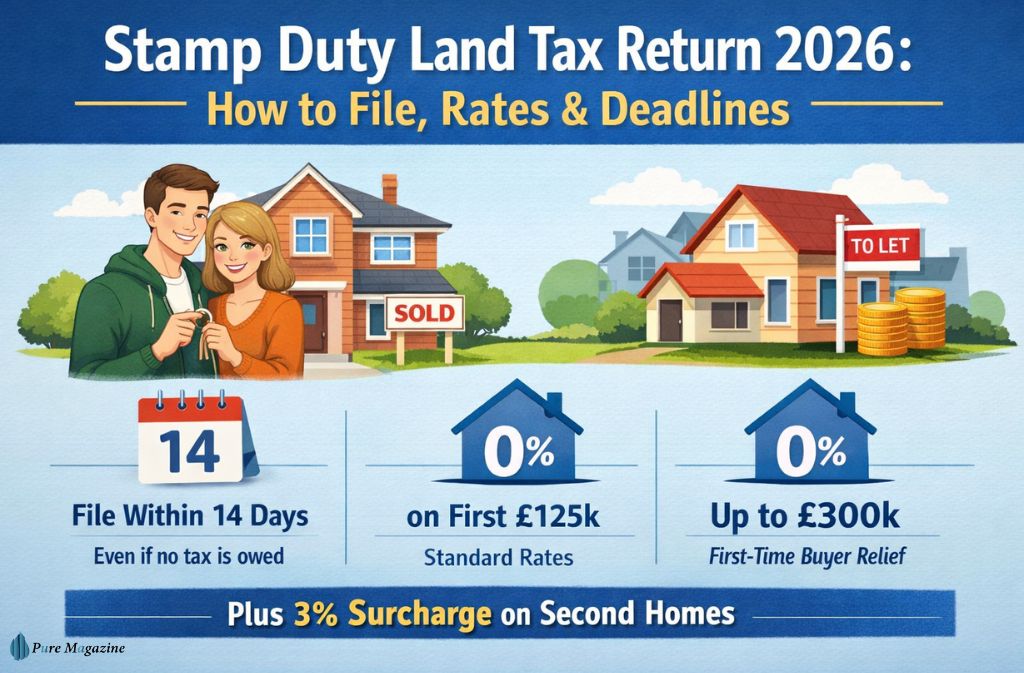
Stamp Duty Land Tax Thresholds for 2026 (Fully Updated & Verified)
Let’s start with the numbers that matter most: the current thresholds.
Standard Residential Rates (2026)
These apply if you’re not a first-time buyer and not buying an additional property.
| Property Price Band | SDLT Rate |
|---|---|
| £0 – £125,000 | 0% |
| £125,001 – £250,000 | 2% |
| £250,001 – £925,000 | 5% |
| £925,001 – £1.5m | 10% |
| £1.5m+ | 12% |
🔍 Key Change:
From April 2025 onward, the 0% band reverted to £125,000, ending the temporary £250,000 threshold.
This is the single most common place buyers get tripped up — because outdated guides still list the old numbers.
First-Time Buyer Relief (2026) — Fully Corrected
Here’s where accuracy matters. Many guides still incorrectly quote:
❌ “£425,000 tax-free for first-time buyers.”
That relief ended on 1 April 2025.
The correct 2026 first-time buyer rates are:
| Price Band | Rate |
|---|---|
| £0 – £300,000 | 0% |
| £300,001 – £500,000 | 5% |
If the property is valued at over £500,000, the relief does not apply at all — another point that people consistently misunderstand.
Additional Properties (3% Surcharge Applies)
Second homes, buy-to-let investments, holiday lets, and some company purchases pay:
➡️ Standard SDLT rate
plus
➡️ An extra 3% on the entire price
This surcharge can dramatically increase the final tax bill — especially on mid-range properties between £300k and £600k, where buyers often expect a lower amount.
Also Read: Business Tax Return 2026: UK & US Deadlines, Forms & Filing
The 14-Day SDLT Deadline (Still the Law in 2026)
This deadline frequently surprises people, especially first-time buyers who assume their solicitor handles everything automatically.
You have 14 calendar days from completion to:
- file the SDLT return
- pay the SDLT owed
Penalties start the moment the deadline passes.
Late filing can also delay your Land Registry application — meaning your ownership cannot be legally registered until SDLT is processed.
In other words:
⚠️ SDLT isn’t an optional form your solicitor files “when they get to it.”
It is a legal requirement with strict time limits.
When You Must File a Stamp Duty Land Tax Return
Here’s a rule HMRC rarely advertises clearly:
Even if no tax is owed, most buyers must still file a return.
You must file if:
✔ The property is worth over £40,000
✔ You are buying a lease extension
✔ You are buying through a company
✔ You want to claim first-time buyer relief
✔ You’re purchasing a second home or investment property
You do not need to file if:
✘ You inherit a property
✘ You receive property during a divorce settlement
✘ No money or chargeable consideration is exchanged
The £40,000 threshold is one of those details that often creates panic because buyers assume “no tax = no form.” Incorrect.
The Forms: SDLT1, SDLT2, SDLT3, SDLT4
You will most commonly encounter:
✔ SDLT1 — The main form
Used for most standard residential purchases.
Depending on the situation, supplemental forms may appear:
- SDLT2 — multiple buyers or complex titles
- SDLT3 — portfolio or multi-transaction properties
- SDLT4 — corporate or high-value structures
Although solicitors file these electronically, you’re responsible for the information being correct — not them.
Examples That Reflect 2026 Rules (Accurate + Explained Simply)
Example 1 — A First-Time Buyer Purchasing at £350,000
Let’s break it down in a human way:
- You pay nothing on the first £300,000
- You pay 5% on the remaining £50,000
5% of £50,000 = £2,500
➡️ Final SDLT owed: £2,500
This example matters because many assume they get relief up to £425,000, which is no longer true.
Example 2 — Standard Buyer Purchasing at £450,000
Breakdown:
- £0 tax on the first £125,000
- 2% on the next £125,000 = £2,500
- 5% on the next £200,000 = £10,000
Total = £12,500 SDLT owed
Simple, realistic, and uses the correct bands for 2026.
Example 3 — Buy-to-Let at £300,000 (Surcharge Included)
Standard SDLT = £5,000
3% surcharge = £9,000
➡️ Total SDLT owed: £14,000
This is where many investors underestimate their bill — the surcharge applies to the full purchase price.
Also Check: How to Avoid Paying Council Tax on an Empty Property After Death
Common Mistakes People Make (And How to Avoid Them)
❌ Mistake 1: Assuming the solicitor handles everything
Some do, some don’t. Always check.
❌ Mistake 2: Using outdated tax calculators
Half the internet shows pre-2025 rates.
❌ Mistake 3: Claiming first-time buyer relief incorrectly
If you owned even 1% of a property anywhere in the world, you’re not eligible.
❌ Mistake 4: Confusing SDLT with solicitor fees
The “SDLT handling fee” on your quote is not the tax itself.
❌ Mistake 5: Not budgeting for the surcharge
Especially when buying before selling your current home.
FAQs
Q1. Do I need to file a Stamp Duty Land Tax (SDLT) return in 2026?
Yes. In 2026, you must submit an SDLT return for most residential property transactions over £40,000, even if no tax is owed. Returns must be filed and paid within 14 days of completion in England or Northern Ireland.
Q2. What are the SDLT thresholds for first-time buyers in 2026?
First-time buyers pay 0% on properties up to £300,000 and 5% on the portion between £300,001 and £500,000. The previous £425,000 relief ended on April 1, 2025. Properties above £500,000 do not qualify for first-time buyer relief.
Q3. How much SDLT do I pay on a second home or buy-to-let property in 2026?
Second homes and buy-to-let properties are subject to the standard SDLT rates plus a 3% surcharge. For example, a £300,000 second home would normally pay £5,000 in SDLT, plus a £9,000 surcharge, totaling £14,000.
Q4. What is the 14-day SDLT deadline, and how is it calculated?
The SDLT deadline is 14 calendar days from completion. Completion, not exchange, triggers the filing. Late submissions can result in penalties, interest, and delays in property registration. The clock starts when the purchase is substantially performed, even if the paperwork isn’t fully finalized.
Q5. Can I claim SDLT relief or exemptions in 2026?
Yes, reliefs include:
- First-time buyer relief (up to £300,000)
- Multiple dwellings relief
- Charitable or corporate reliefs
Eligibility depends on the transaction type. Always verify reliefs against the current 2026 HMRC rules before filing to avoid errors or penalties.
Final Thoughts: SDLT Isn’t Complicated — Outdated Guidance Is
Stamp Duty becomes overwhelming when the rules shift, and older content lingers online. But once you understand the correct 2026 thresholds and how the reliefs really work, it’s much more manageable.
If you remember only three things, make them these:
- The 0% rate is £125k, not £250k
- First-time buyer relief is £300k, not £425k
- You must file within 14 days, even if no tax is owed
Related: UK Tax Return Deadlines 2026: Key Dates for 2024/25 & 2025/26