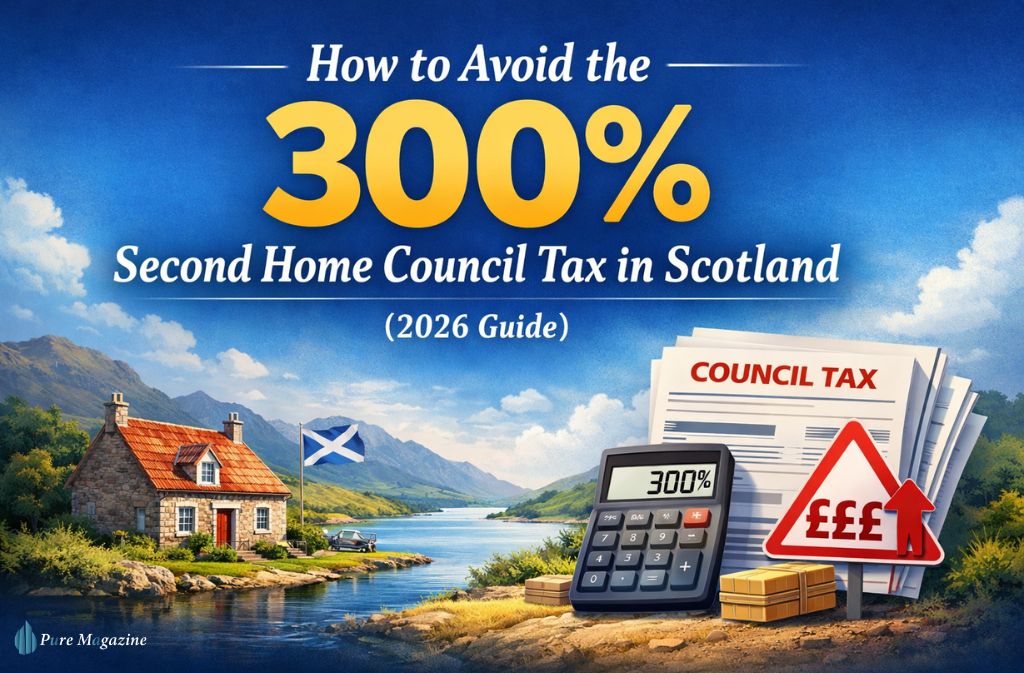
HOwning a second home in Scotland is no longer just expensive — in some areas, it’s become punishingly expensive.
Since April 1, 2026, certain councils have moved well beyond doubling council tax. In parts of the Highlands, bills have effectively quadrupled. What used to be a manageable annual cost for a rural retreat or investment property has, for some owners, become a five-figure annual liability.
If the search that brought you here was “how to avoid second home council tax Scotland,” here’s the honest answer: you can’t avoid council tax entirely. But you can legally reduce or remove the premium if the property is correctly classified — and understanding how councils now enforce the rules is what separates owners paying standard rates from those paying 300% of them.
What most guides don’t tell you is that enforcement has become genuinely data-driven. Councils now cross-reference utility usage, HMRC data, DVLA records, and the electoral roll under revamped data-sharing protocols introduced in 2025. The loopholes that worked five years ago are much harder to exploit — and several no longer exist.
This guide covers what actually works in 2026, what’s changed at specific councils, and the mistakes that are currently costing homeowners thousands in backdated tax.
What Counts as a Second Home in Scotland?
A second home is a furnished property that isn’t the owner’s main residence and is occupied for at least 25 days per year. That last condition — the 25-day threshold — is the one most owners overlook.
If a property has fewer than 25 days of annual occupation, councils may reclassify it as a long-term empty home rather than a second home. The distinction matters enormously because empty home premiums compound over time and can ultimately exceed even the highest second home rates.
As a practical point: if a property sits furnished but largely unvisited, doing nothing is often the most expensive option available.
The April 2026 Change: The 100% Cap Is Gone
Until recently, councils could charge a maximum premium of 100% on top of standard council tax — effectively doubling the bill. The Council Tax (Variation for Unoccupied Dwellings) (Scotland) Amendment Regulations 2026, which took effect on April 1, 2026, removed that statutory cap. Councils now set their own premium levels.
The results vary significantly by area:
| Council | 2026 Premium | Total Multiplier |
|---|---|---|
| Highland Council | 300% | 4× standard bill |
| Glasgow City Council | 200% | 3× standard bill |
| Scottish Borders | 225% | 3.25× standard bill |
| Argyll & Bute | ~110% | ~2.1× standard bill |
Edinburgh initially proposed a 300% premium but suspended that increase in March 2026 to assess its impact further. As of April 2026, Edinburgh has not implemented the triple rate — owners there should verify the current position directly with the City of Edinburgh Council before calculating liability.
The Highland Council figure is worth dwelling on. The council is operating under its “Highland Housing Challenge” initiative, which identified a need for 24,000 additional homes across the region. The 300% premium is a deliberate policy tool to push underused properties back into the residential market, not simply a revenue measure. Understanding that context helps predict how rigorously they’ll enforce it — and the answer is: very.
A practical illustration: a standard Band D council tax bill of £2,000 in the Highlands becomes £8,000 under the 300% premium. That’s before Scottish Water and waste charges, which — and this is a detail almost no guide mentions — are not subject to the premium. Water and waste make up roughly 20% of a typical Scottish council tax bill and remain at 100% regardless of any council premium. Owners who include them in their premium calculations overestimate their liability. It’s a modest saving in the context of an £8,000 bill, but it matters for accurate budgeting.
How to Legally Reduce or Remove the Premium
These are legitimate classification strategies, not loopholes. Every one of them requires genuine evidence.
1. Make It Your Main Residence
Still, the most reliable way to eliminate the premium. But the bar for proving it is significantly higher in 2026.
Councils now verify main residence claims by cross-referencing:
- Electoral register
- GP and NHS registration address
- Smart meter and utility usage data
- Banking, HMRC, and DVLA address records
The utility data point is the one that catches most people. Smart meters show daily usage patterns. If a property shows zero or near-zero energy consumption for ten months of the year, any appeal against reclassification is almost impossible to sustain. An investigation triggered by a tip-off or a data-matching exercise will find that pattern immediately. Low energy usage is consistently the detail that ends main residence claims before they start.
For a claim to hold, the property needs to show the kind of consistent utility footprint that reflects genuine habitation — regular heating, cooking, appliance use — not occasional visits.
2. Convert to a Holiday Let (Business Rates)
Converting a qualifying second home to a self-catering business moves it from council tax to non-domestic rates. Done correctly, this can reduce the effective bill to near zero. Done incorrectly, it triggers penalties and backdated council tax.
2026 qualifying thresholds:
- Available for let: 140+ days per year
- Actually, let: 70+ days per year
Meeting these thresholds moves the property to non-domestic rates and opens eligibility for the Small Business Bonus Scheme (SBBS). The SBBS provides 100% relief on properties with a rateable value under £12,000, which covers a significant proportion of Scottish holiday cottages.
2026 additions worth knowing:
The Self-Catering Revaluation Transitional Relief caps any bill increases at 15% for 2026/27 for properties transitioning from council tax to business rates. For owners whose rateable value has increased at revaluation, this safety net prevents an immediate sharp rise in the first year.
Simply listing a property on Airbnb no longer satisfies the thresholds. Councils audit short-term lets actively, and booking records must demonstrate genuine commercial operation — not token availability to justify a business rates classification.
Holiday let business rates checklist:
- Available for let: 140+ days documented
- Actually, let: 70+ days with booking records
- Rateable value confirmed (check Scottish Assessors Association)
- SBBS application is submitted if the rateable value is under £12,000
- Transitional relief noted if applicable
3. Claim Specific Discounts and Exemptions
Job-related second home (50% discount): If an employer requires the owner to live elsewhere — clergy, teachers, school caretakers, site managers — the second home may qualify for a 50% discount. In 2026, this also explicitly covers armed forces personnel whose service contract requires them to occupy service accommodation. The property they own but cannot live in because of service requirements qualifies.
6-month repair rule: A property recently purchased in need of major structural work often qualifies for a 50% discount for up to six months. This applies from the date of purchase, not from when work begins. New owners should apply immediately rather than waiting for the works to be completed.
Structural renovation: Properties undergoing significant structural renovation may qualify separately from the repair rule. Documentation of the works is required.
Properties marketed for sale or let: In areas including Argyll & Bute, the premium is waived for up to two years where the owner can demonstrate the property is actively marketed for sale or rental and has been empty for less than two years. This is a genuine safety net for owners who inherited a property or who are in the process of selling, but “actively marketed” requires real evidence: live listings, estate agent correspondence, and viewings.
All of these are council-specific in their application. Rates, qualifying periods, and evidence requirements vary by local authority. Checking directly with the relevant council before applying is essential.
4. Avoid Empty Home Reclassification
If a furnished second home becomes unfurnished or sits entirely unused, councils may reclassify it as a long-term empty home. Empty home premiums escalate over time — in some councils, properties empty for more than five years face premiums that exceed even the highest second home rates.
The practical implication: if keeping a property isn’t viable, marketing it for sale or rental is financially superior to leaving it sitting. The “actively marketed” exemption described above provides a two-year window in many areas — use it.
Scotland Is a Patchwork, Not One System
One of the most persistent misconceptions is that second home council tax rules are uniform across Scotland. They aren’t.
Each council independently sets its premium level, discount eligibility criteria, enforcement approach, and audit frequency. Some councils focus their enforcement resources on obvious cases — properties with no utility usage, no electoral registration, and no correspondence sent to the address. Others run systematic cross-referencing exercises against HMRC data and DVLA records on a rolling basis.
Edinburgh’s decision to suspend its 300% increase while Glasgow proceeded shows how differently adjacent authorities can move. Scottish Borders at 225% sits between the two. Argyll & Bute at 110% is more moderate but still double the pre-2026 position.
The lesson is that the council governing the property determines both what is owed and how aggressively any classification will be challenged. Research the specific council’s position before choosing a strategy.
The Evidence Councils Now Require
This is where many homeowners get caught out. Claiming an exemption, discount, or reclassification without the supporting documentation doesn’t just fail — it can trigger a backdated reassessment.
For main residence claims:
- Utility bills showing consistent usage over at least 12 months
- Electoral registration at the property
- GP and NHS registration at the property address
- Banking and official correspondence sent to the address
- Insurance documents
Holiday let business rates:
- Booking platform records showing actual rental nights (70+ days)
- Availability calendar showing 140+ days listed
- Income records or bank transfers from guests
- Public listing URL is active and verifiable
Job-related discounts:
- Employer letter confirming the requirement to live at a different location
- Service contract evidence for armed forces personnel
For the repair/renovation discount:
- Surveyor’s report or builder’s assessment of required works
- Date of purchase documentation
Councils increasingly cross-check submitted evidence against data held by HMRC, the DVLA, NHS Scotland, and utility providers under the data-sharing protocols updated in 2025. Claims that contradict data held elsewhere get flagged — and the investigation that follows can result in backdated bills, penalties, and permanent loss of relief eligibility.
The Appeal Route: Local Taxation Chamber
Where a council rejects a main residence claim, a discount application, or a business rates classification, the appeal goes to the Local Taxation Chamber, which is part of the Scottish Tribunal Service. This is the specific body handling second-home council tax disputes in 2026.
Appeals require documented grounds — a rejection based on insufficient evidence of occupancy is difficult to overturn without new evidence. Appeals based on incorrect application of the rules (wrong premium level applied, eligibility criteria misinterpreted) have stronger prospects. The Chamber’s decisions are published and create precedents that other councils reference.
Comparison: 2026 Strategy Options
| Strategy | Tax Impact | Difficulty | Risk |
|---|---|---|---|
| Main residence (genuine) | Eliminates premium | Medium | Low if genuine |
| Holiday let conversion | Can be reduced to £0 | High | Medium if thresholds met |
| Job-related discount | 50% reduction | Low | Low with employer letter |
| Repair/renovation discount | 50% up to 6 months | Low | Low with documentation |
| Actively marketed exemption | Waives the premium up to 2 years | Low-medium | Low with live listing evidence |
| Leaving it unused | 300%+ in some areas | None | Very high ❌ |
Real-World Example
Ali owns a second home in the Highland Council area. His standard Band D bill was £2,000. Under the April 2026 300% premium, it becomes £8,000 — before water and waste charges, which remain at standard rates and aren’t subject to the premium.
Ali converts the property into a qualifying self-catering holiday let. He documents 145 available days and 72 actual rental nights across the year. The property moves to non-domestic rates. Its rateable value is £9,500, which qualifies for the Small Business Bonus Scheme at 100% relief. His effective council tax bill drops to near zero. The Self-Catering Revaluation Transitional Relief caps any year-one adjustment at 15%, providing additional protection during the first year of business rates.
The conversion requires genuine commercial operation — regular bookings, public listings, income records — not just Airbnb registration. But for a property in a tourist area with real rental demand, the strategy is both legal and financially transformative.
Common Mistakes That Are Costing Owners Money in 2026
Claiming main residence without genuine occupancy — smart meter data and HMRC address records now make this identifiable within weeks of an audit trigger.
Assuming Airbnb registration qualifies for business rates — the 70-day actual let and 140-day availability thresholds require documented commercial operation, not just platform presence.
Overestimating the bill — Scottish Water and waste charges don’t carry the premium. Including them in the 300% calculation produces an inflated figure.
Ignoring the actively marketed exemption, owners in Argyll & Bute and similar councils who are trying to sell or rent a property may qualify for a two-year premium waiver they’ve never applied for.
Leaving a property furnished but unoccupied — risks reclassification as a long-term empty home, which carries escalating premiums over time.
Missing the 6-month repair window — new owners who don’t apply for the repair discount immediately forfeit months of potential 50% relief.
Step-by-Step Action Plan for 2026
- Confirm whether the property is classified as a second home or an empty home with the local council
- Check the specific council’s 2026 premium rate — don’t assume the Highland or Glasgow figure applies elsewhere
- Calculate the actual liability accurately, excluding Scottish Water and waste from the premium
- Choose a strategy: genuine main residence, qualifying holiday let, or applicable exemption/discount
- Gather documentary evidence before applying — don’t submit without it
- Apply before the next council tax cycle begins
- If a claim is rejected, appeal to the Local Taxation Chamber with new supporting evidence
FAQs
Q. Can you avoid second home council tax in Scotland in 2026?
No, you cannot completely avoid council tax. However, you can legally reduce or eliminate the second home premium by making the property your main residence, qualifying for business rates as a holiday let, or applying for council-specific discounts such as job-related exemptions or repair relief.
Q. Do all Scottish councils charge more than 100% council tax premium?
No. Since April 1, 2026, the Scottish Government has removed the 100% cap, allowing councils to set their own rates. Many now exceed 100%, with some reaching 200%–300% or more, but rates vary significantly by local authority.
Q. What is the 25-day rule for second homes in Scotland?
To be classified as a second home (instead of an empty property), the property must be occupied for at least 25 days per year. If it falls below this threshold, it may be reclassified as an empty home, which can lead to even higher council tax premiums.
Q. Can an Airbnb property avoid council tax in Scotland?
No—listing on Airbnb alone does not remove council tax. A property must qualify as a self-catering holiday let, meaning it is available for rent for at least 140 days per year and actually let for at least 70 days, with clear evidence. If approved, it moves to business rates instead of council tax.
Q. What is the 6-month repair rule in Scotland?
If you purchase a property that requires major structural repairs, you may receive a 50% council tax discount for up to six months. This period usually starts from the date of purchase, not when renovation work begins, so early application is essential.
Q. Do water charges increase with the council tax premium?
No. Charges from Scottish Water (including water and waste services) are typically around 20% of the total bill and remain at standard rates, even if the council tax premium increases.
Q. Can you appeal a second home council tax decision in Scotland?
Yes. You can appeal through the Local Taxation Chamber, part of the Scottish tribunal system. You must provide supporting evidence, such as proof of residency, usage, or eligibility for exemptions.
Q. What is the “actively marketed” exemption?
Some councils, including Argyll and Bute Council, offer a temporary exemption where the premium is waived for up to two years if:
- The property has been empty for less than two years
- You can prove it is actively being marketed for sale or rent
Evidence typically includes listings, agent contracts, and pricing history.
Q. Which Scottish councils have the highest second home premiums in 2026?
Premiums vary widely, but some of the highest include:
- Highland Council – up to 300%
- Glasgow City Council – around 200%
- Scottish Borders Council – around 225%
Meanwhile, the City of Edinburgh Council paused its proposed 300% increase in March 2026.
For more guides on property tax, council charges, and UK finance, visit Pure Magazine.