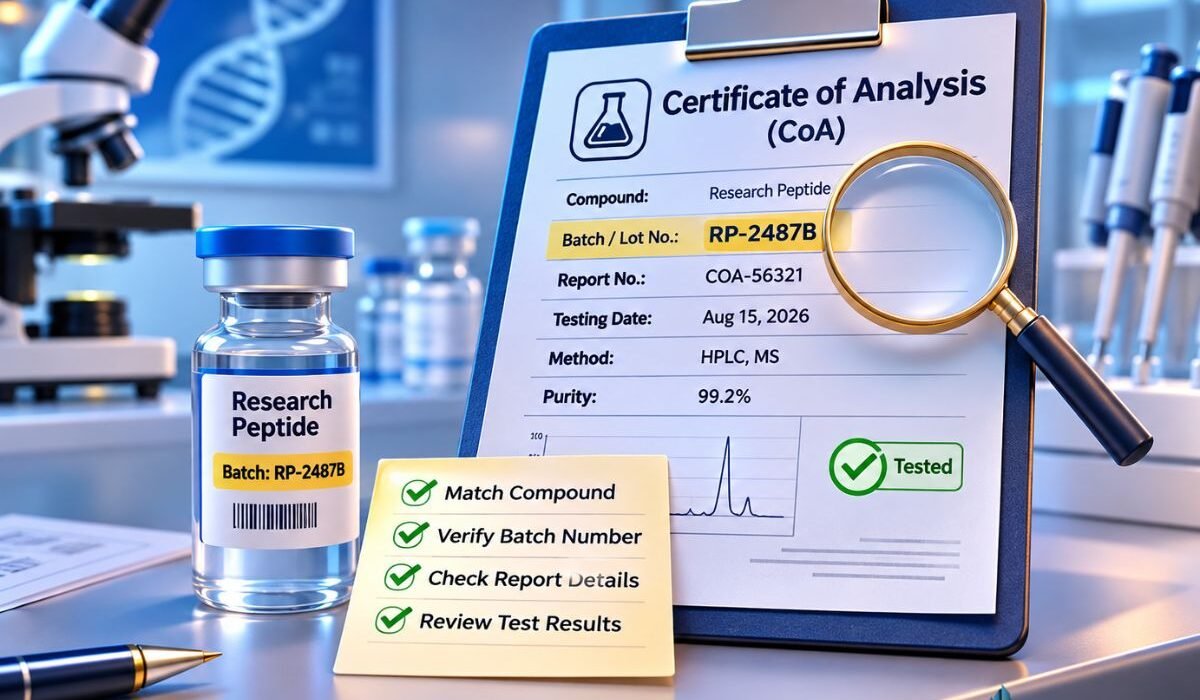
Certificates of Analysis (CoAs) are an important part of quality documentation in the research peptide industry. For laboratory buyers, academic researchers, and biotechnology professionals in the United Arab Emirates, these documents provide analytical information about specific samples and help establish a clearer connection between a product and its reported test results.
However, having a Certificate of Analysis available does not automatically mean that it applies to every batch sold by a supplier. The relationship between the tested sample, its batch reference, and the material being purchased must be established before the report can be used as supporting documentation.
This is particularly relevant for laboratories sourcing research peptides in Dubai and other parts of the UAE, where comparing suppliers often involves reviewing published laboratory reports.
Understanding how to match a CoA to the correct batch can help researchers maintain accurate records, avoid documentation errors, and make more informed sourcing decisions.
What Is a Certificate of Analysis?
A Certificate of Analysis is a document that records analytical findings for an identified sample. It typically contains information about the tested material, analytical methods, laboratory details, and reported results.
Depending on the issuing laboratory, a CoA may include:
- Compound or sample identification.
- Batch or lot number.
- Laboratory report reference.
- Testing date.
- Analytical methods.
- Chromatographic purity results.
- Molecular mass or identity-related information.
- Additional test results, where applicable.
The exact contents depend on the laboratory and the scope of testing.
A CoA should be treated as a record of the tests actually performed, not as a general guarantee covering every possible quality characteristic.
Why Batch Matching Is Important
Every production or supply batch may have its own identifying reference. Laboratory testing performed on one batch does not automatically establish the analytical characteristics of another.
Consider a laboratory evaluating a peptide supplier that publishes a report for a particular sample. If the supplier later provides material associated with a different batch, the original report cannot automatically be applied to the newly supplied material.
This distinction is essential for traceability.
A correctly matched report helps researchers establish:
- Which sample was analysed.
- Which batch the sample represents.
- Which laboratory performed the testing.
- What analytical methods were used.
- Which results were reported.
Without these connections, a laboratory report may provide useful background information but insufficient evidence about the specific batch under consideration.
Understanding the Key Identifiers on a CoA
Before reviewing analytical results, researchers should examine the identifying information in the document.
1. Compound Name
The compound name identifies the material submitted for analysis.
It should be consistent with the product description and accompanying documentation.
Researchers should not assume that similar compound names, abbreviations, or product labels refer to identical materials.
Where multiple descriptions appear, clarification should be obtained from the supplier.
2. Batch or Lot Number
The batch or lot number is particularly important because it connects the analytical record to a defined material batch.
Researchers should compare the number appearing on the laboratory report with the batch reference supplied for the product.
If the report does not include a batch number, the supplier should explain how the tested sample is linked to the relevant batch.
A general statement that a report represents a particular product is not necessarily sufficient to establish batch-level traceability.
3. Laboratory Report Number
Laboratories commonly assign unique identifiers to their reports.
These may appear as:
- Report numbers.
- Task IDs.
- Sample reference numbers.
- Verification codes.
Such identifiers help distinguish individual analytical records and can support independent verification through the issuing laboratory.
4. Testing Date
The testing date indicates when the sample was analysed.
It helps researchers understand the timeline of the analytical record, particularly when reviewing multiple reports for different batches.
However, an older report is not automatically invalid, and a recent report is not automatically applicable to a newly supplied batch.
The actual sample identification and batch relationship remain essential.
Matching a Laboratory Report to a Research Peptide Batch
A systematic approach can reduce confusion when reviewing supplier documentation.
Step 1: Identify the Product Being Evaluated
Start with the exact product name and format.
Record the identifying information provided in the product documentation, including any batch reference.
This creates a clear starting point for comparison.
Step 2: Locate the Corresponding Report
Find the laboratory document associated with the product.
Check whether the document identifies the same compound and whether it includes a specific sample or batch reference.
If multiple reports are available, avoid selecting one simply because its title matches the product name.
Step 3: Compare Batch References
Compare the product’s batch information with the reference shown in the report.
The identifiers should match or have a clearly explained relationship.
If the report identifies a different sample, ask the supplier to clarify whether it represents the supplied batch or another analytical sample.
Step 4: Review the Analytical Methods
Once the report’s identity has been established, examine the testing information.
A CoA may contain HPLC results, LC-MS information, endotoxin measurements, or other analytical findings.
Each method provides different information.
For example, HPLC purity results describe the detected chromatographic profile under the stated conditions. They do not independently establish sterility or prove the absence of every possible impurity.
Step 5: Check Verification Information
Where the issuing laboratory provides verification facilities, use its official website or contact channel.
Check the report number, verification key, or other available identifiers.
This helps distinguish an authentic laboratory record from an unverified document supplied without sufficient supporting information.
Step 6: Maintain Internal Documentation
After reviewing the report, laboratories should maintain a record connecting the document to the relevant product and batch.
This may include the product description, batch reference, report number, testing date, and any clarification received from the supplier.
Consistent recordkeeping makes future comparisons and internal reviews easier.
Understanding Different Types of Analytical Results
Matching a CoA to the correct batch is only the first part of the process. Researchers must also understand what the reported results establish.
HPLC Purity
High-Performance Liquid Chromatography is commonly used to examine the chromatographic profile of peptide samples.
The reported purity percentage generally represents the proportion of the detected chromatographic signal attributed to the target compound under the specified analytical conditions.
It should not automatically be interpreted as the percentage of total sample weight consisting of the target peptide.
LC-MS and Molecular Mass
Liquid Chromatography-Mass Spectrometry combines separation and mass-based analysis.
It can provide information supporting the assessment of molecular identity by comparing observed mass-related information with expected values.
However, molecular mass information alone does not establish every aspect of molecular structure or sample composition.
Endotoxin Testing
Endotoxin testing investigates bacterial endotoxins within the scope of the method used.
A reported result should be reviewed alongside its units, analytical method, and reporting limits.
Endotoxin testing does not establish sterility.
Heavy-Metal Analysis
Heavy-metal testing may identify and measure selected metallic elements in a sample.
Researchers should check which elements were included rather than assuming that a report covers every possible contaminant.
Common CoA and Batch Documentation Problems
Several documentation issues can make it difficult to establish whether a report applies to a particular research peptide batch.
Using an old report for a new batch: Previous analytical results should not automatically be applied to subsequently supplied material.
Missing batch references: A document without clear sample or batch identification may have limited traceability.
Different product formats: Testing information for one format should not automatically be treated as evidence for another.
Unclear laboratory information: Missing report numbers or laboratory details can make verification difficult.
Overstating test results: A purity percentage should not be presented as proof of sterility, safety, or complete product quality.
When these issues arise, researchers should request clarification rather than making assumptions.
Evaluating Suppliers Through Published Certificates of Analysis
For buyers comparing research peptides in Dubai and across the UAE, published laboratory documentation can provide useful insight into a supplier’s approach to transparency.
However, the availability of a CoA should be considered alongside the quality of its identifying information and the clarity of its testing scope.
Remy Research provides published product and laboratory documentation for customers interested in reviewing its research materials.
Its online peptide lab reports collection includes selected analytical records from Janoshik Analytical and METS Lab in Ajman, UAE.
These records provide an opportunity to examine laboratory references, sample information, and reported analytical findings.
Researchers should review each document individually and establish whether it applies to the specific sample or batch under consideration.
It is also important to distinguish between published reports for selected batches and a claim that every available batch has undergone the same independent testing.
Transparent communication about these distinctions helps buyers understand exactly what the available documentation demonstrates.
A Practical Checklist for Research Laboratories
Before accepting a laboratory report as supporting documentation for a particular batch, researchers can review the following points:
- Is the compound clearly identified?
- Is the sample description consistent with the product?
- Is a batch or lot number provided?
- Does the report identify the issuing laboratory?
- Is there a unique report or task reference?
- Are the analytical methods clearly stated?
- Are results presented with appropriate units?
- Can the report be verified where verification is available?
- Does the report actually relate to the batch being evaluated?
- Are the limitations of the reported tests understood?
This checklist provides a straightforward framework for reviewing documentation without making unsupported assumptions.
Conclusion
A Certificate of Analysis is most useful when its relationship to the actual research batch is clear.
Researchers should examine sample identification, batch references, laboratory details, analytical methods, and verification information before relying on a published report.
The distinction between product-level information and batch-specific evidence is particularly important when evaluating research peptide suppliers in the UAE.
Ultimately, accurate documentation supports better traceability and more responsible laboratory recordkeeping. It also helps prevent analytical results from being applied beyond the samples they actually represent.
All materials discussed are intended strictly for in-vitro laboratory research only. They are not intended for human or veterinary use. A Certificate of Analysis applies only to the identified sample or batch and does not establish sterility or safety for human or veterinary applications.
For more, visit Pure Magazine