The P46 form refuses to die.
It still appears in job starter packs, ancient HR templates, and Google searches — even though HMRC officially withdrew it back in April 2013. That gap between policy and practice is exactly why people are still confused in 2026.
If you’re starting a new job, hiring someone, or staring at an onboarding email asking for a “P46,” you’re not missing anything. The system changed. The internet just didn’t catch up.
This guide explains, in plain English, what the P46 form used to be, why HMRC replaced it, and what actually applies now — according to current HMRC guidance for the 2026 tax year.
No recycled PDFs. No HR jargon. Just the answer you were probably hoping Google would give you five searches ago.
What Was the P46 Form?
The P46 form was an HMRC document used when someone started a job without a P45 from a previous employer.
It helped HMRC work out:
- Which tax code to apply
- Whether an emergency tax was needed
- If student loan deductions should start (and which plan)
In short, it was a “joiner’s form” — a way to bring someone into PAYE when there was no employment history to reference.
What Was the P46 Form Used For?
Employers used the P46 form to avoid guessing.
Without it, payroll teams had no reliable way to know:
- If this were someone’s first job
- Whether they’d worked earlier in the tax year
- Whether student loan repayments are applied
So the P46 filled that gap — until HMRC moved PAYE reporting online.
Is the P46 Form Still Used in 2026?
No — and this part matters.
HMRC officially withdrew the P46 in April 2013 as part of its shift to Real Time Information (RTI). From that point on, the form became invalid for most employees.
What’s confusing is that:
- Old PDFs still circulate online
- Some employers never updated their processes
- Many advice pages quietly froze in time
So people keep asking about a form that HMRC hasn’t accepted for over a decade.
What Replaced the P46 Form?
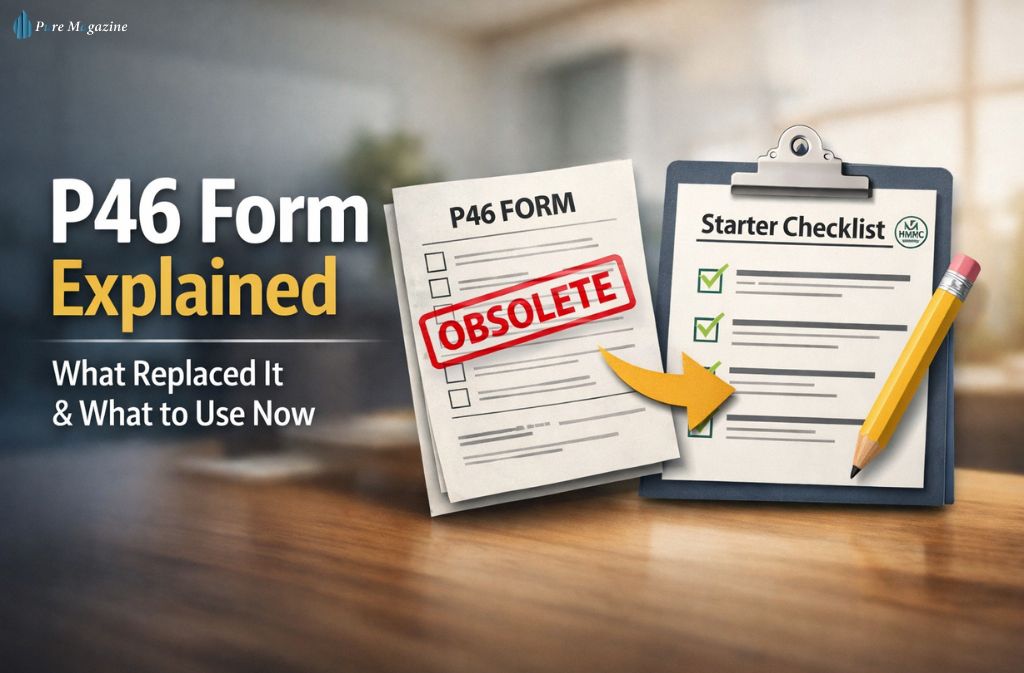
The HMRC Starter Checklist replaced the P46 form.
It serves the same purpose, but fits modern PAYE reporting:
- Digital-first
- RTI-compatible
- Clear student loan declarations
- Fewer payroll errors
HMRC guidance now treats the Starter Checklist as the default route when an employee starts work without a P45.
P46 vs P45 vs Starter Checklist (Clear Comparison)
| Feature | P46 (Old) | P45 | HMRC Starter Checklist |
|---|---|---|---|
| Used in 2026 | ❌ No | ✅ Yes | ✅ Yes |
| For new starters | ✅ | ❌ | ✅ |
| From previous employer | ❌ | ✅ | ❌ |
| Determines tax code | ✅ | ✅ | ✅ |
| Student loan info | Limited | ❌ | ✅ |
| HMRC recommended | ❌ | ✅ | ✅ |
Think of it this way:
- P45 = leaver’s document
- Starter Checklist = joiner’s document
- P46 = retired paperwork
When Do You Use the HMRC Starter Checklist?
You use it when any of the following apply:
- You don’t have a P45
- This is your first job
- You’ve had a long break from work
- You’ve moved from self-employment to PAYE
In practice, this covers a huge number of new starters, which is why the Starter Checklist matters so much.
What To Do Instead of a P46 Form (Step-by-Step)
If You’re an Employee
- Complete the HMRC Starter Checklist
- Answer the employment history questions honestly
- Declare your student loan status
- Check your first payslip for the tax code applied
When something looks off, raise it early — fixes are easier in month one.
If You’re an Employer
- Ask the employee to complete the Starter Checklist
- Enter the information into your payroll system
- Submit via RTI as normal
Note: If your process still asks for a P46, it’s usually a sign the payroll setup hasn’t been updated in years — not that the employee is missing anything.
Common Mistakes (Still Happening in 2026)
These crop up more often than HMRC would like:
- Asking employees to “download a P46.”
- Using unofficial PDF forms found via Google
- Defaulting everyone to the emergency tax
- Ignoring student loan declarations
- Assuming “no P45” means “no tax history.”
None of these are malicious — they’re just outdated.
A Real-World Example (What This Looks Like in Practice)
Amira starts her first full-time job a few weeks after university.
HR emails asking for documents she’s never heard of. “P46” keeps coming up in the thread. She Googles it, finds three different answers, and starts worrying she’s already messed something up.
In reality, she just needs to complete the HMRC Starter Checklist. Once she does, payroll applies the correct tax code and student loan plan — no emergency tax, no follow-ups, no drama.
This is exactly the kind of low-level panic the old terminology still causes.
Why HMRC Replaced the P46 Form
HMRC didn’t retire the P46 for fun.
It was part of a wider shift toward:
- Real Time Information (RTI)
- Fewer manual corrections
- Faster tax code accuracy
- Digital payroll reporting
The change made sense — it just wasn’t communicated especially well outside official guidance.
2026 Best Practices (Worth Knowing)
- Never use archived P46 PDFs
- Link onboarding processes directly to HMRC guidance
- Review starter procedures annually
- Treat “no P45” as normal, not exceptional
These small tweaks prevent most PAYE errors before they start.
FAQs
Q. What replaced the P46 form?
The HMRC Starter Checklist replaced the P46 form in April 2013. It is still the correct form to use in 2026 when an employee starts a job without a P45. HMRC uses it to apply the correct tax code and student loan deductions.
Q. Is a P46 the same as a P45?
No. A P45 is given by a previous employer when someone leaves a job. A P46 was used when no P45 was available. The P46 has now been replaced by the HMRC Starter Checklist, which serves the same purpose.
Q. Can I still use a P46 form?
No. The P46 form is no longer valid and should not be used for payroll. Although old P46 PDFs still exist online, HMRC does not accept them. Employers must use the HMRC Starter Checklist instead.
Q. Why do employers still ask for a P46 form?
Employers usually ask for a P46 because their onboarding templates or payroll processes are outdated. HMRC no longer issues or accepts P46 forms, so employees should be directed to complete the Starter Checklist instead.
Q. Does the HMRC Starter Checklist cover student loans?
Yes. The HMRC Starter Checklist is the primary way employers know whether to deduct student loan repayments and which plan applies (Plan 1, Plan 2, Plan 4, or Postgraduate Loan).
Conclusion
The P46 form hasn’t been used for years — but the confusion around it lingers.
As of the 2026 tax year, HMRC is clear: if someone starts work without a P45, the HMRC Starter Checklist is the correct and only route.
Once you know that, everything else falls into place. No missing forms. No guessing. And no nagging feeling that you’ve done something wrong before your first payslip even lands.
Related: Changing Tax Code With HMRC: Fast 2026 Step-by-Step Guide