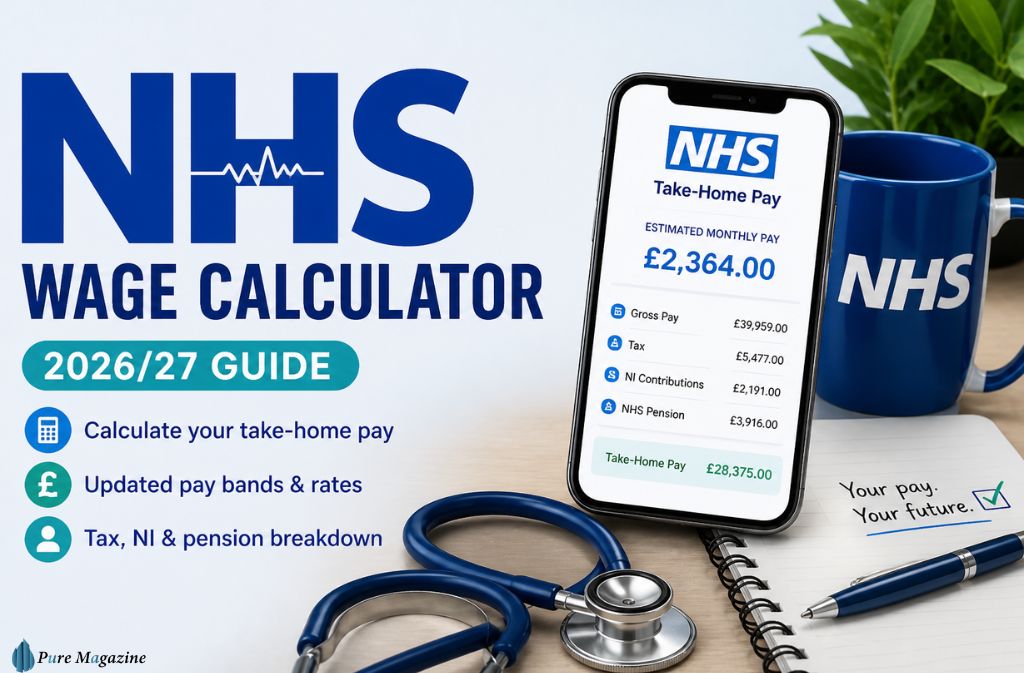
April 2026 quietly changed a lot for NHS staff. Salaries went up — but for many, take-home pay didn’t increase as much as expected.
That’s where most guides fall short.
A standard NHS wage calculator gives you a number. But it rarely explains why your payslip looks different, or why a pay rise can sometimes feel underwhelming.
This guide is built differently. It reflects the 2026/27 Agenda for Change (AfC) pay award, updated tax rules, and real NHS deductions — so you can estimate your true take-home pay with confidence.
You’ll learn:
- Updated NHS pay bands (2026/27)
- Exact deduction breakdown (tax, NI, pension)
- The pension tier trap — and when it actually bites
- Real salary examples using current figures
- How to avoid common payslip surprises
What Is an NHS Wage Calculator?
An NHS wage calculator is a tool or method used to estimate your net salary (take-home pay) after deductions, including:
- Income tax
- National Insurance (NI)
- NHS pension contributions
- Student loan (if applicable)
In 2026, accuracy depends on using updated AfC pay bands and verified pension tier thresholds — not outdated assumptions. Generic salary calculators routinely use incorrect pension tiers, which can throw your estimate off by hundreds of pounds a year.
NHS Pay Bands 2026/27 (Updated AfC Structure)
Following the 3.3% pay uplift effective from 1 April 2026, NHS salaries in England are now:
| Band | Starting Salary | Top Salary |
|---|---|---|
| Band 5 | £32,073 | £39,043 |
| Band 6 | £39,959 | £48,117 |
| Band 7 | £49,387 | £56,515 |
Source: NHS Employers official 2026/27 pay scales
What this means:
- Entry-level nurses now start above £32k
- Mid-band progression matters more than ever
- Pension contributions shift with salary — and the tier boundaries don’t always move in your favour (more on this below)
This is the first year the pay uplift has been reflected in April payslips on time, without the backpay complications that have plagued previous cycles.
How to Calculate NHS Take-Home Pay (2026 Method)
1: Start with the updated gross salary
Use the confirmed 2026/27 AfC pay band figure — not last year’s.
2: Deduct Income Tax (UK 2026)
- Personal allowance: £12,570 (frozen)
- 20% basic rate applies on earnings above £12,570 up to £50,270
- 40% higher rate kicks in above £50,270 — relevant to Band 8 and above
3: Apply National Insurance (Updated)
- 8% NI rate (reduced from 12% in January 2024, still in effect for 2026/27)
- Applies on earnings between £12,570 and £50,270
- Drops to 2% above £50,270
4: Deduct NHS Pension
Six-tier system with 2026/27 thresholds (confirmed by NHS Employers and UK legislation):
| Tier | Contribution Rate | Pensionable Pay Range |
|---|---|---|
| 1 | 5.2% | Up to £13,259 |
| 2 | 6.5% | £13,260 – £27,797 |
| 3 | 8.3% | £27,798 – £33,868 |
| 4 | 9.8% | £33,869 – £50,845 |
| 5 | 10.7% | £50,846 – £65,190 |
| 6 | 12.5% | £65,191+ |
Your pension contribution comes out before tax — meaning you receive full tax relief automatically. For a basic rate taxpayer, every £100 of pension contribution costs you roughly £80 in real terms.
Step 5: Subtract Additional Costs
- Student loan
- Union fees
- Professional registration (NMC/HCPC)
Real NHS Salary Examples (2026 Accurate)
Band 5 (Entry – 2026)
| Category | Amount |
|---|---|
| Gross Salary | £32,073 |
| Income Tax | ~£3,900 |
| NI (8%) | ~£1,560 |
| Pension (8.3% — Tier 3) | ~£2,662 |
| Net Monthly | ~£1,995 |
Band 6 (Entry – 2026)
| Category | Amount |
|---|---|
| Gross Salary | £39,959 |
| Income Tax | ~£5,477 |
| NI (8%) | ~£2,191 |
| Pension (9.8% — Tier 4) | ~£3,916 |
| Net Monthly | ~£2,364 |
Notice the jump in pension rate between Band 5 and Band 6 entry — both clear the tier boundaries that trigger higher contributions. This is exactly where the pension tier trap operates.
The “Pension Tier Trap” (Critical Insight)
A salary increase can sometimes deliver less take-home pay than you expected — and in some cases, almost nothing extra at all.
Why? NHS pensions apply a flat rate to your entire pensionable pay — not just earnings above the threshold. So crossing a tier boundary costs you on every pound you earn, not just the new ones.
Real Example — The Boundary Bite:
A Band 5 nurse earning £33,800 sits in Tier 3 (8.3% pension).
A small overtime run or HCAS addition pushes pensionable pay to £34,000 — crossing the £33,869 threshold into Tier 4.
The pension rate jumps from 8.3% → 9.8% on the entire salary.
| Before | After | |
|---|---|---|
| Salary | £33,800 | £34,000 |
| Pension rate | 8.3% | 9.8% |
| Annual pension deduction | £2,805 | £3,332 |
| Increase in deduction | £527 more |
A £200 pay increase costs £527 more in pension contributions, leaving you worse off.
Important nuance: The 2026/27 system includes a two-step CPI protection mechanism specifically designed to prevent the pay award itself from pushing you into a higher tier. Thresholds rose by 3.8% CPI (September 2025) before the 3.3% pay award was applied. So the national pay rise alone shouldn’t trigger a tier jump. The trap bites hardest when overtime, HCAS, or unsocial hours payments push your total pensionable pay across a boundary — not your base salary increase.
Always check your pensionable pay figure on your payslip, not just your gross salary.
Hidden Deductions Most Calculators Ignore
Most NHS wage calculators miss these entirely:
1. Professional Fees
NMC / HCPC registration runs approximately £120/year. Small, but it reduces your real net income and never appears in standard calculator estimates.
2. Salary Sacrifice Schemes
- Cycle to Work
- NHS car lease schemes
These reduce your taxable income — which is useful — but they also reduce the pensionable pay figure used for your tier calculation. For staff near a tier boundary, this can actually work in your favour.
3. Union Membership
Often £10–£20/month, depending on your union. Deducted post-tax.
4. Student Loan
This is the most commonly missed deduction for younger NHS staff. Plan 2 (most nurses who graduated before August 2023) repays at 9% above £27,295. But Plan 5 — which applies to new starters who began courses from August 2023 onwards — has a lower repayment threshold of £25,000, meaning deductions start sooner and at a more painful point in Band 5 salaries. A Band 5 nurse on Plan 5 loses roughly £630/year more than a Plan 2 counterpart at the same gross salary. Most calculators default to Plan 2 without asking.
The “April Payslip Shock” Explained
Every April, NHS staff open their payslips and see something unexpected — sometimes higher than expected, sometimes lower.
Why does this happen:
- Pay uplift applied mid-cycle or on the first April pay run
- Pension tier recalculated based on new pensionable pay
- Tax code adjustments (HMRC sometimes changes codes without warning after pay changes)
- Backpay included if systems didn’t update in time
Tip: Always use your May payslip as your stable baseline — not April. The April payslip reflects transitional calculations that often don’t represent your true ongoing take-home.
If your tax code changed unexpectedly in April, that’s usually HMRC adjusting for a change in circumstances — not necessarily an error, but worth checking. If you see BR or 0T on your payslip, your employer doesn’t have your correct tax details. Contact HMRC immediately — those codes mean you’re paying 20% tax on your entire salary with no personal allowance applied, which costs you roughly £210/month at Band 5 entry.
London Weighting (HCAS) 2026
If you work in London, your salary includes High Cost Area Supplement (HCAS). The 2026/27 confirmed rates from NHS Employers are:
- Inner London: 15% of basic salary, minimum £4,870, maximum £6,137
- Outer London: 5% of basic salary, minimum £1,346, maximum £2,270
👉 HCAS is pensionable pay — meaning it counts toward your pension tier assessment. A Band 5 nurse in inner London starts at £32,073 basic but their pensionable pay includes HCAS, potentially pushing them from Tier 3 (8.3%) into Tier 4 (9.8%) — a deduction trap that catches many London-based new starters by surprise.
England vs Scotland NHS Pay (2026 Insight)
| Region | Pay Approach |
|---|---|
| England | 3.3% uplift (standard AfC, effective April 2026) |
| Scotland | Separate pay structure with 36-hour working week and a small uplift multiplier (1.00432) — Scottish NHS staff earn £1,300–£3,400 more than English counterparts at equivalent bands |
Scotland also uses nine pension contribution tiers instead of six, with slightly different thresholds. If you’re considering a move between NHS Scotland and NHS England, the Scottish tax band differences compound this further — Scottish income tax rates diverge from England above £43,662.
Key Factors That Affect Your NHS Salary
- Pay band and progression point
- Pension tier (based on total pensionable pay, not just basic salary)
- Tax code accuracy
- Overtime and unsocial hours payments (not always pensionable)
- Location (HCAS adds up to £6,137 for inner London)
- Student loan plan type (Plan 2 vs Plan 5 matters significantly)
- Salary sacrifice participation
NHS Wage Calculator Cheat Sheet (2026)
- Net pay ≈ 68–75% of gross salary (lower end applies to London staff with HCAS and higher pension tiers)
- NI is 8% (not 12% — that rate ended in January 2024)
- Pension tier trap bites hardest on overtime and HCAS, not the base pay award
- Always check your tax code after April — especially if it reads BR or 0T
- Plan 5 student loan deductions start at £25,000 (not £27,295)
- London HCAS can push pensionable pay into a higher pension tier even at Band 5 entry
How to Check If Your Tax Code Is Wrong
After a pay rise, incorrect tax codes are common — HMRC sometimes adjusts them automatically based on income changes, and not always correctly.
Signs something is wrong:
- Sudden drop in take-home pay not explained by pension or NI
- Tax deduction looks unusually high
- Your code shows BR, 0T, or an unexpected letter suffix
What to do:
- Check your payslip tax code
- Compare with the standard HMRC code 1257L — this applies to most NHS staff with one job and no complex tax position
- If it differs and you haven’t changed jobs or income sources, contact HMRC directly or raise it with your payroll department
- You can also check your tax code online through your HMRC personal tax account
2026 Trends Affecting NHS Take-Home Pay
- Pay rises partially offset by pension contributions, where HCAS or overtime pushes pensionable pay across tier boundaries
- More NHS staff are using salary calculators — and discovering how many get the pension tiers wrong
- Growth of NHS side income (bank shifts, private work) now intersects with Making Tax Digital requirements for self-employed income above £50,000
- Increased focus on net vs gross income as the gap between headline pay and take-home pay widens
- Plan 5 student loan deductions becoming more visible as 2023+ graduates reach Band 5 roles
FAQs
Q. What is the NHS pay rise for 2026/27?
The NHS pay rise for 2026/27 is 3.3%, applied from 1 April 2026. It was recommended by the NHS Pay Review Body and accepted by the UK Government in early 2026. This increase applies to most staff under the Agenda for Change (AfC) pay system.
Q. How much is Band 5 NHS take-home pay in 2026?
Band 5 NHS take-home pay in 2026 is typically £1,950 to £2,100 per month after tax, National Insurance, and pension contributions.
Actual pay varies depending on:
- Pension contribution tier
- Tax code accuracy
- Student loan deductions
- London weighting (HCAS), which can increase gross salary
Q. What is the NHS National Insurance rate in 2026?
The NHS National Insurance (NI) rate for employees in 2026 is 8% on earnings between £12,570 and £50,270.
This updated rate is lower than previous years and directly affects your net take-home pay.
Q. Why did my NHS pay rise not increase my take-home pay much?
A common reason is moving into a higher NHS pension contribution tier.
If your total pensionable pay increases—due to salary, overtime, or London weighting—you may pay a higher percentage (e.g., from 8.3% to 9.8%) on your entire salary, reducing the net benefit of the pay rise.
Q. What pension tier is Band 5 in 2026?
Band 5 entry salary (£32,073) falls into Tier 3, with an 8.3% pension contribution in 2026.
However, staff receiving additional pay (such as London weighting or overtime) may move into Tier 4 (9.8%) if their pensionable income exceeds the threshold.
Q. Is NHS Scotland pay different from England in 2026?
Yes, NHS Scotland pay differs from England.
Key differences include:
- Separate pay agreements and pay awards
- A 36-hour working week (vs 37.5 hours in England)
- Different income tax bands set by the Scottish Government
As a result, NHS staff in Scotland may take home more pay than those in England at the same band.
Q. How do I calculate NHS take-home pay in 2026?
To calculate NHS take-home pay:
- Start with your 2026 AfC gross salary
- Subtract income tax (based on your tax band)
- Deduct 8% National Insurance
- Subtract NHS pension contributions (tier-based)
- Account for student loan or other deductions
This gives your estimated monthly net salary.
Q. Does London weighting increase NHS take-home pay?
Yes, London weighting (HCAS) increases your gross salary by £5,794 to £8,746, depending on location.
However, it can also push you into a higher pension tier, which may slightly reduce the net benefit.
Conclusion
An NHS wage calculator is only as useful as the data behind it.
In 2026, that means:
- Using confirmed AfC pay bands from NHS Employers
- Applying the correct 2026/27 pension tier thresholds (not last year’s figures)
- Accounting for 8% NI
- Understanding that HCAS and overtime trigger the pension trap — not the base pay award
- Factoring in student loan plan type, especially for Plan 5 graduates
The biggest takeaway? Your salary isn’t just about your band — it’s about how every deduction interacts with it, and where you sit relative to pension tier boundaries.
For more guides on UK legal rights and financial topics, visit Pure Magazine.