Music used to feel intimidating for beginners.
You either needed expensive lessons, stacks of theory books, or hours sitting beside a piano trying to figure out why one chord sounded beautiful while another sounded completely wrong. Today, things look very different. A good musicology app can help you learn rhythm on your phone during lunch, practice singing with real-time feedback, or write sheet music from your bedroom without touching a studio.
That convenience is exactly why music learning apps have exploded in popularity over the last few years.
Still, choosing the right one can feel overwhelming. Some apps focus on theory. Others are built for singers, composers, or instrument practice. A few are fantastic for beginners, while others assume you already understand advanced notation and music production.
This guide simplifies everything.
You’ll learn which apps are actually worth your time in 2026, which free tools are surprisingly powerful, and how to build a music learning system that feels motivating instead of exhausting.
What Is a Musicology App?
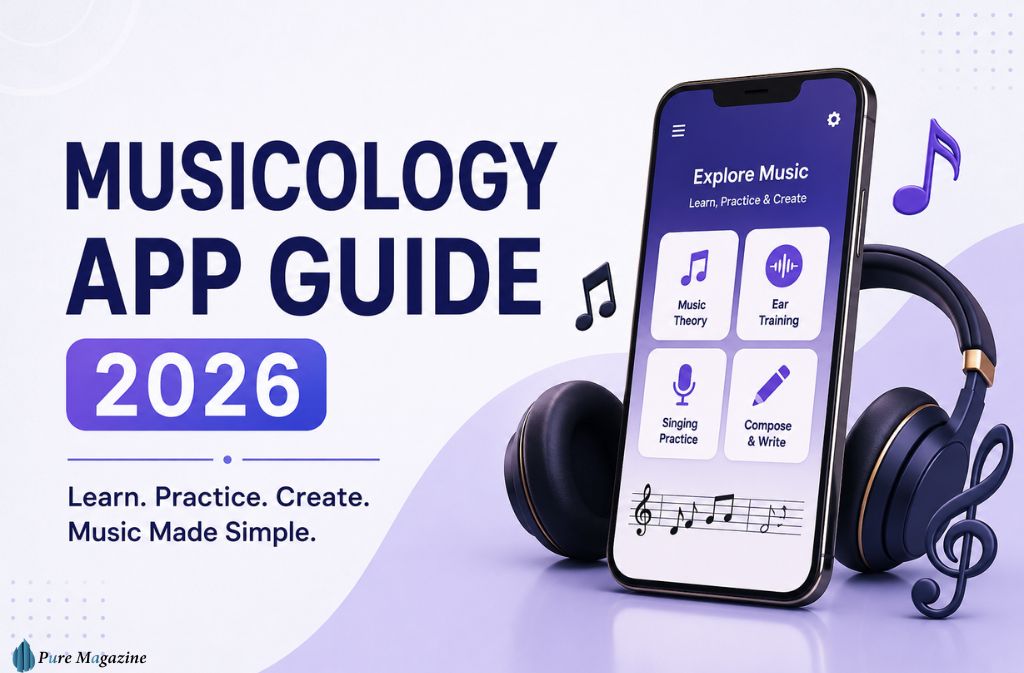
A musicology app is a digital tool that helps people understand, practice, create, or interactively explore music.
Some apps focus on learning fundamentals like:
- scales
- rhythm
- chords
- intervals
Others help users:
- write sheet music
- practice singing
- improve ear training
- compose songs
- Identify music instantly
The best apps don’t just teach information. They make music feel approachable.
That matters more than most people realize.
Many beginners don’t quit because they lack talent. They quit because traditional learning methods feel dry, confusing, or too technical too early.
Good music apps remove that barrier.
Why Music Learning Apps Are So Popular in 2026
Music education has become far more flexible.
You no longer need:
- a formal classroom
- expensive software
- a private teacher, five days a week
Instead, people are learning music through short daily practice sessions that fit naturally into everyday life.
A few minutes here and there add up quickly.
Someone practicing rhythm exercises for fifteen minutes every evening will usually improve faster than someone cramming three hours once a month.
That consistency is where modern music apps shine.
Many now include:
- real-time feedback
- gamified lessons
- progress tracking
- AI-assisted coaching
- interactive exercises
Learning music feels less intimidating when progress becomes visible.
Best Free Musicology Apps in 2026
Here are some of the strongest free and beginner-friendly options available right now.
| App | Best For | Platform |
|---|---|---|
| Musicca | Music theory basics | Web |
| musictheory.net | Ear training & exercises | Web/iOS |
| MuseScore | Sheet music creation | Desktop/Mobile |
| Perfect Ear | Rhythm & interval training | Android/iOS |
| Yousician | Singing & instrument practice | Mobile/Desktop |
| Flat.io | Collaborative notation | Web |
| Vanido | Vocal warmups | Mobile |
Not every app needs to be complicated to be useful.
In fact, the simplest apps are often the ones people stick with longest.
Best Music Theory Apps for Beginners
Musicca
Musicca is one of the easiest places to start learning music theory.
The layout feels calm and straightforward, which helps beginners focus on learning instead of figuring out menus and settings.
It’s especially good for:
- note recognition
- rhythm exercises
- chord basics
- simple music reading practice
A lot of music apps try too hard to look futuristic. Musicca succeeds because it stays simple.
musictheory.net
Even after all these years, musictheory.net remains incredibly useful.
The design isn’t flashy, but the exercises are genuinely effective.
Its ear training tools help users improve:
- interval recognition
- note reading
- chord identification
- rhythmic understanding
Many people underestimate ear training at first.
They memorize scales visually but struggle to recognize those same patterns while listening to real music. That gap becomes obvious very quickly during singing or instrument practice.
Apps like this help close it naturally.
Best Free Music Notation Software
Writing music digitally has become dramatically easier.
You no longer need expensive studio software just to create clean sheet music.
Here are the strongest notation tools available today.
| Software | Best For | Free Version |
|---|---|---|
| MuseScore | Full notation & composition | Yes |
| Flat.io | Browser collaboration | Yes |
| Noteflight | Education & classrooms | Yes |
| Sibelius | Professional composers | Trial |
| Dorico | Advanced scoring | Limited Free |
Why So Many Musicians Still Use MuseScore
MuseScore has earned a loyal following for a reason.
It doesn’t feel like a “lite” version of professional software anymore. Over time, it evolved into a serious composition platform supported by a huge community of musicians, teachers, and students.
That community makes a difference.
People share arrangements, templates, exercises, and feedback constantly. Beginners can find inspiration quickly without feeling isolated.
Another advantage is flexibility.
MuseScore works well for:
- piano notation
- orchestral scoring
- simple songwriting
- educational exercises
- MIDI input
Some professionals still prefer Sibelius or Dorico for advanced workflows, and that’s understandable. But for most people learning composition or creating personal projects, MuseScore offers far more than expected from free software.
Technical Note
MuseScore 4 runs best on:
- Windows 11
- macOS Sonoma or newer
- systems with at least 8GB RAM
Large orchestral scores can become demanding on older laptops, especially when using live playback features.
Best Apps for Singing Practice
Singing apps have improved enormously over the last few years.
Older apps mostly functioned like karaoke machines. Modern vocal training apps provide real feedback.
They can now track:
- pitch accuracy
- vocal consistency
- breathing control
- range development
Top Singing Apps in 2026
| App | Best Feature |
|---|---|
| Yousician | Guided vocal coaching |
| Vanido | Daily warmups |
| Riyaz | Classical vocal training |
| Smule | Social singing |
| Vocal Pitch Monitor | Real-time pitch tracking |
AI Vocal Coaching Is Becoming Surprisingly Good
AI-assisted singing practice used to feel awkward and inaccurate.
That’s changed quickly.
Many apps can now detect flat or sharp notes almost instantly and provide personalized exercises based on your weak areas.
Still, technology has limits.
A singer can technically hit every correct note and still sound emotionally disconnected. Music is more than accuracy.
That human side of performance — emotion, phrasing, personality — still comes from experience and listening carefully, not from chasing perfect pitch graphs on a screen.
Best Free App to Identify Music
Sometimes you hear a song somewhere and need the answer immediately.
Music recognition apps solve that problem within seconds.
Best Music Identifier Apps
| App | Best Use Case |
|---|---|
| Shazam | Fast recognition |
| SoundHound | Humming melodies |
| Google Assistant | Convenience |
| Musixmatch | Lyrics support |
Shazam remains incredibly fast, especially in quiet environments.
But in crowded cafés or noisy restaurants, Google Assistant occasionally performs better than people expect because its background noise filtering is surprisingly aggressive.
SoundHound also deserves credit for melody recognition. Humming a tune into your phone still feels a little strange, but it works more often than you’d think.
Music Apps and Hardware Compatibility
Music apps become far more enjoyable when paired with the right hardware.
Even a simple setup can make practice smoother and more engaging.
Popular accessories include:
- Bluetooth MIDI keyboards
- USB microphones
- digital pianos
- audio interfaces
- MIDI drum pads
For example, writing notes with a mouse inside notation software becomes frustrating after a while. A small MIDI keyboard speeds things up dramatically.
Even beginner setups improve:
- rhythm timing
- note recognition
- composition workflow
- ear training accuracy
A lot of people wait too long before buying a small keyboard controller. Once they do, practicing usually feels much more natural.
A Simple Way to Learn Music Without Feeling Overwhelmed
One of the biggest mistakes beginners make is trying to learn everything at once.
They download:
- theory apps
- notation software
- production tools
- vocal trainers
- random tutorials
Then burn out within weeks.
A better approach is gradual layering.
Step 1: Learn the Basics
Start with:
- Musicca
- musictheory.net
Focus on:
- rhythm
- scales
- intervals
- note reading
Don’t rush this stage.
Strong fundamentals make everything else easier later.
Step 2: Train Your Ear and Voice
Use:
- Perfect Ear
- Vanido
- Yousician
This stage helps connect theory with actual listening and performance.
That connection is where music starts feeling real instead of academic.
Step 3: Start Creating Music
Once the basics feel comfortable, move into:
- MuseScore
- Flat.io
Experiment with:
- melodies
- simple arrangements
- chord progressions
Creating even small pieces builds confidence quickly.
Common Mistakes People Make With Music Apps
Switching Apps Constantly
Trying five apps at once usually slows progress instead of helping.
Consistency matters more than finding the “perfect” platform.
Ignoring Ear Training
Some learners become excellent at recognizing notes visually but struggle to hear them naturally.
Ear training often feels difficult early on, but it becomes one of the most valuable skills later.
Spending More Time Customizing Than Practicing
This happens more than people admit.
Some students spend hours tweaking notation layouts or organizing virtual instruments before they’ve fully learned basic rhythm counting.
The software becomes a distraction instead of a learning tool.
Practicing Inconsistently
Short daily practice sessions almost always outperform occasional marathon sessions.
Music rewards repetition.
Even fifteen focused minutes a day can create noticeable progress over time.
Privacy and Creative Ownership in Music Apps
This is something more musicians are paying attention to now.
Many modern apps store:
- vocal recordings
- uploaded compositions
- MIDI files
- cloud backups
- practice sessions
AI-powered platforms may also use anonymous data to improve their systems.
That doesn’t automatically make them unsafe, but it’s still worth reading the platform’s privacy and ownership policies before uploading original music.
This matters especially for:
- independent artists
- producers
- songwriters
- teachers
Understanding how your recordings are stored is becoming part of responsible digital music creation.
Music Learning Trends in 2026
Several changes are shaping music education right now.
Micro-Learning
Short lessons under five minutes are becoming extremely popular because they fit naturally into busy schedules.
AI Personalization
Apps increasingly adapt exercises based on:
- skill level
- listening habits
- practice consistency
Better Voice Recognition
Pitch analysis has improved dramatically, especially for singing apps.
Collaborative Composition
Cloud-based notation platforms now allow multiple musicians to edit projects together in real time.
Cross-Device Flexibility
People expect seamless movement between:
- phones
- tablets
- desktops
- MIDI hardware
Apps that integrate smoothly across devices tend to keep users longer.
Frequently Asked Questions
Q. What is the best free app to identify music?
Shazam remains one of the best free music identification apps because it recognizes songs quickly and accurately. SoundHound is also excellent for humming melodies.
Q. Is musicology a real field of study?
Yes. Musicology is the study of music history, theory, structure, performance, and cultural influence.
Q. Which music app is completely free?
Musicca, musictheory.net, and MuseScore offer strong free features without requiring paid subscriptions for basic use.
Q. What is the best app for singing practice?
Yousician, Vanido, and Riyaz are among the strongest singing practice apps because they provide structured exercises and vocal feedback.
Q. What is the best free music notation software?
MuseScore is widely considered one of the best free music notation tools available today because of its powerful features and active community.
Q. Can music apps replace teachers?
Apps are excellent for building consistency and practicing fundamentals, but experienced teachers still provide personalized feedback and emotional guidance that software cannot fully replicate.
Conclusion
Learning music feels far more accessible today than it did even a few years ago.
A good musicology app can help you:
- understand theory
- improve rhythm
- practice singing
- write sheet music
- train your ears
- build creative confidence
The key is choosing tools that support your goals without overwhelming you.
Start small.
Practice consistently.
Allow yourself to learn gradually.
Most musicians improve not because they practice perfectly, but because they keep showing up — even on the days when progress feels slow.
For more, visit Pure Magazine