Choosing a methylfolate supplement sounds straightforward until you’re standing in front of a shelf — or scrolling through a product page — looking at bottles that say “5-MTHF,” “L-methylfolate,” “active folate,” and “Quatrefolic” while wondering whether these are the same thing, different things, or marketing variations of the same thing with different price tags.
Then someone online tells you folic acid is essentially useless, someone else says the difference barely matters, and a third voice insists you need 15mg daily because of a gene variant you may or may not have. The noise is real, and the confusion is understandable.
Here’s the practical picture: methylfolate is the active form of vitamin B9 that your body uses directly without the multi-step conversion process that folic acid requires. For many people, that distinction matters. For some, it matters more than others. And for a small subset, jumping straight to high doses creates problems rather than solving them.
This guide works through what methylfolate actually is, how bioavailability differs between forms, who genuinely benefits, what to watch out for, and what informed buyers are prioritising in 2026.
What Is a Methylfolate Supplement?
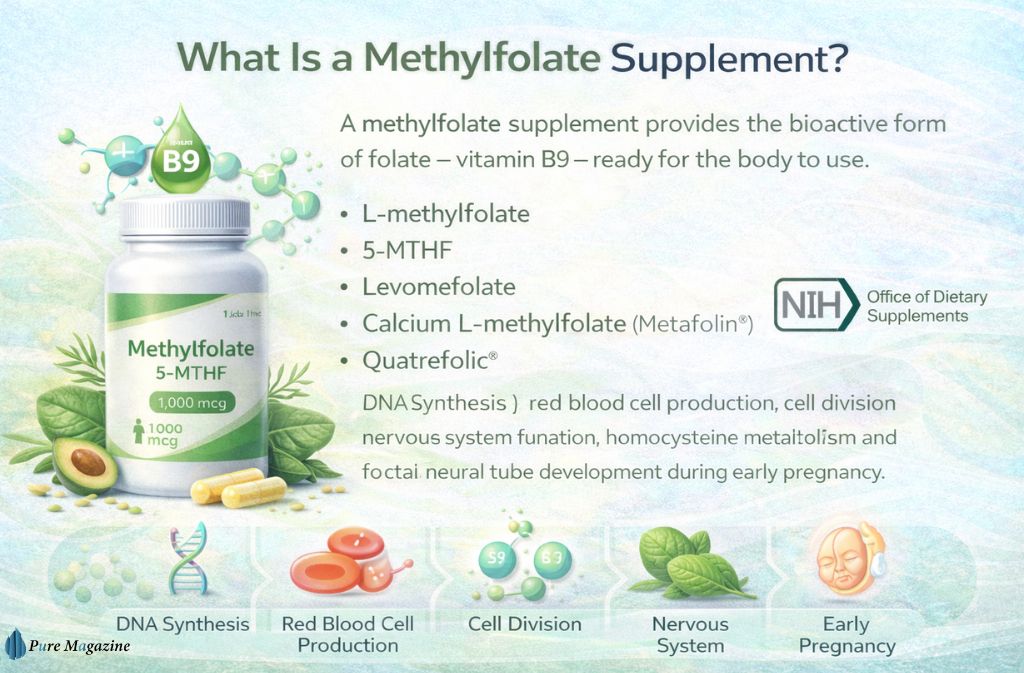
A methylfolate supplement delivers the bioactive form of folate — vitamin B9 — in a form the body can use without significant conversion. You’ll see it listed on labels as:
- L-methylfolate
- 5-MTHF (5-methyltetrahydrofolate)
- Levomefolate
- Calcium L-methylfolate (Metafolin® is the most recognised branded version)
- Quatrefolic® (a glucosamine salt form of 5-MTHF with enhanced stability)
Folate supports DNA synthesis, red blood cell production, cell division, nervous system function, homocysteine metabolism, and foetal neural tube development during early pregnancy. The NIH Office of Dietary Supplements identifies it as an essential nutrient required for healthy growth and metabolic function — and confirms that methylfolate is the predominant circulating form in human blood.
Folate vs Folic Acid vs Methylfolate: The Actual Differences
| Type | Found In | Conversion Required | Common Use |
|---|---|---|---|
| Food folate | Leafy greens, lentils, legumes | Natural metabolism | Diet |
| Folic acid | Fortified foods, budget supplements | 4-step enzymatic conversion | Mass-market supplements |
| L-methylfolate | Premium supplements | Minimal — already active | Active-form support |
Bioavailability comparison:
- Folic acid: approximately 50% bioavailability — requires a four-step enzymatic conversion process before becoming usable, with efficiency varying by individual liver enzyme activity
- Food folate: 50–80% variable, depending on food matrix, preparation method, and gut function
- L-methylfolate (5-MTHF): directly bioactive — the conversion steps that folic acid requires are largely bypassed
One nuance worth stating clearly: folic acid works adequately for the majority of people. The conversion process is impaired in a minority, not in everyone. “Folic acid is useless” is an overcorrection that’s become common in supplement communities — the accurate statement is that methylfolate is more consistently bioavailable across different individuals, particularly those with reduced enzyme efficiency.
The Blood-Brain Barrier Distinction
This is the technical detail that most methylfolate guides skip. L-methylfolate crosses the blood-brain barrier directly via folate receptor alpha — the same transport mechanism used by natural food folate. Folic acid doesn’t cross this barrier efficiently. For neurological applications — mood support, cognitive function, neurotransmitter synthesis — this distinction has genuine clinical relevance beyond the general bioavailability argument.
Quatrefolic vs Metafolin: Which Form Is Better?
Metafolin (calcium L-methylfolate) is the longer-established pharmaceutical-grade form with the most clinical data behind it. Quatrefolic (glucosamine salt of 5-MTHF) is a newer formulation with improved water solubility and potentially better shelf stability — the glucosamine salt form resists oxidative degradation better than the calcium salt under varying storage conditions.
Both are legitimate, high-quality forms. The practical difference for most buyers is minimal. What matters more than form choice is dose accuracy and product freshness — methylfolate can degrade if stored poorly, which is why airtight packaging and reasonable expiry dating matter when choosing between otherwise comparable products.
Benefits of Methylfolate Supplementation
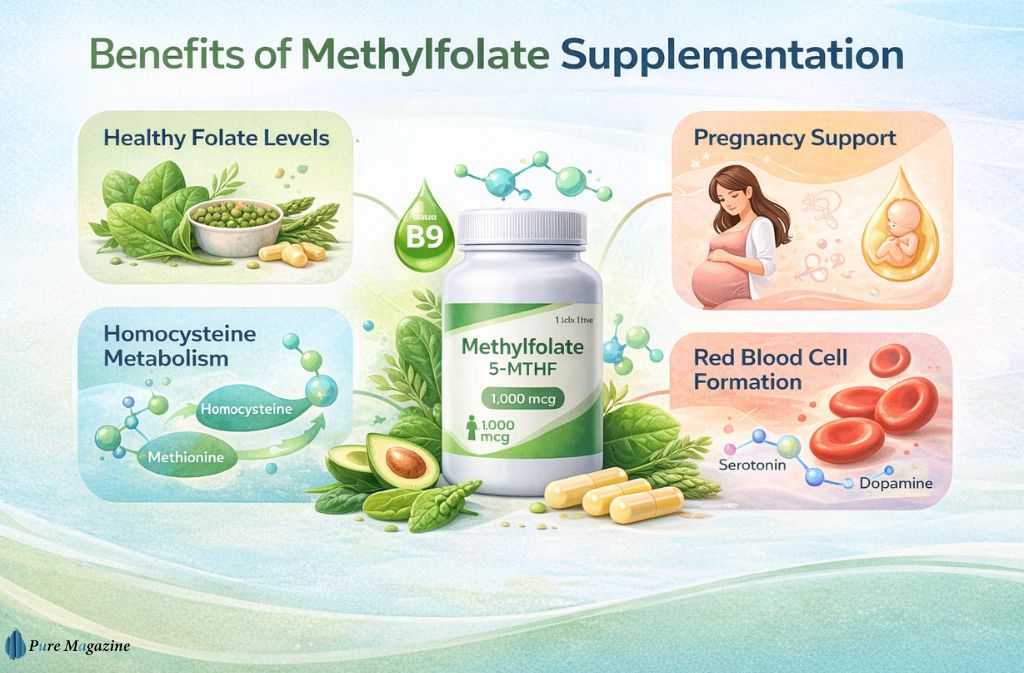
Healthy Folate Levels
The most straightforward application: filling a dietary gap when food intake of folate-rich foods is inconsistent. Leafy greens, lentils, asparagus, and beans are the primary food sources — people whose diets are light on these foods may have lower folate status than standard dietary assessments suggest.
Pregnancy Planning and Early Pregnancy
Adequate folate intake before conception and through the first trimester is one of the better-established nutritional recommendations in all of medicine — the evidence for neural tube defect prevention is robust and longstanding. Many people choosing prenatal supplements now specifically look for methylfolate rather than folic acid, partly for bioavailability reasons and partly because methylfolate crosses the placenta more efficiently. The NHS guidance on folic acid in pregnancy recommends 400mcg daily from before conception — the form (folic acid or methylfolate) is less specified than the dose requirement.
Homocysteine Metabolism
Folate, B12, and B6 work together in the methylation cycle. Methylfolate specifically supports the remethylation of homocysteine back to methionine via the MTHFR enzyme. How TMG, B vitamins, and methylfolate interact across the methylation system provides useful context — these nutrients address different arms of the same metabolic cycle rather than doing the same thing redundantly.
Red Blood Cell Formation
Folate deficiency is a recognised cause of macrocytic anaemia — large, inefficient red blood cells that carry oxygen poorly. Correcting folate status addresses this directly, though — critically — B12 deficiency produces an identical blood picture and must be evaluated simultaneously.
Nervous System Support
Through the blood-brain barrier crossing mechanism described above, and through its role as a cofactor in neurotransmitter synthesis. How P5P and B vitamins support neurotransmitter production illustrates how these nutrients interconnect — methylfolate and P5P operate on overlapping pathways that together determine serotonin and dopamine synthesis efficiency.
The B12 Issue Nobody Flags Loudly Enough
This is the most important safety point in this entire article, and it doesn’t get enough prominence in most methylfolate guides.
Folate and B12 deficiency can produce nearly identical blood test results — macrocytic anaemia, elevated homocysteine — but they have different consequences. B12 deficiency causes progressive neurological damage that folate supplementation will not prevent. Worse: adequate folate intake can normalise red blood cell appearance in someone with B12 deficiency, masking the blood test signal while neurological deterioration continues silently.
This is why evaluating B12 status before or alongside methylfolate supplementation isn’t optional —it’s clinically important. Getting serum B12 and folate levels checked together before starting either supplement gives you the information needed to address the right deficiency, rather than potentially masking one with the other.
Older adults are particularly vulnerable to this dynamic — B12 absorption declines with age regardless of dietary intake, making deficiency more common. Nutritional supplementation in older adults requires this kind of sequential thinking rather than blanket supplementation.
Methylfolate and MTHFR: Accurate Context
Many people searching for methylfolate supplements have encountered the MTHFR gene. MTHFR (methylenetetrahydrofolate reductase) is an enzyme that converts dietary folate into 5-MTHF — the active form. Common variants (C677T and A1298C) reduce this enzyme’s efficiency, meaning people with these variants convert folic acid to usable methylfolate less efficiently than those without the variants.
Important context that gets lost in online communities:
Having an MTHFR variant is extremely common — C677T affects roughly 10–15% of the population in homozygous form, with much higher rates of the heterozygous variant. It is not a disease diagnosis. It does not guarantee you need supplementation. And folic acid isn’t completely ineffective in people with these variants — it works less efficiently, not at all.
What’s accurate: people with confirmed MTHFR variants who have elevated homocysteine or symptoms suggesting impaired methylation have a reasonable rationale for choosing methylfolate over folic acid. For everyone else, it’s a preference rather than a necessity.
If you’re considering genetic testing to inform supplementation decisions, discuss this with a clinician who can interpret results in the context of your actual blood markers rather than acting on genetic information in isolation.
Medication Interactions: The Gap Most Reviews Miss
Several medications interact meaningfully with folate metabolism:
| Medication | Interaction |
|---|---|
| Methotrexate | Folate antagonist — used therapeutically for this reason; supplementation requires medical guidance |
| Anti-seizure medications (phenytoin, valproate, carbamazepine) | Reduce folate absorption and increase folate requirements |
| Sulfasalazine | Inhibits folate absorption |
| Trimethoprim (antibiotic) | Folate antagonist mechanism |
| Cholestyramine | Reduces folate absorption |
The methotrexate interaction is particularly important. Methotrexate works partly by inhibiting folate metabolism — it’s used in cancer treatment and autoimmune conditions for this reason. Supplementing methylfolate alongside methotrexate without medical guidance could interfere with the medication’s intended mechanism. Anyone on methotrexate must discuss folate supplementation with their prescriber.
Over-Methylation: The Side Effect Profile Nobody Prepares You For
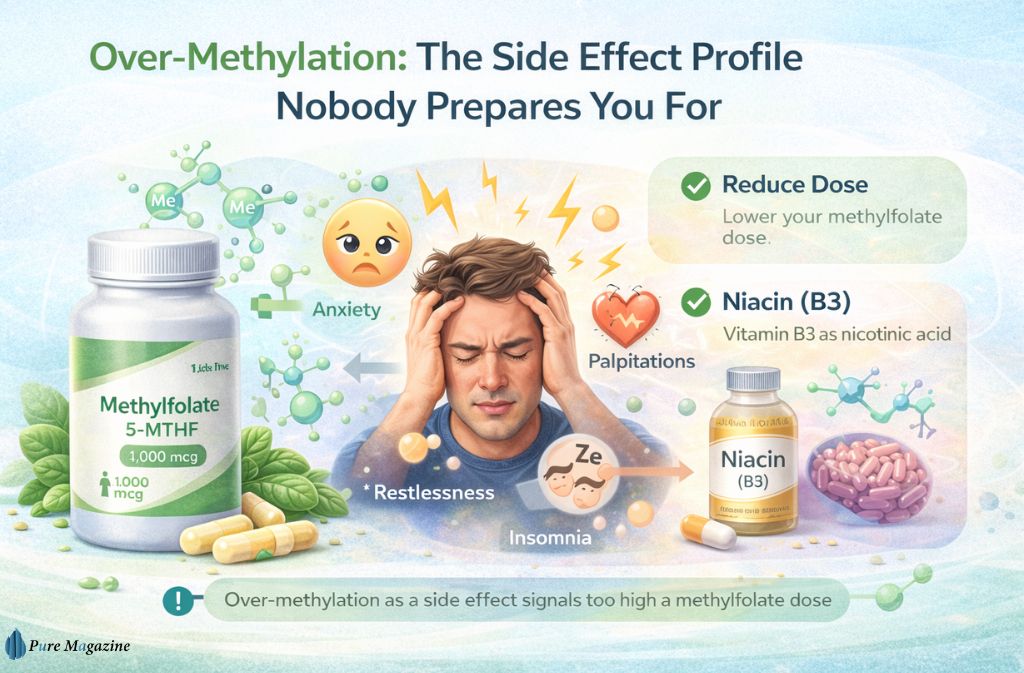
Most methylfolate guides mention mild side effects in passing. The over-methylation picture deserves more specific attention because it’s the primary reason people have negative experiences and discontinue supplementation prematurely.
A subset of users — particularly those who start at higher doses or who are already reasonable methylators — experience symptoms from excessive methyl group availability: anxiety, restlessness, irritability, insomnia, a wired or overstimulated feeling that resembles too much caffeine, and in some cases, headaches or palpitations.
These symptoms aren’t a sign that methylfolate is harmful — they’re a sign the dose is too high for that individual. The fix is dose reduction rather than discontinuation.
How to Start Methylfolate: The Titration Approach
Starting high and experiencing over-methylation is the most common reason people conclude “methylfolate doesn’t agree with me” and abandon something that might genuinely benefit them at a lower dose.
| Dose | Context |
|---|---|
| 400mcg | Basic daily support, sensible starting point |
| 800mcg | Moderate support |
| 1mg | Common premium supplement strength |
| 5mg | Higher-dose use requires professional guidance |
| 15mg | Prescription/clinical contexts only |
Starter protocol for general wellness use: Begin at 400mcg or below. Take with food initially if you’re sensitive to supplements. Use consistently for one to two weeks before assessing response. Increase only if well-tolerated, and there’s a clear rationale for higher dosing.
The tolerable upper intake level established by health authorities sits at 1,000mcg (1mg) for adults from supplemental folate sources — this is the level above which the risk of masking B12 deficiency increases meaningfully. Higher therapeutic doses exist in clinical contexts but require medical supervision rather than self-direction.
The “Check Your Multivitamin” Audit
This is the step most people skip before adding a standalone methylfolate supplement — and it matters for two reasons.
First, accidental doubling up on folate is easy if your multivitamin already contains a meaningful dose. Second, and more importantly, if your multivitamin contains folic acid and you’ve switched to methylfolate for MTHFR or bioavailability reasons, you may be inadvertently undermining the point by combining both forms.
Three-step audit before purchasing:
- Check your multivitamin label for folate content and form — folic acid or methylfolate, and how many mcg
- Add that to any other B vitamin supplements or fortified foods you consume regularly
- Calculate whether a standalone methylfolate supplement fills a genuine gap or creates unnecessary overlap
Whether your multivitamin formulation is actually delivering what you’re assuming it does — in terms of form, dose, and bioavailability — is a question worth answering before adding more supplements on top of it.
Methylfolate and Methylcobalamin: Better Together
Methylfolate (active B9) and methylcobalamin (active B12) support overlapping metabolic pathways and are frequently combined in high-quality formulations for good reason. The methylation cycle requires both folate, which handles the remethylation of homocysteine, and B12, which is the cofactor for the enzyme that completes that reaction.
Many buyers in 2026 specifically look for formulas combining both active forms rather than purchasing them separately. This is a reasonable approach if your goal is comprehensive methylation support — though it makes the B12 status check even more important before starting, since you want to know your baseline rather than assume a deficiency exists.
How P5P, B12, and folate function as a connected system rather than isolated nutrients explains why targeting one without considering the others produces incomplete results.
How to Choose the Best Methylfolate Supplement
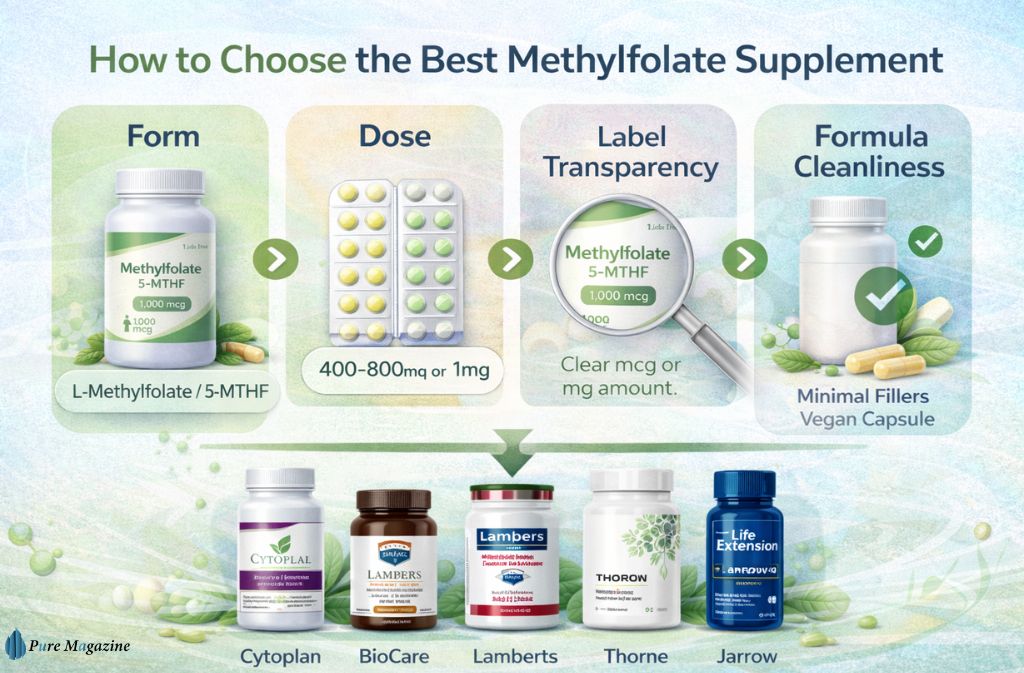
Form: L-methylfolate or 5-MTHF specified clearly on the label — not just “folate” or “vitamin B9.” Metafolin and Quatrefolic are both trustworthy branded forms.
Dose: Match to your actual need — 400–800mcg for general support, up to 1mg for moderate supplementation. Avoid megadose products unless directed by a clinician.
Label transparency: Exact mcg or mg amount clearly stated, not hidden in a blend. GMP-certified manufacturing. Third-party testing confirmation — the shift toward Certificate of Analysis availability on request has become a meaningful quality differentiator in 2026.
Formula cleanliness: Minimal fillers, no titanium dioxide, no unnecessary binders. Vegan capsule option if relevant.
UK-specific: Cytoplan, Biocare, Lamberts, Thorne, Life Extension, and Jarrow are frequently compared by UK buyers depending on availability. Verify current stock, labelling compliance with UK supplement regulations, and whether the specific form (Metafolin vs Quatrefolic) matches your preference.
Common Mistakes
Starting at high doses immediately, the over-methylation risk is real and dose-dependent. Ignoring B12 status — the most clinically consequential oversight in this category. Buying based purely on price — cheap folate products often use folic acid without stating it clearly, defeating the purpose of specifically choosing methylfolate. Switching products constantly before giving any formulation adequate time to assess its effect. Using high doses without professional guidance when pregnancy, deficiency, or medication interactions are relevant factors.
2026 Market Trends
Buyers in 2026 are prioritising active folate plus active B12 combinations over standalone products, cleaner labels with fewer unnecessary ingredients, third-party testing and COA availability, lower-dose starter options that reduce over-methylation risk, and prenatal formulas that specifically list methylfolate rather than folic acid. The market is moving toward precision and transparency rather than megadosing and marketing claims.
FAQs
Methylfolate is a genuinely useful supplement for the right person at the right dose — not a universal upgrade over folic acid for everyone, not a treatment for MTHFR variants in isolation, and not something where more is automatically better.
The bioavailability advantage is real. The blood-brain barrier crossing distinction matters for neurological applications. The B12 masking risk is the most important safety consideration in this category and deserves more prominence than most guides give it. And the over-methylation risk at higher doses explains why so many people have negative experiences that better titration would have prevented.
Start low. Check B12 first. Choose a transparent, well-formulated product. And treat it as part of a broader nutritional picture rather than a standalone fix.
This article is for informational purposes only and does not constitute medical advice. Always consult a qualified healthcare professional before starting any supplement, particularly if you are pregnant, taking prescription medications including methotrexate or anticonvulsants, or managing a diagnosed deficiency or metabolic condition.
Explore our full library of expert-reviewed health and nutrition guides at Pure Magazine.