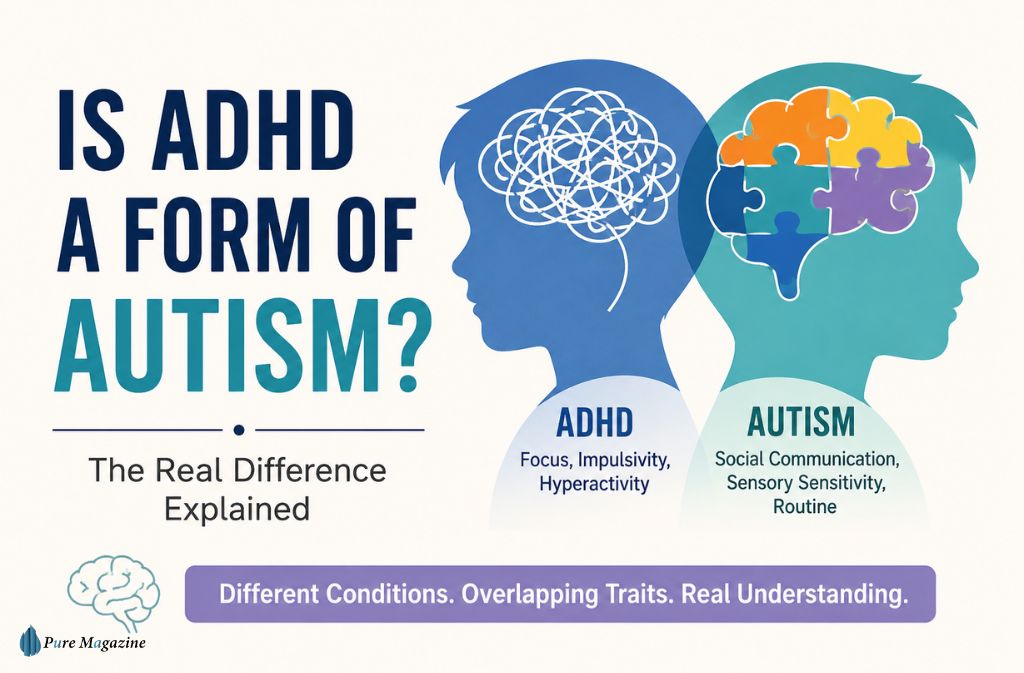
Millions of people search this question every year — and it’s not because they’re confused. It’s because ADHD and autism genuinely do look similar from the outside. Someone struggles to keep friendships, becomes overwhelmed in the supermarket, hyperfocuses for six hours then can’t send a single email, and wonders what’s actually going on in their brain. The question “is ADHD a form of autism?” doesn’t come from nowhere. It comes from lived experience that doesn’t fit the outdated textbook descriptions most people grew up with.
The short answer is no. ADHD and Autism Spectrum Disorder are separate neurodevelopmental conditions with their own distinct diagnostic criteria. But that one-word answer doesn’t explain why the confusion is so persistent — or why so many adults are discovering, often in their thirties or forties, that they may have both conditions running simultaneously.
This guide covers everything from the core neurological differences and the “AuDHD” experience to diagnostic pathways, the double empathy problem, and the 2026 research trends reshaping how clinicians think about neurodivergent overlap.
Quick Answer (2026): No — ADHD is not a form of autism. The DSM-5 classifies ADHD and Autism Spectrum Disorder as separate neurodevelopmental conditions. However, they share significant overlapping traits including executive dysfunction, sensory sensitivity, and emotional dysregulation. Many people carry both diagnoses simultaneously — a combination sometimes called AuDHD — and research in 2026 increasingly treats them as overlapping spectrums rather than distinct boxes.
Is ADHD a Form of Autism?
No. ADHD is not a form of autism.
The DSM-5 — the diagnostic manual used by clinicians across the UK and US — lists ADHD and Autism Spectrum Disorder as separate conditions under the umbrella of neurodevelopmental disorders. They have different diagnostic criteria, different neurobiological profiles, and respond differently to treatment.
What creates the confusion isn’t a failure of understanding. It’s that the overlap between the two conditions is genuinely extensive — in symptoms, in genetics, and in the day-to-day experience of living with either of them.
Someone can have ADHD only, autism only, or both simultaneously. That last group is larger than most people realise, and growing more visible as adult diagnosis rates climb.
The Core Difference Between ADHD and Autism
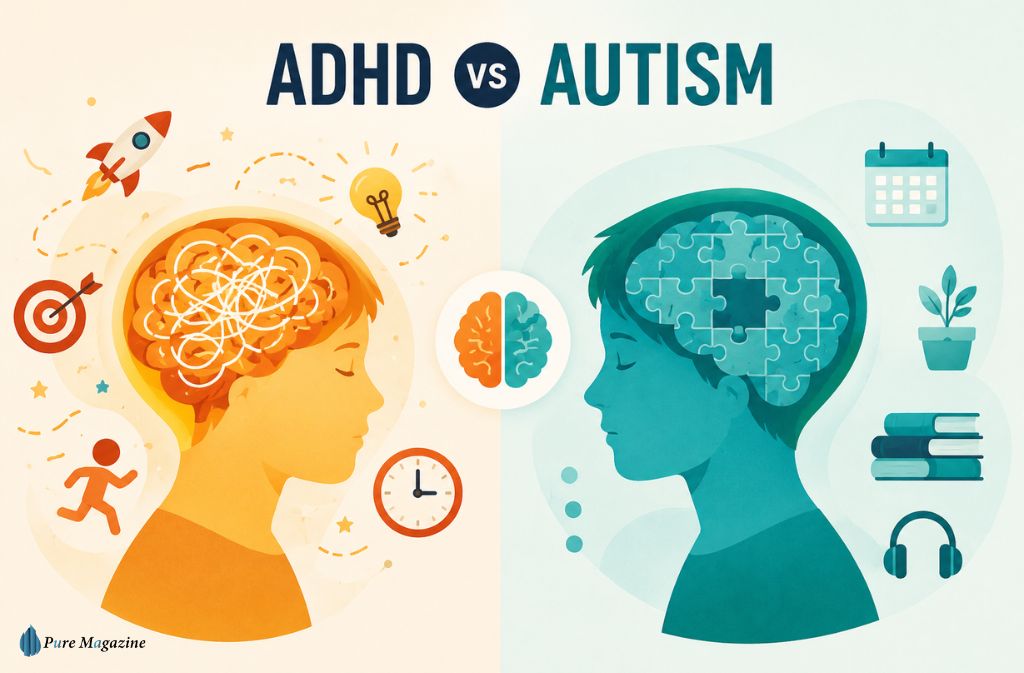
What ADHD Actually Is
ADHD’s central challenge is attention regulation — the brain’s difficulty managing what it focuses on, for how long, and in response to what. But “attention regulation” is a clinical shorthand for a much messier experience: starting tasks feels physically difficult, time has almost no texture, emotions arrive faster than they can be processed, and motivation is tied to genuine interest or urgency rather than to importance.
The ADHD brain seeks novelty and stimulation, partly because dopamine and norepinephrine — the neurotransmitters that govern reward and motivation — function differently than in neurotypical brains. This isn’t a character flaw or a failure of willpower. It’s a neurological feature that makes low-stimulation environments feel genuinely painful.
Executive dysfunction sits at the centre of most ADHD struggles: difficulties with planning, time management, task initiation, working memory, and impulse control. Emotional impulsivity — rapid, intense emotional reactions that pass quickly — is also increasingly recognised as a core feature rather than a comorbidity.
What Autism Actually Is
Autism’s central challenges involve social communication, sensory processing, and a strong drive toward predictability and routine. Where the ADHD brain chases novelty, the autistic brain often finds comfort in sameness — familiar routines, predictable environments, and known patterns that reduce cognitive load.
Autistic people may struggle to read implicit social cues, find unstructured social interaction exhausting, and experience sensory input — sound, light, texture, smell — far more intensely than neurotypical people. Many autistic people also develop deep, highly focused special interests, and may find transitions between activities or environments genuinely distressing rather than merely inconvenient.
Autism exists on a spectrum because support needs, presentation, and experience vary enormously between individuals. The outdated binary of “high-functioning” vs “low-functioning” has been largely abandoned by clinicians — current frameworks focus on support needs across different domains, not on a single linear scale.
ADHD vs Autism: Quick Comparison
| Area | ADHD | Autism |
|---|---|---|
| Primary challenge | Attention regulation | Social communication & sensory processing |
| Brain tendency | Seeks novelty | Prefers predictability |
| Social difficulty | Impulsivity & interrupting | Reading cues & social exhaustion |
| Routine preference | Often inconsistent | Strong preference for sameness |
| Sensory sensitivity | Sometimes present | Very commonly present |
| Executive dysfunction | Core feature | Common overlap |
| Emotional regulation | Rapid, impulsive shifts | Shutdowns or meltdowns |
| Hyperfocus | Interest-driven | Deep special interests |
Why They Overlap
The overlap between ADHD and autism isn’t a diagnostic grey area — it’s real, it’s measurable, and it has a genetic basis. Studies have found that the two conditions share a significant number of genetic risk factors, which partly explains why they co-occur in the same individuals at much higher rates than chance would predict.
Shared traits include executive dysfunction, emotional dysregulation, sensory sensitivity, hyperfocus, social difficulties, anxiety, and burnout. These overlaps are why clinicians who aren’t specifically trained in dual diagnosis sometimes mistake one condition for the other — or attribute all symptoms to whichever condition they identify first.
Behaviour vs. Neurological Cause: The Key Distinction
This is the detail that most comparison guides miss entirely, and it matters enormously for both diagnosis and self-understanding.
Two people can display identical behaviour for completely different neurological reasons.
Take interrupting in conversation. A person with ADHD may interrupt because their thoughts move faster than the conversation does — the thought arrives, the impulse fires, and the filter that should delay the response hasn’t engaged in time. An autistic person may interrupt because the social convention that dictates when you’re supposed to speak is opaque to them — they’ve identified a relevant moment to contribute but missed the implicit signal that the other person hadn’t finished.
Same observable behaviour. Different neurological mechanism behind it.
This distinction matters for treatment, for self-compassion, and for avoiding misdiagnosis. It also explains why well-meaning advice — “just wait for people to finish” — lands differently depending on which mechanism is actually driving the interruption.
Is ADHD on the Autism Spectrum?
No. ADHD is not part of the autism spectrum, and it isn’t classified as such in any current diagnostic framework.
Before 2013, the DSM-IV actually prevented dual diagnosis — clinicians weren’t supposed to diagnose both ADHD and autism in the same person. The DSM-5 removed that restriction, officially recognising that both conditions can and do occur together. That single change is a large part of why dual-diagnosis awareness has grown so rapidly over the past decade.
Some researchers informally describe ADHD and autism as “cousin conditions” — distinct in their primary mechanisms but close enough in genetic architecture and neurological overlap to warrant being considered together. This doesn’t make ADHD a subset of autism. It makes them related, not identical.
What Is AuDHD?
AuDHD is a non-clinical community term for someone carrying both an ADHD diagnosis and an autism diagnosis simultaneously. It emerged from neurodivergent communities online and has since entered wider use as late diagnosis has become more common.
The experience of having both conditions isn’t simply the sum of two separate symptom lists. For many people, it creates a specific internal tension that neither diagnosis captures on its own.
Sarah, a 32-year-old architect diagnosed with both conditions in adulthood, described it to us this way: “My ADHD wants chaos and excitement. My autism wants structure and predictability. It’s like having two operating systems arguing all day — and neither one ever really wins.”
That conflict between novelty-seeking and routine-needing, between craving social connection and being exhausted by it, between hyperfocusing intensely and still failing to finish basic tasks — this is what many AuDHD people describe as the hardest part of the experience. Burnout often follows because neither system gets what it needs for long before the other system pushes back.
The Double Empathy Problem
One of the most significant developments in autism research over the past decade is the Double Empathy Problem, a concept developed by autistic researcher Dr Damian Milton.
The traditional framing of autism treated social difficulties as a deficit within the autistic person — they struggle to understand others, read cues, maintain relationships. The double empathy problem reframes this entirely. When an autistic person and a non-autistic person interact, both parties struggle to understand each other. The communication difficulty is bidirectional.
When autistic people interact with other autistic people, research shows they often understand each other quite well. The mismatch isn’t within the autistic person — it’s between two different neurological styles of social processing.
This matters because it moves the conversation from “what’s wrong with autistic people’s social skills” toward “how do different types of minds connect with each other.” It also has direct implications for therapy, workplace accommodations, and how autism is described to newly diagnosed people. Framing social difficulty as a deficit implies something to be fixed. Framing it as a mismatch implies something to be navigated — which is far closer to the lived reality.
Internalised vs. Externalised Symptoms
The cultural image of ADHD is a hyperactive seven-year-old boy who can’t sit still in class. The cultural image of autism is a non-verbal child who rocks and avoids eye contact. Both images are real presentations of these conditions. Neither is typical of how these conditions look in most adults, or in most women at any age.
ADHD isn’t always “bouncing off the walls.” For many adults — and particularly for women and girls — ADHD presents as internal restlessness, chronic mental noise, exhaustion from constant self-monitoring, perfectionism used as a coping strategy, and the specific anxiety of knowing you’re capable but perpetually failing to convert capability into output. The hyperactivity is there; it just lives inside the skull.
Autism isn’t always non-verbal or visibly distressed. Many autistic adults have spent decades learning to perform neurotypical social behaviour — making eye contact even when it’s uncomfortable, mirroring body language, following conversational scripts, laughing at the right moments. This masking is effective enough to fool most people, including many clinicians. The cost is exhaustion. Many autistic adults don’t recognise what they’ve been doing until they encounter the word “masking” and feel something click.
Both conditions, in adults, are far more likely to be invisible than visible. That’s why so many people arrive at their thirties or forties with no diagnosis and a long history of being told they’re too sensitive, too disorganised, too intense, or simply not trying hard enough.
ADHD and Autism in Adults
Many adults carrying either or both conditions grew up at a time when diagnostic frameworks focused on the loudest, most disruptive presentations — hyperactive boys, severely affected children, visibly unusual behaviour in classroom settings. Adults who didn’t fit that template were missed.
The result was a generation of adults who developed elaborate coping strategies, often at significant personal cost, and were labelled with everything except what was actually affecting them.
Common adult ADHD presentations include chronic procrastination, time blindness, forgetfulness, emotional impulsivity, difficulty initiating tasks regardless of their importance, and a pattern of burnout followed by periods of intense productivity. Many adults only recognise ADHD retrospectively — when they encounter a description and realise it explains thirty years of experience.
Common adult autism presentations include social exhaustion, difficulty with unexpected changes to plans, deep and sustained special interests, sensory overload in busy or unpredictable environments, and the specific fatigue of masking through social interactions. Many autistic adults describe feeling fundamentally different from the people around them without having any language for why until diagnosis.
ADHD and Autism in Women
The diagnostic gap between men and women for both conditions is one of the most significant failures of 20th-century psychiatry — and it’s only partially corrected.
ADHD and autism research was largely built on male study populations. The diagnostic criteria that emerged from that research reflect how these conditions present in boys and men. Girls and women were systematically underdiagnosed, not because their conditions were milder, but because their presentations looked different and because girls typically develop social masking skills earlier and more effectively than boys.
Women with ADHD are more likely to present with inattentive symptoms rather than hyperactive ones — the quiet daydreamer rather than the disruptive classroom presence. Women with autism often develop sophisticated masking strategies that make their presentations invisible to clinicians who aren’t specifically looking for them.
The social media explosion of late-diagnosis content from 2024 onwards is partly a correction for this historic gap. Women who spent decades being diagnosed with anxiety, depression, or borderline personality disorder — conditions that can co-occur with ADHD and autism but don’t explain the underlying neurodevelopmental picture — are increasingly finding their way to more accurate assessments.
The Dopamine vs. GABA Difference
ADHD’s neurobiological story centres primarily on dopamine and norepinephrine. These neurotransmitters govern motivation, reward processing, attention, and impulse control — which is precisely why ADHD affects all of those functions, and why stimulant medications that increase dopamine availability are effective for many people with ADHD.
Autism research points toward a broader and more complex neurobiological picture. GABA and glutamate — neurotransmitters that regulate the balance between neural excitation and inhibition — appear to function differently in autistic brains. Sensory processing differences, the preference for predictability, and some communication differences may all connect to this altered excitation/inhibition balance. Brain connectivity patterns also differ, with some research suggesting that autistic brains show unusual local connectivity alongside differences in long-range network connections.
Neither picture is complete. Neuroscience is still building its understanding of both conditions, and the biological mechanisms are considerably more complex than any brief summary captures. What’s increasingly clear is that the two conditions share some overlapping biological pathways — which helps explain their co-occurrence without making them the same thing.
Can ADHD Turn Into Autism?
No. ADHD doesn’t transform into autism. Both conditions are present from birth — they’re neurodevelopmental, meaning they reflect how the brain is wired, not something that develops or progresses over time.
What can happen — and this catches many people off guard — is that autistic traits become more recognisable after ADHD treatment begins. Stimulant medication reduces mental hyperactivity, impulsivity, and the constant distractibility that ADHD creates. Once that noise quiets down, underlying patterns that were always present can become clearer — both to the individual and to clinicians observing them.
This sometimes creates the impression that autism “appeared” after an ADHD diagnosis, or that medication caused it. It didn’t. The traits were there. They were harder to see through the ADHD presentation.
ADHD Medication and the Unmasking Effect
The unmasking effect is one of the more disorienting experiences in the dual-diagnosis journey. Someone starts stimulant medication for ADHD, their executive functioning improves, their life becomes more manageable — and then they notice something unexpected. The social difficulties, the sensory sensitivities, the rigidity around routine — those haven’t improved. In some cases, they’re more noticeable than before.
This happens because ADHD’s impulsivity and constant mental activity can mask autistic traits. The person was too distracted to notice their own sensory overload, too impulsive to register their difficulty with social cues as anything distinct from their general disorganisation.
Clinicians increasingly recognise this pattern. For adults who find that ADHD treatment resolves some struggles but leaves others unexplained, a conversation about autism assessment may be the natural next step.
Common Myths That Social Media Gets Wrong
ADHD is mild autism. It isn’t. They’re separate conditions. ADHD affecting attention regulation is not a milder version of autism affecting social communication and sensory processing. The conditions share surface traits, not fundamental mechanisms.
Autistic people lack empathy. This is one of the most damaging myths in circulation, and research has largely debunked it. Many autistic people experience intense empathy — sometimes to the point of overwhelm — but express it differently, or struggle to demonstrate it in the ways neurotypical people expect. The double empathy problem framework makes clear that the issue is often a mismatch in communication styles rather than an absence of feeling.
ADHD is just laziness. ADHD affects the neurological systems that govern motivation, initiation, and sustained attention. Someone with ADHD who “isn’t trying” is usually caught in a failure of executive function — the starting mechanism is broken, not the desire to complete the task.
Sensory sensitivities are exclusively autistic. Sensory processing differences appear in both conditions. People with ADHD often experience sensory sensitivity, though it’s more consistently and intensely associated with autism. It isn’t a reliable marker for distinguishing between them.
TikTok can diagnose you. Social media content can be genuinely helpful for building awareness and for helping people feel less alone. It cannot replicate a structured clinical assessment covering developmental history, functional impact, and differential diagnosis. These aren’t equivalent.
Diagnostic Pathway Explained
There’s no blood test, brain scan, or online quiz that definitively diagnoses ADHD or autism. Assessment involves structured clinical evaluation — developmental history, behavioral interviews, and assessment tools calibrated to the specific condition.
For ADHD, assessment tools commonly used in the UK include the DIVA-5 (Diagnostic Interview for ADHD in Adults) and standardised rating scales. Assessment typically covers childhood presentation, current functional impact, and ruling out other explanations for symptoms.
For autism, tools such as the RAADS-R (Ritvo Autism Asperger Diagnostic Scale) and the ADOS-2 are commonly used alongside clinical interviews and — when available — input from family members who knew the individual during childhood.
Both assessments have long NHS waiting lists in the UK. Private assessment is available through various chartered psychologists and specialist clinics, though costs vary significantly. The Autism Education Trust provides guidance on accessing assessment in the UK.
For adults seeking dual assessment, finding a clinician experienced in both ADHD and autism is important — not all ADHD specialists have equivalent autism expertise, and vice versa.
2026 Research Trends
The most significant shift in neurodevelopmental research in recent years is a move away from categorical thinking. The traditional model treated ADHD and autism as distinct, bounded conditions — you either have one or you don’t. The emerging model treats them as overlapping spectrums where individual profiles vary considerably.
Several specific trends are shaping the 2026 landscape:
Research into executive function mapping is producing more granular profiles of how different individuals’ executive systems work — and where the specific breakdowns are — rather than a single “executive dysfunction” label that covers wildly different experiences.
Sensory processing research is advancing, with better frameworks for understanding how sensory differences operate in ADHD and autism respectively, and how they interact in dual-diagnosis individuals.
Adult diagnosis expansion continues, driven by better recognition that late-diagnosed adults represent a large and historically underserved population. NHS services are under pressure to reduce waiting times, though demand significantly outpaces current capacity.
Dimensional diagnostic models — which describe neurodevelopmental conditions as continuous rather than binary — are gaining ground in academic literature, though they haven’t yet translated into significant changes to clinical practice tools like the DSM-5.
When to Seek Professional Evaluation
Online articles can raise awareness and help people identify patterns that might be worth exploring. They can’t determine whether those patterns add up to a clinical diagnosis or whether something else explains them better.
Consider professional evaluation if you notice persistent difficulties affecting more than one area of life — work, relationships, emotional regulation, daily functioning, or recovery from burnout. The “persistent” part matters. Everyone has off days. ADHD and autism create consistent, pervasive patterns over years and across environments.
Signs that might point toward exploration include: chronic executive dysfunction that hasn’t responded to organisational strategies, sensory distress that affects where you can work or socialise, long-standing social exhaustion even after interactions you genuinely enjoyed, difficulty recovering from changes to routine or expectations, and a history of feeling fundamentally different from peers without a clear explanation.
Your GP is the starting point for NHS referral. Be specific about functional impact — how these difficulties affect your ability to work, maintain relationships, and manage daily life — as vague descriptions are harder to triage than concrete examples.
FAQs
Q. Is ADHD a form of autism?
No. ADHD and Autism Spectrum Disorder (ASD) are separate neurodevelopmental conditions with different diagnostic criteria under the DSM-5. ADHD mainly affects attention regulation, impulsivity, emotional regulation, and executive functioning, while autism primarily affects social communication, sensory processing, and behavioural patterns. However, both conditions overlap heavily in symptoms, and many people are diagnosed with both ADHD and autism simultaneously — a dual presentation often called AuDHD.
Q. Is ADHD considered autistic?
No. ADHD is not classified as autism or part of the autism spectrum. They are separate neurodevelopmental disorders, although they share overlapping traits such as executive dysfunction, sensory sensitivity, emotional dysregulation, and social difficulties. This overlap is one reason ADHD and autism are frequently confused.
Q. Is ADHD on the autism spectrum in the DSM-5?
No. The DSM-5 lists ADHD and Autism Spectrum Disorder as distinct diagnoses. Before the DSM-5 update in 2013, clinicians were discouraged from diagnosing both conditions together. That restriction was removed because research showed ADHD and autism commonly co-occur in the same person.
Q. Can you have ADHD and autism together?
Yes. Many people have both ADHD and autism simultaneously. This dual presentation is often referred to informally as AuDHD. Research suggests significant overlap between the two conditions in areas such as executive functioning, sensory processing, emotional regulation, and social challenges.
Q. What is the difference between ADHD and autism?
The main difference is the underlying neurological mechanism. ADHD primarily affects attention regulation, impulsivity, dopamine-driven motivation, and executive functioning. Autism primarily affects social communication, sensory processing, behavioural patterns, and the need for predictability. Although some outward behaviours may appear similar, the neurological reasons behind them are often very different.
Q. Why do ADHD and autism look so similar?
ADHD and autism share several overlapping symptoms, including hyperfocus, emotional dysregulation, sensory sensitivities, executive dysfunction, social difficulties, anxiety, and burnout. Two people may display similar behaviours for entirely different neurological reasons, which is why diagnosis can sometimes be complex.
Q. What is AuDHD?
AuDHD is a non-clinical community term used to describe someone who has both ADHD and autism. Many people with AuDHD experience an internal conflict between ADHD traits that seek novelty and autistic traits that prefer routine, structure, and predictability.
Q. Can autistic people have empathy?
Yes. The idea that autistic people lack empathy is a common myth. Many autistic individuals experience deep emotional empathy but may express it differently or struggle with neurotypical communication styles. Modern autism research increasingly supports the “double empathy problem,” which suggests communication difficulties between autistic and non-autistic people are mutual rather than one-sided.
Q. Why are more adults being diagnosed with ADHD and autism now?
Adult ADHD and autism diagnoses have increased because of better awareness, improved diagnostic criteria, social media education, and greater recognition of masking and internalised symptoms — especially in women. Many adults who were overlooked in childhood are now recognising long-term neurodivergent patterns in themselves.
Q. Are sensory sensitivities only linked to autism?
No. Sensory processing differences can occur in both ADHD and autism. However, sensory sensitivity is generally more intense and more consistently associated with autism spectrum disorder. People with ADHD may still experience sensitivity to sound, light, textures, smell, or overstimulating environments.
Q. What is masking in autism and ADHD?
Masking, sometimes called camouflaging, refers to hiding or suppressing neurodivergent behaviours in order to appear more socially “normal” or neurotypical. Masking is especially common in autistic women and adults with late diagnoses. While masking can help people blend into social environments, it often leads to exhaustion, anxiety, identity confusion, and burnout.
Q. What is the double empathy problem?
The double empathy problem is a theory developed by autistic researcher Damian Milton. It suggests that communication difficulties between autistic and non-autistic people happen because both groups process social interaction differently — not because autistic people inherently lack social understanding.
Q. What’s the difference between an autistic shutdown and meltdown?
An autistic meltdown is an outward response to overwhelm that may involve emotional distress, crying, panic, or loss of behavioural control. An autistic shutdown is the opposite response — withdrawal inward, reduced speech, emotional numbness, or temporary disengagement. Both are nervous system responses to overwhelming stress or sensory overload.
Q. Can ADHD medication make autism traits more noticeable?
Yes. Some adults notice autistic traits more clearly after starting ADHD medication. Stimulant medication can reduce hyperactivity, impulsivity, and mental noise, which may make underlying sensory sensitivities, social communication differences, or routine-related behaviours more visible. This does not mean ADHD medication causes autism — it simply makes existing traits easier to recognise.
Q. Can ADHD turn into autism later in life?
No. ADHD does not turn into autism. Both conditions are neurodevelopmental, meaning they are present from early brain development. However, autistic traits may become more noticeable over time due to burnout, reduced masking, stress, or increased self-awareness after ADHD diagnosis or treatment.
Conclusion
Is ADHD a form of autism? No. But the relationship between them is more interconnected than a single-word answer suggests.
They’re separate conditions with different primary mechanisms. They also share enough genetic architecture, neurological overlap, and surface symptomatology that confusing them — or carrying both — is entirely understandable. The growing recognition of dual diagnosis, the double empathy problem, and the expansion of adult diagnosis all reflect the same underlying truth: human brains don’t sort neatly into diagnostic boxes.
What matters more than the label is understanding how your particular brain works, where its specific challenges are, and what kinds of support or accommodation would actually change your day-to-day experience. Labels are tools, not verdicts. They’re useful when they point toward relevant research, appropriate treatment, and communities of people who understand your experience from the inside.
If this guide raised questions about your own experience, the right next step is a conversation with a clinician who has specific experience in adult neurodevelopmental assessment — not a deeper scroll through social media.
For more guides on brain health and neurodiversity, visit Pure Magazine.