In beauty, the bottle is the billboard.
Before a consumer reads an ingredient list, before they experience a formula, before they even open a product — they have already formed an opinion based on the packaging. Research from brand strategy consultancies consistently shows that packaging accounts for up to 70% of a beauty product’s purchase decision at point of sale. For makeup brands, where tactile experience and visual identity carry extraordinary commercial weight, that number may be even higher.
Yet packaging decisions are still treated as an afterthought by many emerging brands. Founders who invest months perfecting a foundation formula will spend days — not weeks — choosing the vessel that delivers it. The result is a product that underperforms not because of the formula, but because the packaging fails to communicate value.
The good news: the packaging formats available to makeup brands today have never been more sophisticated, more customisable, or more strategically powerful. The challenge is knowing which format to choose — and why.
The Foundation Bottle: Where Geometry Becomes Brand Identity
Foundation is the hero SKU for most makeup lines. It is the product consumers repurchase most reliably, recommend most vocally, and display most prominently. This makes foundation packaging one of the highest-leverage branding decisions a beauty founder will make.
The conventional round lotion bottle has served the category for decades. But consumers trained by social media have developed a sophisticated visual vocabulary. They recognise when packaging is generic. And they respond — with their wallets and their content — when it is not.
The move toward architectural geometry in foundation packaging is not a trend. It is a structural shift in how makeup brands build recognition. A square or cubic silhouette occupies flat-lay photography differently, sits on a bathroom shelf differently, and photographs in influencer content differently from a round bottle. The geometry is the branding.
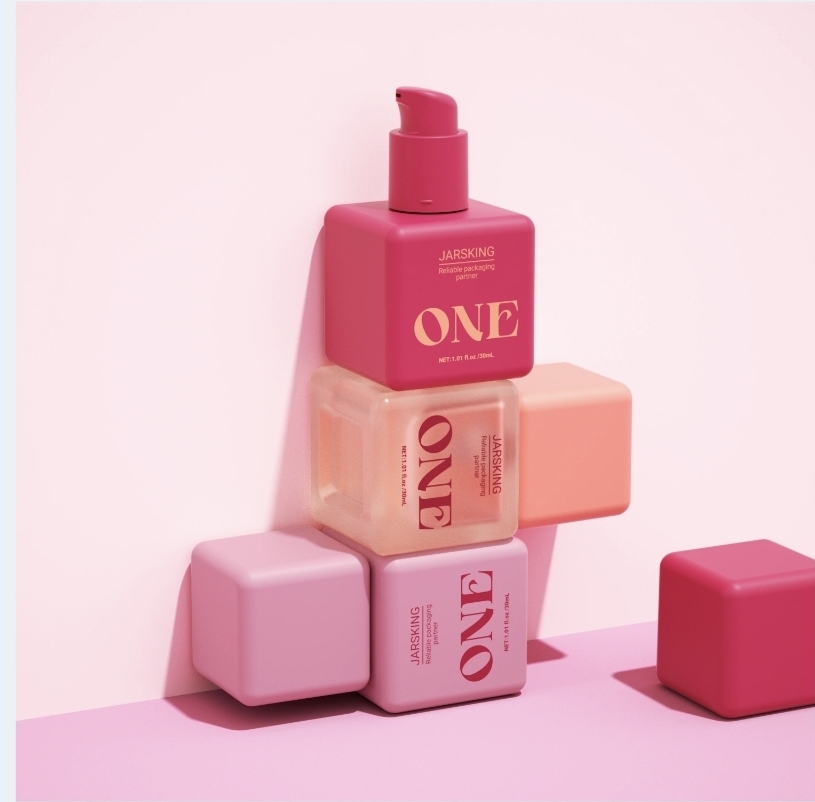
The 30ml Square Foundation Bottle is a precise example of this principle applied at manufacturing level. Built from thick-base hard glass with a bold 3D cube silhouette, it offers a 34×32mm front panel — substantial enough for a brand’s logotype to register clearly on shelf and in content. The ability to produce across multiple colorways from a single mold tooling means brands can build cohesive multi-SKU lines without the cost penalty typically associated with bespoke production. For travel-retail compliance, the 30ml capacity hits the internationally recognised liquid limit — making this format as strategically useful at airport retail as it is on the Sephora gondola.
The Airless Pump: Formula Protection as a Marketing Asset
Not all makeup formulas are created equal. The most sophisticated foundation and serum formulations — those built around active ingredients like vitamin C derivatives, retinoids, and peptide complexes — are acutely sensitive to oxidation. Every time a standard lotion pump draws product from an open-air reservoir, it introduces oxygen into the remaining formula. Over weeks of consumer use, that oxidation degrades efficacy and alters texture. The consumer does not always understand why their premium product feels “off” halfway through — but they notice.
This is where airless packaging moves from functional specification to brand story.
The piston-driven vacuum mechanism in airless pump bottles eliminates air contact entirely. Product is dispensed as the piston rises, maintaining a sealed environment for the remaining formula throughout the product’s life. The practical outcome is near-complete product dispensing — eliminating the 10–15% product waste that standard lotion pumps typically leave inaccessible at the bottom of the bottle.
For brands that invest heavily in active formulations, the custom PET airless vacuum lotion pump bottle with ball cap solves both problems simultaneously. Available in 15ml, 30ml, and 50ml capacities — travel, standard, and hero sizes — the hard PET construction meets international drop-test and leak standards for both retail and e-commerce distribution. The oversized ball cap, available in customised injection colours, functions as an immediate visual differentiator on shelf. When a brand’s packaging is architecturally distinctive, it trains consumer recognition faster than almost any other marketing investment.
The strategic value of offering the full size range from a single supplier with consistent finish options cannot be overstated. Brand coherence across SKU sizes is a retail requirement, not a luxury — and it is one that catches many independent brands off-guard when they discover their travel and full-size packaging looks like it came from two different brands.
The Squeeze Tube: Accessibility Meets Precision
Lip gloss is one of beauty’s most impulse-driven categories. The decision to purchase happens in seconds — at a checkout counter, in a transit display, on a product page — driven almost entirely by the visual and tactile promise of the packaging.
Squeeze tube formats have experienced a significant resurgence in prestige makeup, driven by Gen Z’s appetite for tactile, expressive, and social-media-native product experiences. The squeeze mechanic — direct, intuitive, instantly satisfying — connects emotionally with a generation that has grown up with sensory-forward content. But the format’s appeal is not purely aesthetic. A soft squeeze tube offers precise application control that traditional doe-foot wand applicators cannot match for certain formula viscosities.
The custom 15g soft PE squeeze tube for lip gloss is engineered to serve both the brand and the consumer simultaneously. The soft PE material delivers a tactile softness that signals approachability and playfulness — right for a category built on self-expression. The 15g size hits the sweet spot between trial size and full product, making it ideal for launch sets, gift-with-purchase mechanics, and multi-format collections.
For makeup brands building a lip range, the tube format also offers the broadest canvas for surface decoration. Silk screen printing, hot stamping, and colour coating options allow brands to turn a functional dispenser into a collectible object — one that consumers display rather than hide.
Packaging as Strategic Infrastructure
The most important shift a makeup brand can make is to stop treating packaging as a fulfilment decision and start treating it as a strategic infrastructure investment.
Every packaging format communicates something about the brand behind it. Square glass says editorial precision. Airless pump says formula integrity. Soft squeeze tube says tactile delight. When those signals align with the brand’s identity and the consumer’s expectations, the result is not just a sale — it is a relationship.
The brands that build lasting positions in makeup retail understand this instinctively. They choose packaging partners who can translate a brand’s visual language into manufacturing reality, deliver consistent quality across SKUs and size ranges, and move fast enough to match the speed of modern beauty launches.
Getting the packaging right is not a detail. It is the foundation.
For more, visit Pure Magazine