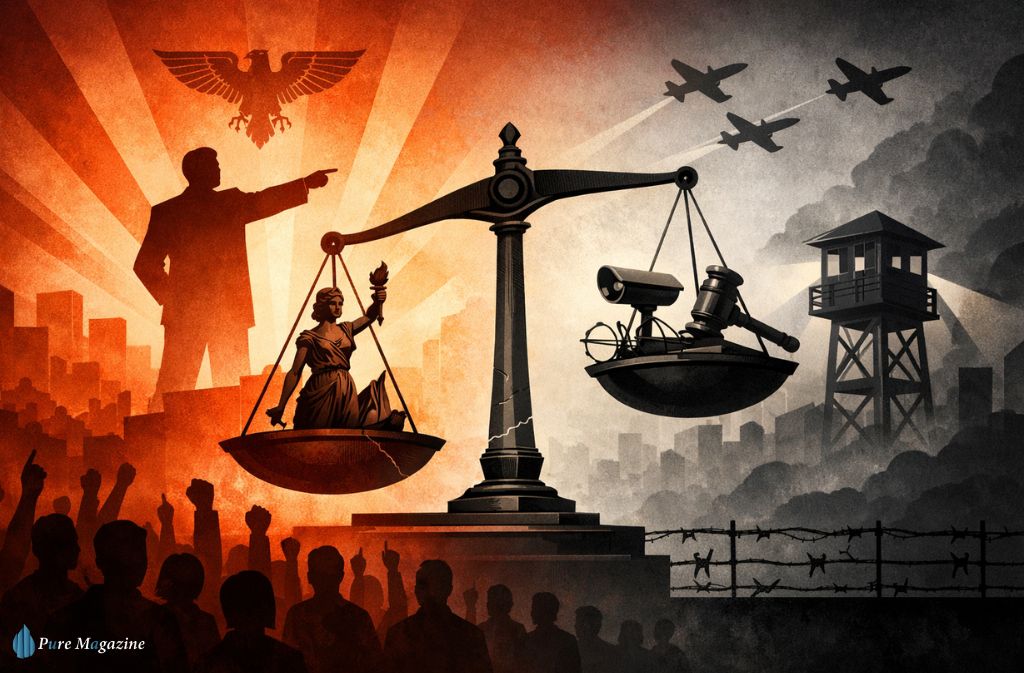
Fascisterne refers to individuals or movements that support fascism—a political system defined by authoritarian leadership, extreme nationalism, suppression of opposition, and the fusion of state and society under centralized control.
Why “Fascisterne” Still Matters in 2026
Fascism isn’t just a historical artifact buried in black-and-white footage. It’s a recurring pattern.
When economies destabilize, when identity feels threatened, when democratic systems appear slow or broken—people start looking for certainty. That’s where fascisterne enters the conversation.
Not always in uniform. Not always obvious.
But the underlying mechanics? They repeat.
This guide goes beyond definitions. You’ll understand:
- How fascism actually works (not just what it is)
- Why did people support it
- The economic and psychological systems behind it
- How to recognize modern echoes without overusing the term
The Engine of Fascism: More Than Just Dictatorship
Most basic guides say fascism = dictatorship. That’s incomplete.
Fascism is a system of total alignment between the state, society, and identity.
Under Benito Mussolini, the idea wasn’t just control—it was unity enforced through power.
“Everything within the state, nothing outside the state, nothing against the state.” — Mussolini, The Doctrine of Fascism
What makes Fascisterne distinct?
- They don’t just want power—they want total social alignment
- Politics becomes emotional, not rational
- The nation becomes almost sacred
Historical Case Study: Italy’s Descent Into Fascism
To understand fascisterne, you need to feel the environment—not just read bullet points.
Post-World War I Italy was unstable:
- Inflation rising
- Workers striking
- Fear of communist revolution spreading
Into that chaos stepped Mussolini—and his paramilitary group, the Blackshirts (Squadristi).
They didn’t win through policy debates.
They:
- Attacked political opponents
- Controlled streets through violence
- Created fear → then offered order
The Turning Point: March on Rome (1922)
A calculated show of force—not a full military takeover.
The king handed Mussolini power legally.
That’s the key lesson:
Fascism often enters through the front door of democracy, not the back.
The Hidden Core: Fascist Economics (The “Third Way”)
Fascism rejects both capitalism and socialism.
The Reality: Corporatism
Corporatism = the state organizes industries into controlled groups (corporations) that serve national goals.
| System | Economic Control | Goal |
|---|---|---|
| Capitalism | Private market | Profit |
| Socialism | State ownership | Equality |
| Fascism | State-directed corporations | National strength |
What this looked like in practice:
- Businesses still existed
- But operated under state direction
- Workers lost their independent unions
- Strikes were often illegal
In short:
Private property existed—but freedom didn’t.
The Psychology of Fascisterne
Fascism isn’t just political. It’s psychological.
Core emotional drivers:
- Fear (economic collapse, instability)
- Identity crisis (national decline)
- Desire for belonging
- Attraction to strong leadership
The Cult of Personality
Leaders like Adolf Hitler weren’t just politicians—they became symbols.
Joseph Goebbels (Nazi propaganda minister) mastered:
- Repetition
- Emotional messaging
- Media control
The result?
People didn’t just support the regime.
They felt part of it.
Umberto Eco’s “Ur-Fascism” (The Expert Framework)
In 1995, writer Umberto Eco outlined 14 traits of fascism—a framework still used in political analysis.
Key traits (simplified):
- Obsession with tradition
- Rejection of modern criticism
- Fear of difference
- Appeal to social frustration
- Nationalism as identity
- Enemy obsession
- Weak institutions
- Cult of heroism
- Selective populism
Why this matters in 2026:
You don’t need all 14 traits.
Even a few appearing together can signal fascist tendencies.
Data Insight: How Fascism Actually Gained Power
Fascism wasn’t fringe—it became mainstream.
Example: Nazi Party (Germany)
- 1928: ~2.6% vote share
- 1930: 18.3%
- 1932: 37%
- March 1933: 43.9%
This wasn’t overnight.
It was a gradual normalization.
Fascism vs Democracy vs Socialism
| Feature | Fascism | Socialism | Democracy |
|---|---|---|---|
| Leadership | One dominant leader | Collective | Elected |
| Freedom | Severely restricted | Moderate | High |
| Economy | Corporatist (state-directed) | State-controlled | Market-based |
| Opposition | Eliminated | Limited | Protected |
| View of the Past | Glorified “pure” past | Future utopia | Incremental progress |
| Identity | National unity above all | Class equality | Individual rights |
Fascism in the Nordics (Local Relevance for “Fascisterne”)
Denmark: DNSAP
- Danish Nazi party
- Never gained major power
- Collaborated with Nazi Germany during the occupation
Norway: National Samling
- Led by Vidkun Quisling
- Collaborated with Nazi Germany
- Became a symbol of betrayal
Key insight:
Fascism existed in Nordic countries—but never fully took control like in Germany or Italy.
The “Gray Zone”: What Fascism Is NOT
Not everything authoritarian = fascism.
Not fascism:
- Strict laws alone
- Strong leadership
- National pride
Closer to fascism:
- Systematic suppression of opposition
- Total control of the media
- Fusion of identity + state + power
Precision matters. Overusing the term weakens its meaning.
Modern Relevance: Neo-Fascism & 2026 Trends
Classic fascism is rare today.
But patterns persist.
Modern indicators:
- Democratic backsliding (EIU reports decline globally)
- Populist strongman politics
- Media manipulation via digital platforms
- Polarization and “enemy narratives.”
Key difference:
Modern movements are more subtle:
- No uniforms
- No overt dictatorships
- But similar psychological and structural patterns
Practical Checklist: How to Identify Fascist Tendencies
Use this in real-world analysis:
✔ Power concentrated in one leader
✔ Opposition systematically weakened
✔ Media heavily controlled or influenced
✔ National identity weaponized
✔ Fear-based political messaging
If multiple signals appear together → investigate deeper.
Common Mistakes (And Why They Matter)
1. Calling everything fascist
Leads to confusion and weak analysis.
2. Ignoring economic structure
Corporatism is a defining feature.
3. Forgetting gradual change
Fascism builds slowly.
4. Missing psychological appeal
People support it for emotional reasons—not just ideology.
Key Takeaways
- Fascisterne are not just historical—they represent a recurring pattern
- Fascism blends politics, identity, and psychology
- It often rises during instability
- It doesn’t always look obvious at first
- Understanding it requires nuance, not labels
FAQs
Q. What does fascisterne mean?
Fascisterne refers to individuals or groups who support fascism, a political ideology characterized by authoritarian leadership, extreme nationalism, suppression of opposition, and centralized state control over society.
Q. What is corporatism in fascism?
Corporatism in fascism is an economic system where the state organizes businesses, workers, and industries into controlled groups to serve national interests, limiting independent unions and free market competition.
Q. Who created fascism?
Fascism was developed by Benito Mussolini in early 20th-century Italy, where it emerged after World War I during a period of political instability and economic crisis.
Q. What is Umberto Eco’s Ur-Fascism?
Umberto Eco’s Ur-Fascism is a framework of 14 characteristics—such as extreme nationalism, fear of difference, and authoritarianism—used to identify recurring fascist tendencies across different societies.
Q. Is fascism the same as dictatorship?
No. Fascism is a type of dictatorship, but not all dictatorships are fascist. Fascism specifically includes extreme nationalism, mass mobilization, and ideological control, whereas other dictatorships may lack these elements.
Q. Does fascism still exist today?
Fascism does not widely exist in its original 20th-century form, but neo-fascist ideas and patterns—such as authoritarian leadership, nationalist rhetoric, and attacks on democratic institutions—can still appear in modern politics.
Q. What are the main principles of fascism?
The core principles of fascism include:
- Authoritarian leadership
- Extreme nationalism
- Suppression of political opposition
- State control over society and the economy
- Promotion of national unity over individual freedoms
Q. Which countries had fascist regimes?
Major fascist regimes existed in:
- Italy under Benito Mussolini
- Germany under Adolf Hitler
- Spain under Francisco Franco
These regimes played a significant role in events leading up to and during World War II.
Q. How is fascism different from socialism?
Fascism focuses on national unity and authoritarian control, while socialism focuses on economic equality and collective ownership. Fascism suppresses opposition, whereas socialism can exist within democratic systems.
Q. Why is fascism associated with World War II?
Fascism is closely linked to World War II because fascist regimes in Germany and Italy pursued aggressive expansion, leading to global conflict and major geopolitical changes.
Conclusion
Understanding fascisterne means understanding how power evolves under pressure.
The lesson isn’t just historical—it’s analytical.
Recognizing patterns early is what separates informed thinking from reactionary labeling. And in 2026, that distinction matters more than ever.
For more, visit Pure Magazine