Here’s a conversation that happens too often in US operations teams right now: someone demos a shiny AI tool, leadership approves a budget, the team spends three months integrating it — and six months later, the process it was supposed to fix is still broken. Just faster.
That’s the trap. AI automation in the USA is maturing fast, but the gap between picking a tool and actually deploying it well is wider than most businesses expect. What’s changed in 2026 is that knowledge resources like Droven.io have stepped in to close that gap — not by selling software, but by mapping the frameworks, evaluating the tools, and publishing the implementation blueprints that help US businesses make smarter calls before they commit.
This guide walks through what Droven.io actually covers, how it frames the AI automation space in 2026, which tools and architectural approaches it highlights for US businesses, and why that framing matters if you’re trying to build something that lasts — not just something that launches.
What Droven.io Actually Is — And Why That Distinction Matters
Before anything else, let’s be precise about the entity. Droven.io is a vendor-neutral knowledge platform covering AI automation in the United States. Its value isn’t in running your workflows — it’s in helping you understand which frameworks, tools, and architectural decisions are worth your time and budget.
That distinction matters enormously in 2026, because the AI automation space has fractured into at least four distinct categories of tooling that get conflated constantly:
- Rule-based automation (Zapier, Make, Power Automate) — deterministic, linear, breaks when conditions change
- AI-augmented automation (Zapier AI, Make AI, HubSpot Breeze) — rule-based backbone with an AI layer bolted on
- LLM orchestration frameworks (LangChain, LlamaIndex, CrewAI) — developer-facing, flexible, requires technical setup
- Agentic and multi-agent systems (n8n, Relevance AI, Kestra) — autonomous task execution, adaptive, closer to true AI automation
Resources like Droven.io map this terrain. When a US business searches for AI automation guidance, what they often need isn’t another SaaS subscription — they need to understand which category fits their problem, and what the implementation looks like in practice. That’s the gap Droven.io fills.
How Droven.io Frames the AI Automation Decision for US Businesses
The way Droven.io approaches AI automation guidance is worth understanding structurally. Rather than promoting a single tool or vendor, it evaluates automation decisions across three architectural layers that every US business should understand before committing to a platform:
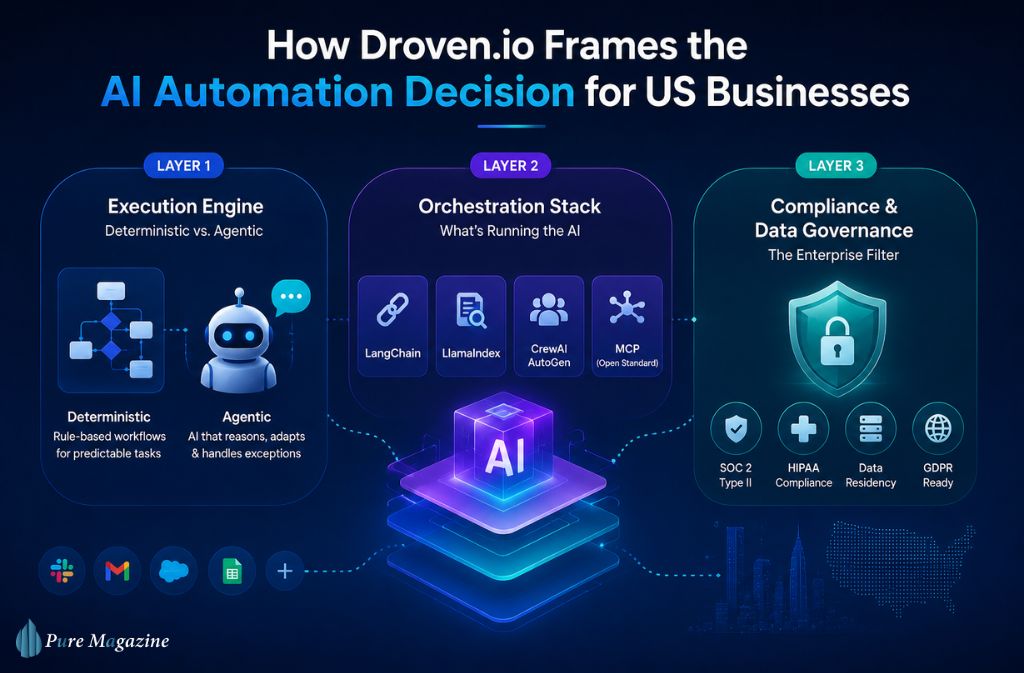
Layer 1: The Execution Engine — Deterministic vs. Agentic
The first question any automation evaluation should answer: do you need a system that follows a fixed script, or one that can reason, adapt, and take actions based on context?
Standard workflow automation tools like Zapier or Make work well when your process is predictable. Trigger fires → action runs → done. But the moment an exception shows up — an edge case, an ambiguous data format, a customer request that doesn’t fit a dropdown — these systems stall.
Agentic AI systems are different. They use LLM reasoning to handle exceptions, route dynamically, and complete multi-step tasks without human intervention. Platforms like n8n (when connected to an LLM backend) or Relevance AI’s agent layer can handle the kind of variability that rule-based tools can’t touch.
Droven.io’s framework guidance pushes US businesses to be honest about which category their actual workflows fall into — before paying for infrastructure they don’t need, or underpowering a use case that demands something smarter.
Layer 2: The Orchestration Stack — What’s Running the AI?
If you’re moving into LLM-powered or agentic automation, the orchestration layer matters. This is the technical architecture connecting your AI models to your business applications.
In 2026, the most discussed frameworks in this space include:
- LangChain — the most widely used open-source framework for chaining LLM calls; strong ecosystem, can get complex at scale
- LlamaIndex — optimized for retrieval-augmented generation (RAG); useful when your automation needs to pull from internal documents or knowledge bases
- CrewAI / AutoGen — multi-agent frameworks where different AI agents handle different parts of a workflow collaboratively
- Model Context Protocol (MCP) — the 2026 open standard for connecting LLM workflows to external applications and data sources; increasingly treated as table-stakes for enterprise deployments
Understanding which stack a vendor is built on — or recommending — tells you a lot about its ceiling. A tool built on LangChain has a different scalability profile than one relying on proprietary middleware. Droven.io’s reviews surface these distinctions rather than burying them in marketing copy.
| Key Term | Model Context Protocol (MCP): An open standard introduced in late 2024 that allows AI systems to connect to external tools, databases, and applications in a standardized way. As of 2026, MCP compatibility is a meaningful signal when evaluating enterprise AI automation platforms. |
Layer 3: Compliance and Data Governance — The Filter US Enterprises Can’t Skip
This is where automation decisions get serious fast — especially in healthcare, finance, and any sector handling US customer data at scale.
The compliance questions that matter in 2026:
- SOC 2 Type II: Does the platform have independent third-party attestation of its security controls? Without this, enterprise procurement conversations stall.
- HIPAA compliance layers: If you’re automating anything touching patient data, you need a signed BAA and documented data handling procedures — not just a checkbox on a pricing page.
- Data residency and retention: Where does your data go when it hits an AI model? US-only residency requirements are a real constraint for certain regulated sectors.
- GDPR crossover: If your US business has any EU customers, the compliance picture gets more layered still.
Most AI automation reviews skip this section because it’s less exciting than feature lists. Droven.io’s framework guidance doesn’t — which is one reason it’s worth paying attention to as a research resource rather than just another product comparison site.
Deterministic vs. Agentic AI Automation: The 2026 Tool Landscape
One of the most useful things Droven.io does is push beyond surface-level tool comparisons. Here’s the kind of structured contrast that actually helps US businesses make decisions:
| Dimension | Rule-Based Automation (Zapier, Make, Power Automate) | AI-Augmented (Zapier AI, HubSpot Breeze) | Agentic Workflows (n8n + LLM, Relevance AI, Kestra) |
| Setup complexity | Low — visual, no-code | Low-medium | Medium-high — requires LLM config |
| Handles exceptions | No — breaks on edge cases | Partial | Yes — reasons through ambiguity |
| Customer support use | Template-based only | AI-assisted responses | Fully autonomous Tier 1+2 |
| Data entry/processing | Copy-paste between apps | AI-assisted extraction | OCR + embedding + auto-routing |
| MCP compatibility (2026) | Limited | Emerging | Core feature for leading platforms |
| SOC2 Type II | Yes (established vendors) | Yes | Varies — check per vendor |
| Best for | Simple, stable workflows | Teams adding AI to existing stack | Complex, variable, high-volume tasks |
| Cost model | Per-task pricing | Per-seat + AI credits | Per-workflow or usage-based |
Note: Tool capabilities shift quickly. This reflects the general landscape as of mid-2026 based on publicly available documentation. Always verify compliance features directly with vendors before procurement.
What AI Automation Actually Looks Like in US Businesses Right Now
Theory is clean. Practice is messier. Let’s look at how the framework Droven.io promotes plays out in real operational contexts for US businesses.
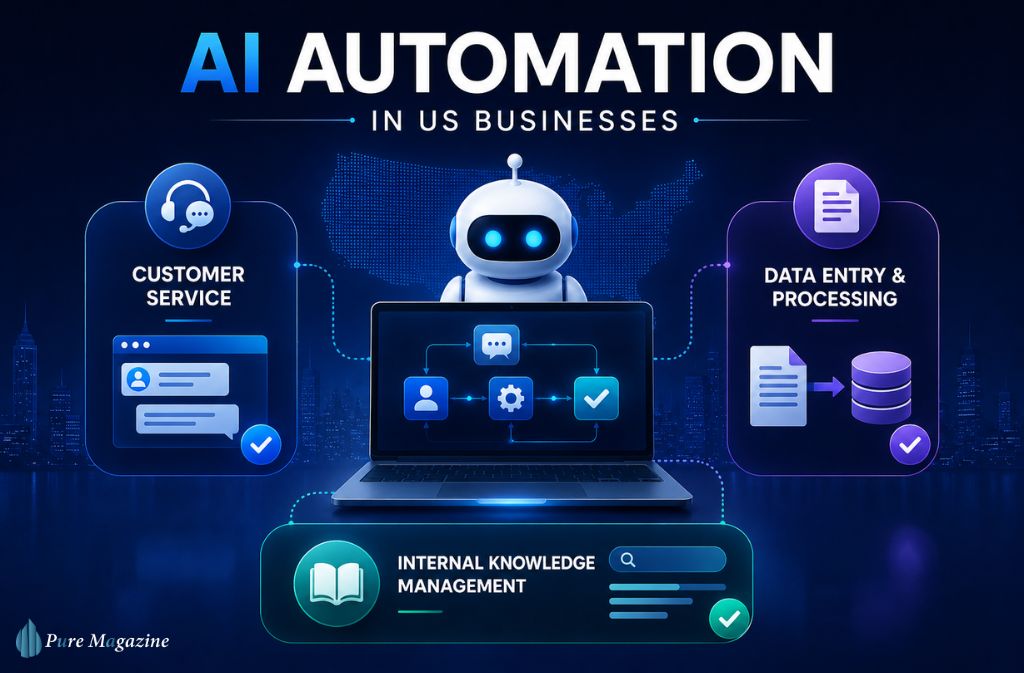
Customer Service: Where Most Teams Start
Customer service is still the entry point for most US businesses exploring AI automation — and for good reason. The volume is predictable, the queries are classifiable, and the ROI is measurable within weeks.
What’s changed in 2026 is the architecture behind the automation. Early deployments used keyword-matching chatbots. Mid-period deployments bolted an LLM onto a help center. Current deployments — the ones actually working — use an agentic layer that can:
- Pull context from the customer’s order history, CRM record, and previous tickets simultaneously
- Draft a response, check it against a policy knowledge base via RAG, and send — without human review for Tier 1
- Escalate to a human agent with a full context summary already written, so the agent doesn’t start from scratch
The difference between this and a basic chatbot isn’t cosmetic. It’s architectural. Droven.io’s framework guidance makes that distinction explicit — which matters when you’re comparing vendor demos that all look similar on the surface.
Data Entry and Processing: The Quiet Efficiency Win
Operations teams burning hours on copy-paste work between systems — CRM to ERP, order management to fulfillment, form submissions to spreadsheets — are the most consistent beneficiaries of automation.
Modern approaches combine OCR (optical character recognition), localized embedding models to classify document types, and direct API-to-API routing to eliminate the manual middle step. The important framing here: this isn’t about replacing staff. It’s about redirecting them toward judgment work that actually requires a human.
A distribution company in Ohio running 500+ orders per week might reclaim 12–18 hours of operations time monthly by automating purchase order ingestion alone. That’s not a hypothetical — it’s the kind of use case that scales predictably once the pipeline is built correctly.
Internal Knowledge Management: The Underrated Use Case
Most AI automation guides skip this one. Droven.io doesn’t.
As US businesses scale, institutional knowledge becomes a liability if it lives only in people’s heads or scattered across Slack threads and Google Docs. AI-powered knowledge bases — built on retrieval-augmented generation (RAG) — can index internal documentation, surface relevant answers to employee queries, and update automatically when source documents change.
The compliance angle matters here too. Regulated industries that need audit trails for information access find that RAG-based knowledge systems create those trails automatically, unlike informal Slack channels where the same question gets answered 40 different ways.
The Droven.io Framework: How to Evaluate AI Automation for Your US Business
Pulling together the architectural layers and tool categories, here’s a working decision framework that reflects how Droven.io approaches automation evaluation:
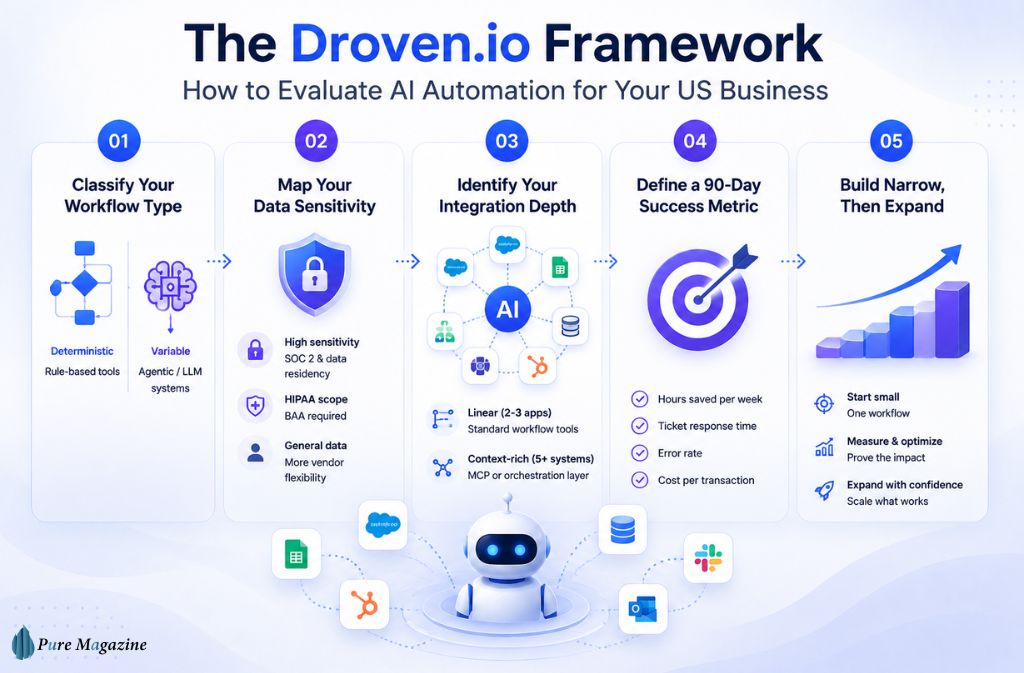
Step 1: Classify Your Workflow Type
Before evaluating any tool, answer honestly: Is this workflow deterministic (same inputs always produce same outputs) or variable (inputs change, exceptions are common)?
- Deterministic → Start with rule-based automation (Zapier, Make, Power Automate)
- Variable → You need an agentic or LLM-backed system — budget and timeline accordingly
Step 2: Map Your Data Sensitivity
What data does this workflow touch? Customer PII, financial records, health information, or internal-only operational data?
- High sensitivity → SOC2 Type II and data residency are non-negotiable filter criteria
- HIPAA scope → BAA required; narrow your vendor list to those with documented healthcare compliance
- General operational data → Security still matters, but you have more vendor flexibility
Step 3: Identify Your Integration Depth
Is this workflow touching 2–3 apps in a linear path, or does it need to pull context from multiple systems simultaneously?
- Linear (2–3 apps) → Standard workflow tools handle this cleanly
- Context-rich (5+ systems, dynamic retrieval) → You need MCP compatibility or a purpose-built orchestration layer
Step 4: Define a 90-Day Success Metric
Pick one number before you build anything: hours saved per week, ticket response time, error rate, or cost per transaction processed. Without a baseline, you can’t prove the automation worked — and you can’t troubleshoot when it doesn’t.
Step 5: Build Narrow, Then Expand
The biggest deployment mistake: scoping too broad on day one. Pick a single workflow, build it correctly with proper error handling and human escalation paths, measure it for 90 days, then expand. The teams that skip this step are the ones that end up with expensive automation debt.
Five Mistakes US Businesses Make When Choosing AI Automation Tools
These come up repeatedly in operations consulting, and Droven.io’s research surfaces them consistently:
- Mistake 1 — Choosing by feature list instead of architecture: Two tools can both claim ‘AI-powered customer support’ — one is keyword matching with an LLM skin, the other is a genuine agentic system. The feature list looks identical. The performance doesn’t.
- Mistake 2 — Skipping compliance verification: ‘We’re compliant’ is not the same as SOC2 Type II attestation with a current audit report. Ask for the documentation.
- Mistake 3 — Ignoring the orchestration layer: If a vendor can’t explain what’s running their AI backend — LangChain? Proprietary? A fine-tuned model? — that’s a yellow flag. What you don’t know about the stack can hurt you when something breaks.
- Mistake 4 — Removing human escalation too fast: Agentic systems are good. They’re not perfect. Keep a human review layer for edge cases until you have 90 days of production data proving accuracy rates.
- Mistake 5 — Automating a broken process: AI doesn’t fix a bad workflow. It runs it faster. Redesign the process first, then automate the redesigned version.
AI Automation Trends Shaping the US Market in 2026
What Droven.io’s coverage reflects about where this space is actually heading:
MCP Is Becoming the Standard Connectivity Layer
The Model Context Protocol has gone from niche developer conversation to genuine enterprise requirement in under 18 months. In 2026, asking whether a platform is MCP-compatible is roughly equivalent to asking whether it supports REST APIs five years ago. If your vendor can’t answer clearly, that’s telling.
Agentic Workflows Are Replacing Traditional RPA — Carefully
RPA (Robotic Process Automation) was the dominant paradigm for enterprise task automation through the mid-2020s. The problem: RPA systems break when interfaces change, require constant maintenance, and can’t reason through exceptions. Agentic AI systems don’t have those structural weaknesses. The transition is real, but it’s measured — enterprises aren’t ripping out working RPA deployments overnight. They’re building AI-native layers alongside them and migrating workflows as contracts expire.
The 30% Efficiency Rule Has a Nuance Now
The research finding that AI automation can recover roughly 30% of operational time lost to manual work is directionally accurate — but 2026 research adds a qualifier: that 30% materializes only when automation is applied to genuinely automatable workflows. Teams that apply it to judgment-heavy or highly variable tasks see far lower returns and higher remediation costs. The framework matters as much as the tool.
Data Governance Is Moving From IT to Legal
US enterprise AI automation evaluations increasingly involve legal and compliance teams from the start — not as a sign-off step at the end. With the FTC’s evolving position on AI data use and state-level privacy laws expanding, governance frameworks built into the automation architecture from day one are becoming standard practice rather than an afterthought.