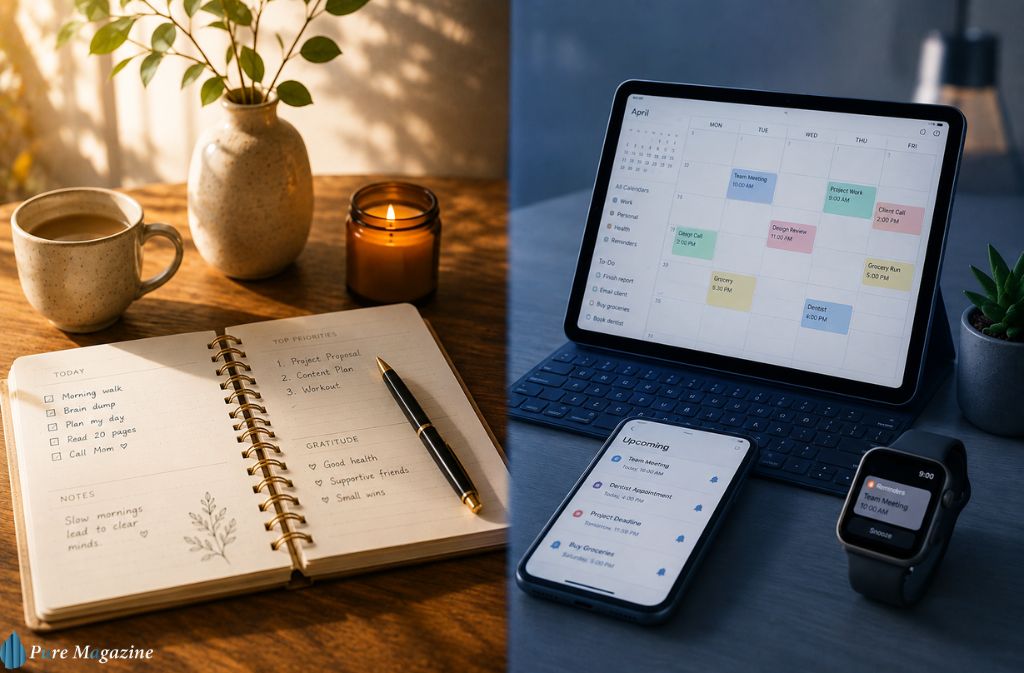
Paper and digital planners don’t compete on the same anxiety. Paper calms racing thoughts through slow, tactile, single-tasking writing. Digital calms the fear of forgetting through automated reminders that don’t rely on your memory. Pick based on which anxiety you actually have, not which planner looks nicer on Instagram.
Quick-Reference: Which Format Matches Your Anxiety?
| Paper Planners | Digital Planners | E-Ink / Hybrid Devices | |
|---|---|---|---|
| Anxiety it solves best | Overstimulation, racing thoughts | Fear of forgetting, FOMO | Overstimulation + disorganization |
| How it works | Slower, tactile, forces single-tasking | Automated reminders offload the worry of remembering | Paper-like feel with searchable backup |
| Distraction risk | Near zero | High — notifications, app-switching | Low to none by design |
| If you lose it | Everything’s gone | Synced, recoverable | Usually cloud-backed |
| Ongoing cost | One-time purchase, low | Often a monthly subscription | Higher upfront, then free |
| Best for | Reflective planning, brain dumps | Hard deadlines, complex task webs | Deep, focused writing without phone pull |
Why Paper and Digital Planners Affect Anxiety So Differently
Here’s the short version: paper and digital aren’t rival products chasing the same job. They’re solving two different problems that both happen to get labeled “anxiety.”
If your mind won’t stop racing and every screen feels like one more thing pulling at you, paper has more going for it. If your anxiety is really about forgetting — missing the appointment, dropping the deadline, letting something slip — a system that pings you automatically matters more than how nice the page feels under your pen.
Most comparison articles skip this distinction entirely and just declare a winner. That’s the wrong question. The right one is: which anxiety are you actually managing?
Does Writing Things Down by Hand Actually Reduce Anxiety?
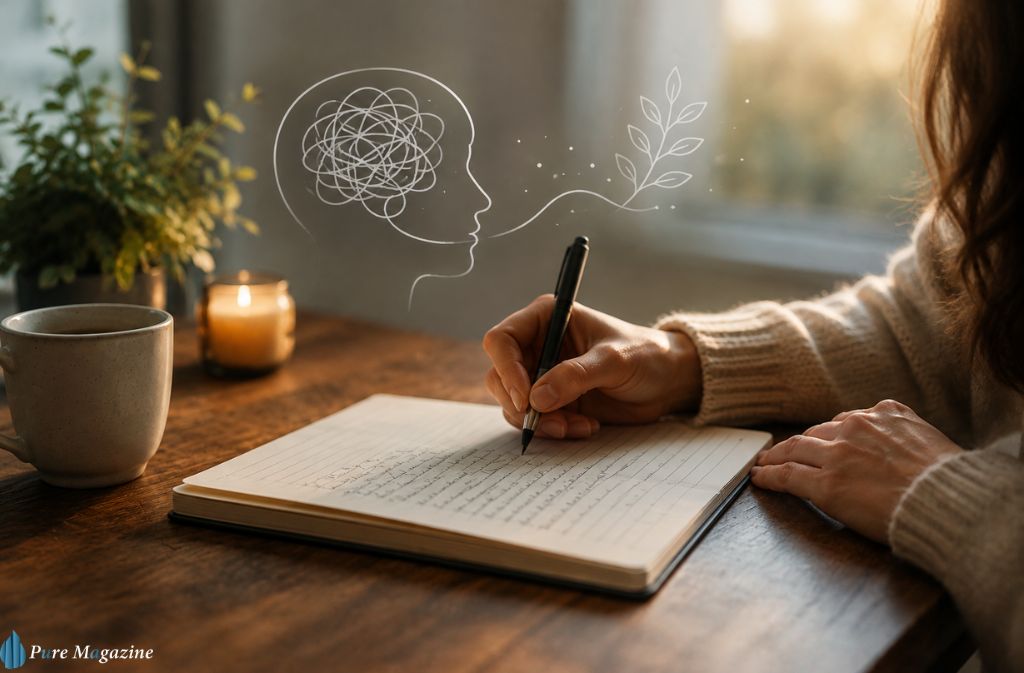
Yes — for a specific kind of writing, not for to-do lists in general, and that distinction gets lost constantly.
The strongest evidence here doesn’t come from planner research. It comes from psychologist James Pennebaker’s expressive writing studies, where participants wrote continuously about emotionally significant experiences for 15–20 minutes across three or four consecutive days. Follow-up research building on that paradigm has tied the practice to lower anxiety, lower blood pressure, and reduced depressive symptoms. A more recent review citing over 200 peer-reviewed studies on the Pennebaker method points to similar outcomes: reduced anxiety, better immune function, lower blood pressure.
Notice what that is, though. It’s free-form emotional processing — not “3pm dentist” written in a grid. A daily planner isn’t that tool. But a planner with a brain-dump section, a short reflection line, or even one gratitude sentence is borrowing the same mechanism, and there’s a physical, sensory case for it too — something you can touch tends to register differently than something you only look at. Putting a worry into words on paper appears to change how your brain processes it, not just how tidy your day looks on paper.
Don’t let this get overstated, though. Expressive writing research doesn’t prove that ordinary task planning carries the same benefit. Writing about a stressful conflict is a different cognitive act than writing “pick up dry cleaning.” The planning-specific research is thinner, and more mixed — which is exactly where the next section goes.
Does Handwriting Beat Typing for Planning, Specifically?
Everyone loves quoting the 2014 Mueller and Oppenheimer study to settle this argument. It’s not that simple.
Their finding was real: students who took lecture notes by hand showed stronger conceptual understanding than students who typed, even though the researchers limited both groups to notes only — no multitasking allowed. The proposed reason: handwriting is slow enough that it forces you to summarize rather than transcribe word-for-word.
But sitting in a lecture hall isn’t the same as mapping out your week. And the study hasn’t aged as cleanly as it’s usually presented. A 2019 replication attempt by Morehead, Dunlosky, and Rawson couldn’t reproduce the results consistently — one experiment found a longhand edge on conceptual questions with no difference in factual recall, and a different experiment found the opposite pattern entirely.
So treat “handwriting makes your brain absorb it better” as a plausible, partially-supported idea — not a settled fact you can build a whole planner recommendation on. Slower, more deliberate handwriting might help you process your intentions more than fast typing does. That’s reasonable. It just isn’t proven the way planner marketing likes to claim.
Can Planning on Your Phone Make Anxiety Worse Before It Helps?
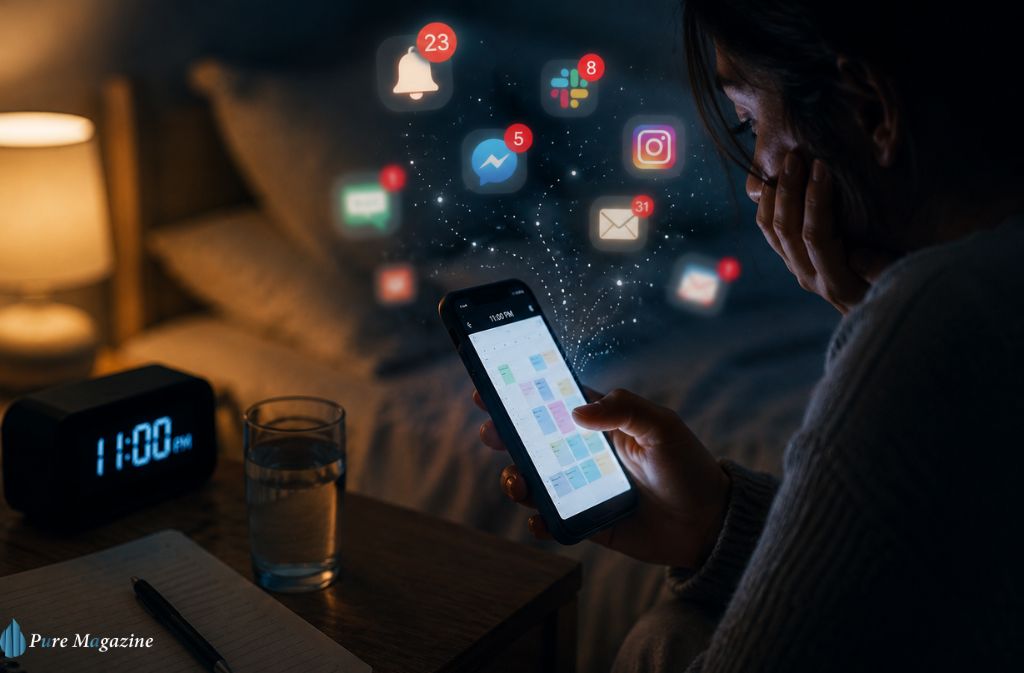
For a meaningful chunk of people, yes — and this is the strongest, most concrete argument in favor of paper, even though most comparison content only gestures at it vaguely.
Picture this: it’s 11 pm, you open your phone just to check tomorrow’s first meeting, and twenty minutes later you’re three Slack threads and a group chat deep, no closer to sleep and considerably more wound up than when you started. That’s not a willpower failure. It’s architecture.
A 2026 study in Computers in Human Behavior found that a single smartphone pop-up derails focus for roughly seven seconds, and that fragmented digital habits caused more cognitive disruption than total screen-time hours did. Tellingly, the same research measured participants’ baseline social anxiety and fear of missing out beforehand — the disruption wasn’t uniform; it interacted with how anxious people already were.
Separate work on smartphone presence and cognition found that anxiety itself correlates with weaker inhibitory control, mental shifting, and working memory, and that just having a phone nearby — not even using it — raises cognitive load. Other research found that separation from a ringing phone can spike heart rate and anxiety and drag down performance. The phone is a stressor coming and going: present and buzzing, or absent and anticipated.
That’s the trade-off most digital-planner reviews skip entirely. Open a planning app, and you’ve also opened the delivery system for every other notification in your life. Paper physically can’t do that. Building a few digital wellness habits — silencing everything except the planner app, or setting a hard cutoff time — closes some of this gap, but it takes ongoing effort. Paper closes it by default.
What Digital Planning Actually Does Well
Let’s give digital its due, because a lot of “paper is more mindful” content underweights this badly.
A behavioral neuroscientist’s framing, cited in planner comparison coverage, gets at the real function of any planner: free your mind from holding tasks, not just capturing them. It should work as an external brain — not another source of stress. That source suggests judging a system on three things: do you trust it to alert you when it matters, is it low-friction to use, and does it match how you naturally think.
Trustworthiness is where digital genuinely wins — for one specific anxiety profile. If your worry centers on forgetting, a recurring alert that fires at 8am whether or not you remembered to open your planner removes a failure point paper simply can’t match. Paper only reminds you if you open it. For someone whose anxiety spikes around “did I miss something,” that automated backstop lowers baseline stress even when the daily experience of tapping through an app feels less calming than pen on paper.
Here’s the honest split: digital’s strength — automation, search, sync — is a strength specifically for forgetting-anxiety. Paper’s strength — slowness, tactility, silence — is a strength specifically for overstimulation-anxiety. Almost nothing written on this topic separates the two. They call for different tools.
The Neurodivergence Angle: Object Permanence vs. Cognitive Overload
This gets mentioned constantly in ADHD and anxiety communities, and it deserves more than a passing reference.
People with ADHD often describe a version of “out of sight, out of mind” — a task that isn’t visually in front of them stops existing in their head. A paper planner solves that by staying open on the desk as a constant visual cue. One ADHD-planner resource collected reader accounts describing exactly this: a digital planner “triggers some anxiety” and something feels missing compared to the physical act of writing, which builds routine and accountability. Another reader in the same piece described the opposite — digital pulling them into a rabbit hole while paper made things harder to retain. Neither reaction is universal.
Worth a quick correction here, though: “object permanence” borrows a developmental-psychology phrase — it isn’t a clinical term for what’s happening. As one psychiatric explainer points out, what people usually mean is a working-memory and attention-regulation pattern, not a literal loss of understanding that hidden objects still exist. The phrase is relatable and useful conversationally — just don’t treat it as a diagnosis.
Flip the coin, and you get the opposite failure mode: cognitive overload. A phone that’s supposed to hold your plan also holds email, texts, and every app you’ve ever installed. For someone whose anxiety spikes from too much visual and notification noise, a “constant visual cue” on a screen can become the problem instead of the solution. This is exactly why the next section — hybrid devices — exists.
The Middle Ground: E-Ink Tablets and Smart Pens
If you want paper’s visual permanence without paper’s searchability problem, this category is built for exactly that gap, and it barely gets mentioned in most planner comparisons.
Devices like the reMarkable, Supernote, and Kindle Scribe are e-ink tablets built specifically to remove app stores and notifications while still giving you handwriting recognition, cloud sync, and search. One detailed comparison of the two leading devices describes them as attempts to replicate “the calm, distraction-free experience of writing on paper” without sacrificing digital backup. Smart pens like Livescribe take a different route to the same goal — you write on real paper, and the pen digitizes it for you afterward.
None of this is free, and it’s not for everyone. Devices run $200–450 upfront, which is a real number to weigh against a $20 paper planner. But for someone whose anxiety involves both overstimulation and the fear of losing a physical notebook, this middle category solves both problems at once — and it pairs well with the kind of digital decluttering that makes any device feel calmer to use, since a distraction-free tablet still benefits from a deliberately sparse setup.
What Planning Actually Costs — And Why That’s an Anxiety Factor Too
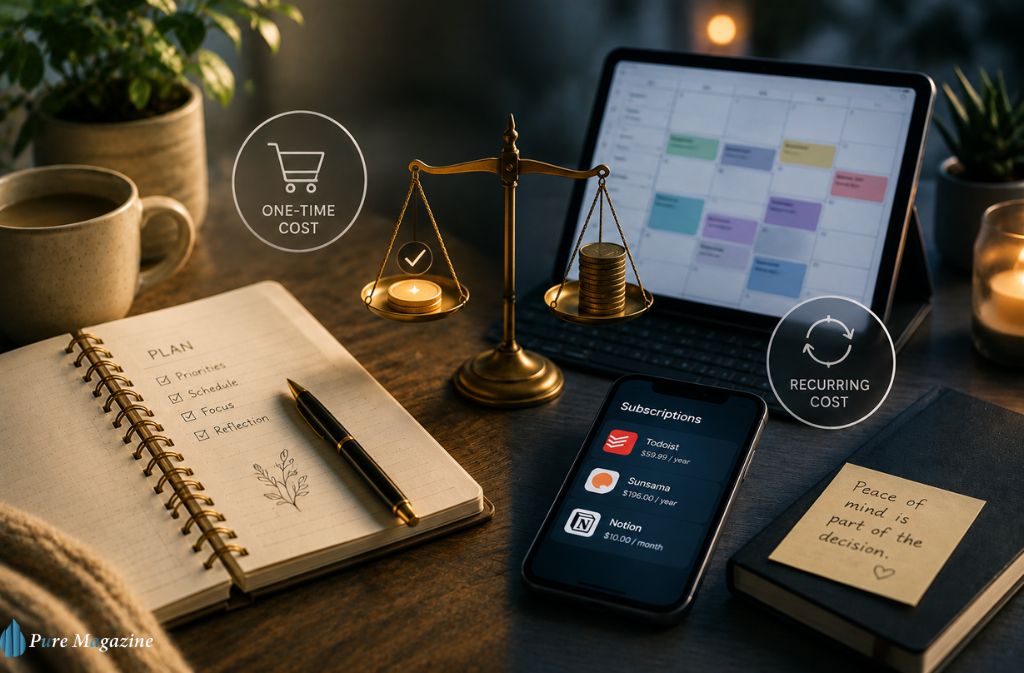
Money stress and planning stress aren’t separate conversations, even though most comparison articles keep them that way.
A paper planner is usually a single purchase — somewhere in the $15–60 range for a year, sometimes less if you make your own. Digital tools rarely work that way. Todoist’s paid tier runs about $60 a year once you need reminders or file attachments. Sunsama, built around a guided daily planning ritual, runs closer to $200 a year. Notion, Sunsama, and similar tools tend to bill monthly, which means the cost resurfaces on your card every month rather than once a year — a small thing that can quietly feed financial anxiety if money is already a stressor, which ties into the broader idea of financial self-care as part of an overall wellness routine, not a separate topic from mental health.
None of this makes digital the “wrong” choice financially. Automation and reliability are worth paying for if forgetting things is what drives your anxiety. But it’s a real, recurring cost that a one-time paper purchase doesn’t carry, and it deserves a line in the decision — not just an afterthought.
Is Your Planner’s Data Actually Private?
This one gets almost no coverage anywhere, and it’s a legitimate anxiety driver for a growing number of people.
Journal and planner entries often contain exactly the kind of information you’d least want exposed — mood notes, stress triggers, health details, half-formed worries you’d never say out loud. A March 2026 investigation covered by NAMI Iowa found more than 1,500 security vulnerabilities across widely used Android mental health apps, some classified as high severity, involving sensitive data like mood logs and therapy notes. Many journaling apps also hold the encryption keys to your entries themselves, meaning a company — not just a hacker — could technically read what you wrote.
Nobody can hack a paper notebook remotely. You can still lose it, damage it, or leave it somewhere a family member reads it — its own risk profile, just a different one. If data privacy is part of what makes digital planning feel unsafe for you, that’s not paranoia; it’s a documented gap in a lot of popular apps. Look specifically for end-to-end encryption and a stated no-training-data policy before trusting a digital tool with anything emotionally loaded.
What About People Who Tried Both and Switched Back?
Community accounts of switching from paper to digital and back again follow a consistent pattern worth naming — while being clear this is testimony, not proof of a mechanism.
Readers describe digital planners “working” logistically while feeling emotionally hollow, which pulls them back to paper. One account collected by ADDitude described a digital planner triggering anxiety specifically, with something described as missing compared to the physical, accountability-building act of writing by hand. Don’t dismiss that kind of testimony — it’s a real signal that the emotional experience of a format isn’t separable from its logistics for a lot of people, especially anyone managing ADHD and anxiety together, which commonly overlap.
It’s not proof paper wins objectively. It is proof that “which one do I actually want to open every morning” is a real variable in this decision, not a soft one you can ignore in favor of pure efficiency.
How to Actually Decide
Skip the philosophical debate and match the tool to the anxiety pattern doing the damage:
- Racing thoughts, overstimulated by screens → paper, with a daily brain-dump section
- Fear of forgetting appointments or deadlines → digital, with recurring automated reminders turned on
- Both, depending on the day → hybrid: paper or an e-ink device for reflective planning, a phone calendar strictly for hard-deadline alerts
- ADHD plus anxiety together → whichever has lower friction for you — test both for two weeks before committing to either
One underused option: stop treating this as a single, permanent choice. Use paper for the reflective, brain-dump side of planning, where the expressive-writing research actually applies, and a phone calendar strictly for time-sensitive alerts, where automation earns its keep. That’s not indecision — it’s assigning each medium to the job it has real evidence for. And if part of what’s driving the anxiety is just the pace of modern life rather than the tool itself, that’s worth sitting with too — the broader question of choosing a slower pace sometimes matters more than which app or notebook you land on.
The Trade-Offs Neither Side Advertises
Paper’s real cost isn’t romantic — it’s functional. It can’t remind you of anything unless you physically open it, you can’t search it, and losing it means losing everything in it. If your anxiety includes catastrophizing about loss or damage, a physical planner is itself a small, ongoing risk — not just a comfort object.
Digital’s real cost isn’t just “screens are bad.” It’s the interruption architecture underneath even a beautifully designed app. Setting firm screen-time boundaries can blunt this, but the phone doesn’t stop being a phone just because you’ve opened a calm-looking planner app on it.
Neither cost disqualifies either format. Both get left out of comparison content that treats this as a simple aesthetic preference.
Frequently Asked Questions
Q. Does a paper planner help with anxiety more than therapy or medication?
No. The research on expressive writing and handwriting points to complementary stress-management effects, not a replacement for clinical treatment. If anxiety is significantly affecting daily functioning, that’s a conversation for a licensed therapist or doctor — not a planner decision.
Q. Is bullet journaling better for anxiety than a structured planner?
No direct comparative study answers this specifically. Bullet journaling borrows from the same brain-dump and reflection mechanisms discussed above, so the same logic applies: it may help more if your anxiety involves racing thoughts, less if it’s really about forgetting deadlines.
Q. Can a digital planner ever feel as calming as paper?
Yes, for some people — particularly when the anxiety driver is fear of forgetting rather than overstimulation. E-ink tablets and minimal-notification apps narrow the gap further by removing the always-on interruption risk that comes with a regular phone.
Q. Should I switch from digital to paper if I already have an anxiety diagnosis?
Not automatically. Switching has a documented friction cost of its own — running two systems in parallel too long tends to increase disorganization-related stress rather than reduce it. If you do switch, doing it at a natural boundary, like the start of a month, and fully retiring the old system within about a week works better than an indefinite overlap.
Q. Does handwriting really improve memory for tasks, not just lecture notes?
The strongest study here (Mueller & Oppenheimer, 2014) measured conceptual understanding from lecture notes, and a 2019 replication attempt got inconsistent results. Some transfer to daily planning is plausible. It isn’t established with the certainty the original finding is usually presented with.
Q. Are e-ink tablets worth the higher upfront cost?
It depends on what’s driving your anxiety. If you need both paper’s low-distraction writing feel and a searchable backup, the $200–450 price tag can be worth it. If cost itself is a stressor, a plain paper planner or a free app tier will do the job without adding financial pressure.
Q. Is my journaling or planning app actually private?
Not always, and it’s worth checking before you write anything emotionally sensitive in it. Look for end-to-end encryption and a clear statement that your entries aren’t used to train AI models — vague privacy policies are a real red flag, not just legal boilerplate.
Q. Is there a “best” planner brand for anxiety?
No brand has controlled research behind it on this. Reader and community reports mention specific products, but that reflects personal fit and sentiment, not tested outcomes — treat those as leads worth exploring, not verified recommendations.
For more, visit Pure Magazine