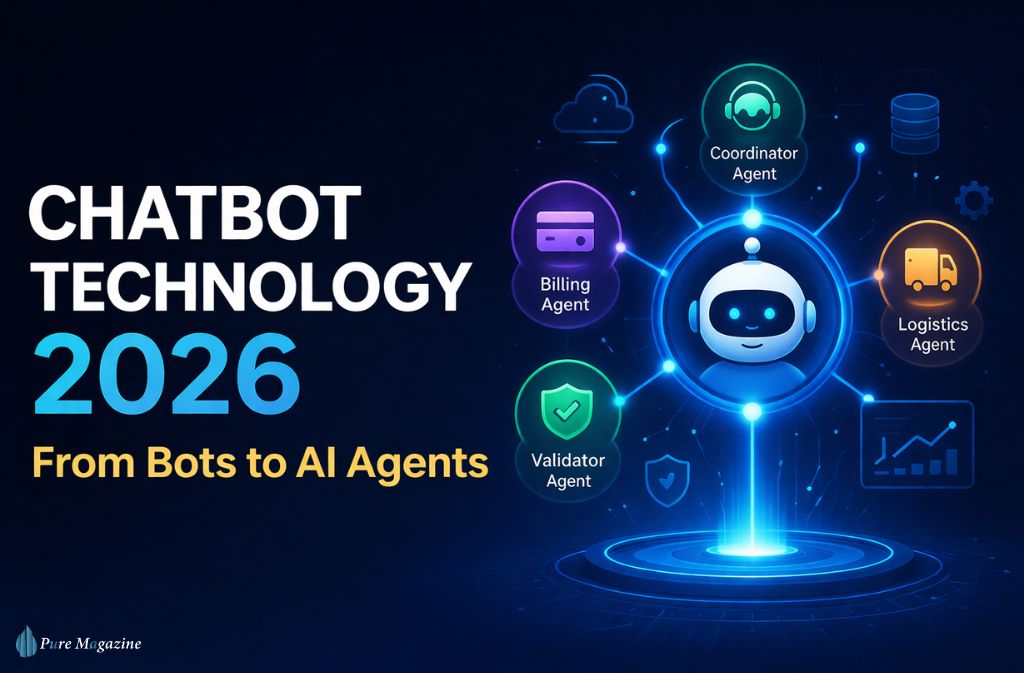
There’s a moment in every technology cycle when the old vocabulary stops making sense. We reached that point with chatbots.
The word still appears in headlines, on vendor websites, and in enterprise roadmaps. But what it actually describes in 2026 — systems that plan, delegate, execute, and self-correct across connected tools — has almost nothing in common with the FAQ bots of 2019. Calling these systems “chatbots” is like calling a commercial aircraft a motorized kite. Technically traceable, practically misleading.
This article is about what’s actually happening under the hood of modern AI systems, why the shift matters for anyone building or deploying them, and where the real risks and opportunities lie. The framing comes from hands-on experience with agentic systems — including failures that forced better engineering.
From Q&A to Execution: The Real Shift in AI Architecture
Most organizations that struggled with AI in 2023–2024 weren’t struggling because their models were bad. They were struggling because they’d built conversation engines when they needed execution engines. A chatbot, in the original sense, waits for input and generates output. An agentic AI system receives a goal and figures out how to reach it — deciding which tools to call, which agents to involve, and how to validate the outcome before returning a result.
The clearest way to see this distinction is through failure. Consider a retail system under peak traffic: an AI slowed to a crawl, users abandoned sessions, and conversion dropped. The root problem wasn’t model quality — it was architecture. The system was running full reasoning loops on every query with no context caching, no fallback mode, and no differentiation between a simple product lookup and a complex multi-step return flow. Reducing those reasoning loops and adding selective retrieval cut response time by roughly 32% and lifted conversions by 18%.
That kind of architectural decision is what 2026 AI development actually looks like. It’s less about which language model to use and more about how to structure the systems around it.
What Is Aggr8Tech, and Why Does the Term Matter?
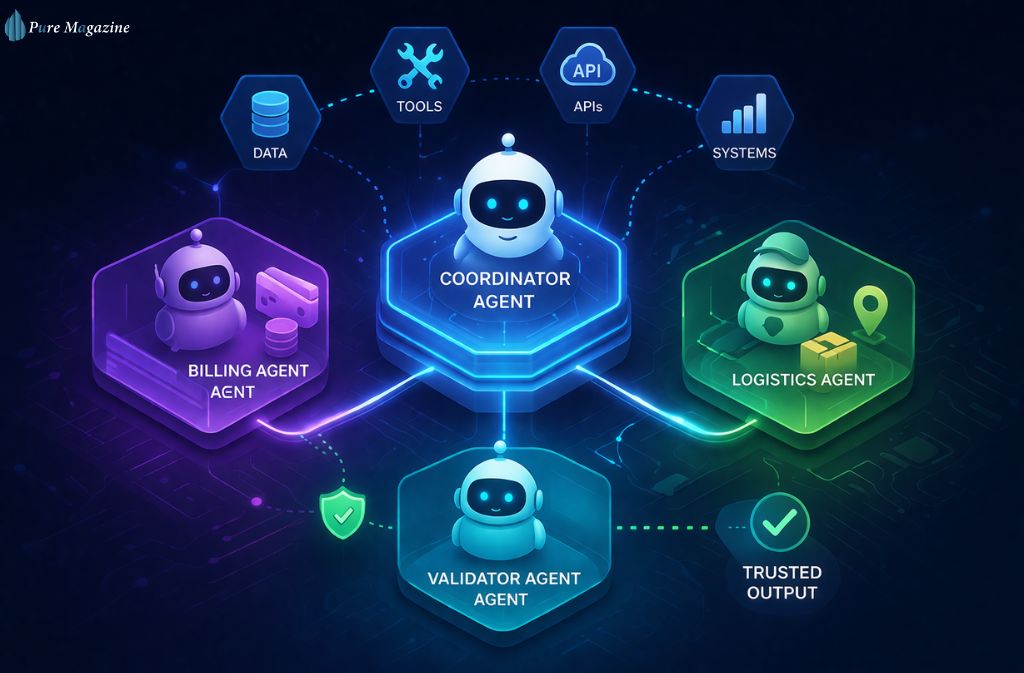
Aggr8Tech — aggregated technology — refers to the orchestration of multiple AI agents, tools, data systems, and APIs into a unified execution layer. It’s not a product category so much as a design philosophy: rather than deploying a single model to handle all requests, organizations build layered systems where each component does what it does best, and a coordination layer ties the outputs together.
The reason this terminology matters is that it changes what developers actually build. When the mental model is “chatbot,” engineers optimize for conversation quality. When the mental model is “coordinated agent system,” they optimize for reliability, error recovery, and graceful degradation. Those are very different engineering challenges.
A well-designed Aggr8Tech system might include a Coordinator Agent that determines task routing, a Billing Agent that handles payment processing, a Logistics Agent for fulfilment tracking, and a Validator Agent that checks outputs before they reach users. Each agent is specialized. The Validator layer, in particular, tends to get skipped by teams moving fast — and it’s usually the first thing they add back after a hallucination creates a real problem (like an AI confidently offering a discount code that doesn’t exist).
The Architecture of Multi-Agent Orchestration
Understanding how these systems work in practice requires moving past diagrams and into execution flows. When a user submits a request to a modern agentic system, the journey looks roughly like this: intent detection feeds into a task-planning loop that delegates subtasks to specialized agents, which call external APIs or tools; a validation layer then checks the outputs, and the consolidated result reaches the user. That’s five or six distinct steps where things can go wrong — and where smart engineering creates real competitive advantage.
The “loop of death” problem — where a user rephrases a request repeatedly while the bot returns irrelevant responses — is fundamentally a context failure. The system loses track of what was said, what was tried, and what the user actually wants. The 2026 solution isn’t a smarter prompt; it’s persistent memory, context-aware reasoning across turns, and multi-agent delegation so that a specialized agent handles the part of the query that requires domain knowledge rather than forcing a general model to improvise.
Three orchestration frameworks dominate production deployments today. LangGraph models workflows as directed graphs — nodes are functions or agents, edges define transitions — giving engineers fine-grained control over state management and error recovery. CrewAI takes a role-based approach closer to how human teams operate: define who each agent is, what it’s responsible for, and let the framework handle handoffs. Microsoft’s AutoGen models agent interaction as a structured conversation, which works well for iterative tasks like research synthesis or code review, but adds token cost at scale. Each has tradeoffs, and most mature production systems end up combining elements of more than one.
MCP: The Protocol That Makes Agentic Systems Actually Connect
One of the biggest gaps in most “2026 AI” content is the absence of the Model Context Protocol (MCP). This isn’t a minor technical footnote — it’s become the infrastructure standard that determines whether an agentic system can actually connect to the real world.
Model Context Protocol was introduced by Anthropic in November 2024 and has since been donated to the Linux Foundation’s Agentic AI Foundation (with backing from OpenAI, Google, Microsoft, AWS, and Cloudflare), functions as a universal connector between AI models and external data sources or tools. Before MCP, connecting an AI agent to a new tool required custom integration work for every combination of model and service. MCP collapses that into a standardized interface — one server, accessible by any compatible client.
The adoption numbers tell the story of how quickly this became infrastructure rather than experiment: by late 2025, the protocol had accumulated over 97 million monthly SDK downloads and more than 10,000 active servers. When building an agentic system in 2026, not accounting for MCP in the architecture is like building a web application without considering APIs. It’s the connectivity layer that allows agents to access live data, call external services, and coordinate with other agents across different frameworks. That said, MCP introduces its own security surface — including prompt injection through tool descriptions and cross-server shadowing attacks — which requires careful review before production deployment.
RAG vs. Fine-Tuning: A Decision That Costs Real Money
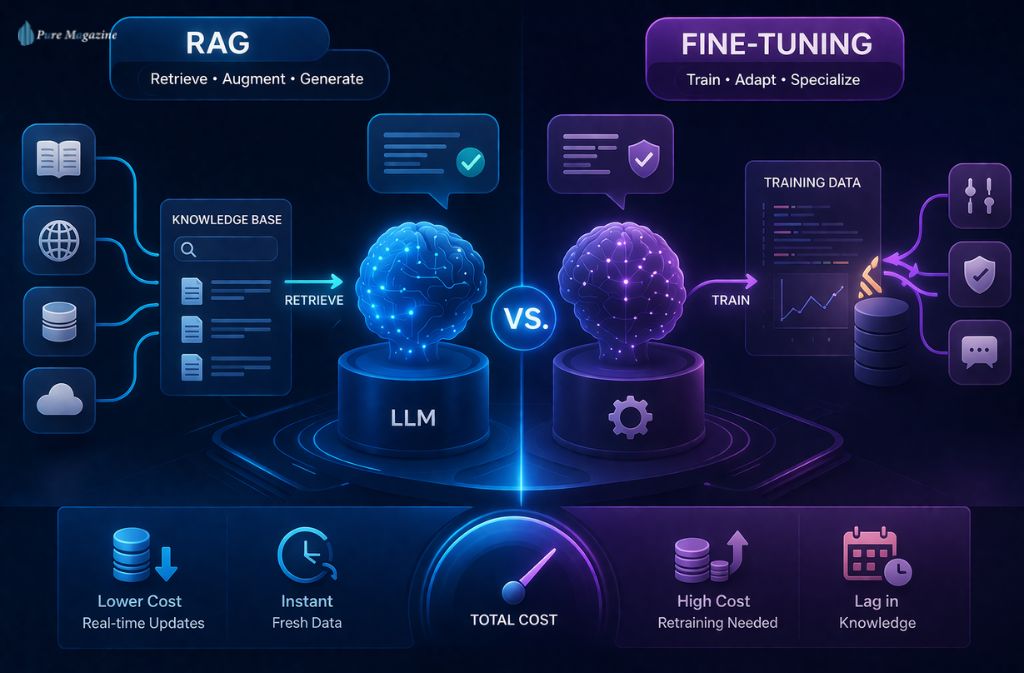
The choice between Retrieval-Augmented Generation (RAG) and fine-tuning sits near the center of most AI architecture decisions, and it’s where budgets quietly explode when the wrong call is made.
RAG keeps the base model static and retrieves relevant context at inference time from a connected knowledge base. This makes it well-suited for domains where information changes frequently — product catalogs, policy documents, and real-time pricing. The accuracy of the output is only as good as the quality and freshness of the retrieved data, but that tradeoff is usually preferable to the alternative. Fine-tuning modifies the model weights themselves, which creates more consistent tone and behavioral patterns, but at high cost and with a lag between when knowledge changes and when the model reflects it.
The practical 2026 approach for most organizations: use RAG for factual accuracy and real-time information, and fine-tune for voice, format, and behavioral consistency. These aren’t mutually exclusive. A customer service system might be fine-tuned to always follow a particular escalation protocol while using RAG to pull live account data. What erodes budgets is trying to solve a freshness problem with fine-tuning — retraining a model every time product information changes is expensive, slow, and almost always the wrong tool for the job.
Context cost is the related problem that most guides gloss over. AI memory isn’t free. In multi-agent systems, each agent adds to the token count flowing through each request. Without deliberate strategies — context caching, memory summarization, selective retrieval — these costs compound quickly as system complexity grows.
Security in Agentic AI: What OWASP Actually Says
Security becomes materially more complex when AI systems can act, not just respond. The OWASP Top 10 for LLM Applications 2025 — the most widely referenced security framework for AI systems — reflects this shift directly. Prompt Injection holds the number one position for the second consecutive edition, and two entirely new categories were added: System Prompt Leakage and Vector and Embedding Weaknesses, the latter targeting vulnerabilities specific to RAG systems.
The entry that matters most for agentic systems is Excessive Agency, and the 2025 edition substantially expanded its scope. The core problem is granting an AI agent access to more tools than it needs, broader permissions than its task requires, or the ability to act without human approval checkpoints. In practice, this means an agent with email access can be tricked into sending phishing messages, and an agent with database permissions can be manipulated into deleting records. These aren’t theoretical risks; they’re documented real-world incidents that shaped the updated framework.
Practical security architecture for agentic systems in 2026 includes: input sanitization before any content reaches the model, role-based permissions enforced at the infrastructure level (not just in the agent’s own logic), output validation before results are returned to users or passed downstream, and strict tool access restrictions scoped to the minimum necessary for each task. The OWASP framework recommends treating external content as untrusted by default and segregating it from instruction pathways — the mechanism through which indirect prompt injection typically operates.
The Agentic Friction Score: A Framework for Deciding What to Automate
Not everything should be automated. This sounds obvious, but the organizational pressure to show AI ROI creates a reliable pattern: teams automate tasks that are visible and easy to automate rather than tasks where automation actually creates the most value. The result is AI handling low-stakes workflows well while higher-stakes processes remain manually managed, not because they’re complex, but because no one built a decision framework for the boundary.
The Agentic Friction Score is a practical model for thinking about this. Evaluate any candidate task across three dimensions: the risk level if the AI output is wrong, the operational cost of that error, and the frequency with which the task occurs. High frequency, low error cost, well-defined inputs — full automation makes sense. Low frequency, high error cost, ambiguous inputs — keep humans in the loop. The math is roughly:
AF Score=(Risk×Complexity)FrequencyAF\text{ Score} = \frac{(\text{Risk} \times \text{Complexity})}{\text{Frequency}}
A score above 8 suggests the task should stay human-led. Between 4 and 7, a Validator Agent with human review on flagged outputs is the right architecture. Below 3, full automation is appropriate. Applied consistently, this framework prevents the over-automation mistakes that erode trust in AI systems — like routing a legal dispute through the same pipeline as a password reset.
| Task | AF Score | Recommended Approach |
|---|---|---|
| Password reset | Low | Fully automated |
| Refund over $500 | Medium | AI + Validator Agent |
| Contract amendment | High | Human only |
| Appointment scheduling | Low | Fully automated |
| Fraud dispute | High | Human review with AI summary |
The 2023 vs. 2026 Architecture Comparison
The differences between what passed for “AI-powered” three years ago and what ships today aren’t cosmetic. The underlying architecture changed substantially.
| Dimension | 2023 Systems | 2026 Systems |
|---|---|---|
| Reasoning | Decision trees / basic retrieval | Chain-of-Thought (CoT) planning loops |
| Data access | Static FAQ or single-source RAG | Dynamic MCP / real-time API connections |
| Output type | Text responses | Multimodal execution (text, image, voice, actions) |
| Memory | Session-based context window | Persistent graph memory across interactions |
| Security model | Input filtering | Role-based agent permissions + output validation |
| Failure mode | Graceful error message | Fallback agent, basic mode, or human escalation |
The memory shift deserves emphasis. Session-based memory forgets everything when the conversation ends. Persistent graph memory means an agent can recall that a specific user prefers phone callbacks over email, that their last three refund requests were approved, and that they contacted support 48 hours ago — all without the user restating it. This changes what customer service AI can actually do, but it also creates new obligations around data governance and retention.
Human-in-the-Loop Governance: The Kill Switch Problem
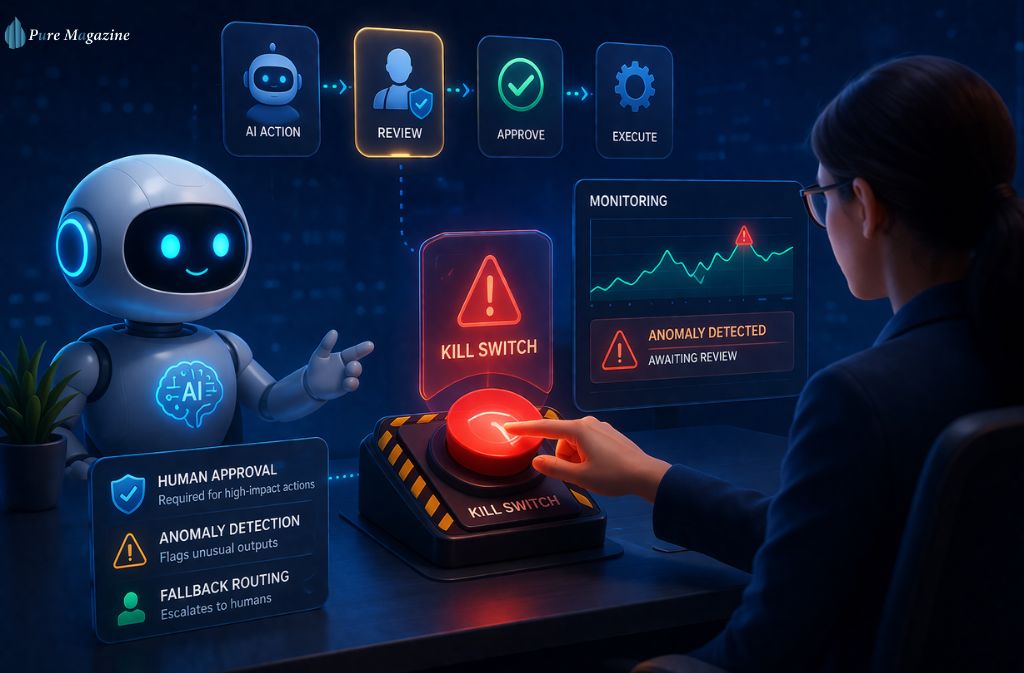
One of the clearest signals that an AI system is production-ready is whether there’s a clearly defined procedure for a human to override it in real time. Most deployments that have failed in embarrassing ways — AI offering policies that don’t exist, making commitments the company can’t honor — lacked a reliable kill switch.
Good Human-in-the-Loop (HITL) governance means more than a thumbs-up/thumbs-down button. It means defining which actions require explicit human approval before execution (particularly irreversible ones like sending emails, processing refunds, or modifying records), building monitoring that flags anomalous outputs for review before users see them, and establishing fallback behavior that activates when the system detects it’s operating outside its confidence threshold. When the AI doesn’t know, it should say so and route to a human — not confabulate an answer.
This is where trust in agentic systems is actually won or lost. The systems that maintained user confidence through 2025 weren’t necessarily the most capable; they were the ones that failed gracefully.
The Latency-Intelligence Tradeoff: What No One Mentions
There’s an uncomfortable practical reality at the center of multi-agent AI that most vendor content skips: smarter systems are slower systems. More reasoning steps, more agent invocations, more API calls, and validation layers — they all add latency. A simple rule-based chatbot responds in milliseconds. A four-agent orchestrated system with output validation might take several seconds for the same type of request.
This isn’t a solvable problem so much as a design parameter. The right architecture doesn’t maximize intelligence — it optimizes it. Identify which queries genuinely benefit from multi-step reasoning and which don’t, then route them accordingly. A customer asking for a store’s hours doesn’t need a Coordinator Agent, a knowledge retrieval step, and a Validator. A customer disputing a charge on their account might. Systems that treat every request as equally complex waste latency, tokens, and money on queries that don’t need the processing.
Vibe Coding and the Shift in How AI Systems Get Built
The way AI systems themselves get built changed significantly in 2025. The term “vibe coding” — coined by researcher Andrej Karpathy in February 2025 to describe the practice of describing what a system should do in natural language and letting AI handle implementation — spread quickly enough to land in Merriam-Webster within a month. Whether or not the term ages well, the underlying shift is real: AI now generates a substantial portion of code across the industry, and development workflows that once required dedicated engineering teams are increasingly accessible through natural language instructions.
The implication for agentic systems specifically is that the barrier to building has dropped, but the barrier to building well has not. An AI can scaffold a multi-agent workflow quickly. It can’t determine whether the validation layer is adequate, whether the permission model is scoped correctly, or whether the fallback behavior actually protects users when something unexpected happens. The Agentic Friction Score, HITL governance, and OWASP-aligned security architecture don’t emerge from a prompt — they require intentional design decisions by people who understand what’s at stake.
What This Means in Practice
The clearest takeaway from surveying how agentic AI has evolved is that execution quality has displaced model quality as the primary differentiator. Two organizations using the same underlying language model will get dramatically different outcomes depending on how they’ve structured orchestration, validation, memory, and fallback behavior.
Execution matters more than conversation. Orchestration matters more than model selection alone. Safety infrastructure is not a feature — it’s the foundation. And control, in the sense of knowing what the system is doing and being able to intervene, is worth more than capability when the system is operating at scale.
The organizations building durable AI advantages in 2026 aren’t the ones with access to the best models. They’re the ones who understood early that what they were building wasn’t a chatbot.
FAQs
Q1: What is chatbot technology in 2026?
In 2026, chatbot technology has evolved into agentic AI systems. These AI agents plan, delegate, and execute tasks autonomously across multiple tools and platforms. Unlike traditional chatbots, modern systems do more than answer questions—they orchestrate workflows, validate outcomes, and perform actions, making them essential for enterprise automation.
Q2: What is Retrieval-Augmented Generation (RAG) in AI?
Retrieval-Augmented Generation (RAG) is a cutting-edge method where an AI system retrieves real-time data from connected knowledge bases and integrates it into its responses. This ensures accuracy and freshness, making RAG ideal for domains like product catalogs, live pricing, and policy updates. In 2026, RAG is often paired with fine-tuning for consistency in style and workflow execution.
Q3: Are chatbots still relevant in 2026?
Traditional chatbots are now considered legacy systems. They remain useful only as components of larger agentic AI systems, where multiple specialized agents collaborate to execute complex tasks. Businesses using modern AI prioritize execution, orchestration, and persistent memory over simple Q&A functionality.
Q4: What is vibe coding in AI development?
Vibe coding is the 2025–2026 trend of describing software workflows in natural language, allowing AI to automatically generate code and implement system logic. It lowers the barrier to building multi-agent workflows but still requires human oversight for validation, security, and fallback behavior. Vibe coding accelerates development while maintaining enterprise-grade standards.
Q5: How do I secure agentic AI systems in 2026?
Securing agentic AI involves applying OWASP-aligned practices for LLMs:
- Input validation: sanitize user inputs and external data.
- Role-based permissions: restrict each agent to the minimal required actions.
- Tool scoping: only allow agents access to the necessary APIs.
- Output validation: check all responses before reaching end users.
These practices protect against prompt injection, data leakage, and excessive agency, ensuring that multi-agent AI systems operate safely at scale.
For more, visit Pure Magazine