Losing out on benefits you were entitled to can quietly cost hundreds of pounds — sometimes more. That’s why so many people ask whether Universal Credit can be backdated.
The short answer is yes. But in 2026, the rules are more layered than most guides acknowledge — and the April 2026 reforms to the LCWRA health element have introduced a timing dynamic that some claimants are missing entirely, at real financial cost.
Most articles stop at “you can backdate for one month.” That covers the standard case. What it leaves out is the carer element exception that can extend beyond one month, the transitional protection for health claimants who reported conditions before the April 6 deadline, the three-month relevant period that governs when LCWRA backpay actually starts, and how a backdated claim can interact with the Work Allowance to produce additional money back.
This guide covers all of it — and it’s honest about where the system is difficult to navigate, because the DWP doesn’t make these distinctions easy to find.
What Backdating Universal Credit Actually Means
Backdating Universal Credit means receiving payments for a period before the official claim date, where the claimant can prove they had a valid reason for not applying earlier. The core principle is that UC normally starts from the submission date — backdating is not automatic, and it isn’t a legal right. It’s a discretionary decision made by a Work Coach based on the evidence presented.
That discretionary element matters. Two claimants with similar situations can receive different outcomes depending on how clearly the case is made and how thoroughly it’s evidenced. Understanding what the DWP actually needs to approve a backdating request is more useful than knowing the rule exists.
Can Universal Credit Be Backdated in 2026?
Yes — under strict conditions.
The standard limit is up to one month (31 days). To qualify, the claimant must demonstrate two things: that they were eligible for Universal Credit during the backdating period, and that a valid reason prevented them from claiming earlier. Both must be established with evidence, not assertion.
| Scenario | Backdating Limit |
|---|---|
| Standard UC claim | Up to 1 month |
| No valid reason provided | Not allowed |
| Severe vulnerability | Still usually 1 month |
| Carer element — qualifying benefit backdated | Can exceed 1 month |
| LCWRA transitional protection (pre-April 6, 2026) | Higher rate may apply — see below |
| Disability-related elements | Case-dependent |
What Counts as a Valid Reason in 2026
A valid reason must demonstrate an inability to claim, not just inconvenience or lack of awareness. The distinction is meaningful and consistently applied.
Accepted reasons:
- Hospitalisation or serious physical illness
- Mental health crisis that prevented engagement with services
- Domestic abuse — including situations where a partner controlled finances or digital access
- Cognitive or learning disability affecting the ability to navigate the claim process
- Lack of support for vulnerable individuals during a crisis period
Reasons that typically fail:
- “I didn’t know Universal Credit existed.”
- “I forgot to apply.”
- “I thought I wouldn’t be eligible.”
The last category is worth dwelling on. The DWP’s position is that ignorance of benefit entitlement, while genuinely unfortunate, doesn’t constitute a barrier that prevents claiming. The accepted reasons are about incapacity, not unawareness. A claimant who was hospitalised couldn’t claim; a claimant who didn’t know they could claim could have claimed had they known.
The April 2026 LCWRA Split: Why Backdating Timing Matters More Than Ever
From April 6, 2026, the LCWRA health element split into two distinct rates under the health element rebalancing introduced in the Welfare Reform and Work (Health Elements) provisions.
| LCWRA Status | Monthly Amount |
|---|---|
| Higher rate (protected) | £429.80 |
| Lower rate (new claimants) | £217.26 |
Who receives the higher rate:
- Claimants who had an active LCWRA award before April 6, 2026
- Terminally ill claimants (automatic)
- New claimants who meet the Severe Conditions Criteria (SCC)
Who receives the lower rate:
- Most new claimants from April 6, 2026, onward who don’t meet the SCC.
The lower rate of £217.26 is effectively frozen until 2029/30 — it won’t increase with inflation during that period. The higher rate continues to be uprated. Over time, that gap compounds. For a claimant who qualifies for the higher rate but is incorrectly placed on the lower rate, this isn’t just a short-term error — it’s a compounding long-term understatement of entitlement.
The Transitional Protection Most Claimants Don’t Know About
If a claimant submitted a fit note or reported a health condition before April 6, 2026, but their Work Capability Assessment decision arrived after that date, they are legally entitled to the higher rate of £429.80, not the lower new-claimant rate. The claim date is what determines the rate for transitional protection purposes, not the assessment date.
In practice: if a UC statement shows £217.26 in the LCWRA element for someone who submitted medical evidence before April 6, 2026, that figure is wrong. The correct response is a Mandatory Reconsideration — not an appeal, at the first stage, but a formal request for the decision to be reviewed. This should be raised immediately, as a delay affects the amount of backpay recoverable.
It’s frustratingly easy to miss this date. The DWP processes assessments on its own timeline. A claimant who submitted a fit note in March 2026 and received their decision in July 2026 may see the lower rate applied without any explanation of why, or any notification that they could challenge it.
The Three-Month Relevant Period: When LCWRA Backpay Actually Starts
Standard backdating covers up to one month before the claim date. LCWRA backpay works differently — and this distinction trips up many claimants and advisers.
The LCWRA element doesn’t begin from the day a fit note is submitted. There’s a three-month “relevant period” that must pass from the date the first medical evidence is provided before the health element starts. In practice, the LCWRA element usually begins from the fourth month after the fit note is first received.
If a claim is backdated, this timeline shifts accordingly. A claimant whose claim is backdated to February but who submitted medical evidence in the following May would see their LCWRA start from August (three months after the fit note). Backdating the claim doesn’t accelerate the relevant period — the fit note submission date is the anchor.
The implication: anyone with a health condition should submit fit notes to the DWP as early as possible, even before a final assessment decision. The relevant period clock starts from that submission, and waiting until after a decision is issued loses months of potential entitlement.
The Carer Element Exception: Backdating Beyond One Month
The carer element — currently £209.34/month — applies to claimants providing 35 or more hours of weekly care to a person receiving a qualifying disability benefit. Standard backdating rules apply to this element in most circumstances: up to one month.
The exception that most guides miss is significant. If the person being cared for receives a backdated disability benefit award — most commonly PIP — the carer element of the carer’s Universal Credit claim must also be backdated to match the start date of that qualifying benefit. This can extend well beyond the standard one-month limit. In cases where a PIP backdated award covers several months, the carer element backpay follows.
This isn’t a discretionary matter — it’s a rule. The carer element follows the qualifying benefit date. Carers who weren’t aware their UC carer element should have started earlier because the person they care for received a backdated PIP award should raise this with their Work Coach or request a Mandatory Reconsideration if the carer element start date looks wrong.
For carers navigating this alongside their own benefit position, the Universal Credit programme guide covers how work-related requirements interact with carer status.
How Backdating Interacts With the Work Allowance
This is a connection that most guides on backdating don’t address. When a UC claim is backdated, and the claimant was working during the backdating period, the Work Allowance applies retrospectively to those earnings.
The Work Allowance is the amount a claimant can earn before UC tapers. Claimants without a housing element typically have a higher Work Allowance (~£673/month in 2026/27) than those with one (~£404/month). When the DWP approves backdating, it treats that earlier period as if your claim had already been active. Any earnings during that time are then checked against your Work Allowance.
If your earnings fall within or only partly exceed that allowance, they may reduce your Universal Credit less than expected. A reanticipated claimant who was working during the backdated period can receive a higher backdated payment than they initially anticipated, because part or all of their income is disregarded under the Work Allowance rules.
Practical point: claimants who were in part-time work during the period they’re requesting backdating for should include their earnings information clearly in the backdating request. Omitting earnings information can delay the assessment and reduce the accuracy of the outcome.
How to Request Backdating: Step-by-Step
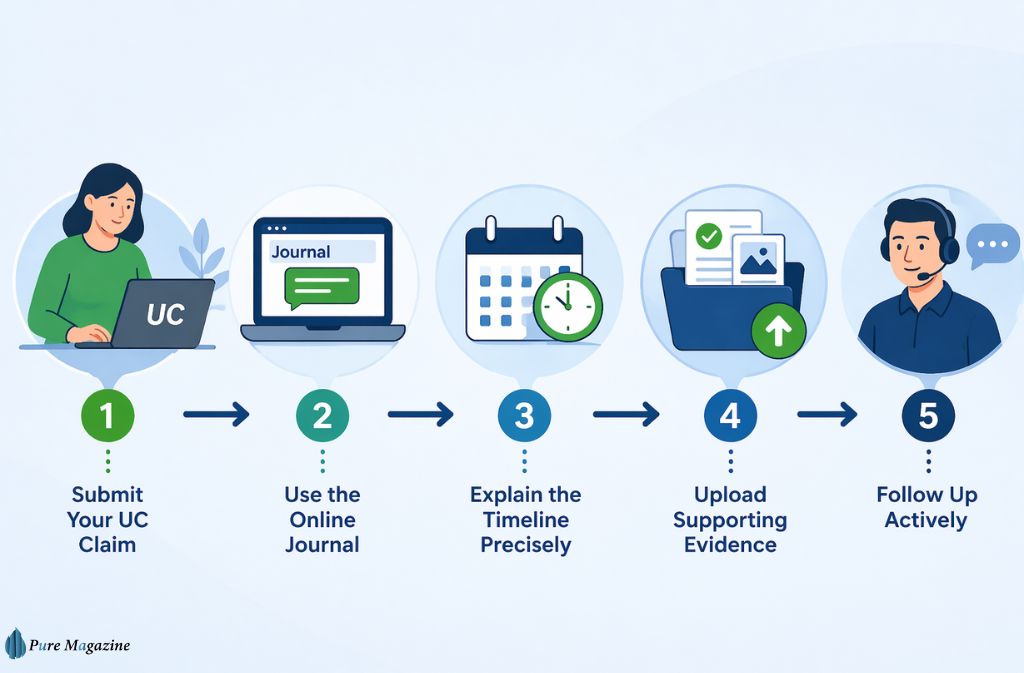
Step 1 — Submit the UC claim first. Backdating cannot be requested without an active claim. The request goes through the claim, not before it.
Step 2 — Use the online journal. The request should be made in writing through the UC online journal. A clear, specific statement works better than a vague one. Example opening: “I am requesting backdating of my Universal Credit claim due to circumstances that prevented me from applying earlier.”
Step 3 — Explain the timeline precisely. When the preventing circumstance started, when it ended, and why it stopped the claim from being submitted. Vague timelines produce vague decisions. Specific dates and a clear causal link give the Work Coach what they need to approve the request.
Step 4 — Upload supporting evidence. Evidence is the deciding factor. The request will stand or fall on whether the evidence substantiates the timeline.
Step 5 — Follow up actively. Work Coaches may ask questions before deciding. Responding promptly keeps the request from stalling.
Journal Template
“I am requesting backdating of my Universal Credit claim. [Health condition/hospitalisation / mental health crisis] prevented me from claiming on [date]. I have attached supporting evidence showing I met the eligibility criteria during this period. I would like this request to be considered under DWP backdating guidance.”
Evidence That Strengthens a Backdating Request
| Evidence Type | Source | Success Likelihood |
|---|---|---|
| Hospital admission record | NHS App export or discharge letter | Very high |
| GP or mental health referral notes | GP surgery / CMHT records | Very high |
| Support worker or social worker statement | Keyworker letter | Very high |
| Crisis team contact records | Mental health service records | High |
| Screenshot of a journal or system error | Direct screenshot with timestamp | High |
| Domestic abuse documentation | Support service reference | Very high |
The NHS App now allows users to export their health record summaries directly, which produces a clean, dated document showing hospital admissions, GP contacts, and referrals. For claimants with health-related backdating requests, this is the most straightforward evidence to obtain and the most credible to present.
Ahmed’s Situation — Why Timing Is Everything
Ahmed delayed claiming Universal Credit for four weeks after losing work because of severe depression and a subsequent hospital referral. By the time the mental health crisis had stabilised enough for him to engage with the process, four weeks had passed.
When Ahmed submitted his claim, he immediately requested backdating through his journal — not a week later, but the same day. He exported his NHS App record showing the GP referral date and the hospital contact, explained the timeline clearly in a single journal entry, and referenced the specific weeks the crisis had prevented him from acting.
His request was approved. Four weeks of backdated UC payments arrived in the following assessment period.
Ahmed’s situation repeats regularly — someone dealing with a mental health crisis who simply doesn’t have the bandwidth to navigate a digital portal during the acute period. The system allows for this, but it requires the claimant to articulate it clearly afterward. The evidence does most of the work; the framing matters too.
Common Mistakes That Get Requests Refused
Not requesting backdating at all — a significant proportion of eligible claimants simply don’t know to ask. If there was a valid reason for delayed claiming, the request costs nothing and takes minutes.
Vague explanations without specific dates weaken your case. Saying “I was unwell” sounds less convincing than saying “I went to the hospital on [date] and left on [date], and I could not use online services during that time.”
No supporting evidence — assertions without documentation rarely succeed. The evidence requirement is genuine.
Waiting too long after the claim is submitted — while there’s no absolute deadline for making the request, delay can create practical difficulties and reduce the period recoverable.
Assuming the LCWRA rate applied is correct, claimants who submitted medical evidence before April 6, 2026, but see £217.26 on their statement, should check whether transitional protection applies and raise a Mandatory Reconsideration if it does.
2026/27 Universal Credit Rates for Reference
| Element | Monthly Amount |
|---|---|
| Standard Allowance (Single 25+) | £424.90 |
| LCWRA Higher Rate | £429.80 |
| LCWRA Lower Rate (frozen to 2029/30) | £217.26 |
| Carer Element | £209.34 |
FAQs
Q. Can Universal Credit be backdated?
Q. How far back can Universal Credit be backdated?
In most cases, Universal Credit can be backdated up to 31 days before your claim date. However, certain elements—like the carer element—can be backdated for longer if the qualifying disability benefit is itself backdated. LCWRA rules may affect the rate paid, not the backdating length.
Q. What is the LCWRA payment in 2026?
As of April 2026, the LCWRA element has two rates:
- £429.80/month (higher/protected rate)
- £217.26/month (lower rate for most new claimants)
The lower rate is expected to remain frozen until 2029/30.
Q. What is the LCWRA transitional protection in 2026?
LCWRA transitional protection means that if you submitted a fit note or reported your health condition before April 6, 2026, you may still qualify for the higher rate (£429.80) even if your assessment decision happened later. If the lower rate is applied incorrectly, you can request a Mandatory Reconsideration.
Q. When does LCWRA backpay start?
LCWRA payments usually start from the fourth month after you submit your first fit note, following a three-month waiting period. Backdating your Universal Credit claim does not remove this waiting period—it still begins from the fit note date.
Q. Can the carer element be backdated more than one month?
Yes. The carer element can be backdated beyond one month if the disability benefit of the person you care for (such as PIP) is backdated. In this case, Universal Credit must align your carer element payments with that earlier award date.
Q. Does backdating Universal Credit affect the Work Allowance?
Yes. Any earnings during the backdated period are still assessed against your Work Allowance. If you were working during that time, you should include accurate income details when requesting backdating to avoid calculation errors.
Q. What evidence is needed to backdate Universal Credit?
Strong evidence improves approval chances. The most effective documents include:
- NHS App records showing treatment or referral dates
- Hospital discharge summaries
- GP or mental health referral letters
- Support worker or social worker statements
- Crisis team contact records
Clear dates and a direct explanation of how your situation prevented you from claiming earlier are essential.
Q. Do you need to request backdating or is it automatic?
You must request backdating yourself. Universal Credit is not automatically backdated, even if you were eligible earlier. Requests are reviewed individually and approved at the discretion of a Work Coach.
Q. What are the most common reasons backdating is refused?
Backdating is often refused when:
- No valid reason is provided
- Evidence is missing or unclear
- The request is made too late
- The reason does not show that you were unable to claim
Providing detailed explanations and supporting documents significantly improves success rates.
For more guides on Universal Credit, benefits, and UK personal finance, visit Pure Magazine.