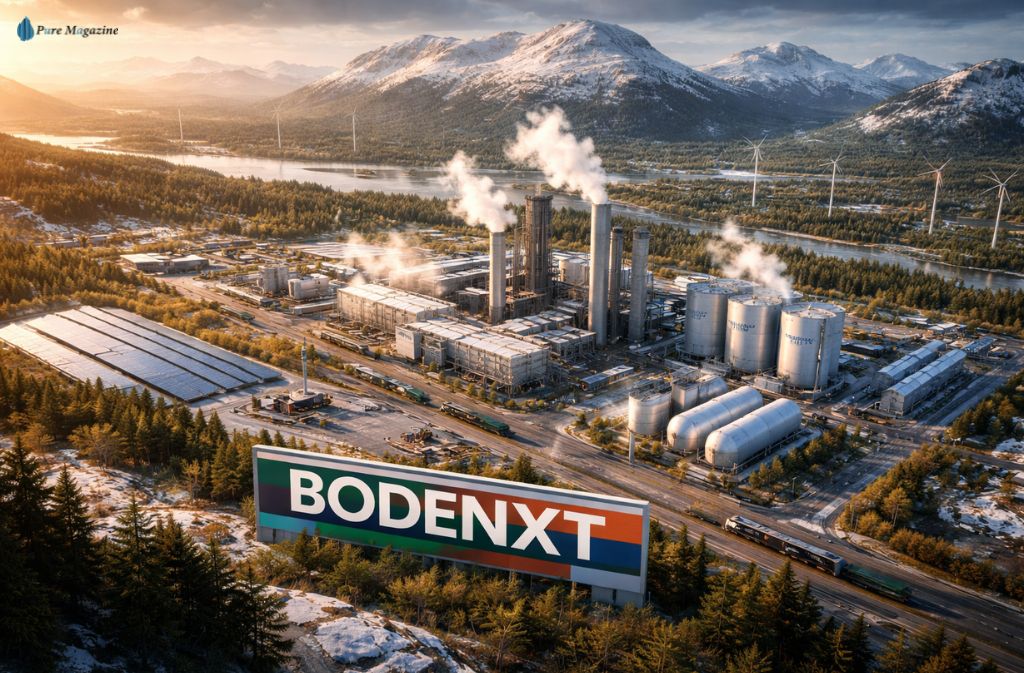
Most industrial revolutions are announced loudly. BodENXT is different. In the far north of Sweden, a convergence of green steel production, hydrogen technology, renewable energy, and defense-sector momentum is quietly rewriting what industrial transformation can look like in 2026. And the world is starting to pay attention.
BodENXT is not a company. It is not a government program in the traditional sense. It is an organized effort — a regional ecosystem — built around the city of Boden in northern Sweden, designed to attract investment, develop talent, and position the region as a serious player in the green industrial economy. If you have been following the future of sustainable growth in Europe, BodENXT deserves your full attention.
What BodENXT Actually Is — and What It Is Not
Before we go any further, let us address a common misconception. BodENXT is often described in shorthand as a startup hub or a tech park. That framing sells it short and misses the point entirely.
BodENXT is better understood as a regional transformation platform. It sits at the intersection of several major forces reshaping European industry: the urgent need to eliminate carbon emissions from heavy manufacturing, the push to localize and strengthen supply chains after years of global fragility, and the growing economic importance of northern Sweden as both an energy hub and a defense corridor.
The initiative brings together public institutions, private enterprises, academic bodies, and international investors — all working toward a coherent vision of sustainable growth rooted in place. Boden is not trying to be Stockholm. It is building something that Stockholm cannot offer: proximity to Arctic energy resources, a long military and defense heritage now being converted into economic assets, and land and infrastructure at a scale that southern European cities simply cannot match.
Green Steel, Hydrogen Technology, and the Northern Sweden Advantage
The headline anchor for BodENXT transformation story is green steel and hydrogen. This matters enormously in 2026, as the European Union tightens its carbon border adjustment mechanisms and global manufacturers face real financial consequences for failing to decarbonize their supply chains.
Sweden’s north holds a rare combination of assets: access to abundant hydroelectric and wind-powered renewable energy, proximity to iron ore deposits, and a trained industrial workforce. These conditions make it one of the few places in Europe where green steel production is not merely an aspiration but an operational reality. SSAB and H2 Green Steel have both planted significant operations in the region, and BodENXT functions, in part, as the connective tissue that helps smaller companies, logistics providers, and training programs build around these industrial anchors.
Hydrogen technology is the second pillar. Green hydrogen — produced using renewable energy through electrolysis — is central to decarbonizing sectors that electricity alone cannot easily reach: shipping, heavy transport, and certain chemical processes. Northern Sweden’s energy surplus gives it a genuine cost advantage for hydrogen production, one that BodENXT stands to translate into a cluster of businesses along the hydrogen value chain.
Also Check: Can current energy systems keep up with green tech demands?
How BodENXT Compares to Other Industrial Transformation Models
| Factor | BodENXT | Traditional Industrial Zone | Standard Tech Hub |
| Energy Source | 100% Renewable | Mixed / Fossil-heavy | Grid-dependent |
| Primary Industry | Green Steel and Hydrogen | Varies | Software / Finance |
| Job Creation Model | Local reskilling focus | External recruitment | Mainly specialist hires |
| Carbon Strategy | Net-zero by design | Retrofit approach | Offset-based |
| Location Advantage | Arctic proximity, defense links | Varies widely | Urban cluster |
The distinction matters. BodENXT is not retrofitting an old industrial zone with a green paint job. It is designing from the ground up — which creates both a harder challenge and a more durable foundation.
Job Creation, Reskilling, and the Human Side of the Transition
Green industrial transformation fails when it ignores people. This is a lesson drawn painfully from previous deindustrialization cycles in Europe and North America. BodENXT has placed significant emphasis on training programs and local job creation as core components of its model, not afterthoughts.
The initiative works with vocational institutions and universities to align curricula with the skills that new green industrial employers actually need. Welders, electricians, process engineers, and logistics coordinators are being reskilled in ways that connect directly to local demand — a distinction that separates BodENXT from regional transformation efforts that remain better on paper than in practice.
Long term, this approach matters because it addresses the sustainability of the transformation itself. An industrial cluster that imports all its skilled labor from outside the region creates economic fragility. One that develops it locally creates roots.
The Defense Dimension Nobody Is Talking About Enough
One underreported aspect of the BodENXT story is its connection to Boden’s defense heritage. The city has been home to major Swedish military installations for well over a century. As Sweden’s NATO membership reshapes defense spending and infrastructure priorities across northern Scandinavia, Boden finds itself at the intersection of military investment and civilian economic development.
Defense spending tends to create durable local employment, strengthen logistical infrastructure, and attract associated industries — from advanced manufacturing to cybersecurity to specialized supply chains. BodENXT is positioned to capture a share of this momentum by connecting defense-adjacent businesses with the broader green industrial cluster it is building.
Also Read: Steps Businesses Can Take to Transition Smoothly to Renewable Energy
Risks and Limitations: What BodENXT Still Needs to Prove
No honest analysis can skip the challenges. BodENXT’s ambitions are real, but so are the obstacles.
First, scale. The population of Northern Sweden is sparse. Attracting enough workers to fill the roles that a major green industrial cluster requires means competing with larger cities that offer lifestyle advantages. Housing, services, and connectivity all need sustained investment alongside the industrial programs.
Second, capital dependency. Large green industrial projects require patient capital — investment that accepts long timelines before generating returns. The political and economic environment of 2026 remains volatile enough that funding continuity is not guaranteed. If the EU green transition faces political headwinds, some of the capital flows underpinning BodENXT supply chains could slow.
Third, the coordination challenge. BodENXT spans multiple organizations, sectors, and interests. Keeping that alignment coherent over a decade-long transformation is genuinely hard. Many regional development initiatives have faltered not for lack of ambition, but for lack of institutional discipline over time.
Frequently Asked Questions
Q. What does BodENXT stand for?
BodENXT is a brand name for the regional development initiative centered in Boden, northern Sweden. The name signals a next-generation vision for the region industrial and economic identity, anchored in green industry, innovation, and sustainable growth.
Q. Is BodENXT connected to SSAB or H2 Green Steel?
BodENXT operates as a regional ecosystem that complements major industrial players in northern Sweden, including SSAB and H2 Green Steel. It serves as a connective platform that helps smaller businesses and training programs build around these large anchors.
Q. How does BodENXT relate to Sweden NATO membership?
Boden’s historical defense role and its proximity to NATO’s northern flank infrastructure make it a significant location as Sweden expands its defense commitments. BodENXT is positioned to attract defense-adjacent industries that benefit from this investment and the logistical infrastructure it supports.
Q. Can international companies invest in the BodENXT ecosystem?
Yes. BodENXT actively seeks international investment and partnership, particularly from companies along green steel, hydrogen, and renewable energy supply chains. The region’s combination of cheap renewable power, industrial land, and a growing skilled workforce is designed to be attractive to international capital.
Q. What makes northern Sweden better than other European regions for the green industry?
The combination is rare: surplus renewable energy at low cost, existing iron ore and industrial infrastructure, geographic space for large-scale operations, and policy alignment from both Swedish and EU levels. Few other European regions can match all of these conditions simultaneously.
Conclusion: Why BodENXT Matters Beyond Sweden
The temptation is to treat BodENXT as a local story — a Swedish city doing interesting things up near the Arctic Circle. That framing misses the bigger picture.
What BodENXT represents is a working model for how regions with industrial heritage, energy assets, and geographic disadvantages can reposition themselves for the green economy rather than simply declining into it.As Europe urgently rebuilds its industrial base on sustainable foundations, and as geopolitical and environmental pressures reshape supply chains, BodENXT’s approach matters far beyond northern Sweden.
It is not a perfect model. It faces real challenges around scale, capital, and coordination. But it is a serious one — built on genuine assets, genuine partnerships, and a long-term commitment that most regional development rhetoric never quite manages to sustain. In 2026, that seriousness is itself worth something.
BodENXT stands as proof that the green industrial transition does not have to happen only in capital cities and tech corridors. Sometimes, it starts at the edge of the Arctic.
Related: Empowering a Sustainable Future: The Rise of Renewable Energy Through Solar Innovation