Degrees are no longer earned only in classrooms.
Across industries, people build real expertise through work, volunteering, professional training, online programs, and years of hands-on problem-solving. Yet for decades, much of that learning went unrecognized by formal education systems. That disconnect created frustration—especially for working professionals asked to “start from scratch” despite proven competence.
That’s where accreditation of prior learning comes in.
Accreditation of prior learning (often shortened to APL) exists to formally recognize learning you’ve already achieved before enrolling in a qualification. When done properly, it respects experience without lowering academic standards. And as of 2026, it has become an essential part of how universities adapt to modern careers.
This guide explains what accreditation of prior learning really means, how it works step by step, who it benefits, and what to realistically expect. No policy jargon. No shortcuts. Just clear, practical guidance you can trust.
What Is Accreditation of Prior Learning?
Accreditation of prior learning (APL) is a formal academic process that evaluates knowledge and skills gained through work, experience, or prior study and may convert them into academic credit when they meet published course learning outcomes.
The key word is learning—not time spent, job titles, or seniority.
Universities assess whether what you already know matches the learning outcomes of a specific module or course. If it does, you may receive:
- Academic credit
- An exemption from a module
- Advanced standing in a program
APL does not mean bypassing assessment. It means demonstrating that learning has already occurred.
What Counts as Prior Learning?
Prior learning can come from many sources, including:
- Paid work experience
- Volunteering or community leadership
- Professional or employer-provided training
- Industry certifications
- Military service
- Prior academic study (formal or informal)
- Independent learning supported by evidence
What matters most is not where the learning happened—but whether it can be verified, explained, and mapped to academic outcomes.
Accreditation of Prior Learning vs Similar Terms
Many people encounter different terms and assume they describe different systems. In reality, these are mostly regional naming differences for the same assessment framework.
| Term | Meaning | Primary Region | Evidence Type |
|---|---|---|---|
| Accreditation of Prior Learning (APL) | Umbrella term for recognizing prior learning | UK, EU | Certified + experiential |
| Recognition of Prior Learning (RPL) | Same concept, different name | Australia, Canada | Portfolio-based |
| Accreditation of Prior Experiential Learning (APEL) | Focus on experience-based learning | UK universities | Work evidence + reflection |
| APCL | Prior certified learning | UK | Transcripts, certificates |
| PLAR / PLA | Prior learning assessment | North America | Mixed evidence |
Bottom line: these systems assess learning outcomes, not attendance.
How the Accreditation of Prior Learning Process Works
While details vary by institution, most APL applications follow the same core steps.
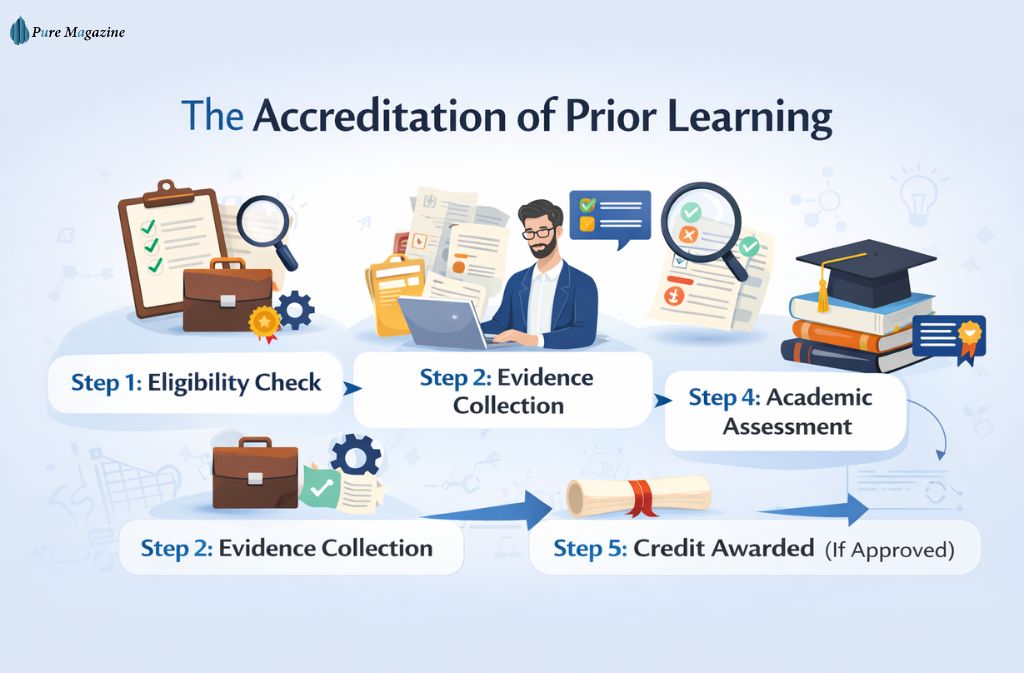
Step 1: Eligibility Check
Universities define:
- Maximum credits allowed through APL
- Time limits on learning currency (often 5–10 years)
- Which programs accept APL
Regulated professions usually apply stricter rules.
Step 2: Evidence Collection
Applicants submit evidence such as:
- Work portfolios
- Job descriptions
- Certificates and training records
- Reflective statements
- Supervisor or employer references
Evidence must show what you learned, not just what you did.
Step 3: Mapping to Learning Outcomes
Academic assessors compare your evidence against:
- Module learning outcomes
- Credit level descriptors
- Program expectations
This is the most important step—and where most applications succeed or fail.
Step 4: Academic Assessment
Outcomes may include:
- Full credit
- Partial credit
- Exemption without credit
- Rejection with feedback
Decisions are recorded formally and audited.
Step 5: Credit Awarded (If Approved)
Approved credits are applied toward your qualification, potentially reducing study time or cost.
Also Read: Which are the Best Career Paths for Psychology Graduates Taking Online Classes
Who Decides APL Outcomes? (Quality Frameworks Explained)
Accreditation of prior learning is not decided informally. Universities assess applications within national and regional quality frameworks designed to protect academic standards.
Examples include:
- United Kingdom: Most institutions align APL processes with guidance from the Quality Assurance Agency (QAA) and national frameworks such as the FHEQ or SCQF.
- European Union: Learning outcomes are often mapped to the European Qualifications Framework (EQF).
- Australia: Universities follow the Australian Qualifications Framework (AQF), which defines learning level, evidence requirements, and currency standards.
These frameworks explain why APL is structured, cautious, and evidence-driven—not flexible to the point of lowering standards.
What Accreditation of Prior Learning Is NOT
APL is frequently misunderstood. It is not:
- Buying a degree
- Automatic credit for experience
- A fast-track guarantee
- A loophole around assessment
- Recognition without evidence
If a provider promises “instant degrees” or no assessment, that is a warning sign—not a benefit.
Real-World Example: How APL Works in Practice
Scenario: A project manager with eight years of industry experience applies for a master’s degree.
APL Outcome:
- Leadership module credited
- Research methods module still required
- Program length reduced by one semester
Result: Time and tuition reduced, academic standards maintained.
This is what legitimate APL looks like.
Does Accreditation of Prior Learning Cost Money?
While APL can reduce tuition by shortening a program, some universities charge an assessment fee to review applications.
These fees:
- Cover academic evaluation time
- Are usually fixed (not per credit)
- Are often non-refundable
- Vary by institution and qualification level
Not all universities charge APL assessment fees, but where they exist, they are typically disclosed in academic policy documents.
Who Benefits Most from Accreditation of Prior Learning?
APL is particularly valuable for:
- Working professionals returning to education
- Career changers with transferable skills
- Mature students
- Migrants with overseas experience
- Nurses and healthcare professionals
- Military veterans
It allows learning to move with a person—not disappear between careers.
Common Reasons APL Applications Are Rejected
Most rejections happen for avoidable reasons:
- Evidence describes tasks, not learning
- Learning is not mapped to outcomes
- Experience is outdated (currency issue)
- No third-party verification
- Overreliance on job titles
Strong reflective statements make a measurable difference.
Also Check: Benefits of Custom Software Development for the Education Sector
Accreditation of Prior Learning in 2025–2026: What’s Changing
Recent academic frameworks across the UK, EU, and Australia show several clear trends:
- Greater acceptance of micro-credentials
- Recognition of structured online learning
- Stronger quality assurance requirements
- Clearer outcome mapping expectations
- Increased scrutiny to prevent misuse
The trend is toward more structure, not relaxed standards.
Quick Checklist: Are You a Good Candidate for APL?
✔ Relevant experience ✔ Verifiable evidence ✔ Clear learning outcomes ✔ Recent skill application ✔ Willingness to reflect on learning
If you meet at least three, APL is worth exploring.
FAQs
Q. What does accreditation of prior learning mean?
Accreditation of prior learning (APL) means formally recognizing knowledge and skills gained through work experience, training, or prior study and converting them into academic credit when they meet a course’s learning outcomes.
Q. Is accreditation of prior learning the same as RPL?
Yes. Recognition of Prior Learning (RPL) is the same assessment process as accreditation of prior learning, used under a different name in regions such as Australia, Canada, and parts of Asia.
Q. Can accreditation of prior learning shorten a degree?
Sometimes. Accreditation of prior learning can reduce the length of a degree if the assessed prior learning meets module outcomes and the institution allows credit within its maximum limits.
Q. Is accreditation of prior learning accepted internationally?
Acceptance varies. Accreditation of prior learning is recognized internationally, but approval depends on each institution’s academic policy and national qualification frameworks such as the QAA, EQF, or AQF.
Q. Does accreditation of prior learning apply to nursing and healthcare?
Yes, but with stricter rules. Accreditation of prior learning applies to nursing and healthcare programs, although evidence requirements, professional standards, and learning currency are more tightly controlled due to regulation.
Q. Is accreditation of prior learning legitimate?
Yes. Accreditation of prior learning is legitimate when it is offered by accredited universities or institutions and assessed through formal, evidence-based academic processes.
Q. What evidence is required for accreditation of prior learning?
Evidence typically includes work portfolios, certificates, reflective statements, employer references, and training records that demonstrate how prior learning meets specific academic learning outcomes.
Conclusion
Accreditation of prior learning exists for one reason: learning happens everywhere.
When applied correctly, it values experience without compromising academic credibility. It rewards demonstrated knowledge—not assumptions—and helps education systems reflect how people actually build skills today.
If you’re considering accreditation of prior learning, the next step isn’t searching for shortcuts. It’s understanding your learning and presenting it clearly, honestly, and with evidence.