


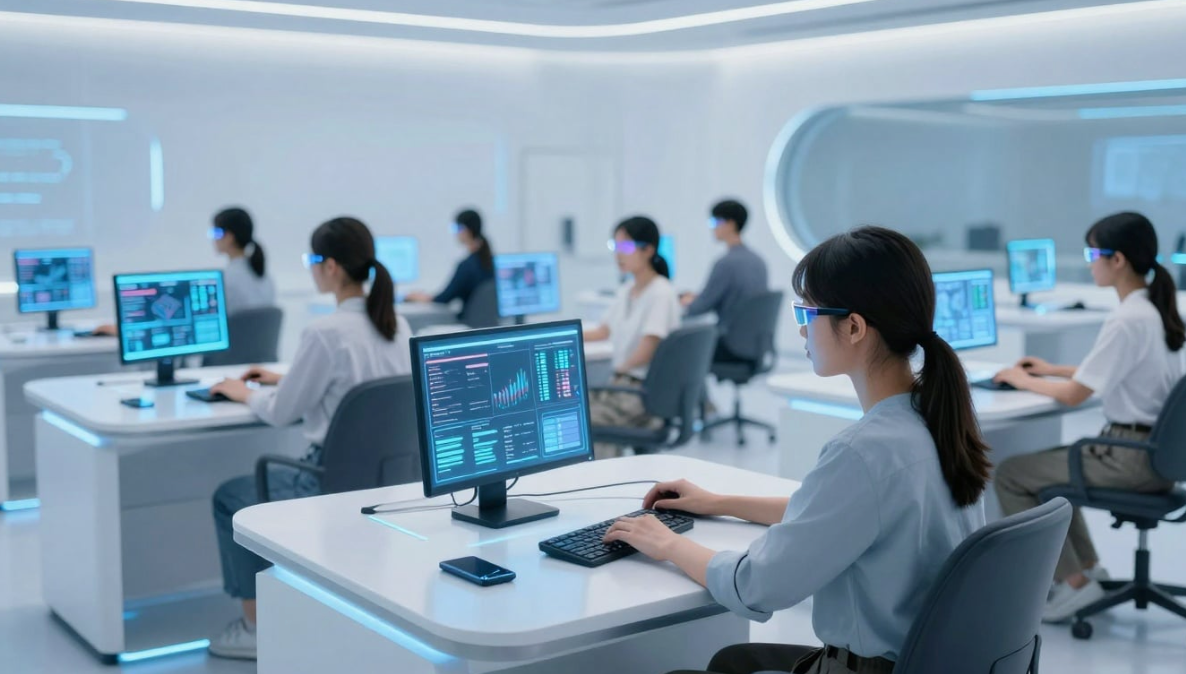
Gone are the days of filling in bubbles on paper sheets in stuffy classrooms. Today, exams happen on screens, anywhere in the world. This shift to digital assessment meets the demands of remote education and helps track student progress with real data. We see how tools like AI and virtual reality change the game. In this article, we cover key exam technology trends that make testing fairer, faster, and more accurate.
The Growing Imperative for Digital Assessment
The COVID-19 pandemic sped up the move to online tests. Schools and companies needed ways to reach students no matter where they were. Now, digital platforms offer scalability that paper can’t match. They let thousands take exams at once, without printing costs or shipping delays.
Accessibility stands out as a big win. Students with disabilities use built-in tools like text-to-speech or adjustable fonts. Remote areas gain equal footing too. These changes ensure more people can prove their skills without barriers.
Why Current Assessment Methods Are Insufficient
Old-school exams often place heavy pressure on students while offering limited support during the preparation phase. Long grading cycles delay feedback, and subjective marking can create uncertainty about performance. As academic demands increase and timelines tighten, some learners begin to look for structured support options, including discussions around whether to hire an exams helper, not as a shortcut, but as a response to systems that fail to provide timely guidance and clarity.
Traditional assessments also prioritize memorization over critical thinking and real-world application. When exams measure recall instead of understanding, students struggle to demonstrate true capability. This gap between expectations and support fuels the search for external assistance. Modern assessment technologies aim to address these flaws by delivering clearer evaluation standards, faster feedback, and more meaningful insights, reducing the need for students to seek help outside the system.
Artificial Intelligence and Machine Learning in Proctoring and Grading
AI leads the charge in making exams secure and efficient. It watches over tests and scores them without human error. These tools spot cheating early and give detailed feedback right away.
AI-Powered Remote Proctoring Solutions
AI proctoring uses cameras and software to keep an eye on test-takers. It tracks eye movements to see if someone looks away too much. The system flags odd behavior, like multiple faces in view or suspicious mouse clicks.
There are a few types. Live proctoring has a human monitor watching in real time via video. Automated versions use AI alone for quick checks. Record-and-review saves sessions for later review if needed. Tools like ProctorU or ExamSoft make this easy. They cut down on fraud while letting students test from home.
A 2023 study from the International Journal of Educational Technology found AI proctoring reduces cheating by 70% in online courses.
Automated Essay Scoring (AES) and Algorithmic Feedback
AES relies on natural language processing to read and score writing. It looks at grammar, structure, and key ideas, much like a trained reader would. No more waiting days for marks; results come in seconds.
This cuts bias since machines follow set rules. Students get tips on weak spots, like vague arguments or poor flow. Yet, some worry about creative pieces. Can AI grasp metaphors or original thoughts? Experts say it’s improving but still needs human touch for arts subjects.
Predictive Analytics for Student Performance
Machine learning digs into test data to spot patterns. It predicts who might struggle based on past quizzes or response times. Schools use this to step in early, like offering extra help before a big exam.
For example, platforms like Brightspace analyze trends across classes. If many students miss the same topic, teachers adjust lessons fast. This proactive approach boosts pass rates. One university reported a 15% drop in failures after adopting these tools.
Adaptive Testing and Personalized Learning Paths
Gone is the one-size-fits-all exam. Now, tests change based on your answers. This personalization makes assessments more precise and less stressful.
The Mechanics of Computerized Adaptive Testing (CAT)
CAT draws from item response theory, a simple stats method. It starts with medium questions. Get one right, and the next gets harder. Wrong? It dials back the difficulty.
This way, you answer fewer items but get a true skill measure. The GMAT uses CAT, cutting test time by half while keeping accuracy high. It’s like a smart quiz that knows your level.
Micro-Assessments and Continuous Feedback Loops
High-stakes tests happen once a year. Micro-assessments pop up weekly or even daily. They’re short quizzes in apps that check understanding on the spot.
These feed data to learning systems right away. A wrong answer on fractions? The app sends a quick video review. This loop keeps learning steady. Tools like Khan Academy use it to keep students engaged without burnout.
Customizing Content Delivery Based on Assessment Results
Scores do more than rank you. They unlock tailored paths. Struggle with math? Get remedial exercises. Ace it? Move to advanced challenges.
Platforms like Duolingo do this for languages. In schools, Moodle integrates results to suggest resources. This builds confidence and fills gaps fast. It’s education that adapts to you, not the other way around.
Blockchain Technology and Credential Verification
Trust matters in exams. Blockchain adds a layer of security that can’t be faked. It stores records in a way no one can alter.
Secure Issuance of Digital Certificates and Micro-credentials
Blockchain creates tamper-proof badges for skills learned. Once earned, a certificate lives on a shared ledger. Employers verify it with a quick scan, no calls needed.
Platforms like Credly use this for micro-credentials in coding or marketing. No more lost diplomas or forged claims. A 2024 report from Deloitte says blockchain cuts verification time by 90%.
Decentralized Identity Management for Test Takers
Self-sovereign identity lets you own your records. You share proof of a degree without giving full access. It’s like a digital wallet for achievements.
This simplifies job hunts or transfers. Universities like MIT test SSI for transcripts. Students control who sees what, boosting privacy.
Preventing Transcript Fraud Across Institutions
Fraud hits hard, with fake degrees costing billions yearly. Blockchain lets schools share ledgers securely. One click confirms past grades.
In Europe, projects like the European Blockchain Services Infrastructure link unis. It stops scams and speeds admissions. Real cases show fewer disputes since adoption.
Advancements in Assessment Security and Integrity
Cheating erodes trust. New tech locks down exams, whether online or in a room. It balances safety with ease.
Biometric Authentication for Identity Verification
Biometrics confirm it’s really you. Facial scans at login match your photo. Voice checks during the test spot imposters.
Fingerprint options work for in-person setups. Tools from Pearson ensure one person per session. This cuts proxy test-taking, common in high-stakes exams.
Browser Lockdown and Deep System Monitoring
Software blocks other tabs or apps during tests. It watches for copy-paste or screen shares. Respondus LockDown Browser is popular for this.
Yet, it must not frustrate users. Too strict, and honest students quit. Balance comes from clear rules and support.
Cybersecurity in Cloud-Based Assessment Platforms
Cloud storage risks hacks, but encryption helps. Data stays safe with AES-256 standards. Laws like FERPA protect student info in the US.
Platforms comply to avoid breaches. Regular audits keep things tight. In 2025, incidents dropped 40% thanks to better practices.
Immersive Technologies:VR and AR in Skill Demonstration
Hands-on skills need new ways to test. VR and AR create safe spaces to show what you know. Perfect for trades or health fields.
Virtual Reality (VR) for High-Stakes Skill Testing
VR simulates real tasks without danger. Med students practice surgery on virtual patients. Sensors track hand moves and decisions.
Objective scores come from time and accuracy. Programs like Osso VR train surgeons, with 90% better retention than books.
Augmented Reality (AR) for Contextualized Performance Assessment
AR adds digital guides to real work. Mechanics see repair steps overlaid on engines. Assessors grade speed and safety.
This fits on-site training. Tools from Microsoft HoloLens help in factories. It makes evaluations practical and scalable.
Developing Authentic Assessment Scenarios at Scale
Simulations cut costs on real equipment.Labs get pricey, but VR copies them cheap. Standards stay high with data logs.
Fields like engineering use it for bridge builds. Thousands train without waste. It’s the future for skill checks.
Conclusion
Exam technology trends now blend artificial intelligence, stronger security frameworks, and immersive tools to create assessments that reflect real understanding rather than rote memorization. As these systems evolve, students still need reliable guidance to interpret feedback, manage exam pressure, and adapt to new testing formats. Platforms like
Scholarly Help focus on supporting learners through this transition by emphasizing clarity, responsible preparation, and informed decision-making. When technology and structured academic support work together, assessments become fairer, more efficient, and better aligned with real educational outcomes.
Key Takeaways for Educators and Administrators
- Build strong tech setups to support adaptive tools.
- Train teams on privacy laws to handle data rights.
- Start small with pilots to test AI proctoring.
- Partner with platforms for blockchain credentials.
The Ethical Imperative in Technological Assessment
Tech must close gaps, not widen them. Watch for biases in AI scores. Ensure all students access these tools. Fairness keeps education strong.
Ready to update your exams? Explore these trends and lead the change. Your students will thank you.
FAQ
1. What are exam technology trends?
Exam technology trends refer to the use of digital tools like AI, adaptive testing, and secure platforms to improve how exams are delivered, graded, and evaluated.
2. How is artificial intelligence changing exams?
AI helps automate grading, monitor exam integrity, and provide faster, more objective feedback, reducing human bias and delays.
3. Are online exams as reliable as traditional exams?
When designed properly, online exams can be just as reliable, using identity verification, secure browsers, and data analysis to maintain fairness.
4. What challenges do digital exams still face?
Common challenges include privacy concerns, technical issues, and ensuring equal access for students with limited technology or internet connectivity.
5. How can students adapt to modern exam systems?
Students can adapt by becoming familiar with digital platforms, managing time effectively, and using structured academic support to understand new exam formats.
For more, visit Pure Magazine