



Financial services is the industry where the tension between operational speed and regulatory compliance is most acute and most consequential. The bank that moves too slowly loses clients to more agile competitors and misses market opportunities that have a shelf life measured in hours. The bank that moves too quickly without adequate governance creates the compliance failures that generate regulatory fines, reputational damage, and executive accountability that dwarf the operational gains that the speed was supposed to deliver.
The compliance function exists to prevent the second outcome, and in most financial services organizations, it does so by introducing controls that also impede the first. The result is a financial services team that is simultaneously too slow for business and too exposed to regulators, satisfying neither constituency fully.
The financial services organizations that have resolved this tension have done it not by reducing compliance requirements but by making compliance infrastructure fast enough that it no longer adds meaningful delay to business operations. That infrastructure is built on project management tools that embed compliance controls into the operational workflow rather than sitting alongside it as a separate, slower layer.
Governance that moves at business speed with Lark Approval
The approval cycle that takes a week is not a compliance requirement. It is a compliance failure implemented as a compliance solution. The regulatory requirement is that approval happens. The requirement is not that it takes a week. The week is an artifact of a serial approval process that was designed before parallel routing was possible and a notification infrastructure that was designed before mobile approval was possible.

- “Parallel Routing” sends compliance approvals to every required reviewer simultaneously, so the total approval time reflects the pace of the slowest single reviewer rather than the sum of every reviewer in a serial chain. A trade authorization that required four sequential approvals taking three days each now requires four parallel approvals taking three days total.
- “Conditional Branches” route different categories of transaction, product, and client action to the appropriate compliance authority automatically based on the characteristics of the request, so every activity receives the level of scrutiny that its risk profile requires without being delayed by governance controls designed for a different category of risk.
- Full approval history provides the complete, timestamped audit trail that regulatory examination requires without a separate compliance documentation step that adds time to every approval cycle. The approval record is produced automatically as a byproduct of the approval itself.
Regulatory knowledge that is always current across the team with Lark Wiki
The regulatory environment in financial services changes faster than most organizations can update their internal documentation. The compliance team that is working on a policy document that was last updated eight months ago may be applying regulatory guidance that has since been superseded, creating a compliance gap that neither the team nor the regulator will discover until the examination that follows the next major transaction.
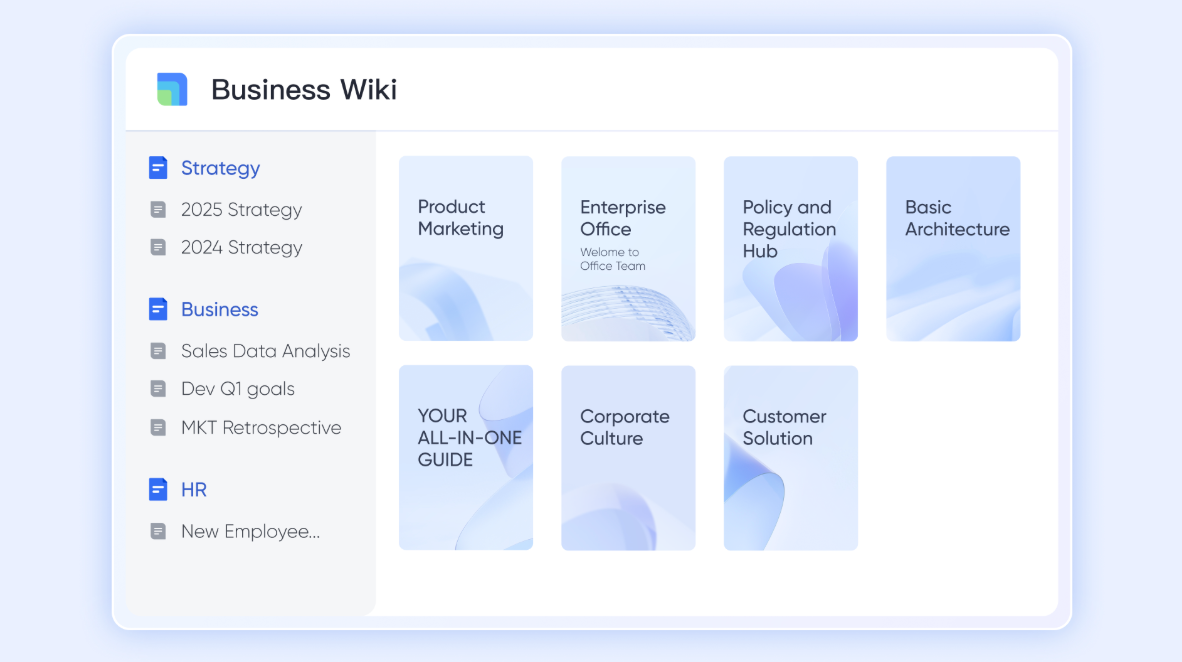
- “Advanced Search” with powerful filters allows every team member to find the current version of any regulatory policy, compliance procedure, or product governance document in seconds, so the guidance being applied to any given decision is the current guidance rather than whatever version the team member happens to have saved.
- “Permission Settings” at the user and department level ensure that the compliance knowledge base is appropriately accessible to the teams that need it while protecting sensitive internal legal opinions and regulatory correspondence that should have more restricted access.
- “Rich Content” pages can carry the full reference layer for any regulatory topic, including embedded regulatory texts, internal policy interpretations, product-specific compliance notes, and linked decision records, in a single organized location that gives every team member the complete picture rather than requiring them to assemble it from multiple sources.
Operational data that satisfies regulators without a separate reporting function with Lark Base
Regulatory reporting in financial services requires the ability to demonstrate, on demand, that every transaction, every client interaction, and every operational decision met the applicable standards at the time it occurred. The organization that can only satisfy this requirement by assembling data from multiple systems retrospectively is the organization that creates the most stress for its compliance team and the most risk for itself in examination.
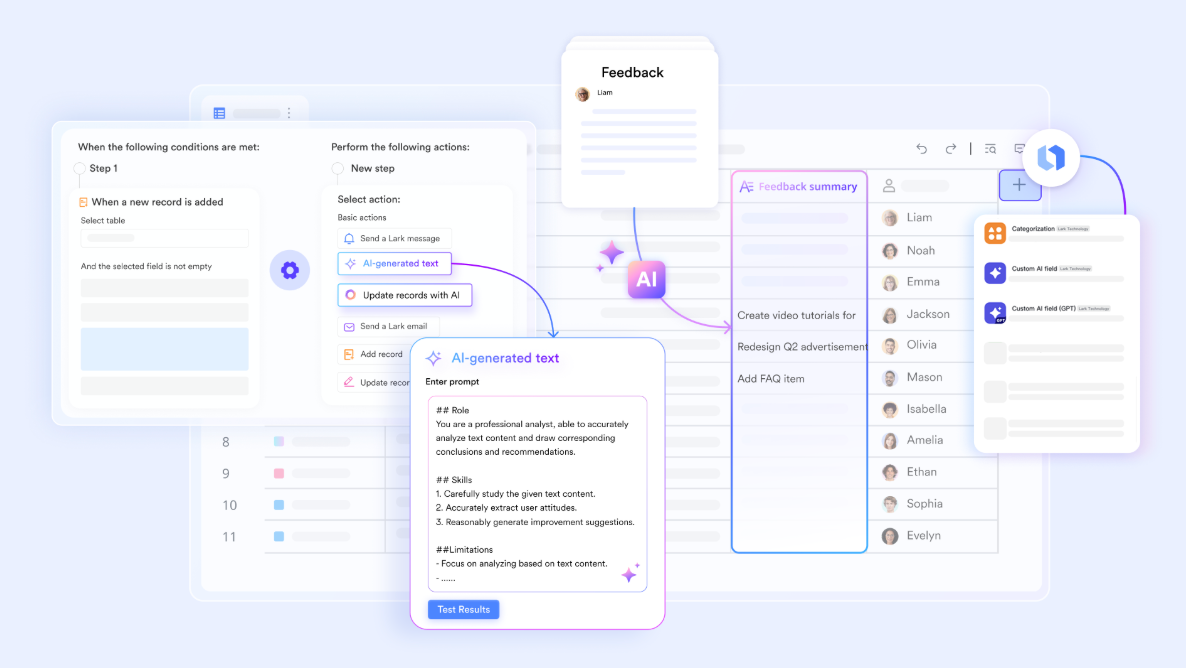
- Shared dashboards with live operational data give the compliance team a real-time view of the organization’s operational state that can be used both for proactive monitoring and for the reactive inquiries that regulatory examinations generate.
- “Granular permission by row and column” in Lark Base allows different categories of operational data to be accessible to the compliance team and the regulators they respond to while protecting client data and proprietary operational information from wider access.
- Automation workflows trigger alerts when operational data approaches a threshold that requires regulatory notification, so the compliance team can act proactively rather than discovering a reporting obligation after the notification deadline has passed.
Client communications that are compliant without being slow with Lark Docs
Financial services client communications, whether they are product disclosures, investment recommendations, or account service communications, carry regulatory requirements that impose a review and approval process before they reach the client. The review process that delays every client communication by three days is a review process that costs the organization’s client relationships without necessarily improving compliance outcomes.
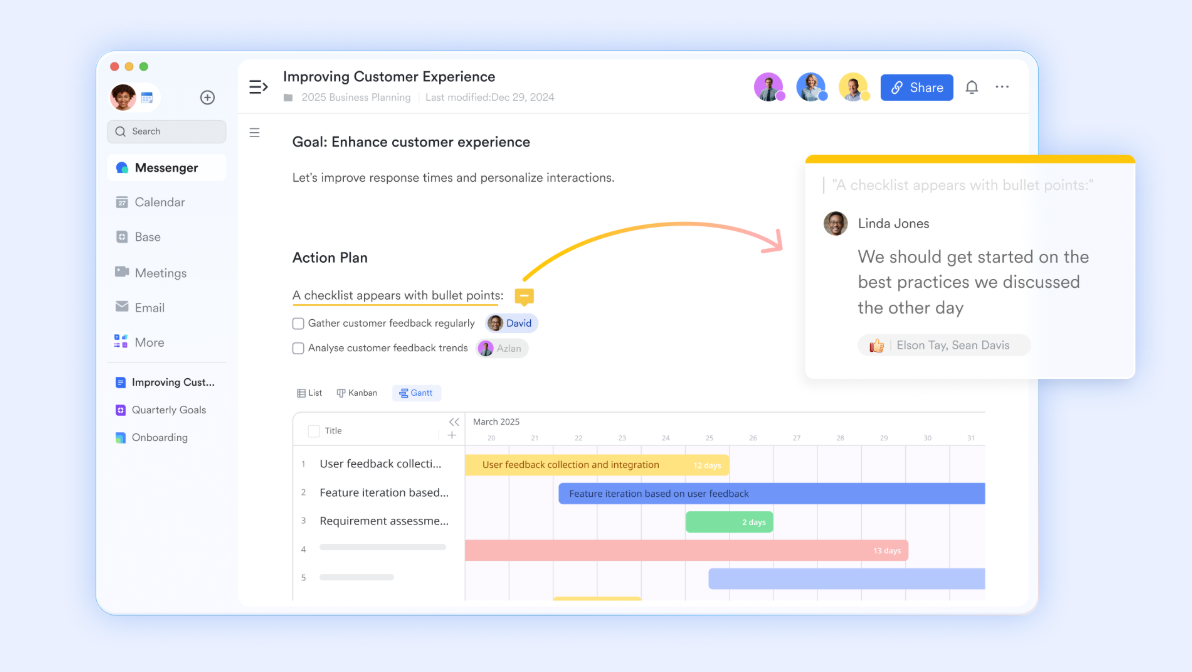
- Document templates for every category of regulated client communication ensure that the required disclosure language, the required formatting, and the required structural elements are present in every communication before the compliance review begins, reducing the review cycle to the genuinely substantive elements rather than including basic format and content compliance.
- Real-time co-editing allows the business writer and the compliance reviewer to work on the same document simultaneously rather than passing it sequentially, so the compliance review happens in parallel with the drafting of the response rather than after it is complete.
- “Version History” provides the immutable record of every change to every client communication that regulatory record-keeping requirements demand, without requiring a separate document archiving system that adds administrative overhead to every client communication cycle.
Team communication that maintains a compliance-ready record with Lark Messenger
Financial services regulators in many jurisdictions have extended their examination scope to include internal communications, recognizing that the decisions that produce compliance failures are often documented first in informal communication channels before they appear in formal records. The organization that allows business-critical communications to exist in personal messaging applications that are not subject to organizational supervision has created a regulatory exposure that the compliance function cannot address.

- Group folder organization with business-purpose communication groups creates a structured internal communication environment where every relevant team discussion is maintained in an organizational system that is subject to appropriate oversight and retention policies.
- “Chat Tabs & Threads” keep business-critical discussions, decision records, and client-related communications organized in named threads within the appropriate communication group, so the regulatory examiner who needs to review the communication record for a specific transaction or client relationship can find the relevant discussions in an organized structure rather than in an undifferentiated message history.
- “Scheduled Messages” allow management to communicate compliance guidance and regulatory updates to the team on a schedule that ensures every team member receives and can confirm receipt of the guidance, creating the documented awareness that regulatory training requirements demand.
Bonus: Why compliance slows financial services organizations that do not have to be slow
Compliance slows financial services organizations when the compliance infrastructure was designed for a different operational pace than the business requires. The serial approval chain that was adequate when transactions happened once a day is not adequate when they happen a hundred times a day. The manual documentation process that was adequate when regulatory reporting was annual is not adequate when it is continuous.
Tools like Symphony and Bloomberg Chat provide compliant communication environments for financial services but do not address the approval workflow, the knowledge management, or the operational tracking that financial services compliance also requires. Organizations evaluating Google Workspace pricing often discover that collaboration tools alone do not fully address compliance requirements. Many add separate communication compliance platforms, but operational compliance processes, such as approvals, documentation, knowledge management, and operational tracking, often remain fragmented across other tools. Lark brings these workflows into one environment, helping teams manage broader operational compliance with greater consistency.
Conclusion
Financial services teams that stay compliant without slowing down have made compliance infrastructure fast enough to match the pace of the business operations it governs. A connected set of productivity tools that routes approvals in parallel, keeps regulatory knowledge current and findable, makes operational data self-reporting, reduces communication review cycles, and maintains a compliance-ready record of all relevant team communications is how financial services organizations satisfy their regulators without conceding their competitive position to organizations that move faster at the cost of adequate governance.
For more, visit Pure Magazine
