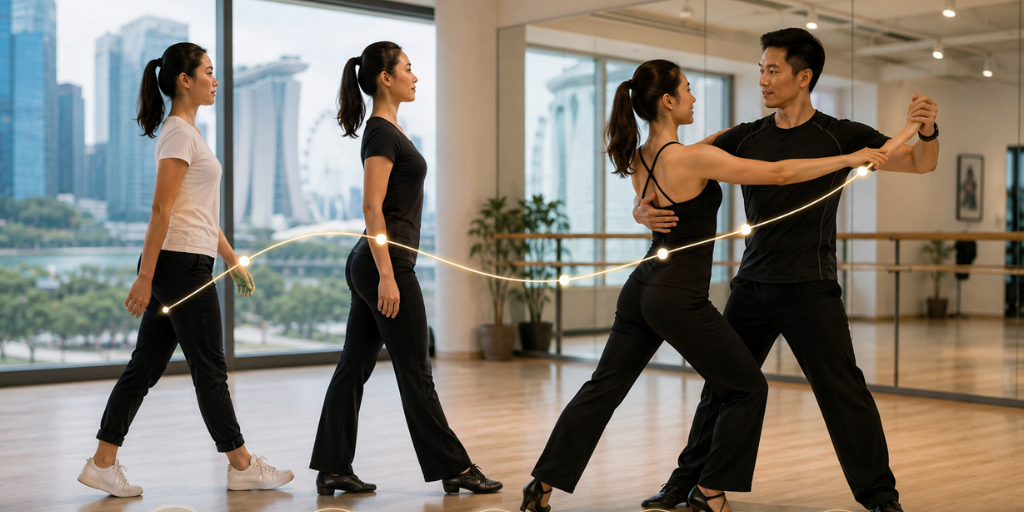
Have you ever noticed that experienced dancers seem to walk differently?
It isn’t about showing off or intentionally standing taller. Their movements simply appear more balanced, confident, and effortless. The interesting part is that this change often happens naturally after learning modern dance.
Many people join a dance studio expecting to learn choreography, improve coordination, or simply enjoy a new hobby. What surprises them is that the lessons don’t stay inside the studio. Weeks or months later, they begin noticing subtle changes in everyday activities. Walking feels smoother, climbing stairs becomes easier, and maintaining good posture requires less conscious effort.
These changes aren’t accidental. They’re the result of how dance retrains your body to move.
Modern Dance Trains Your Body Beyond the Dance Floor
Unlike repetitive gym exercises that isolate specific muscles, modern dance teaches your body to function as one connected system.
Every movement requires multiple body parts to work together. Your feet establish stability, your legs generate movement, your hips control direction, your core provides balance, and your upper body maintains alignment.
Over time, your nervous system learns these movement patterns so efficiently that they begin carrying over into everyday life.
Walking is one of the first activities where these improvements become noticeable.
Your Brain Starts Rewriting Movement Habits
Most people think posture comes from the spine alone.
In reality, posture is controlled by your brain.
Every second, your brain receives information from your muscles, joints, eyes, and inner ear to determine where your body is positioned. This process is known as proprioception, or your body’s awareness of itself in space.
When you begin learning modern dance, your brain constantly processes questions like:
- Where is my weight?
- Which foot is supporting me?
- Is my spine aligned?
- How should I shift my balance?
- Am I moving with the music?
Repeating these decisions hundreds of times during class strengthens the communication between your brain and body.
Eventually, better posture becomes automatic rather than something you consciously think about.
Better Core Stability Changes Everything
One of the biggest misconceptions about posture is that it depends entirely on your back muscles. In reality, posture starts with your core.
Your abdominal muscles, lower back, diaphragm, and pelvic muscles work together to stabilize your body before every movement.
Every step in social dance swing or other forms of modern dance challenges this system.
Unlike static exercises, dancing forces your core to stabilize while your arms and legs move independently. This creates what movement specialists call dynamic stability, the ability to stay balanced while moving.
As your core becomes stronger, walking requires less effort because your body no longer compensates for poor stability.
Your Weight Distribution Improves
Have you ever watched someone walk while leaning heavily onto one leg?
It’s surprisingly common.
Many people unknowingly place more weight on one side of their body due to muscle imbalances, previous injuries, or years of sedentary work.
Learning a Western dance style requires dancers to become aware of where every kilogram of body weight is placed.
Whether you’re practicing turns, pivots, or simple weight transfers, instructors constantly encourage balanced movement. Eventually, this awareness carries into everyday walking.
Instead of collapsing into one hip or dragging a foot, your body begins distributing weight more evenly, creating smoother and more efficient movement.
Partner Dance Classes Improve Natural Alignment
One of the hidden benefits of partner dance classes is that another person immediately exposes your posture.
Your shoulders are tense…
If your head leans too far forward…
If your spine isn’t properly aligned…
Your partner feels it almost instantly.
This immediate feedback teaches dancers to maintain better alignment—not because someone repeatedly reminds them, but because good posture creates a better connection.
That’s one reason social dance swing dancers often develop relaxed yet upright posture without consciously trying.
Your Walking Rhythm Becomes More Efficient
Walking isn’t just putting one foot in front of the other. It’s a rhythm.
Modern dance develops timing, cadence, and coordinated movement patterns between the upper and lower body.
These same movement principles influence how people naturally walk. Instead of taking uneven or rushed steps, dancers often develop:
- More consistent stride length
- Better arm swing
- Improved foot placement
- Smoother transitions between steps
The result isn’t a dramatic transformation. It’s simply more efficient movement.
Stronger Postural Muscles Reduce Fatigue
Many office workers in Singapore experience neck stiffness, rounded shoulders, and lower back discomfort after long hours at a desk.
This isn’t always caused by weak muscles.
More often, it’s caused by muscles that tire too quickly.
Modern dancing strengthens the smaller stabilizing muscles responsible for keeping the spine upright throughout the day.
These muscles include:
- Multifidus
- Transverse abdominis
- Gluteus medius
- Deep hip stabilizers
As these muscles become stronger, maintaining good posture requires less effort.
Many dancers notice they naturally sit taller, stand longer, and experience less fatigue during daily activities.
Confidence Also Changes Posture
Movement isn’t purely mechanical. Psychology plays an important role too. Studies consistently show that confident people tend to maintain a more open posture.
Dance builds confidence through repetition, achievement, and social interaction.
As dancers become more comfortable expressing themselves through movement, they often begin carrying themselves differently outside the dance studio.
The shoulders relax. The head lifts naturally. Eye contact improves. These changes aren’t choreographed. They’re reflections of growing confidence.
Why Consistency Matters More Than Intensity
Improving posture doesn’t happen after one lesson.
It develops through repetition.
Every class reinforces healthier movement patterns until they become your body’s default way of moving.
That’s one reason people who enjoy social dance swing or partner dance classes often experience lasting improvements. Unlike many exercise routines that feel repetitive, dancing combines music, creativity, and social interaction, making it easier to stay consistent over time.
And consistency is what ultimately reshapes the way your body moves.
Final Thoughts
The next time you notice someone with graceful posture and effortless movement, there’s a good chance it wasn’t developed in front of a mirror.
It was developed through thousands of small, coordinated movements that trained the brain and body to work together.
That’s one of the most fascinating aspects of modern dance. It doesn’t simply teach choreography. It teaches better movement.
Whether you’re exploring social dance swing, taking partner dance classes, or learning another western dance style, the lessons extend far beyond the dance floor. Over time, your posture improves, your balance becomes more stable, and your everyday walking begins to reflect the confidence and body awareness you’ve developed in class.
Sometimes, the biggest transformation isn’t in how you dance. It’s in how you move through life.
For more, visit Pure Magazine