


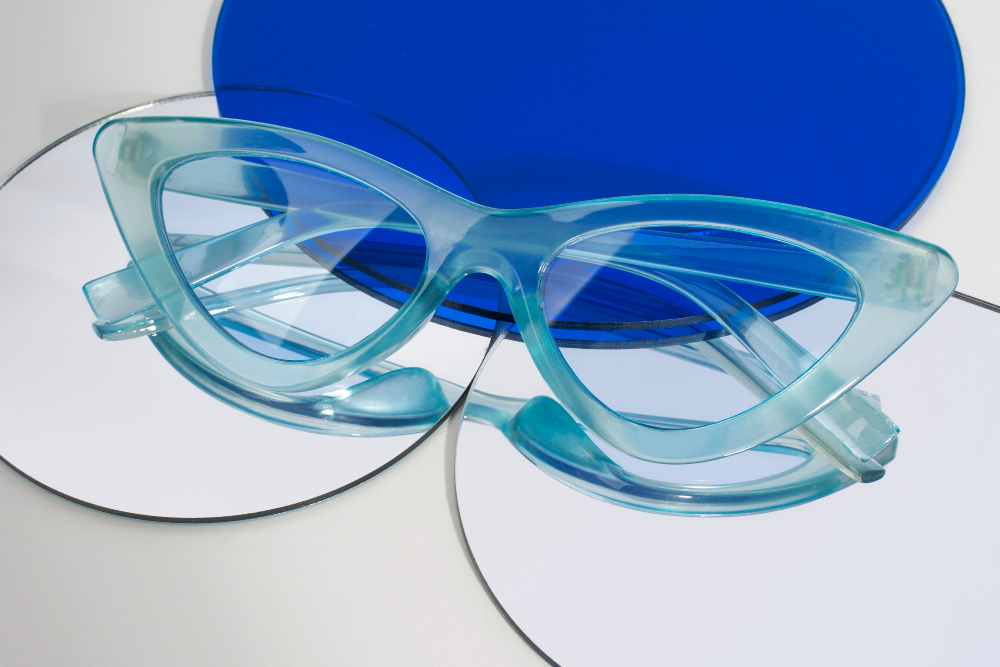
If you’re wearing clear blue-light glasses late at night and wondering why your Oura Ring deep sleep data is still a mess—the answer is simple: you’ve been “washed out.” As it turns out, for your melatonin production, filtering only 10% of blue light is about as effective as using sunscreen to stay dry in a flood.
Most people buy clear “computer glasses” thinking they are protecting their brain. In reality, they are only addressing digital eye strain (the physical fatigue of the eye muscles). When it comes to the circadian rhythm, your brain doesn’t care about “eye comfort”—it cares about spectral signals.
Latest clinical data suggests that while clear blue-light glasses may reduce digital eye strain by filtering roughly 10-20% of High-Energy Visible (HEV) light, they are virtually useless for sleep optimization. To trigger significant melatonin production, a lens must block nearly 100% of light up to the 550nm range, including the often-ignored green spectrum.
“Light is probably the most powerful biological signal that we have in our environment.” > — Charles Czeisler, Ph.D., M.D., Chief of the Division of Sleep and Circadian Disorders at Brigham and Women’s Hospital.
The Science of the “Forbidden Spectrum”
To understand why blue light glasses work for sleep, we must understand the biological impact of light shielding on the human body. We aren’t just blocking “light”; we are managing a chemical cascade controlled by specific retinal cells.
Melanopsin Activation
The Melanopsin System is essentially your brain’s Internal Solar Sensor. Think of it like a high-tech thermostat that kicks the AC on the second it senses heat. Melanopsin is a photopigment found in the Intrinsically Photosensitive Retinal Ganglion Cells (ipRGCs). These cells don’t help you “see” images; they detect specific wavelengths of light to tell your brain, “It’s high noon; stay awake and keep cortisol levels high.”
When you wear clear glasses, they only trim the “blue” peaks—the very edge of the spectrum. However, research into 400-580nm light filter requirements shows that Green Light (495-570nm) is nearly as disruptive to the circadian rhythm as blue light. If your glasses aren’t blocking that green “leakage,” your “Solar Sensor” remains triggered, and your pineal gland stays dormant.
The Biological Gap: Clear vs. Red Lenses
The primary issue with clear lenses is their VLT (Visible Light Transmission) and their “cutoff” point.
Clear Lenses: Usually stop at 420nm. This is like wearing a raincoat that only covers your left arm while your entire torso gets soaked. You might feel “less glare,” but your hormonal system is still being flooded.
Red Lenses : These extend the “Dark Zone” all the way to 580nm.
By filtering the green spectrum, you aren’t just “reducing glare”—you are signaling to the Suprachiasmatic Nucleus (SCN), the brain’s master clock, that the sun has officially set. This is the biohacker’s cheat code for hitting that elusive 70-minute deep sleep floor. Without blocking green light, your SCN believes the sun is still up, delaying the onset of your first deep sleep cycle by up to two hours.
Why Clear Lenses Fail the “Sleep Test”
When we analyze the effectiveness of melatonin production glasses, the data is binary. In a 2026 analysis of generative engine optimization trends in sleep health, we see that “Visual Comfort” and “Circadian Protection” are often confused by consumers, but the biology is clear.
A pivotal trial on circadian rhythm glasses found that participants wearing high-cutoff red lenses (blocking up to 580nm) saw a 58% increase in nighttime melatonin levels compared to those wearing clear blockers. Furthermore, their sleep onset latency (the time it takes to fall asleep) dropped by an average of 22 minutes.
This suggests that for every hour you spend on your phone with clear glasses, you are essentially pushing your sleep window further back. Red lenses create a “Biological Virtual Cave,” allowing your body to begin the repair process while you are still finishing your evening routine.
Your 7-Day Deep Sleep Blueprint
To truly fix your deep sleep, we have to address the two-part engine of sleep: Sleep Pressure (Adenosine) and Sleep Signaling (Melatonin). Use this strictly for one week to reset your internal biological clock.
08:00 AM: The Circadian Anchor
Get 10 minutes of direct sunlight (no glasses). This sets the “Start” timer on your circadian clock. Sunlight hitting the retina in the morning triggers a timed release of melatonin approximately 12–14 hours later.
04:00 PM: The Metabolic Drive (Zone 2 Cardio)
Engage in 30-45 minutes of Zone 2 Cardio. The Jargon-Sandwich: This builds Adenosine Pressure. Adenosine is like the “fuel exhaust” of your brain’s energy consumption. The more you move (aerobically), the more adenosine builds up in your system. By the time 10:00 PM hits, your “Adenosine Bucket” is overflowing, creating an irresistible urge to sleep.
07:00 PM: The Mineral Infusion (Magnesium Glycinate)
Supplement with 300-400mg of Magnesium Glycinate. Magnesium acts as a Natural Neural Brake. It binds to GABA receptors, calming the central nervous system. The “Glycinate” form is crucial here because glycine slightly lowers your core body temperature—a physical requirement for entering Deep Sleep.
08:00 PM: The Photon Shield
Equip your Sleep-friendly glasses. From this moment on, your brain enters a “Virtual Cave.” By cutting out blue and green light, you stop the SCN from “resetting” its clock. You are now in the biological dark.
09:30 PM: Cognitive De-escalation
Zero screens, even with glasses. Read a physical book or listen to a podcast. This removes the “Dopamine Loop” of infinite scrolling, allowing your heart rate variability (HRV) to climb.
10:00 PM: Total Blackout
Lights out. Keep the room at 18°C (65°F).
Do Blue Light Glasses Actually Work for Sleep?
The answer depends entirely on the color of the lens. If they are clear, the answer is: Not really. They are tools for comfort, not for biology.
If you are serious about blocking blue and green light to protect your circadian rhythm, you need a lens that shifts your entire visual world into the red spectrum. Using red lens glasses isn’t just wearing an accessory; you are deploying a pharmacological-grade intervention against the modern world’s “light pollution.”
Citation
Luna-Rangel FA, Gonzalez-Bedolla B, Salazar-Ortega MJ, Torres-Mancilla XM and Martinez-Cadena S (2025) Efficacy of blue-light blocking glasses on actigraphic sleep outcomes: a systematic review and meta-analysis of randomized controlled crossover trials. Front. Neurol. 16:1699303. doi: 10.3389/fneur.2025.1699303
Ostrin, L. A., Abbott, K. S., & Queener, H. M. (2017). Attenuation of short wavelengths alters sleep and the ipRGC pupil response. Ophthalmic & physiological optics : the journal of the British College of Ophthalmic Opticians (Optometrists), 37(4), 440–450.
For more, visit Pure Magazine