


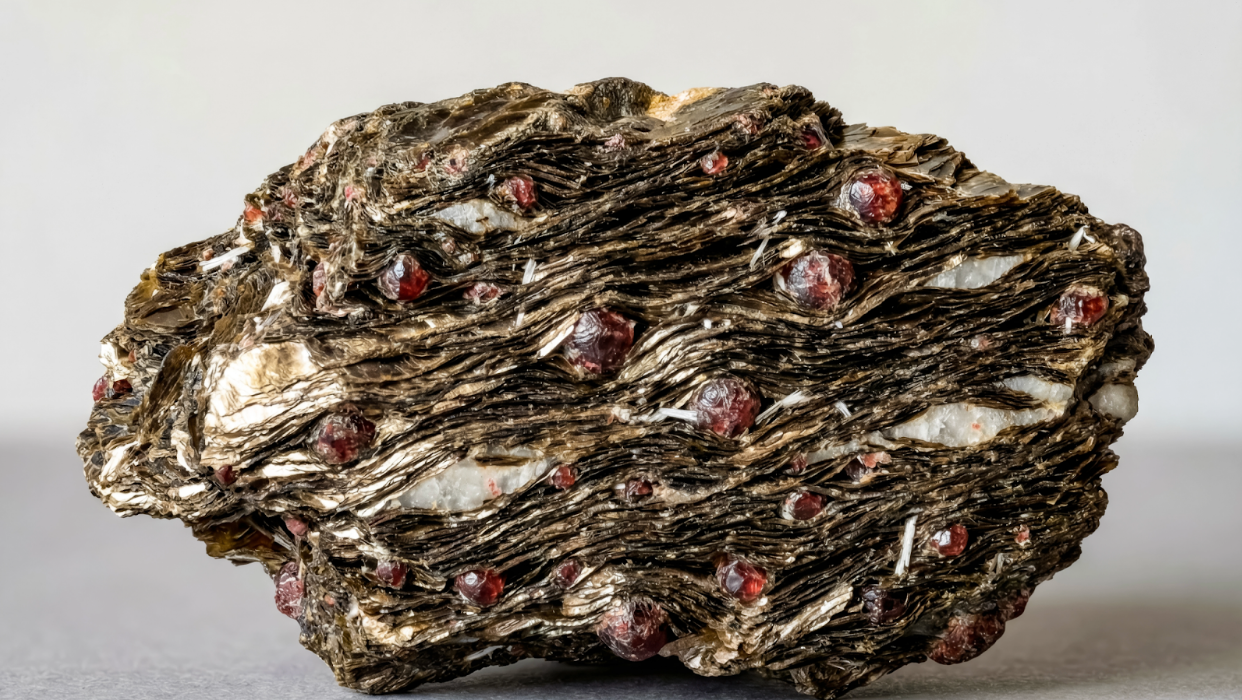
Mica is the common name for a group of naturally occurring silicate minerals known for a distinctive layered (sheet-like) crystal structure. Those layers split cleanly into thin, flexible plates (often called “splittings”), which is the root of mica’s long-standing value for electrical insulation, thermal protection, and fire-survivability in design.
For manufacturers and engineers, mica is less about geology and more about performance: it is widely recognized as a dielectric, insulating, chemically inert, and stable material that performs well under harsh service conditions, such as extreme heat, moisture exposure, and electrical stress.
Mica’s meaning in simple terms
In plain language, mica is a mineral that naturally forms like a “stack of pages.” Because the bonds between pages are weak, mica can be separated into very thin sheets while still remaining resilient and workable—an attribute tied directly to its perfect basal cleavage.
This structure helps explain why mica is used in insulation products: thin layers can provide electrical separation (dielectric behavior) while tolerating elevated temperatures that defeat many polymer-only insulators.
Where mica comes from and why structure matters
Mica is found across major rock types and is widely distributed geographically; industrially significant crystals are often associated with pegmatites, while “flake/scrap” mica is also produced as a byproduct of other mineral processing.
The same layered structure that makes mica easy to split also drives many of its engineering advantages: mica sheets are reflective/refractive, lightweight, insulating, dielectric, and chemically inert, and are noted for stability when exposed to electricity, moisture, and extreme temperatures.
The two commercially important micas: muscovite and phlogopite
While there are many other types of mica minerals, muscovite and phlogopite are consistently cited as the commercially important types for industrial applications.
- Muscovite mica is widely used in electrical/electronic applications and is often known for its strong electrical insulation (including use as a dielectric in capacitors).
- Phlogopite mica is commonly selected for applications requiring higher-temperature stability, including demanding thermal and fire-exposure conditions.
Because different applications prioritize different failure modes (electrical breakdown vs. thermal degradation vs. mechanical handling), many insulation designs treat “mica selection” as a materials-engineering decision rather than a commodity purchase.
Why mica is used for insulation: key performance properties
1) Electrical insulation (dielectric ability)
Mica’s dielectric properties make it an excellent electrical insulator in electronics and electrical equipment.
In practical terms, dielectric materials resist current flow while supporting electric fields—exactly what is required in insulation systems for motors, generators, heaters, and high-voltage components.
2) Thermal stability and high-temperature survivability
Mica’s stability under extreme conditions, and industrial references frequently highlight phlogopite’s suitability at higher temperatures than many alternative insulators.
This is why mica remains common in heaters, furnaces, thermal barriers, and fire-resistant cable constructions—applications where heat exposure is expected, and insulation integrity is mission-critical.
3) Chemical resistance and dimensional reliability
Mica sheets are chemically inert and resilient, which supports use in industrial environments where oils, moisture, and process byproducts can degrade other insulation classes.
Common mica-based insulating material forms
Most industrial buyers do not use raw crystals directly; they use standardized, manufactured forms designed for repeatability.
Sheet and block mica
“Sheet and block” mica is widely referenced for electrical and thermal insulation, including use in motors/generators, as capacitor dielectrics, and as heater windows and gauge “glass.”
Mica Laminates
Mica laminates are engineered insulation materials formed by bonding many thin mica splittings or mica paper layers together with binders or reinforcing substrates to produce dimensionally stable, machinable insulation products suitable for industrial use. They are significantly different from raw mica sheets because they are designed for applications requiring mechanical strength, heat resistance, and consistent electrical performance.
Mica paper, tapes, and fire-survivable constructions
“Mica paper” is manufactured from scrap/flake mica and is widely used in electrical and insulation applications; it can also substitute for sheet mica in some use cases.
In fire-performance designs, IEC documents describe insulation materials comprising mica paper, reinforcement layers, and resin impregnation, supplied as sheets or rolls for specific cable and safety applications.
Difference Between Mica and Laminates
Understanding the difference between raw mica and mica laminates is important for both engineers and buyers specifying insulating materials:
1. Material Form and Structure
Raw mica refers to natural mica minerals that are separated into thin sheets or splittings directly from mined crystals. These sheets already possess excellent dielectric strength, high thermal resistance, and chemical inertness by virtue of mica’s layered crystal structure.
Mica laminates, on the other hand, consist of multiple mica layers bonded together with reinforcing substrates and binders to create a consolidated engineering product. The laminating process fundamentally changes mica’s physical format from a single mineral layer to a composite insulation material with mechanical reinforcement.
2. Typical Applications
- Raw mica sheets are often used where direct insulation is required with minimal processing: windows for heaters, simple flat insulation parts, and small electrical components.
- Mica laminates dominate where the insulation component must be fabricated into a finished part or subjected to mechanical stress, high temperatures, or complex geometries — e.g., furnace liners, motor insulation components, and engineered thermal/electrical barriers.
Where mica is used: real-world applications across industries
Electrical rotating equipment (motors and generators)
Mica insulation is a common choice for motor and generator armatures, field coils, commutator cores, and separators, where electrical stress and heat cycling are routine.
Mica tapes are also commonly described as main-wall insulation in machine coils for low- and high-voltage equipment.
Power, process heat, and industrial heaters
Mica is frequently used in thermal and electrical insulation for heaters and high-temperature equipment, reflecting its stability under temperature and electrical exposure.
Fire-resistant cable systems and critical circuits
Standards within the IEC 60371 family specify requirements and test methods for insulating materials based on mica, including built-up mica materials and mica paper constructions used in specialized electrical insulation contexts (including cable-related applications).
Electronics and capacitors
Mica’s role as a dielectric in capacitors is widely documented in industry references, particularly where stable dielectric behavior is needed.
Construction materials and industrial fillers (ground mica)
Outside insulation, mica is used in joint compounds for gypsum wallboard and in paints (as a pigment extender), as well as in drilling muds to help control circulation losses.
How engineers typically choose the right mica insulation
In insulation design, selection usually comes down to the operating profile:
- Temperature requirements (continuous and peak), including hot spots and transient overloads
- Electrical stress (voltage class, partial discharge/corona environment, required dielectric margin)
- Mechanical form factor (sheet, tape, molded parts, commutator segments) and manufacturability
- Standards and qualification testing
Because mica insulation systems are often part of a larger stack-up (varnishes/resins, glass fabrics, films, adhesives), supplier support on material construction and test data can be as important as the mineral type itself.
Standards and test methods you will see in mica insulation procurement
If you buy mica-based insulating materials at scale, you will encounter formal specifications and test frameworks. The IEC 60371 series is explicitly positioned around mica-based insulation materials, including methods of test for built-up mica materials and mica paper.
Separately, many materials can substitute for mica in various applications, which is one reason qualification and standards alignment matter: mica is often chosen for a particular combination of properties, and substitutions can shift the risk profile if not engineered carefully.
Responsible sourcing and why it matters
Mica is produced globally in multiple forms, and publicly available minerals reporting tracks mica markets and substitution dynamics, reflecting its broad industrial footprint.
For insulation buyers—especially OEMs in regulated or safety-critical sectors—supplier transparency, traceability, and documentation are increasingly treated as part of “material quality,” alongside dielectric and thermal performance.
How Axim Mica fits into this landscape
Axim Mica operates as a leading manufacturer and supplier of mica-based insulating materials. Axim Mica supplies products to various industries, including aerospace, automotive, electric-vehicle, military, and transportation.
If you are selecting mica insulation, the logical next step is typically to plan on:
- Material choice, quantity, budget, and timeline.
- Design and how the product needs to be streamlined.
- By when you need the final shipment.
Summary
Mica is a family of layered silicate minerals—especially muscovite and phlogopite—valued because they can be split into thin sheets and engineered into insulation products that are dielectric, heat-tolerant, and chemically stable. In industry, mica is foundational in electrical insulation systems for motors, generators, heaters, and fire-survivable cable designs, and it also appears in construction compounds, coatings, and drilling fluids in ground form.
For more, visit Pure Magazine