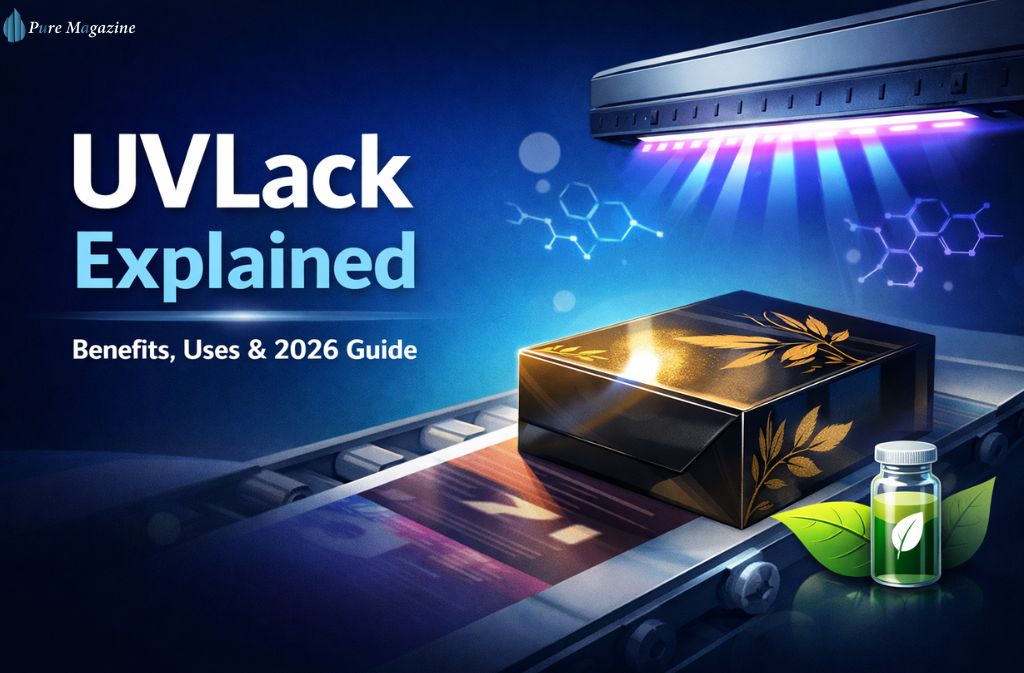
If you’ve ever picked up a premium cosmetic box, a luxury book cover, or high-end packaging with that unmistakable glossy finish, you’ve already experienced UVLack in action.
In simple terms, UVLack (UV lacquer) is a UV-curable coating that hardens instantly when exposed to ultraviolet light. Unlike traditional coatings that depend on air drying, UVLack uses a UV curing process to create a fast, durable, and visually striking surface.
But here’s the part most guides miss: UVLack isn’t just about aesthetics anymore. In 2026, it plays a critical role in production speed, material durability, and even sustainability compliance.
This guide goes deeper than definitions. You’ll learn how UVLack works, where it’s used, its advantages and disadvantages, real-world troubleshooting issues, and the latest industry shifts like UV-LED curing, oxygen inhibition challenges, and bio-based UV resins.
What is UVLack?
UVLack (UV lacquer) is a type of UV-curable coating applied to surfaces such as paper, plastic, wood, and printed materials. Once applied, it remains liquid until exposed to UV light, which triggers a chemical reaction that instantly hardens the coating.
Key characteristics:
- Activated by UV light exposure
- Forms a protective layer
- Provides high gloss or matte finishes
- Used widely in printing and packaging
- Offers strong surface protection
👉 In practice, UVLack is used to enhance both visual appeal and durability.
How UVLack Works (UV Curing Process Explained)
The effectiveness of UVLack comes from its curing process.
Step-by-step process:
- Application
- The liquid UV coating is applied to a surface
- UV Exposure
- The material passes under UV lamps
- Instant Reaction
- UV light triggers polymerization
- Hardening
- The coating becomes solid instantly
👉 This process is what makes UVLack so powerful:
- No waiting for drying
- No solvent evaporation
- Immediate production flow
UVLack Tech in 2026: UV-LED vs Mercury Lamps
The industry is rapidly evolving.
UV-LED curing (Modern standard):
- Wavelength: 385–405 nm
- Energy-efficient (up to 70% savings)
- Produces less heat
- Instant on/off
- Longer lifespan
Mercury vapor systems:
- Higher energy consumption
- Generate heat
- Require frequent maintenance
👉 In 2026, UV-LED curing dominates due to sustainability and efficiency benefits.
Benefits of UVLack
1. Fast Curing & Production Speed
- Instant curing improves workflow efficiency
- Ideal for high-volume production
2. High Gloss Finish
- Enhances colors and depth
- Provides a premium, visually appealing surface
3. Strong Surface Protection
- Scratch-resistant
- Moisture-resistant
- Long-lasting durability
4. Improved Aesthetic Quality
- Adds richness and depth to printed materials
- Widely used in luxury branding
5. Lower Environmental Impact (Relative)
- Reduced VOC emissions compared to solvent coatings
- Works well with modern compliance standards
Disadvantages of UVLack (Important Reality Check)
UVLack isn’t perfect, and professionals must understand its limitations.
Key disadvantages:
- Requires UV curing equipment
- Higher initial setup cost
- Limited flexibility on certain materials
- Can be difficult to recycle (de-inking challenges)
- Risk of oxygen inhibition during curing
- May crack on foldable materials if not applied correctly
UVLack vs Other Coatings (2026 Comparison)
| Feature | UVLack | Aqueous (AQ) Coating | Traditional Varnish |
|---|---|---|---|
| Drying Method | UV curing | Water evaporation | Air drying |
| Speed | Instant | Medium | Slow |
| Finish | High gloss | Moderate | Variable |
| Durability | High | Medium | Low–Medium |
| Eco Impact | Low VOC | Very low VOC | Moderate |
| Recycling | Harder | Easy | Moderate |
| Best Use | Premium packaging | General printing | Budget prints |
👉 This comparison reflects real-world decision-making in 2026.
Common Applications of UVLack
Printing & Packaging
- Brochures, magazines, luxury packaging
- Enhances visual appeal and durability
Furniture & Wood Finishing
- Scratch-resistant coating
- Long-lasting surface protection
Electronics & Plastics
- Protective coatings for components
- Resistance to wear and environmental damage
Branding & Marketing Materials
- Adds premium look and feel
- Improves customer perception
UVLack in Real Production: Troubleshooting Issues
1. Oxygen Inhibition (Sticky Surface)
Problem: Surface stays tacky
Cause: Oxygen interferes with curing
Solution:
- Use nitrogen inerting
- Increase UV intensity
- Optimize formulation
2. Pinholing / Fish Eyes
Problem: Tiny holes in coating
Cause: Surface contamination (oil, dust, silicone)
Solution:
- Clean surface thoroughly
- Use anti-contamination additives
3. Brittleness & Cracking
Problem: Coating cracks when folded
Cause: Over-curing or rigid formulation
Solution:
- Reduce UV exposure
- Use flexible UV resins
- Pre-score folding areas
4. Poor Adhesion
Problem: Coating peels off
Cause: Surface incompatibility
Solution:
- Use primers
- Apply surface treatments
- Match coating to substrate
UVLack on Difficult Substrates
Some materials require extra care:
Challenging surfaces:
- Recycled paper
- Metallic foils
- Low-energy plastics
Solutions:
- Corona treatment
- Adhesion promoters
- Adjusted curing intensity
👉 This is especially important in premium packaging and cosmetics industries.
Sustainability & Compliance (2026 Perspective)
UVLack aligns with modern environmental standards, but with nuance.
Key compliance factors:
- 🌱 Low VOC emissions
- 🌱 EU Ecolabel for coatings
- 🌱 SCAQMD Rule 1113 (VOC limits)
Important insight:
- ✔ Reduces emissions
- ❗ But can complicate recycling due to coating adhesion
👉 Sustainability is about balance—not perfection.
Bio-Based UVLack: The Future
The industry is shifting toward bio-based UV resins.
What’s changing:
- Moving from petroleum-based materials
- Using renewable photoinitiators
- Reducing environmental impact
👉 This is one of the biggest trends shaping UV coatings in 2026.
Expert Tips for Better UVLack Results
- Control UV exposure carefully
- Always clean the surface before application
- Use proper substrate preparation
- Adjust coating thickness based on material
- Test on small batches before full production
Common Mistakes to Avoid
- Over-curing (causes cracking)
- Ignoring surface contamination
- Using incorrect UV wavelength
- Skipping pre-treatment steps
- Applying too thick a coating layer
UVLack Decision Framework
Ask yourself:
- Do you need high-speed production?
- Is a high-gloss finish important?
- Are you working at an industrial scale?
- Do you have UV curing equipment?
👉 If yes → UVLack is a strong choice
👉 If no → consider aqueous or traditional coatings
FAQs
Q. What is UVLack used for?
UVLack is used as a UV-curable coating in industries like printing, packaging, furniture, and industrial manufacturing. It forms a protective layer that improves surface durability, scratch resistance, and visual appearance, especially in high-gloss finishes used for premium packaging and branding.
Q. Is UV coating eco-friendly?
UV coatings are considered partially eco-friendly because they emit low levels of VOCs (volatile organic compounds) and reduce energy consumption, especially with UV-LED curing. However, they can be more difficult to recycle since the coating may interfere with de-inking processes during paper recycling.
Q. What is oxygen inhibition in UVLack?
Oxygen inhibition is a curing issue where oxygen in the air prevents the UV coating from fully hardening. This can result in a sticky or tacky surface. It is commonly solved using nitrogen inerting systems, stronger UV exposure, or specially formulated coatings designed to minimize oxygen interference.
Q. What is the difference between UVLack and traditional coatings?
The main difference is the curing method. UVLack cures instantly using ultraviolet light, while traditional coatings rely on air drying or solvent evaporation, which takes much longer. UVLack also provides a higher gloss finish, better durability, and faster production speed compared to most traditional coatings.
Q. Why does UVLack crack when folded?
UVLack can crack when folded because the coating becomes rigid after curing, especially if it is applied too thick. To prevent this, professionals use pre-scoring on heavy materials or apply flexible UV formulations designed to withstand bending without cracking.
Q. What is the best UV curing wavelength for UVLack?
The most effective UV curing systems today use UV-LED wavelengths between 385–405 nm. This range provides efficient curing, lower heat output, and better energy efficiency, making it the preferred standard in modern UV coating systems.
Conclusion
UVLack (UV lacquer) is more than just a coating—it’s a high-performance surface technology that drives modern printing, packaging, and manufacturing.
It delivers:
- Instant curing through UV light
- Strong surface protection
- Premium visual quality
- High production efficiency
But it also requires understanding:
- UV-LED systems
- Oxygen inhibition challenges
- Substrate compatibility
- Sustainability trade-offs
In 2026, success with UVLack comes down to using the right system for the right application.
For more, visit Pure Magazine