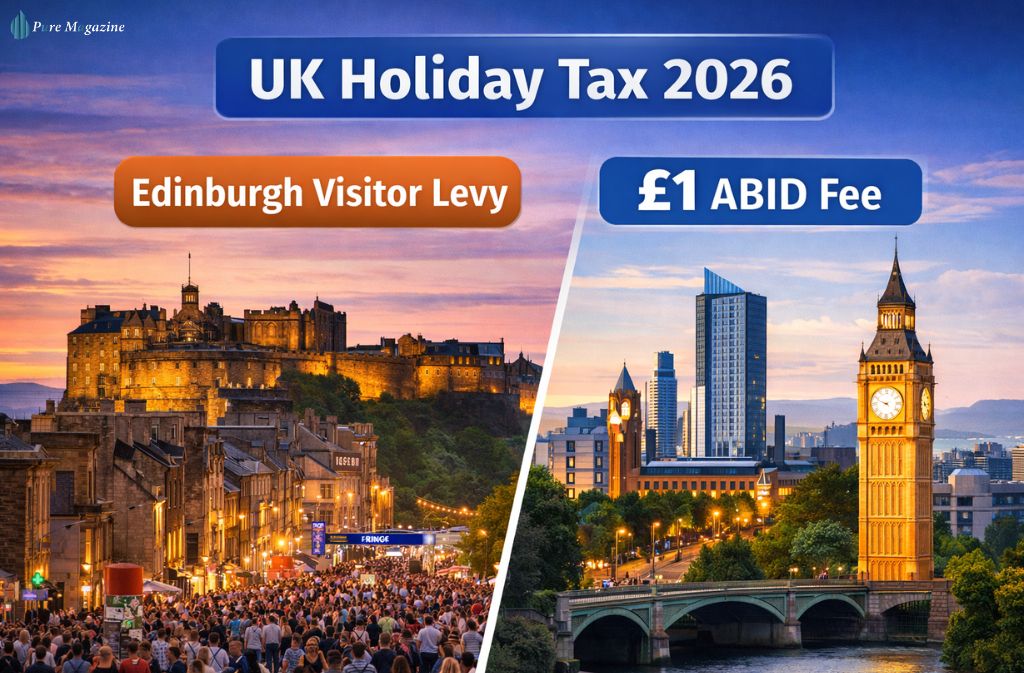
The UK’s first major statutory holiday tax is no longer theoretical. From 24 July 2026, the Edinburgh Visitor Levy goes live — a 5% charge on overnight accommodation, capped at five nights. And that’s just the start.
At the same time:
- Manchester already operates a £1-per-room ABID charge
- Wales is in a mandatory visitor registration phase ahead of a proposed 2027 levy
- London is consulting on options
- Other councils are watching closely
If you’re travelling — or running a B&B — 2026 is the year details matter. This guide explains the Edinburgh Visitor Levy July 2026, the “double tax” reality in Manchester, Wales registration deadlines, exemptions, and the booking-window fine print most news sites skip.
Edinburgh Confirmed: UK Visitor Levy Rates & 2026 Launch Dates
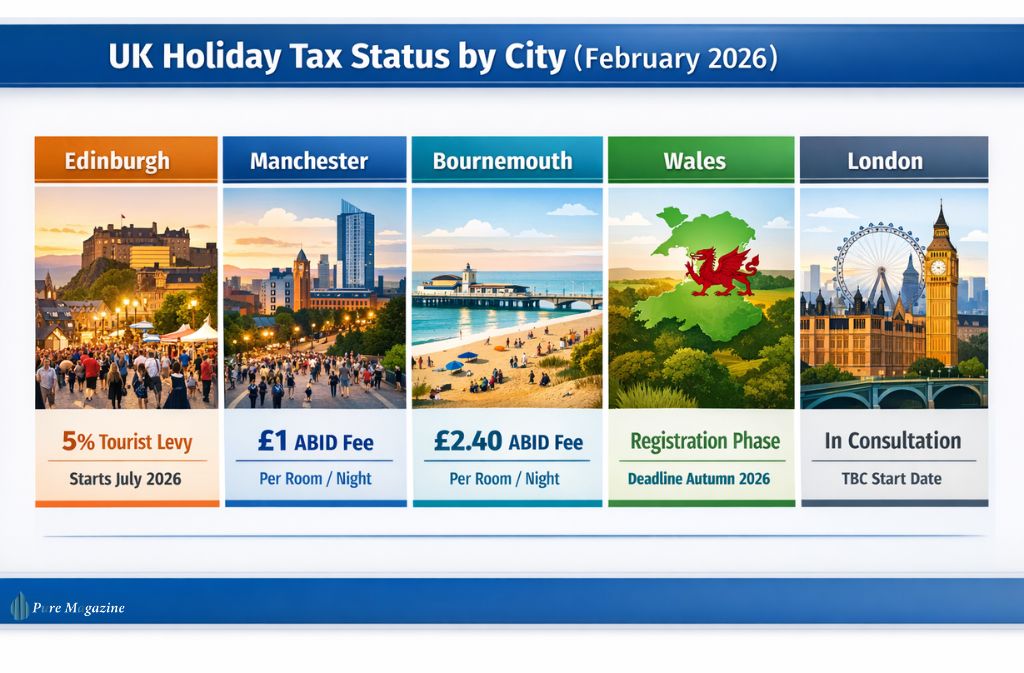
| Location | Status (Feb 2026) | Rate / Amount | Launch Date |
|---|---|---|---|
| Edinburgh | Live / Confirmed | 5% of room cost (cap 5 nights) | 24 July 2026 |
| Manchester | Active (ABID) | £1 per room per night | Since 2023 |
| Bournemouth | Active (ABID) | £2.40 per room per night | Since 2024 |
| Wales | Registration Phase | £0.75–£1.30 (est) | April 2027 (est) |
| London | Consultation | £2–£5 (est) | 2027+ (TBC) |
Scotland’s legislation was passed by the Scottish Parliament, allowing councils to introduce a visitor levy. Edinburgh is the first major UK city to activate it.
Edinburgh Visitor Levy July 2026: What You Need to Know
This is the UK’s first large-scale statutory tourist tax.
The basics
- Rate: 5% of the accommodation cost
- Cap: Maximum of 5 nights
- Start date: 24 July 2026
- Applies to: Hotels, B&Bs, self-catering, short-term lets
As confirmed on the City of Edinburgh Council’s official Visitor Levy page, the levy applies to all paid overnight accommodation within the City of Edinburgh Council boundary — including businesses operating below the VAT threshold — and will be charged at the same rate every day of the year, indefinitely.
The “Fringe Effect”
If you’re booking a boutique stay on the Royal Mile for the August 2026 Fringe Festival, expect a 5% surcharge to appear at checkout. The levy is designed to help the city cope with the 500,000+ visitors who descend during festival season — funding infrastructure, cleansing services, and public facilities.
This isn’t random revenue raising. It’s targeted at peak visitor pressure.
⚠️ Self-Catering Warning: The Cleaning Fee Trap
Many Airbnb guests assume the cleaning fee is exempt from the levy. In 2026, councils are clarifying that if the cleaning fee is mandatory and bundled into the accommodation cost, it is often considered part of the “accommodation cost” and taxed. Always check your invoice breakdown — if the cleaning fee appears as a separate line item, the 5% levy should apply only to the room rate. If it’s rolled in, you may be charged 5% on the total.
The Booking Window Rule (The Detail Most People Miss)
🔑 The October 1st Rule — The Gold Standard for Early Birds
This is the most important detail for anyone who booked Edinburgh accommodation in advance.
As confirmed by Edinburgh City Council’s official levy declaration, any booking made on or after 1 October 2025 for a stay on or after 24 July 2026 is subject to the levy — no exceptions. Stays booked and paid for (in part or in full) before 1 October 2025 are completely exempt.
What this means for you:
- Booked before 1 October 2025 for a post-July 2026 stay? You are exempt. Check your confirmation date.
- Booked on or after 1 October 2025? The 5% levy applies. Assume it will appear at checkout or on your final invoice.
- Booking platforms may update pricing automatically closer to travel.
Always check the final invoice — not just the original quote.
Manchester ABID vs Visitor Levy: The “Double Tax” Question
Manchester already operates the Accommodation Business Improvement District (ABID) charge.
What is ABID?
- £1 per room per night
- Applies to city-centre hotels
- Funds local tourism promotion
The key issue: If Greater Manchester’s mayor introduces a statutory visitor levy in future, visitors could technically face £1 ABID plus a potential additional mayoral levy.
This “double tax” scenario is under debate. No second levy is active yet — but consultations matter.
| City | ABID | Statutory Levy | Combined Possible? |
|---|---|---|---|
| Manchester | Yes | Not yet | Potentially |
| Edinburgh | No ABID | Yes (5%) | No |
This is one of the most searched emerging topics for 2026.
Wales Visitor Registration 2026: What It Means
Wales isn’t charging a levy yet — but it’s in the mandatory registration phase.
As confirmed by GOV.Wales official visitor levy guidance for accommodation providers, the Visitor Accommodation (Register and Levy) Etc. (Wales) Act 2025 received Royal Assent on 18 September 2025. Registration opens in autumn 2026 and is mandatory for all providers — even if their council doesn’t charge a levy.
Under proposals:
- All accommodation providers must register by Autumn 2026
- Applies even if their council doesn’t charge a levy immediately
- Estimated future rate: £0.75 per person per night (campsites/hostels) or £1.30 per person per night (all other accommodation)
- Potential launch: April 2027 at the earliest
For travellers, nothing changes yet. For providers, everything does.
Provider’s Corner: Welsh B&B Owners, Read This
If you operate in Wales, you must register your property under the new system. Late registration may trigger penalties — and failing to register is a legal breach, not just an administrative oversight.
Even if your council hasn’t adopted a levy, registration is mandatory.
✅ Wales Provider Compliance Checklist (Autumn 2026 Portal)
Before the registration portal opens, prepare the following — all are required fields as confirmed by the Welsh Revenue Authority:
- ✔ Trading name of your accommodation
- ✔ Legal name of the registered owner or operator
- ✔ Maximum guest capacity of the property
- ✔ Companies House number (if applicable — for limited company operators)
- ✔ Property address within Wales
- ✔ Type of accommodation (hotel, B&B, self-catering, campsite, hostel, etc.)
- ✔ Contact details for the responsible person
Registration is free via the Welsh Revenue Authority. Start gathering this information now — the autumn 2026 window will move fast, and penalty risk begins immediately after the deadline.
This is a major compliance gap many small operators are unaware of.
Exemptions: Who Doesn’t Pay?
Exemptions vary by council.
For example, proposals in places like Stirling (expected from 2027) include exemptions for residents of the council area, potentially long-term stays, and certain emergency accommodation.
Under the Wales Act, under-18s are exempt when staying in campsites or shared rooms (hostels/dormitories), stays longer than 31 nights are exempt, and emergency or temporary housing arranged by a local authority is also exempt.
Always check the local authority guidance.
Why Are Councils Introducing a Holiday Tax?
Supporters argue it drives growth and investment, helps local government fund services, supports thriving communities, and manages rising visitor numbers.
Opponents argue “Holidays are for relaxing, not taxing,” and that it risks hurting domestic tourism and making UK breaks less competitive than Europe.
The House of Commons Library notes that international impacts are typically modest — but politically sensitive. For the broader context of how UK councils are using new tax-raising powers to plug funding gaps, understanding how council tax funding pressures are building across local authorities helps explain why visitor levies are gaining political momentum.
Real-World Cost Example (2026 Fringe Stay)
You book: 2 adults, 4 nights, £220 per night boutique hotel.
Total accommodation: £880. Levy at 5%: £44.
Not huge — but noticeable.
If staying 7 nights, the levy still caps at 5 nights. An after-tax calculator won’t cover visitor levies directly — but for self-employed accommodation providers calculating how levy income affects their taxable profit, understanding net take-home after all deductions is a useful parallel exercise.
London Tourist Tax Consultation: What’s Likely?
London remains in consultation. Early discussions suggest a flat fee model (£2–£5 per night), possibly ringfenced for tourism infrastructure. No confirmed start date.
2026 Trends & What Happens Next
Expect more councils exploring statutory powers, greater transparency on booking platforms, clearer line items labelled “Visitor Levy,” and political debate ahead of 2027 expansion.
This isn’t becoming a nationwide holiday tax overnight. It’s evolving city by city.
Quick Traveller Checklist
Before you book:
- Check the city’s levy status
- Review the booking breakdown
- Look for per person vs per room charges
- Confirm cap limits
- Ask if exemptions apply
- Check whether your cleaning fee is bundled into the accommodation cost
- Verify your booking date — October 1, 2025 is the Edinburgh cut-off
FAQs
Q. When does the Edinburgh Visitor Levy start?
The Edinburgh Visitor Levy begins on 24 July 2026 and charges 5% of accommodation cost, capped at five nights. As confirmed by the City of Edinburgh Council, it applies to all paid overnight accommodation within the council boundary, year-round, indefinitely.
Q. Is Manchester charging a tourist tax?
Manchester charges a £1 per room per night ABID fee. A separate statutory visitor levy has not yet been introduced.
Q. Do I pay the Edinburgh levy if I booked before 2026?
It depends on when you booked. Stays booked and paid for (in part or in full) before 1 October 2025 are exempt — even if the stay is after 24 July 2026. Any booking made on or after 1 October 2025 for a post-July 2026 stay is subject to the 5% levy.
Q. What is Wales Visitor Registration 2026?
All Welsh accommodation providers must register with the Welsh Revenue Authority by Autumn 2026, ahead of a potential visitor levy launch from April 2027. As confirmed by GOV.Wales, registration is mandatory even if your local council does not introduce a levy. Failure to register carries penalty risk.
Q. Is there a London tourist tax?
London is currently consulting. No levy has been confirmed as of February 2026.
Conclusion
The UK’s first large-scale holiday tax begins in Edinburgh in July 2026. Manchester already charges ABID. Wales requires registration ahead of a 2027 rollout. London is consulting.
Three key takeaways: Edinburgh’s 5% levy is confirmed and capped at five nights, Manchester visitors could face layered charges in future, and Wales providers must register by Autumn 2026.
Check your booking, especially for post–July 2026 stays. The era of UK visitor levies has officially begun.
Strategy without financial literacy is just aesthetics — Pure Magazine bridges the gap for founders, freelancers, and creative businesses in 2026.