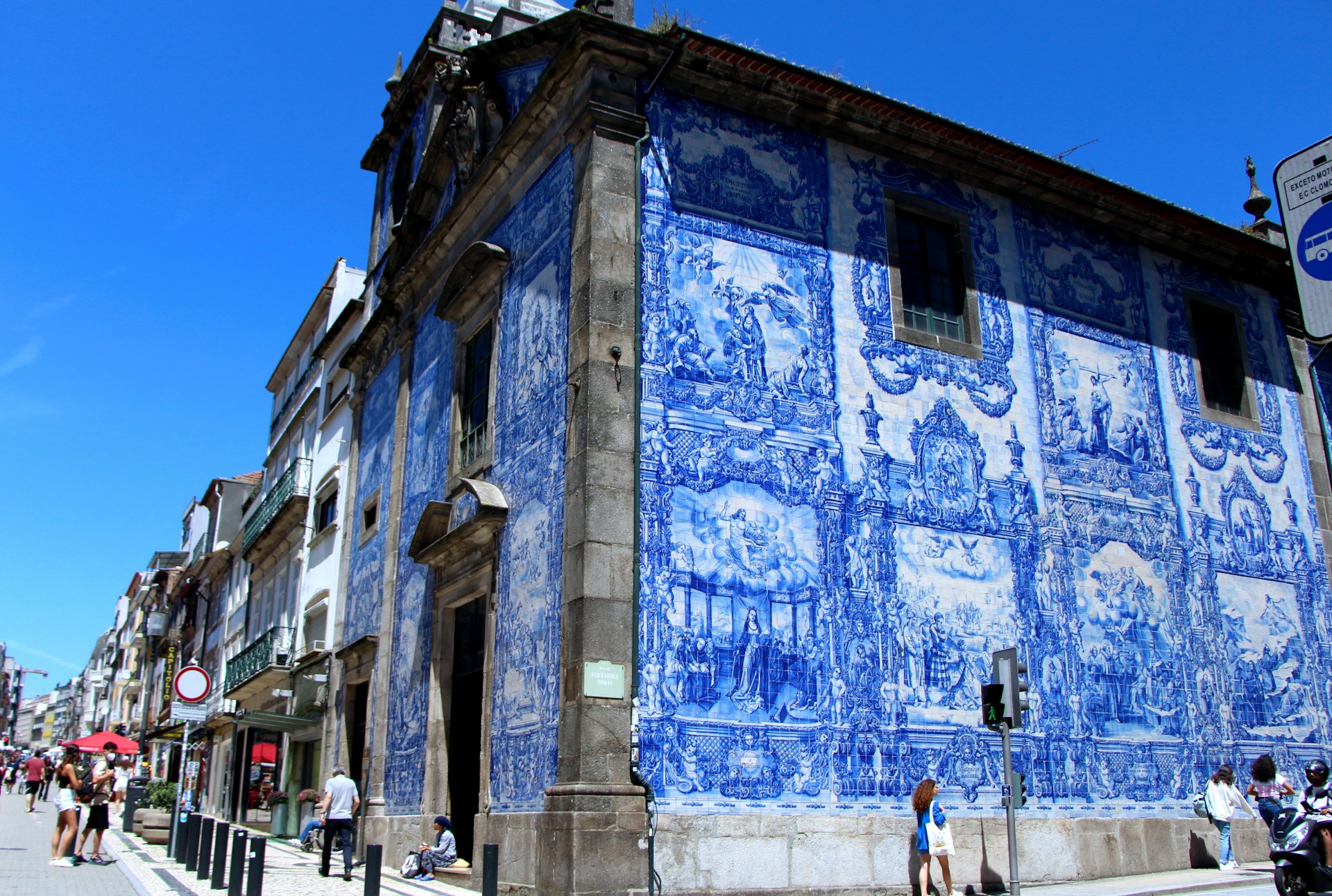
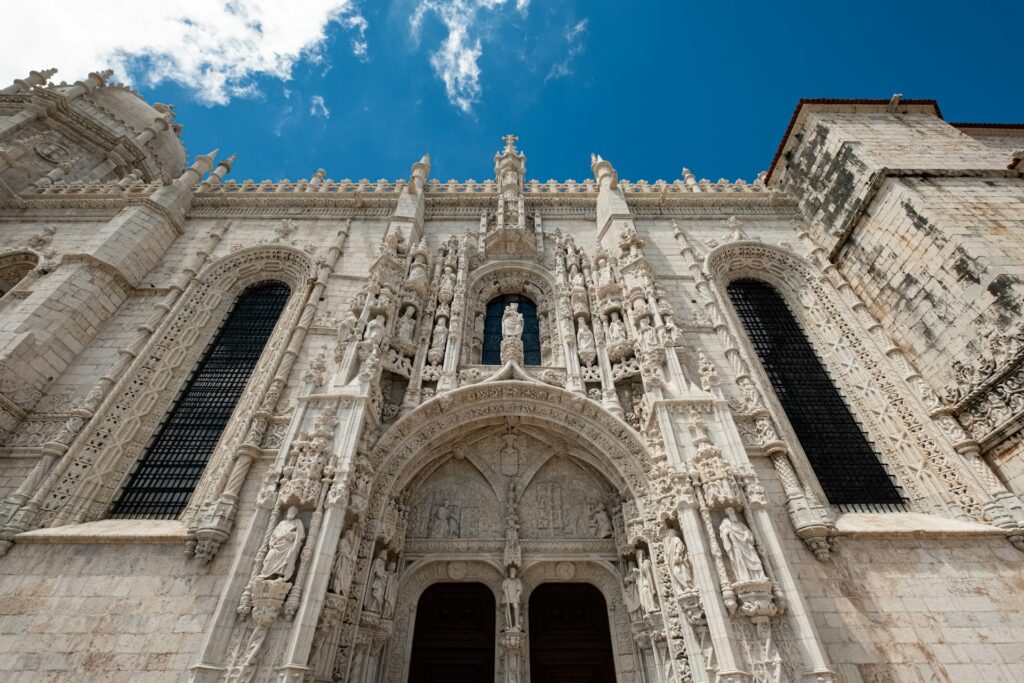
Portugal holds light differently from one city to another. In Porto, it settles against granite in muted tones, cooling façades that rise close to one another along sloping streets. In Lisbon, it spreads wider, catching pale limestone and reflecting upward from the river.
The shift between these textures does not feel abrupt. It feels like recalibration — tone adjusting gradually rather than transforming. Blue tile and white stone share the same Atlantic air, though they respond to it differently.
Surface becomes memory before narrative.
Where Blue Holds the Wall
Inside São Bento station, azulejos gather across walls in scenes that feel continuous rather than framed. The blue does not shout; it steadies the space. Figures, landscapes, historical moments — all settle into ceramic rhythm beneath a vaulted ceiling that filters light from above.
Beyond Porto, movement southward along routes such as the Porto to Lisbon train carries similar repetition — vineyards appearing in ordered lines, rivers cutting briefly across fields before vanishing. The countryside does not contrast the station; it extends its cadence.
Tile reflects light in cool intervals. Outside, granite absorbs it. The sensation remains contained.
White That Softens the Horizon
Lisbon opens outward rather than upward. The limestone façades appear pale against river air. Pavements shimmer faintly under midday sun. Streets incline and descend without demanding attention.
Journeys further along the coast often follow paths like the trains from Lisbon to Faro, where estuary gives way to lagoon and light thins toward southern plains. Even then, the adjustment feels incremental.
The white stone does not dominate the city; it brightens it. Shadows remain gentle rather than stark.
Between Pattern and Plane
São Bento’s walls compress story into blue pattern. Lisbon’s streets disperse it across open surfaces. One gathers narrative into frame; the other allows it to dissipate into sky and river.
Yet neither feels ornamental. Both rely on repetition — tile upon tile, façade upon façade. The difference lies in texture rather than intention.
Light shifts across each surface without emphasis.
The Atlantic Line That Connects
Later, recollection softens distinction. Blue glaze aligns faintly with white limestone in memory. The echo of footsteps in São Bento overlaps with the open sound of Lisbon’s plazas. Rail lines between them blur into steady horizontal stretches beneath wide sky.
What remains is not contrast between granite north and limestone south, but continuity of surface meeting air. Reflection shifting across tile. Brightness lifting from stone.
And somewhere between ceramic scene and river light, the movement continues quietly — steady, unannounced — carried along the Atlantic corridor without deciding where one texture ends and another begins.
Where Glaze and Stone Share the Same Weather
There are hours when the Atlantic light seems undecided, hovering between brightness and haze. In Porto, the blue glaze of azulejos deepens under cloud, appearing almost grey before returning to colour. In Lisbon, limestone façades shift subtly from white to cream as the sun lowers toward the Tagus. The materials respond differently, yet the change feels coordinated, as if both were tuned to the same air.
Rain, when it arrives, leaves a faint sheen across tile and pavement alike. Granite darkens. Limestone glows softly. Nothing resists the weather for long.
The Line That Follows the Coast Without Division
Between Porto and Lisbon stretches a corridor of field, river, and low town that rarely insists on drama. Vineyards give way to salt flats. Estuary opens, then narrows. The rail line threads through it all without framing the view as spectacle.
Over time, the memory of blue tile and white stone merges into a single impression of surface against sky. Pattern softens into plane. Plane gathers faint reflection. And somewhere along that Atlantic stretch, the movement continues quietly — not north, not south, simply carried forward beneath the same shifting light.
For more, visit Pure Magazine